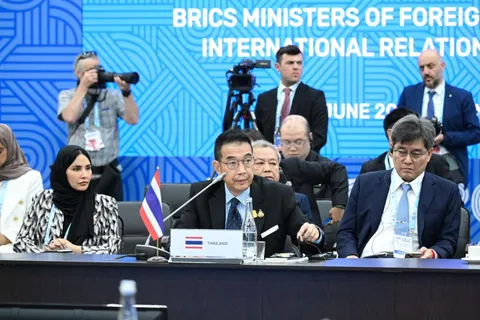
Thailand's simultaneous applications to join BRICS and the OECD perplexed the international community, signaling a strategic diplomatic shift aimed at enhancing its global standing.
Despite initial confidence, Thailand's BRICS membership is delayed as the bloc develops new partner terms and manages a waiting list of over 30 countries, making its immediate admission unlikely.
Thailand, the first Southeast Asian nation to apply for BRICS, advocates for an inclusive world order and positions itself as a neutral 'bridge' between developing countries and the bloc.
The Pheu Thai government pursues OECD membership to attract foreign investment and elevate trade standards, viewing both organizational affiliations as crucial to boosting its international profile and asserting an independent foreign policy.
Both BRICS and OECD are currently evaluating Thailand's economic situation and strategic value, requiring the nation to await decisions as its diplomatic trajectory unfolds amidst domestic political considerations.
Thailand's Education Ministry is implementing a four-pronged strategy to address its students' below-average performance in PISA 2025 and tackle significant educational inequality.
The plan prioritizes closing performance gaps by increasing funding for small and low-income schools, overhauling the curriculum to foster critical thinking, and adopting a data-driven management system to reduce teacher workload.
Key initiatives include enhancing school safety, combating cyberbullying, and expanding mental health support through peer-to-peer networks, recognizing the severe impact of distress on academic performance.
An education expert advises verifying if PISA improvements stem from structural changes, advocating for a revived STEM curriculum with practical 'learn by doing' methods, and urging bureaucratic reform to link teacher evaluations to student development.