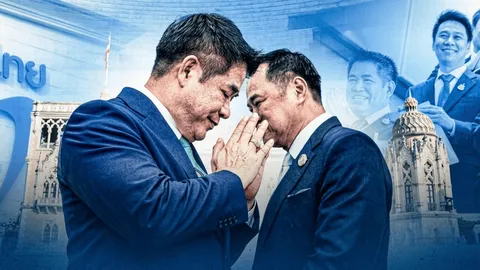
Speculation growing over merger between Bhumjaithai and Kla Tham parties
Thailand’s opposition parties and anti-establishment protest leaders denounce charter court’s ruling
AI In-Brief
Thailand News in Brief
Thai PBS World
Thailand and the world, every day
AI can make mistakes. Please double-check.
Thailand’s opposition parties and anti-establishment protest leaders denounce charter court’s ruling
14 Sept 02:49Key points summarised by AI
Constitutional Court Acquits PM Prayut: Thailand's Constitutional Court cleared Prime Minister Prayut Chan-o-cha of ethical breaches for living in an army property after retirement, dismissing charges of conflict of interest.
Widespread Denunciation and Protests: Opposition parties and anti-establishment groups immediately denounced the ruling, with protesters staging a mock court and ritual at Lat Phrao intersection to ridicule the decision.
Justice System Questioned: Opposition leaders from Kao Klai and Pheu Thai parties asserted the acquittal highlights an "abnormal" justice system, viewing the court as a tool of the military junta and "ruling elites" to prop up Prayut's regime.
Calls for PM's Resignation Intensify: Despite the ruling, both major opposition parties reiterated their demands for Prime Minister Prayut to step down to de-escalate political tensions and address the ongoing crisis of confidence.
Speculation growing over merger between Bhumjaithai and Kla Tham parties
Yesterday 16:46Key points summarised by AI
A dinner between Bhumjaithai leader Anutin Charnvirakul and Kla Tham leader Capt. Thamanat Prompow ignited widespread speculation about a potential merger between their parties.
The meeting is viewed as a strategic message to coalition partner Pheu Thai, indicating Bhumjaithai's alternative options following Pheu Thai's chief whip's remarks about not fully defending all ministers in the upcoming no-confidence debate.
A direct merger between parties with sitting MPs is currently prohibited by Section 99 of the Constitution until the House's term expires, though MPs can switch parties through dismissal or party dissolution.
These constitutional rules aim to prevent financially strong parties from easily absorbing smaller ones, a practice that historically led to single-party dominance, as seen with Thai Rak Thai's 2005 election victory.