Six injured after car smashes into On Nut shopping mall
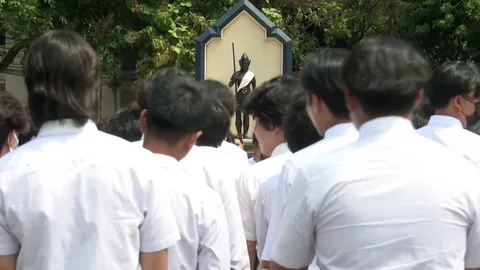
Uthenthawai students and alumni declare truce with Pathumwan rivals
Lessons for Thailand from South Korea's soft power
AI In-Brief
Thailand News in Brief
Thai PBS World
Thailand and the world, every day
AI can make mistakes. Please double-check.
Lessons for Thailand from South Korea's soft power
15 Sept 08:24Key points summarised by AI
South Korea's global soft power, exemplified by K-pop and K-dramas, emerged from strategic government investment in its entertainment industry since the 1990s, inspiring nations like Thailand.
Soft power, defined by Joseph Nye, is a nation's ability to attract and persuade through its culture, political ideals, and policies, distinct from hard power's coercive nature.
Thailand, motivated by K-pop star Lalisa Manobal's international success, aims to develop its soft power, with experts suggesting infrastructure investment and leveraging its '5Fs' (food, film, fashion, fighting, festival).
Global indices rank Germany as the top soft power, with South Korea at 11th and Thailand at 33rd, underscoring Thailand's need for a comprehensive strategy beyond mere cultural exports.
Experts advise Thailand to address challenges like censorship and make sustained investments in its creative industries, emulating South Korea's planned approach to fully realize its cultural potential.
Uthenthawai students and alumni declare truce with Pathumwan rivals
Yesterday 20:34Key points summarised by AI
Uthenthawai students and alumni have pledged to cease violent clashes with Pathumwan Institute rivals, coinciding with their campus's reopening after a 90-day closure.
The Minister of Higher Education is mediating the long-running conflict, while the campus closure has significantly disrupted in-person classes and laboratory work for over 1,000 students.
Uthenthawai resists relocation from its current site, citing a historical land grant from King Rama VI, despite Chulalongkorn University's plans to reclaim the land for an educational hub.
Concerns are mounting over the legality of the campus closure, its detrimental impact on uninvolved students, and the potential commercial development of the land, which critics argue contradicts the late King Rama VI's intentions.