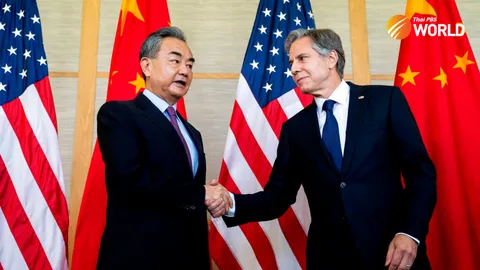
The US views the 'rules-based International Order,' founded on principles like sovereignty and human rights, as challenged by Russia and, notably, by China's potential aim for a more 'illiberal' global structure.
US Secretary of State Blinken acknowledges the complex US-China relationship, emphasizing the necessity for cooperation on critical global issues such as climate change and health, despite existing disagreements.
Thailand, historically non-aligned in geopolitics, faces increasing pressure from both the US and China, who are actively seeking to strengthen their ties with countries in the region.
The US advocates for nations to choose a 'positive vision' for the future, promoting a 'race to the top' in protecting rights and collaborating on global challenges, while analysts caution Thailand against definitive alignment due to potential geopolitical instability.
Thailand's Education Ministry is implementing a four-pronged strategy to address its students' below-average performance in PISA 2025 and tackle significant educational inequality.
The plan prioritizes closing performance gaps by increasing funding for small and low-income schools, overhauling the curriculum to foster critical thinking, and adopting a data-driven management system to reduce teacher workload.
Key initiatives include enhancing school safety, combating cyberbullying, and expanding mental health support through peer-to-peer networks, recognizing the severe impact of distress on academic performance.
An education expert advises verifying if PISA improvements stem from structural changes, advocating for a revived STEM curriculum with practical 'learn by doing' methods, and urging bureaucratic reform to link teacher evaluations to student development.