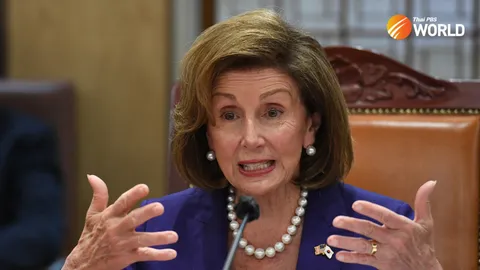
Pelosi's stopover in Taiwan is framed as a selfish act to secure her legacy, directly violating China's 'One China' policy and prompting severe reactions.
The visit inflicts significant unintended consequences, notably damaging US-China relations and undermining President Biden's credibility after his pledge to respect the 'One China' policy.
China views Pelosi's visit as a serious challenge, given her high-ranking position, asserting that it has fundamentally upended US-China ties and will require extensive time to heal.
The article criticizes the US mainstream media for downplaying China's warnings, contrasting this with the historical US acknowledgment of the 'One China' policy in past communiques.
ASEAN ministers reaffirmed their 'One China' policy, urging all parties to exercise maximum restraint and warning that Pelosi's visit could lead to miscalculation, serious confrontation, and unpredictable consequences in the region.
Thailand's Education Ministry is implementing a four-pronged strategy to address its students' below-average performance in PISA 2025 and tackle significant educational inequality.
The plan prioritizes closing performance gaps by increasing funding for small and low-income schools, overhauling the curriculum to foster critical thinking, and adopting a data-driven management system to reduce teacher workload.
Key initiatives include enhancing school safety, combating cyberbullying, and expanding mental health support through peer-to-peer networks, recognizing the severe impact of distress on academic performance.
An education expert advises verifying if PISA improvements stem from structural changes, advocating for a revived STEM curriculum with practical 'learn by doing' methods, and urging bureaucratic reform to link teacher evaluations to student development.