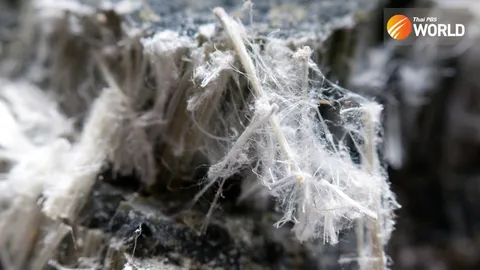
Asbestos, a mineral widely used in manufacturing, poses severe health risks, causing serious conditions like lung fibrosis, lung cancer, mesothelioma, and an increased risk of ovarian cancer.
Johnson & Johnson announced it will discontinue its talc-based baby powder globally from next year, switching to cornstarch, following thousands of lawsuits alleging its talcum powder contained asbestos and caused ovarian cancer.
Historically, asbestos was extensively used in industrial, building, and automotive products due to its durability, but nearly 70 countries have banned its use due to its link to life-threatening diseases.
Exposure to asbestos primarily occurs through occupational settings or when asbestos-containing products in homes are disturbed, releasing harmful airborne fibers that, when inhaled, accumulate in the lungs.
While the Thai FDA reassured consumers that no asbestos was found in baby powder samples in Thailand, safe use of talc-based powders is advised to prevent respiratory irritation.
Thailand's Education Ministry is implementing a four-pronged strategy to address its students' below-average performance in PISA 2025 and tackle significant educational inequality.
The plan prioritizes closing performance gaps by increasing funding for small and low-income schools, overhauling the curriculum to foster critical thinking, and adopting a data-driven management system to reduce teacher workload.
Key initiatives include enhancing school safety, combating cyberbullying, and expanding mental health support through peer-to-peer networks, recognizing the severe impact of distress on academic performance.
An education expert advises verifying if PISA improvements stem from structural changes, advocating for a revived STEM curriculum with practical 'learn by doing' methods, and urging bureaucratic reform to link teacher evaluations to student development.