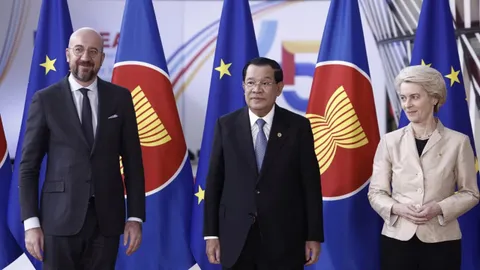
Cambodian Prime Minister Hun Sen called for the EU to treat all ASEAN members as equal partners, free from political preconditions, and to pursue a bloc-to-bloc free trade agreement.
The summit's potential was constrained by the EU's historical tendency to impose conditions on issues like human rights and agricultural standards, hindering the development of a comprehensive strategic partnership.
Pre-summit pressure from the EU on ASEAN regarding the war in Ukraine and other regional issues, despite prior knowledge of ASEAN's established positions, created unnecessary friction.
Despite a comprehensive joint statement and agreement on Indo-Pacific strategies, both blocs recognize trade and investment as paramount, with calls for the EU to swiftly implement strategic action plans to leverage ASEAN's significant economic potential.
Thailand's Education Ministry is implementing a four-pronged strategy to address its students' below-average performance in PISA 2025 and tackle significant educational inequality.
The plan prioritizes closing performance gaps by increasing funding for small and low-income schools, overhauling the curriculum to foster critical thinking, and adopting a data-driven management system to reduce teacher workload.
Key initiatives include enhancing school safety, combating cyberbullying, and expanding mental health support through peer-to-peer networks, recognizing the severe impact of distress on academic performance.
An education expert advises verifying if PISA improvements stem from structural changes, advocating for a revived STEM curriculum with practical 'learn by doing' methods, and urging bureaucratic reform to link teacher evaluations to student development.