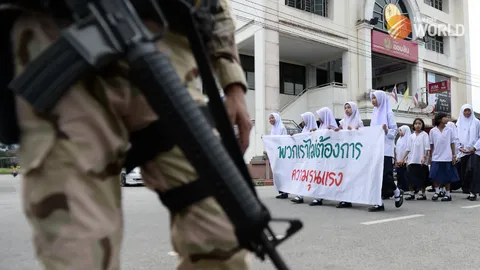
Thailand's peace process, particularly the Cessation of Hostility Agreement (COHA), is criticized as a superficial effort, prioritizing quick political gains over a meaningful, sustainable resolution for the Patani Malays.
Ramadan ceasefires have been repeatedly exploited for short-term political advantage, often failing due to a lack of genuine commitment from the Thai Army and the absence of neutral monitoring mechanisms.
The Thai Army's 'all-or-nothing' military approach and failure to adopt a sophisticated counter-insurgency strategy demonstrate a fundamental misunderstanding of the conflict's political and ethno-nationalist roots.
The government missed opportunities, such as responding positively to the BRN's COVID-19 ceasefire, and risks escalating the conflict by clumsily involving religion, underscoring the need for international engagement and humanitarian principles.
Thailand's Education Ministry is implementing a four-pronged strategy to address its students' below-average performance in PISA 2025 and tackle significant educational inequality.
The plan prioritizes closing performance gaps by increasing funding for small and low-income schools, overhauling the curriculum to foster critical thinking, and adopting a data-driven management system to reduce teacher workload.
Key initiatives include enhancing school safety, combating cyberbullying, and expanding mental health support through peer-to-peer networks, recognizing the severe impact of distress on academic performance.
An education expert advises verifying if PISA improvements stem from structural changes, advocating for a revived STEM curriculum with practical 'learn by doing' methods, and urging bureaucratic reform to link teacher evaluations to student development.