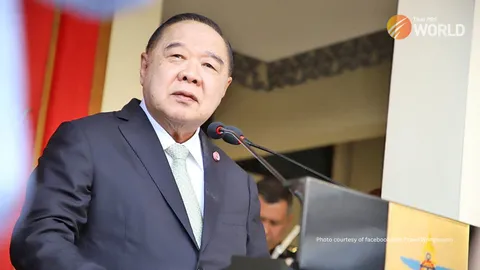
Prawit’s reconciliation politics: Solution to political conflict or election power play?
AI In-Brief
Thailand News in Brief
Thai PBS World
Thailand and the world, every day
AI can make mistakes. Please double-check.
Prawit’s reconciliation politics: Solution to political conflict or election power play?
23 Sept 05:28Key points summarised by AI
General Prawit Wongsuwan proposes leading a reconciliation government, forming a coalition of conflicting parties post-election to end Thailand's two-decade political conflict.
Through 'open letters,' Prawit strategically rebrands himself, aiming to shed his authoritarian image and distance his Palang Pracharath Party from coup-makers, positioning it as a neutral 'connecting link.'
Analysts view Prawit's initiative as a calculated election power play, leveraging his influence over appointed senators to become a kingmaker and secure a strong bargaining position for his party in forming a new government.
Despite his reconciliation pledges, experts remain skeptical, suggesting Prawit's actions are primarily 'political trickery' to boost his party's electoral chances and potentially secure the prime ministership or significant political influence.
Prawit's campaign actively discredits Prime Minister Prayut Chan-o-cha's coup-led ascent, despite his own past involvement, to appeal to a broader electorate and enhance his perceived neutrality in the polarized political landscape.
Thailand's Education Ministry is implementing a four-pronged strategy to address its students' below-average performance in PISA 2025 and tackle significant educational inequality.
The plan prioritizes closing performance gaps by increasing funding for small and low-income schools, overhauling the curriculum to foster critical thinking, and adopting a data-driven management system to reduce teacher workload.
Key initiatives include enhancing school safety, combating cyberbullying, and expanding mental health support through peer-to-peer networks, recognizing the severe impact of distress on academic performance.
An education expert advises verifying if PISA improvements stem from structural changes, advocating for a revived STEM curriculum with practical 'learn by doing' methods, and urging bureaucratic reform to link teacher evaluations to student development.