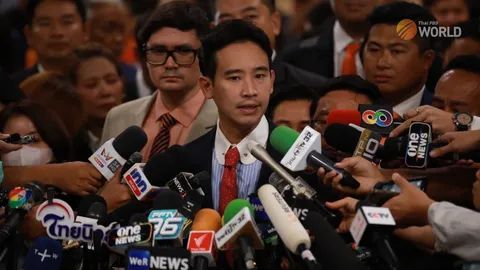
Parliament's rejection of Pita Limjaroenrat as Prime Minister has plunged Thailand into a chaotic 'free for all survival game' among political factions.
Pita faces immense legal and constitutional challenges, including questions about resubmitting his nomination and the divisive Article 112, severely jeopardizing his path to premiership.
Pheu Thai confronts a critical dilemma: either continue supporting Pita with their own nominee or consider a controversial alliance with figures like Prawit Wongsuwan, risking their public image and future electoral standing.
The political vacuum creates opportunities for alternative candidates, particularly Prawit Wongsuwan, whose potential alliance with Pheu Thai could secure the premiership but would be fraught with fragility and public backlash.
The Move Forward party's firm stance on amending Article 112 remains a central isolating factor, alienating much of the Senate and other parties, thereby deepening the current political deadlock.
Thailand's Education Ministry is implementing a four-pronged strategy to address its students' below-average performance in PISA 2025 and tackle significant educational inequality.
The plan prioritizes closing performance gaps by increasing funding for small and low-income schools, overhauling the curriculum to foster critical thinking, and adopting a data-driven management system to reduce teacher workload.
Key initiatives include enhancing school safety, combating cyberbullying, and expanding mental health support through peer-to-peer networks, recognizing the severe impact of distress on academic performance.
An education expert advises verifying if PISA improvements stem from structural changes, advocating for a revived STEM curriculum with practical 'learn by doing' methods, and urging bureaucratic reform to link teacher evaluations to student development.