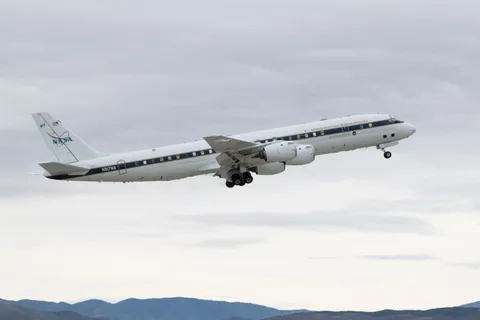
World's biggest flying lab comes to Asia on air pollution mission
AI In-Brief
Thailand News in Brief
Thai PBS World
Thailand and the world, every day
AI can make mistakes. Please double-check.
World's biggest flying lab comes to Asia on air pollution mission
16 Sept 04:16Key points summarised by AI
NASA launched its ASIA-AQ mission, deploying the DC-8 flying laboratory to Asia, beginning in the Philippines, to enhance air pollution forecasting models.
The mission involves low-altitude flights, sometimes just 15 meters from the ground, to collect direct measurements of air particles, supplementing ground stations and satellite data.
By improving the understanding of pollution sources and spread, the project aims to develop more accurate warning systems and inform public health policies in a region with high air pollution-linked death rates.
The research flights are conducted in collaboration with governments in the Philippines, South Korea, Malaysia, and Thailand, with results expected to be shared publicly after a year.
Thailand's Education Ministry is implementing a four-pronged strategy to address its students' below-average performance in PISA 2025 and tackle significant educational inequality.
The plan prioritizes closing performance gaps by increasing funding for small and low-income schools, overhauling the curriculum to foster critical thinking, and adopting a data-driven management system to reduce teacher workload.
Key initiatives include enhancing school safety, combating cyberbullying, and expanding mental health support through peer-to-peer networks, recognizing the severe impact of distress on academic performance.
An education expert advises verifying if PISA improvements stem from structural changes, advocating for a revived STEM curriculum with practical 'learn by doing' methods, and urging bureaucratic reform to link teacher evaluations to student development.