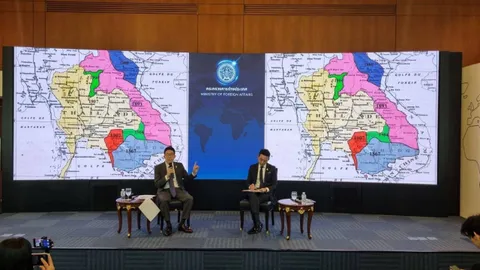
Thailand-Cambodia border pacts caught in political crossfire
AI In-Brief
Thailand News in Brief
Thai PBS World
Thailand and the world, every day
AI can make mistakes. Please double-check.
Thailand-Cambodia border pacts caught in political crossfire
10 Sept 21:27Key points summarised by AI
Two decades-old Memorandums of Understanding (MOUs) between Thailand and Cambodia, designed to resolve land and maritime boundary disputes, have become a flashpoint in Thailand's domestic politics.
Right-wing nationalists and opposition parties are vehemently demanding the termination of these MOUs, citing concerns over potential territorial loss, compromised sovereignty (especially regarding the 1:200,000 French map and maritime resources), and alleged unconstitutional approval processes.
A recent parliamentary session was controversially halted to block a motion aimed at terminating the MOUs, revealing the ruling Pheu Thai government's struggle to manage the contentious issue amidst border tensions and its own political vulnerabilities.
While critics fear sovereignty loss, the Foreign Ministry defends the MOUs as essential and functional mechanisms for joint border surveys and dispute resolution, warning that their revocation would undermine established frameworks and progress.
Thailand's Education Ministry is implementing a four-pronged strategy to address its students' below-average performance in PISA 2025 and tackle significant educational inequality.
The plan prioritizes closing performance gaps by increasing funding for small and low-income schools, overhauling the curriculum to foster critical thinking, and adopting a data-driven management system to reduce teacher workload.
Key initiatives include enhancing school safety, combating cyberbullying, and expanding mental health support through peer-to-peer networks, recognizing the severe impact of distress on academic performance.
An education expert advises verifying if PISA improvements stem from structural changes, advocating for a revived STEM curriculum with practical 'learn by doing' methods, and urging bureaucratic reform to link teacher evaluations to student development.