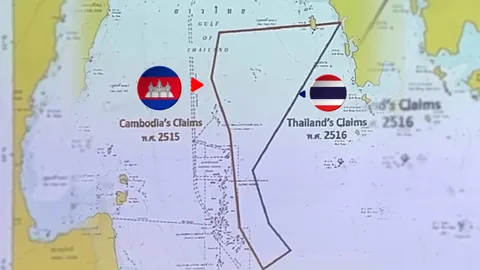
Thailand plans a referendum on two decades-old MOUs with Cambodia regarding land and maritime boundaries, a move critics warn could complicate domestic politics, damage international standing, and fail to resolve disputes.
Right-wing nationalists advocate revoking the MOUs, accusing them of potentially ceding territory and hydrocarbon resources to Cambodia amidst recent border tensions.
Analysts and opposition leaders caution that the MOUs' complexity makes them unsuitable for a public referendum, urging the government to assume executive responsibility for such intricate foreign policy matters.
Critics warn that terminating bilateral dispute mechanisms could prompt Cambodia to escalate unresolved issues to the International Court of Justice, a body with a history of rulings unfavorable to Thailand.
A poll reveals a majority of Thais favor terminating the MOUs despite many admitting a lack of understanding, underscoring the challenge of an informed public decision on technical international agreements.
Thailand's Education Ministry is implementing a four-pronged strategy to address its students' below-average performance in PISA 2025 and tackle significant educational inequality.
The plan prioritizes closing performance gaps by increasing funding for small and low-income schools, overhauling the curriculum to foster critical thinking, and adopting a data-driven management system to reduce teacher workload.
Key initiatives include enhancing school safety, combating cyberbullying, and expanding mental health support through peer-to-peer networks, recognizing the severe impact of distress on academic performance.
An education expert advises verifying if PISA improvements stem from structural changes, advocating for a revived STEM curriculum with practical 'learn by doing' methods, and urging bureaucratic reform to link teacher evaluations to student development.