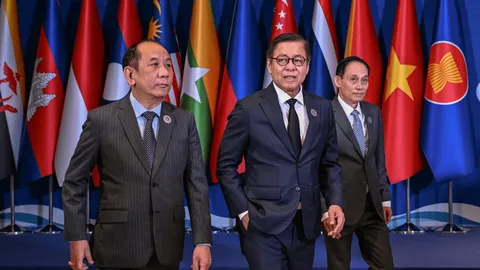
ASEAN ministers reaffirmed the Five-Point Consensus as the exclusive framework for resolving Myanmar's political crisis, asserting that recent elections cannot replace an end to violence and inclusive dialogue.
They underscored that genuine political progress in Myanmar hinges on peace, security, and the full participation of all stakeholders, with ASEAN facilitating a Myanmar-owned and led solution.
ASEAN pledged to expand humanitarian assistance to Myanmar, mobilizing support from partners, and backed the continuity of a special envoy for the crisis.
Beyond Myanmar, ministers prioritized regional peace, economic connectivity, and people-centered development, committing to maritime security and aiming for a South China Sea Code of Conduct by 2026.
The bloc also addressed combating transnational crime, global challenges like AI and climate change, and reinforced the importance of ASEAN unity and multilateralism.
Thailand's Education Ministry is implementing a four-pronged strategy to address its students' below-average performance in PISA 2025 and tackle significant educational inequality.
The plan prioritizes closing performance gaps by increasing funding for small and low-income schools, overhauling the curriculum to foster critical thinking, and adopting a data-driven management system to reduce teacher workload.
Key initiatives include enhancing school safety, combating cyberbullying, and expanding mental health support through peer-to-peer networks, recognizing the severe impact of distress on academic performance.
An education expert advises verifying if PISA improvements stem from structural changes, advocating for a revived STEM curriculum with practical 'learn by doing' methods, and urging bureaucratic reform to link teacher evaluations to student development.