Destroying campaign signs, editing, and posting misinformation about election candidates: to what extent is it illegal?
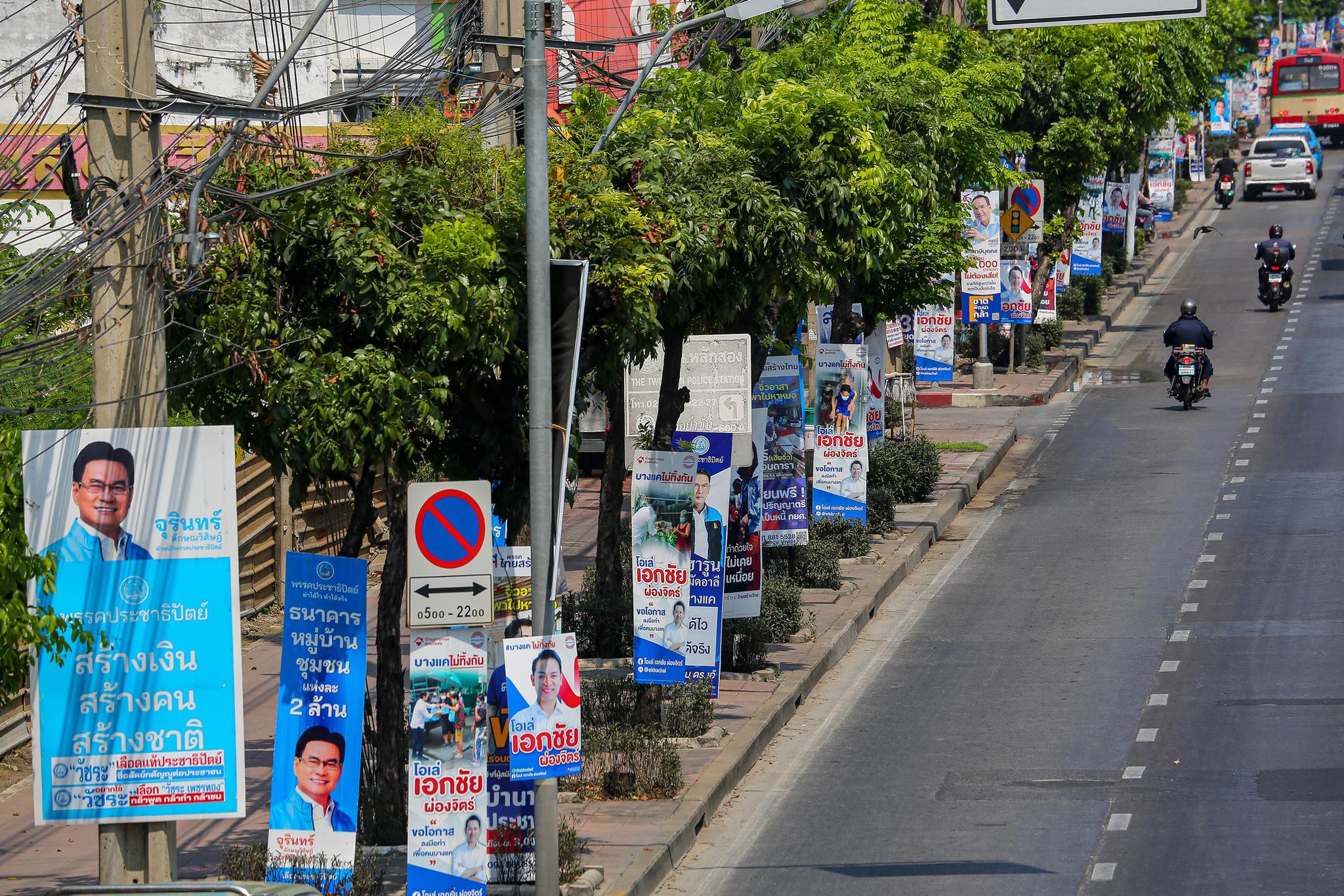
Warning to political parodists and meme creators: Beware of legal consequences. Whether it involves posting misleading content by swapping party or candidate numbers, creating parody campaign signs, or modifying and destroying them, legal experts clarify that such actions constitute offenses under Criminal Law, Election Law, and the Act on Computer Crime.
Is destroying or modifying campaign signs an offense?
As the election day approaches, social media trends have begun to show instances of posting edited images, swapping candidate numbers, creating parody campaign signs, or attacking political parties, as well as modifying or destroying physical signs. This has raised questions about whether such actions constitute legal violations.
Tassanai Chaikhwang, lawyer from KSS Law Office, told Thai PBS Verify that, regarding the act of pasting signs or stickers over others’ campaign signs—even if the sign is not physically torn or destroyed—campaign signs are considered properties of the candidates or political parties. Covering a sign to make original campaign messages obscured or unusable for its intended purpose constitutes an offense of property damage under Section 358 of the Criminal Code. This applies regardless of whether the perpetrator is a member of the general public, candidates from other parties, or political supporters.
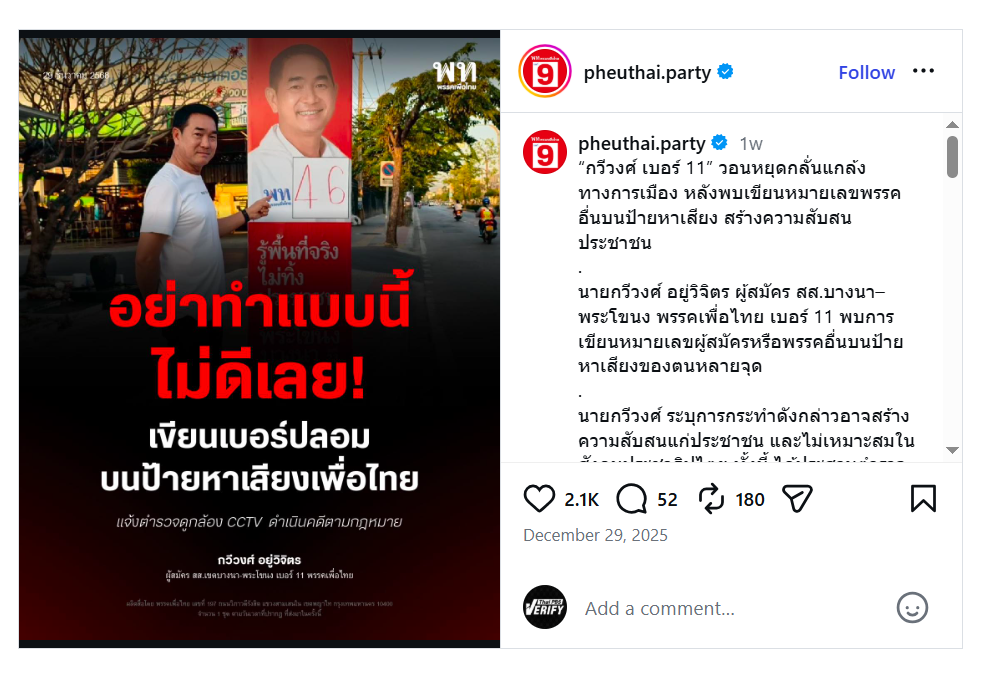
Photo Credit: Pheu Thai Party stated that its MP candidates’ campaign signs were tampered with by overwriting them with fake candidate numbers.
However, such actions do not constitute a direct violation of election law and do not trigger political penalties, unless it can be proven that the act was committed with fraudulent intent and involves a candidate, a political party, or their associated teams. In such instances, the Election Commission of Thailand (ECT) may include these circumstances as part of its investigation or inquiry into election-related cases.
Assoc. Prof. Somchai Srisutthiyakorn, former commissioner of the Election Commission (ECT), stated to Thai PBS Verify that whether it involves destroying campaign signs or creating fake ones, if such actions lead to public misunderstanding or cause damage, they are inherently a violation of law.
“If a member of the general public destroys or slashes a campaign sign, it is classified as property damage. The property owner has the right to file a legal complaint and take appropriate action.
“However, if the act is committed by an opposing candidate—though election law may not explicitly and directly address this—it is regarded as an action that causes damage to a competitor. Such conduct may
be factored into the consideration of dishonest practices during the election.”
He further stated that, typically, campaign signs are those legally permitted for installation during the election period. Therefore, they can be placed in designated areas, such as roadsides or locations authorized by law.
In contrast, for other signs that are not the official ones intended to undermine a candidate’s popularity, such actions fall under unauthorized sign installation wrongdoings. In this case, the land owner or relevant authorities may take action. If the perpetrator is identified, they can be held liable for damages, or a lawsuit can be filed to recover costs from those who installed the signs.
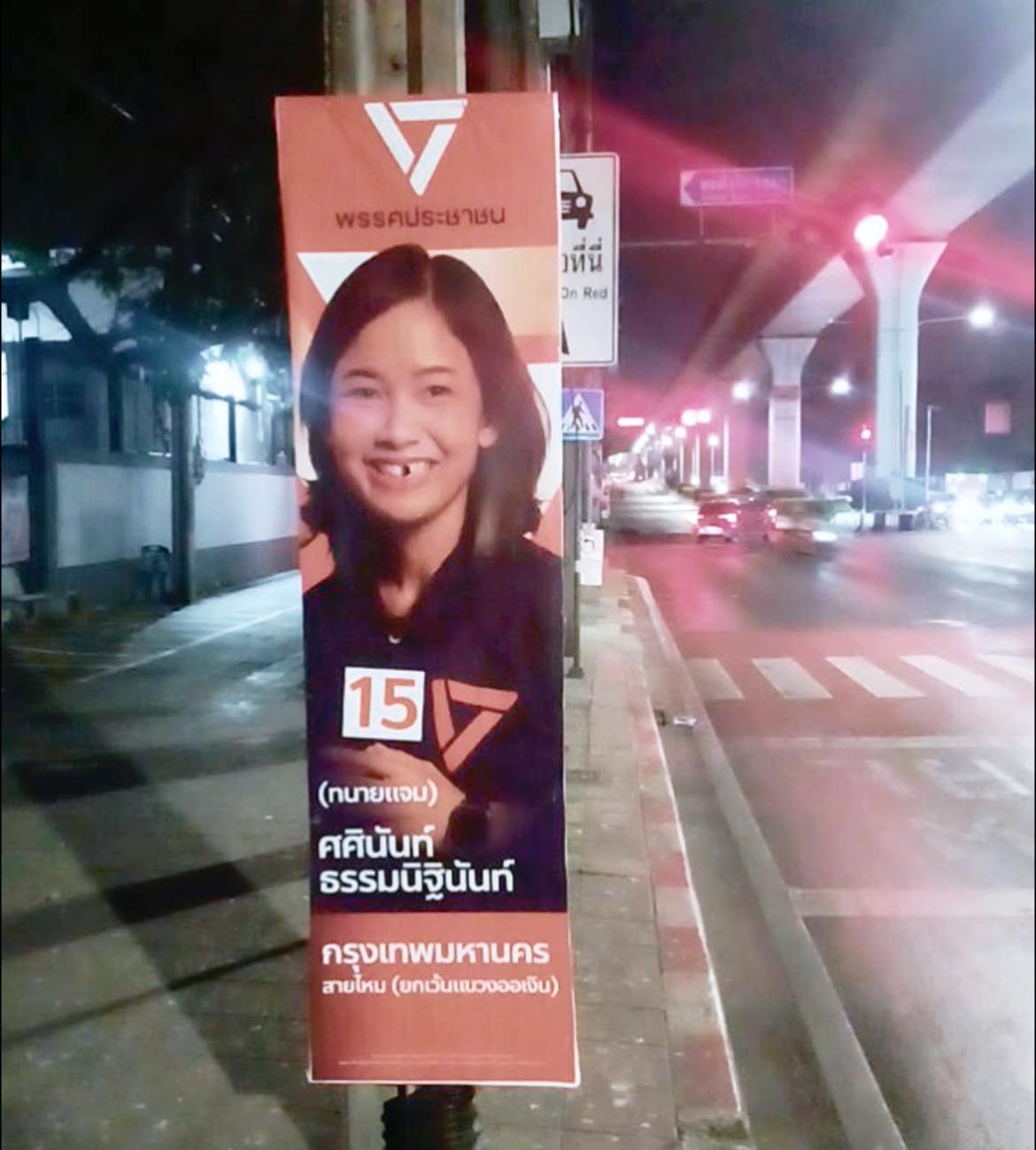
Facebook Photo: ศศินันท์ ธรรมนิฐินันท์ – ทนายแจม – Sasinan Thamnithinan (“Lawyer Jam”)
Additionally, destroying or removing campaign signs personally is an offense under Section 358 of the Criminal Code for property damage. This carries a penalty of imprisonment for up to three years, a fine of up to 6,000 THB, or both. This penalty applies equally to both the general public and election candidates.
Therefore, if you encounter campaign signs that obstruct sidewalks or are installed in inappropriate locations, do not destroy or remove them yourself, as this may also constitute a criminal offense. Please instead report the issue to the local Election Commission of Thailand (ECT) via the 1444 hotline, or in the Bangkok area, via the Bangkok Metropolitan Administration (BMA) hotline at 1555.
Maliciously posting party numbers or distorting candidate information have legal consequences under the Act on Computer Crime
In addition, Assoc. Prof. Somchai commented on the creation of false information on social media, noting that intentionally posting or swapping candidate numbers may constitute a violation of Section 73 (5) of the Organic Act on the Election of Members of the House of Representatives and may also fall under the Act on Computer Crime.
Such actions are regarded as defamation and the dissemination of fake news, both of which are punishable by law. Under Section 73 (5) of the Organic Act on the Election of Members of the House of Representatives B.E. 2561 (2018), it is prohibited for any person to influence voters through false accusations or to mislead them regarding the popularity of a candidate or a political party.
“Section 73. Any candidate or any person shall not perform any act, by the following means, in order to induce a person entitled to vote to cast a vote for himself or for any other candidate or refrain from casting a vote for candidates or in order to solicit an act of not electing any person as a member of the House of Representatives:
Paragraph (5): (5) exerting a deceit, compulsion, threat or threatening influence, insulting by a false statement or enticing a misunderstanding in popularity of candidates or political parties.”
Furthermore, Mr. Tassanai noted that expressing opinions on social media, based on the principle of political expression, remains a constitutional freedom and does not constitute an offense under the Act on Computer Crime. This is because the law does not prohibit criticism or expression of opinions. However, legal risks arise if the content involves importing false information where the poster knows or should know it is incorrect, and such dissemination is likely to cause damage to individuals or the public.
In cases where political party numbers are posted inaccurately, for example, if one party is assigned number 29 and another is 31, but they are posted as being swapped, this is considered “false information.” This is because party numbers are critical election information that can influence voters’ decision-making.
Nevertheless, a mere dissemination of false information does not constitute an offense under the Act on Computer Crime as well. Additional factors must be considered, such as whether the poster acted with intent, whether they knew or should have known the information was incorrect, and whether the post is likely to cause widespread damage or confusion. If a person knows the information is incorrect, but he fails to correct it, continues to repost it, or acts in a manner that leads to public confusion, especially as the election day approaches, there is a significant risk that such actions will fall under an offense in Section 14 of the Act on Computer Crime.
“I would like to caution the public, political supporters, and social media users that while political expression is permitted, it should be casting a vote for candidates or in order to solicit an act of not electing any person as a member of the House of Representatives:
Paragraph (5): (5) exerting a deceit, compulsion, threat or threatening influence, insulting by a false statement or enticing a misunderstanding in popularity of candidates or political parties.”
exercised with care. A clear distinction must be made between ‘personal opinion’ and ‘legal allegations.’ One should avoid disseminating information that is not true or infringing upon the property and rights of others, as such actions may lead to criminal liability and other legal consequences. Ultimately, elections should be a competition based on policies and visions.” said Mr. Tassanai.