
Some youth have slipped out of the education system and fallen victim to online crime—young lives that cannot grow, instead they become gears in future criminal networks.
Mirror Foundation: “Children” are also being deceived into working as scammers
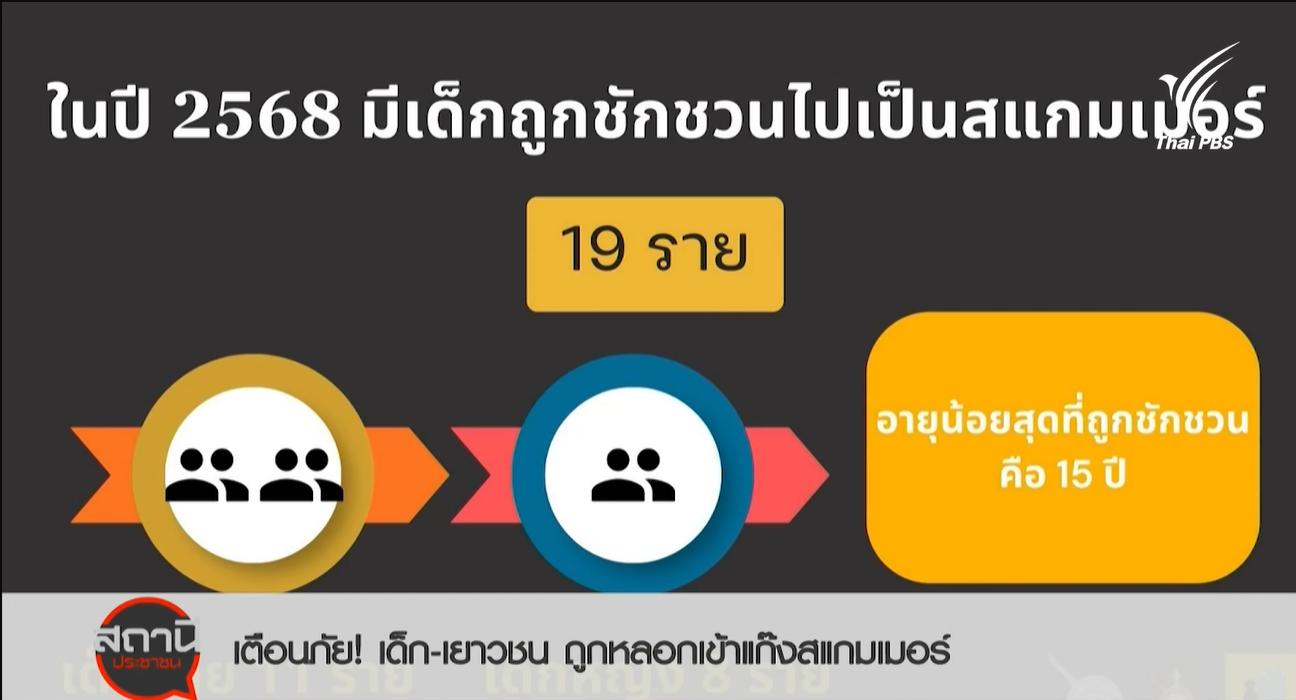
In 2025, Mirror Foundation received reports of 265 missing children, including 96 boys and 169 girls. Among them, 47 remain missing. Main causes of which include runaways – 176 cases, custody disputes – 24 cases, and deception into scam operations – 19 cases
Ekalak Lhumsungkhah, Head of the Missing Persons Information Center at Mirror Foundation, told Thai PBS Verify that child scam cases are found nationwide—North, Northeast, and South—with the North having the highest number.
Two major methods used to lure children:
1. Online job recruitment – children are enticed through the Internet with promises of good income and easy work.
2. Romance scams – this is different from adults’; the aim isn’t stealing money directly but tricking children into affection, then collecting “recruitment fees” from handing them over to brokers.
The foundation gives an example case regarding the youngest 15-year-old victim in the North, who was groomed online, had already left formal schooling, and followed the recruiter with trust but did not know being trafficked into a scam gang.
From home to scam bases
The foundation reports organized methods of moving children from their hometowns and there are a few travel routes used. In some cases, brokers coordinate through LINE or Messenger while transferring bus fares directly to ticket sellers, so that the children pay nothing. Other children are instructed to travel to Mo Chit Bus Terminal and cross a pedestrian bridge before boarding a pre-arranged van. Some cases in Bangkok involve taxis transporting children to Rong Kluea Market, after which they are smuggled across the border to Cambodia.
Forced to work in call-center scams: If victims cannot reach their goals, violence may follow
At the destination, children are forced to work as scammers, such as making calls impersonating banks or authorities. Others who cannot reach the goals, are reassigned to pick up new victims at border points. Violence is not immediate but begins when a child refuses orders or fails to meet quotas—leading to threats and physical abuse.
19 children sent to Cambodia – 12 rescued, 7 still missing
According to the latest report, all 19 children lured into scam operations were sent to Cambodia. So far, 12 have been rescued while 7 remain missing and unreachable. These cases signal that online crime is no longer limited to financial fraud and personal information. It has evolved into child trafficking and forced labor. It begins with trust and online grooming and ends with children trapped under transnational criminal networks.
New law for child protection
On June 10, 2025, the Cabinet approved a draft of the Child Protection Act, replacing the long-standing 2003 Act. This aims to improve the law to comply with the current social context.
One of the key revisions is selling or transferring a child under 15, whether or not the child consents, in exchange for money or benefits, will be a crime with a penalty of 3-year imprisonment, and a fine of 60,000–200,000 baht, or both.
The draft law is still being processed, and questions remain about enforcement amid rapidly evolving online crime. Strong protection from all social segments is vital to prevent Thai children from repeatedly falling victim in the digital era.
Additional sources [in Thai]: FM91, Thai PBS News