Iran doesn’t attack USS Gerald R. Ford, but carrier suffers fire in laundry room
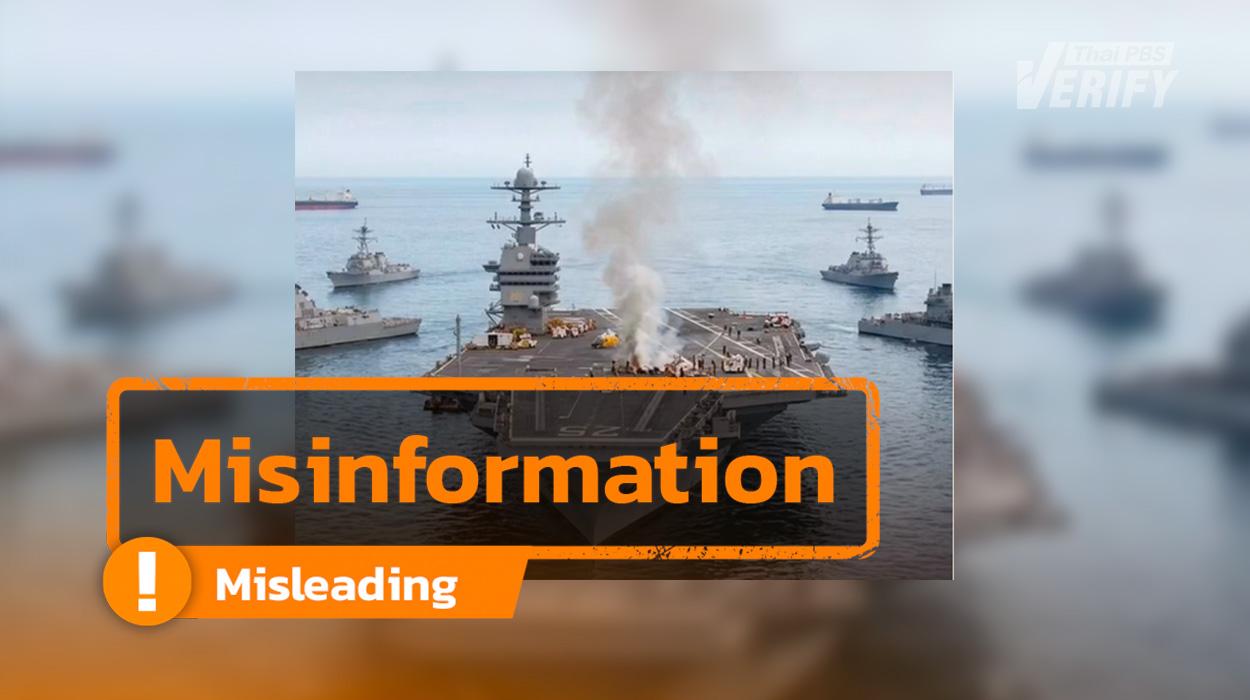
Thai PBS Verify found the piece of misinformation on: Instagram
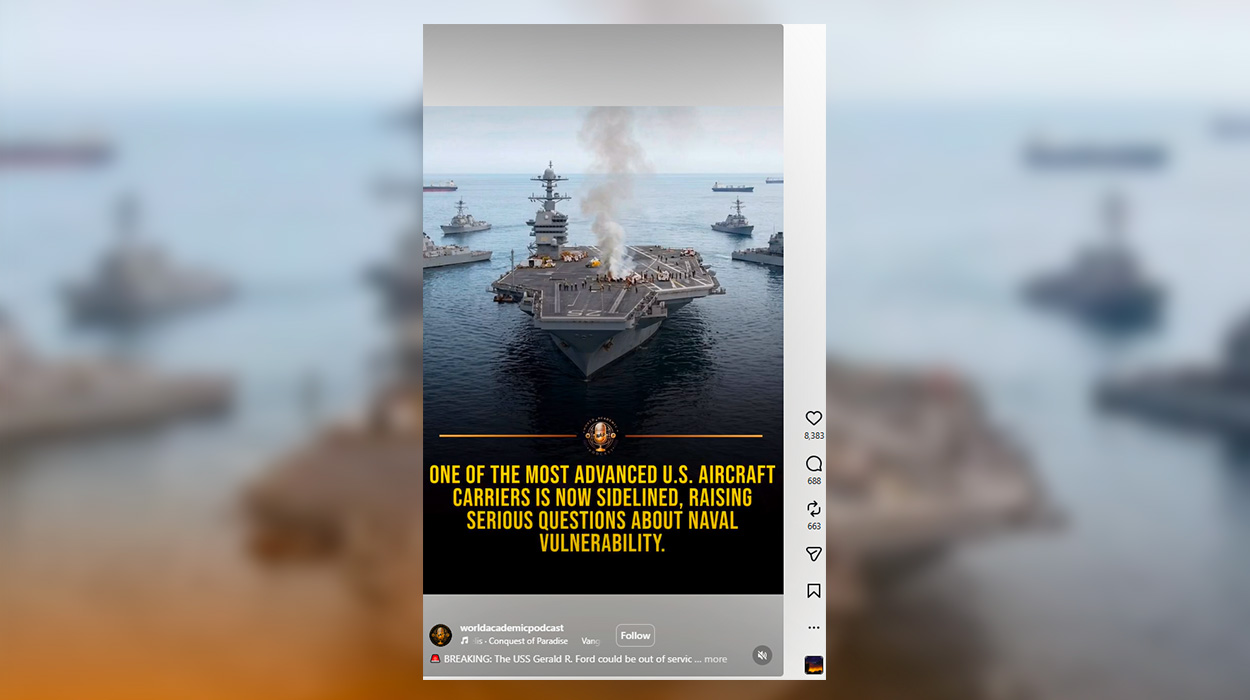
A reel from an Instagram account ‘worldacedemicpodcast,’ was published on March 29, 2026.
published on March 29, 2026.
Thai PBS Verify found an Instagram reel published by user ‘worldacademicpodcast’ on March 29, 2026. The video shows the damaged U.S. aircraft carrier USS Gerald R. Ford, accompanied by the following descriptions:
“BREAKING: The USS Gerald R. Ford could be out of service for up to 2 years after reportedly being struck by Iran.
Major blow: One of the most advanced U.S. carriers is rendered inoperative, raising alarms about its vulnerability.
Strategic impact: If confirmed, the damage represents an unprecedented hit to U.S. naval power.
Narrative under scrutiny: While U.S. officials downplay the incident, signs suggest it was not a simple internal accident.
“Key implications:
- temporary loss of a critical naval asset
- shift in maritime balance and operational readiness
- heightened perception of vulnerability in U.S. naval operations
- escalation potential in the region due to weakened U.S. sea power
“From a strategic perspective, sidelining a carrier like the Gerald R. Ford could alter naval equilibrium, forcing recalibration of U.S. operations in critical theaters.”
The USS Gerald R. Ford was not attacked
Thai PBS Verify examined the details of the images used in the reel with Hive Moderation. The analysis found that the image was more than 99.9% likely to be AI-generated, concluding that it was created using Gemini 3 AI.
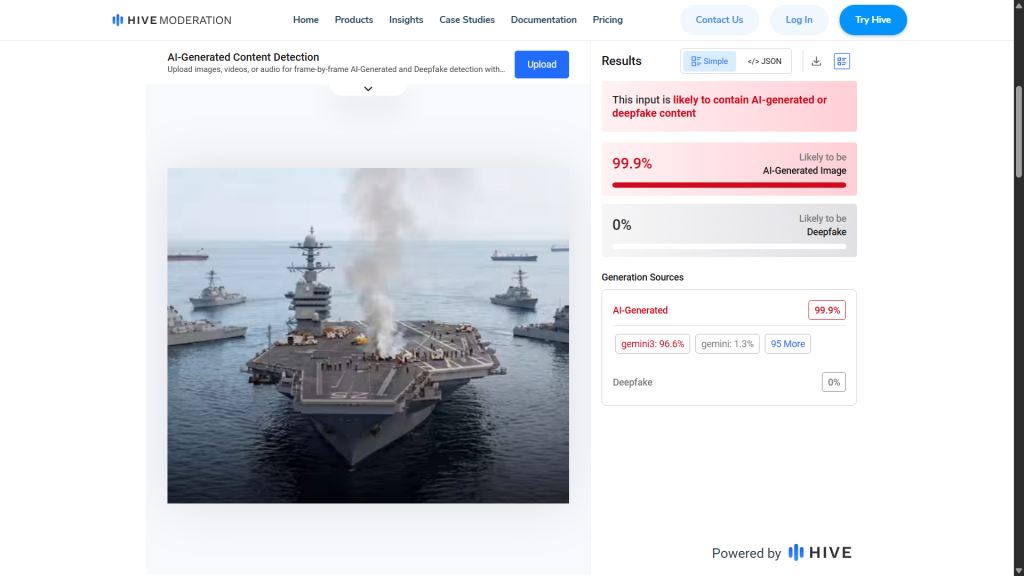
Verification results from Hive Moderation show that the image was 99.9% AI-generated.
In addition, irregularities were found in the images. The aircraft carrier Gerald R. Ford appeared to have been hit, leaving a hole in the middle of the vessel. However, upon closer inspection, the ship in the image was marked with the number “25,” while the real USS Gerald R. Ford should bear the faint number “78” on the bow.
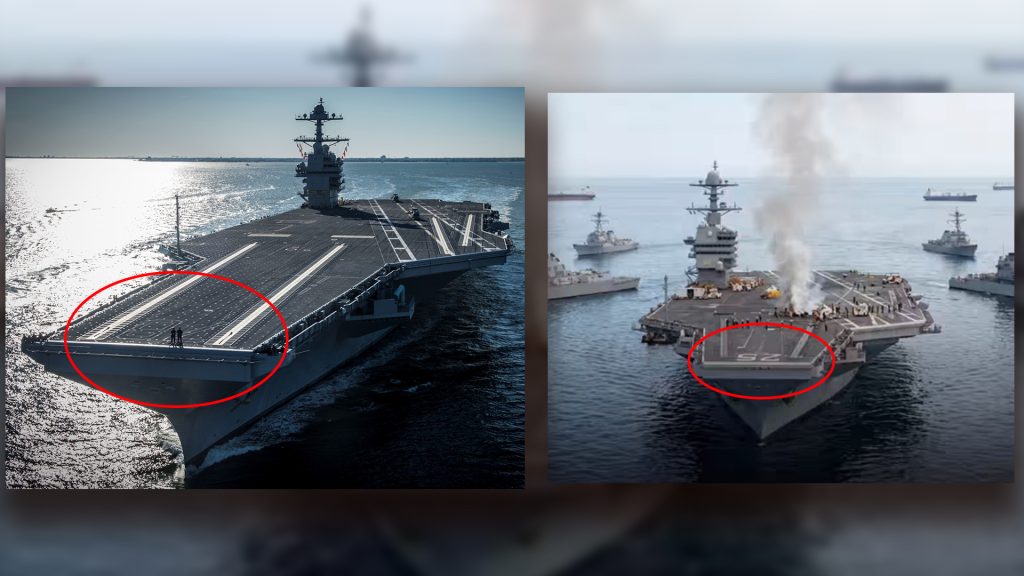
A comparison between the real USS Gerald R. Ford (left) and the fake image (right).
Meanwhile, other details in another image — such as the depiction of navy personnel inspecting damage on the aircraft carrier’s deck — were also analyzed. Hive Moderation’s results showed that this image was 98.9% likely to have been AI-generated.
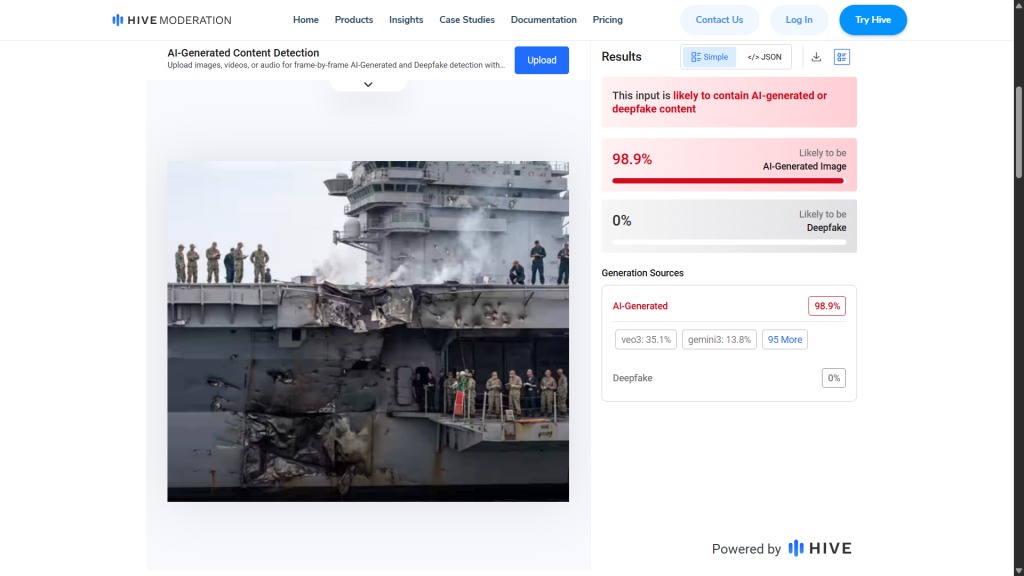
Additional verification by Hive Moderation found the image was 98.9% AI-generated.
Further irregularities were also detected in the image. Normally, the USS Gerald R. Ford (CVN-78) should have a relatively small, tall command tower. However, in the image, the command tower appeared as a long strip, resembling earlier Nimitz-Class carriers rather than the Gerald R. Ford-Class. In addition, the sides of the command tower bore no numbers, which contradicts U.S. Navy standards that require numbers to be displayed on both port and starboard sides, as well as on the sides of the command tower itself.
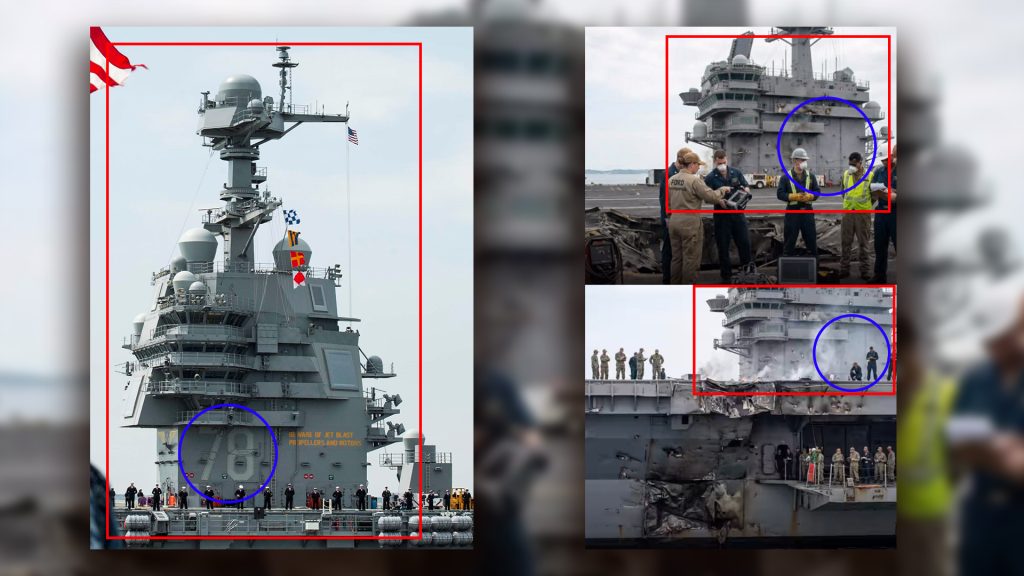
A comparison between the real command tower of the USS Gerald R. Ford (left) and the fake image (right).
What is the situation of the U.S. aircraft carrier “USS Gerald R. Ford”?
Thai PBS Verify further conducted a keyword search for “USS Gerald R. Ford Laundry Fire,” and found current reports about the USS Gerald R. Ford (CVN-78) from USNI News dated March 28, 2026. The key points could be summarized as follows:
The USS Gerald R. Ford (CVN-78) was, at the moment, in Split, Croatia, after stopping earlier in the week at Souda Bay, Greece. The carrier departed the Red Sea last week en route to Crete, following a laundry room fire in mid-March 2026 that damaged several crew quarters.
While docked at Souda Bay, personnel from the regional maintenance center, structural engineers, naval architects, and specialized experts assessed the repairs. Military law enforcement and federal civilian authorities continued to investigate the laundry room fire.
Officials added that “personnel and industry partners have supported the restoration of the affected crew quarters.”
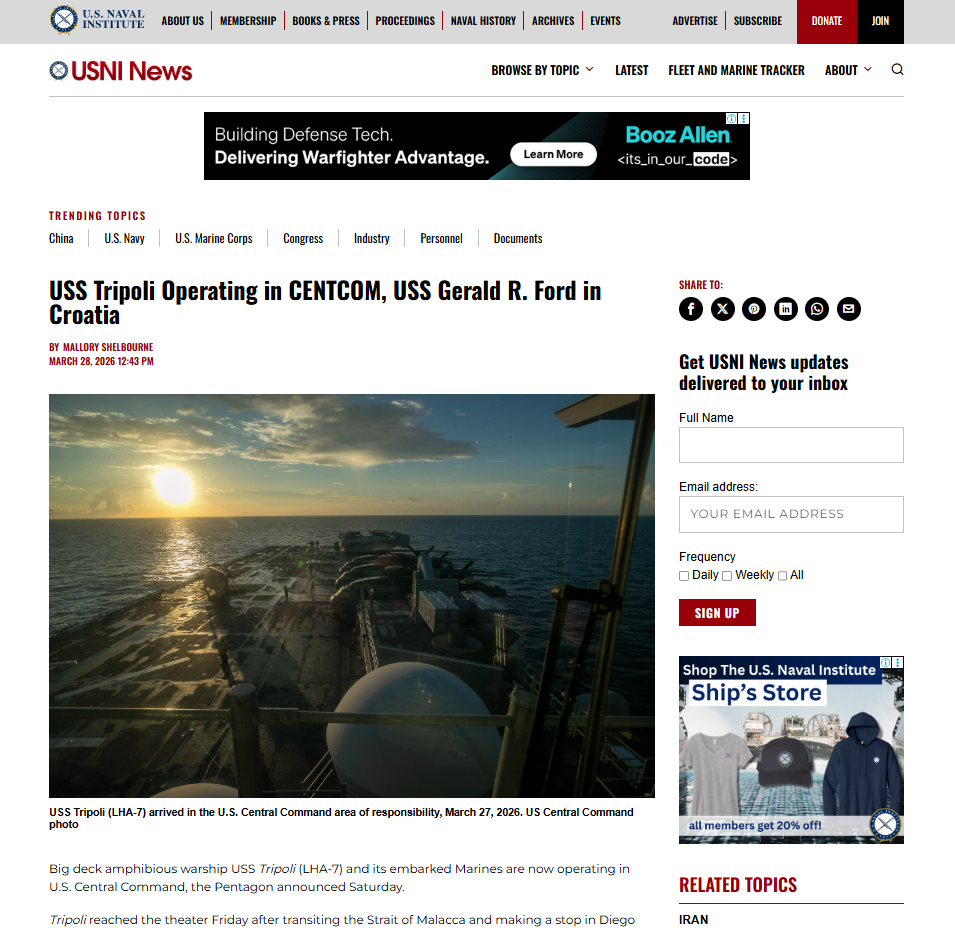
A screenshot of the USNI News report, stating that the USS Gerald R. Ford (CVN-78) is currently in Split, Croatia, after sustaining damage from a laundry room fire.
In addition, according to the USNI News Fleet & Marine Tracker report dated March 23, 2026, the amphibious assault ship USS Tripoli (LHA-7) arrived in the operational area on March 27, 2026, as reported by CENTCOM. It was accompanied by the USS New Orleans (LPD-18) and the 31st Marine Expeditionary Unit, under orders from the U.S. Department of Defense.
What is the truth?
Following the claims on Instagram that the U.S.’s most advanced aircraft carrier, the USS Gerald R. Ford (CVN-78), was heavily damaged by an Iranian attack, Thai PBS Verify has found that it is “false information.” The fact is: the USS Gerald R. Ford was docked in Split, Croatia, for repair assessments following a laundry room fire in mid-March 2026. The incident caused only partial damage to certain crew quarters. The ship was not attacked by foreign forces, nor did it sustain the severe damage claimed in the posts.
Verification Process
- AI detection analysis: Hive Moderation was used to examine images accompanying claims that the U.S. carrier Ford was disabled for two years after an Iranian attack. Results from the tool confirmed the images were AI-generated.
- Image detail observation: Close inspection revealed multiple inconsistencies, such as incorrect deck numbers and the shape of the command tower, which did not match the real ship.
- Keyword search: The phrase “USS Gerald R. Ford Laundry Fire” led to reports from USNI News confirming that the carrier had docked in Croatia for repairs after a laundry room fire, not due to an Iranian attack.
Impacts of misinformation
- Global security misperceptions: Claims that the U.S.’s most advanced aircraft carrier was attacked by Iran undermine confidence in naval power and could be exploited to distort regional power balances.
- Propaganda and conflict escalation: The narrative aims to portray U.S. military defeat, fueling propaganda that encourages support for violence among audiences following Middle East conflicts.
- Policy and military disruption: Suggesting the ship would be out of service for two years could alarm U.S. allies and mislead the public into fearing a war scenario that never occurre
- Viral spread of rumors: Evidence shows the post gained over 7,000 likes, demonstrating how sensational, strategically framed false claims can attract significant attention despite lacking any factual basis.
What to do with this misinformation?
- Check official military sources: For incidents involving global military assets, verify statements directly from the U.S. Department of Defense or Navy. If no official announcement exists, assume the claim is false.
- Assess plausibility of damage: Internal accidents (e.g., a laundry room fire) differ greatly from wartime attacks. A genuine attack would produce clear external damage photos and be widely reported by major global outlets.
- Beware of “BREAKING” posts without sources: Watch for social media accounts that frequently publish conspiracy-style content, often disguised as podcasts or pseudo-academic analysis, which may embed false claims.
- Spot “agenda-pushing” in comments: If commenters insist authorities are “covering up” or “downplaying” incidents without evidence, recognize this as a persuasion tactic to make false information seem credible.
- Rely on trusted verification channels: When uncertain about military or international events, follow reliable debunking sources or share fact-checks to avoid becoming a tool of propaganda.
Editor: Nuttapoln Toomma
Translation edited by: Peerachai Pasutan