Verification: Teng Natthaphong does not say that if he becomes prime minister, he will accelerate trade with Cambodia – and resign if unsuccessful.

Thai PBS Verify found the source of the information from: Threads
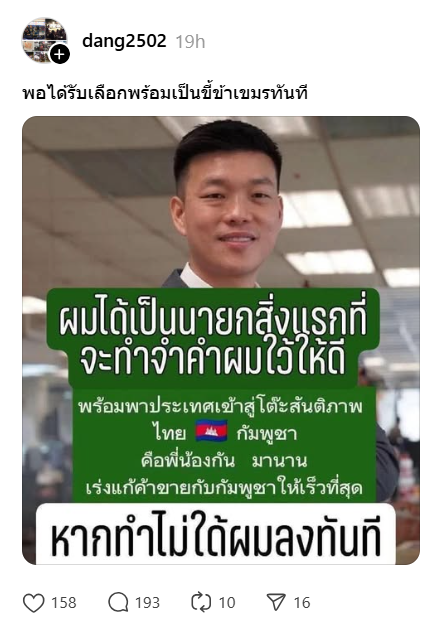
Verification found a post quoting text alongside an image of Natthaphong Ruengpanyawut, leader of the People’s Party and prime ministerial candidate. The post’s caption indicated that Natthaphong had spoken about the Thai–Cambodian border situation:
“If I become prime minister, the first thing I will do—remember my words—is to bring the country to the Thai–Cambodian peace table. We have long been brothers and sisters. I will urgently resolve and accelerate trade with Cambodia as quickly as possible. If I cannot do it, I will step down immediately.”
The post recorded more than 21,600 views.
Is this claim true?
statements related to campaign policy on the Thai–Cambodian border issue.
“I have never said that. As for the party’s position on the Thai–Cambodian border situation, we believe it is necessary to engage on all fronts—military, diplomatic, and in the suppression of scam operations. The most urgent objectives are to protect sovereignty, to use force in a proportionate manner, and to bring the matter to an end as quickly as possible so that the affected citizens can return home. This is our approach to address the Thai–Cambodian border situation.”
In addition, a review of People’s Party statement regarding the Thai–Cambodian conflict, following the military clash in the Chong Bok area, Nam Yuen District, Ubon Ratchathani Province, which was published on 5 June 2025, indicated that:
In light of the ongoing tensions between Thailand and Cambodia, which began with a military clash in the Chong Bok area of Nam Yuen District, Ubon Ratchathani Province, the situation has yet to be resolved. Meanwhile, the Thai government has been widely criticized for lacking clear, proportionate, and timely measures to address the problem. This has led to growing public concern that the situation could escalate and affect Thailand’s sovereignty.
In addition, there are concerns that certain groups may exploit the situation to stir calls for the unnecessary use of military force to resolve the issue, or to incite the armed forces to exercise power beyond the civilian government’s control.
The People’s Party therefore proposes the following measures to the Thai government to ease public concerns and to de-escalate the Thai–Cambodian situation as follows:
1.In addition to using bilateral mechanisms for negotiations and demonstrating military readiness, the government should consider employing economic measures to respond to the Cambodian government in a proportionate and situation-appropriate manner, such as:
- Prohibiting the export of certain categories of goods to Cambodia
- Increasing strictness of inspections at permanent border crossings, temporary trade facilitation points, and tourism checkpoints, or even closing certain Thai–Cambodian border checkpoints if necessary
- Prohibiting Thai nationals from crossing the border to travel or gamble in Cambodia, as it has previously been estimated that around 5,000 Thais travel to gamble in Cambodia each day, generating more than 40 billion baht in annual circulation
- Stepping up measures to dismantle call center scam rings that have their main bases along the Cambodian border, by using existing Thai laws to freeze the assets of those involved, cutting mobile phone and internet signals, and suspending electricity supplies that Thai authorities sell to Cambodia
- Suspending assistance for development projects in Cambodia
2. The Thai government should pursue proactive diplomatic measures alongside bilateral negotiations, such as:
- Accelerating proactive diplomatic efforts to build an accurate understanding of the situation with Thailand’s partners in ASEAN, member states of the United Nations Security Council, and other allies. This would help persuade all parties to resolve the Thai–Cambodian tensions through bilateral dialogue within existing cooperation frameworks. The Thai government should also urgently engage with international media to ensure that Thailand does not fall victim to false or distorted information, which could place the country at a disadvantage on the global stage.
- As Cambodia seeks to bring the dispute into international mechanisms, the Thai government must be prepared to present the factual basis of the dispute to the international community—whether within ASEAN, the United Nations, or other multilateral frameworks—to avoid being placed at a disadvantage should Cambodia use international mechanisms to escalate the issue.
- The Thai government must communicate with the public effectively.
Over the past week, Thai citizens have not received clear information from the government on how it plans to respond to Cambodia’s actions, nor have they been adequately informed of the factual situation. Instead, they have had to rely on news circulated through social media and mass media, leading to confusion and various speculations.
The People’s Party proposes that the government establish a communication war room to officially inform the public on developments of the Thai–Cambodian situation, particularly on the measures taken by the Thai government. This should be done through daily factual updates until the situation is resolved.
In addition, an investigative committee should be set up to establish the facts surrounding the clash between Thai and Cambodian troops on 28 May 2025, so that the facts can be made public and used as a basis for building accurate understanding that the Thai government was not the aggressor or the party at fault in this incident.
Finally, the People’s Party affirms that the current conflict along the Thai–Cambodian border can be de-escalated through unified crisis management by the government. This must be supported by clear strategies and timely, appropriate measures. Such approach would allow the conflict to be resolved without the loss of lives or bloodshed among soldiers and innocent civilians.
Furthermore, a review of the statement issued on 9 December 2025 found no such claims in the nature of campaign-style remarks or promises. The statement merely set out positions, approaches, and recommendations to the government, at the time, under the administration of Prime Minister Anutin Charnvirakul.
Natthaphong stated that the use of military force must be a last resort and applied only to the extent necessary, after all other tools have been exhausted and proven ineffective. Military action should be used solely for self-defense to address immediate threats, and it must be grounded in human rights principles, alongside the use of diplomatic and information measures to address the Thai–Cambodian border issue.
In addition, a review of the publication claiming Natthaphong said, “If I become prime minister, I will accelerate trade with Cambodia, and if I fail, I will step down,” also found that it had been published 19 hours before Thai PBS Verify examined the claim on 25 December 2025.
A review of interviews given by the leader of the People’s Party within the past 24 hours found that, on the party leader’s social media platforms, he had appeared in two programs: Kammakorn Khao Khui Nok Jor and Ting Khao – the later was broadcast on Workpoint channel.
For the program Kammakorn Khao Khui Nok Jor, aired on 24 December 2025 at minute 29:03, Natthaphong addressed the party’s stance and proposals regarding the Thai–Cambodian border situation. He stated that the party’s position is to protect sovereignty, ensure that the conflict would not become prolonged, bring people home, and maintain safety along the border.
“We do not reject the use of military force to protect sovereignty and prevent losses, but we will not use this issue to generate momentum or popularity for the party,” said Natthaphong Ruengpanyawut, leader of the People’s Party and prime ministerial candidate, during the Kammakorn Khao Khui Nok Jor program on 24 December 2025.
For the program Ting Khao, aired on 24 December 2025, the discussion on the Thai–Cambodian border issue began at 10:04. No content was found that matched the post claiming, “If I become prime minister, I will accelerate trade with Cambodia, and if I fail, I will step down.”
How do academics view the phenomenon of nationalist sentiment being used to undermine opponents’ electoral support?
Dr. Sathitorn Thananithichot, lecturer at the Faculty of Political Science, Chulalongkorn University, said that the use of distorted statements to create fake news of this nature often occurs as elections draw near. Misleading or false information is frequently used to defame, discredit, and attack political opponents. Based on his observation, this has led to legal provisions allowing such evidence to be submitted to the Election Commission, with perpetrators subject to legal penalties.
Especially in the era of social media, online information can spread rapidly across various platforms and be used as a tool to damage political rivals. This type of phenomenon occurs in almost every election, with the difference lying in which issues are chosen for attack each time.
In the past, politicians’ personal issues—such as age, health, or illnesses of politicians—were often exploited to discredit them, framing the opposing side as “past their prime” or no longer useful in the eyes of society. However, in this election cycle, nationalist sentiment has been gaining momentum and is being used as a tool, by attempting to link certain parties to being insufficiently tough in defending national sovereignty. In many cases, this involves distortion and does not stem from what the individual or the party actually said.
Nevertheless, an indecisive image of a certain group/party/figure has been used by its opponents who selectively present partial information to attack and undermine one’s political credibility.
“The issue of nationalism and politics ahead of this election is quite clear, because we have not really had conflicts with neighboring countries on sensitive issues for nearly the past 20 years. Previously, there may have been nationalist sentiment in other dimensions affecting the “Orange Party [People’s Party]”, such as issues related to Section 112 and military reform. Those were nationalist issues in terms of values and internal notions of the nation. But now, there is a foreign dimension involved. Distorted information may generate emotional resonance only within one side. For example, stirring up news to attack the People’s Party will only further reinforce the feelings of groups that already do not support the party.”
only makes them more emotionally invested and more firmly entrenched, to the point that they are almost impossible to sway.
“However, this group rarely changes its stance anyway, even without misinformation. The group that is truly affected is those who remain neutral: they have not yet decided who to vote for, or do not particularly favor any party. This is a large group.”
“Misinformation is therefore aimed at this group, to stir sentiment, create confusion or misunderstanding, and influence them to view the opposing side negatively by constructing a damaging image that affects political decision-making,” said Dr. Sathitorn Thananithichot.
What are the facts?
A Threads post claiming, with quoted text and an image, that Natthaphong Ruengpanyawut, leader of People’s Party, said he would accelerate trade with Cambodia if he became prime minister and would step down if he failed to do so, was found by Thai PBS Verify to be untrue. No such statement was found in any interview, official statement, or media report, and Natthaphong himself confirmed that he has never made such remarks.
Verification Process
Keyword search:
A search using key phrases from the quoted statement found no such interview in mainstream media or on any website.
Interviewing the subject:
Thai PBS Verify contacted Natthaphong Ruengpanyawut, also known as “Teng,” who confirmed that he has never made statements of this nature related to campaign policy on the Thai–Cambodian border issue.
Review of online media interviews:
A review of People’s Party leader’s recent media interviews found that, on social media platforms, he had appeared in two programs—Kammakorn Khao Khui Nok Jor and Ting Khao. But no statements were found in which he said, “If I become prime minister, I will accelerate trade with Cambodia, and if I fail, I will step down.”