Post Claims “Cambodia Intimidates Thailand with MiG-21” — In Fact, It Is Only Transported for Exhibition
The footage showed a retired aircraft being moved to a museum. In fact, Cambodia has not flown this model of jet fighter for more than three decades, leaving only abandoned remains.
Thai PBS Verify found the source of fake news from: Facebook

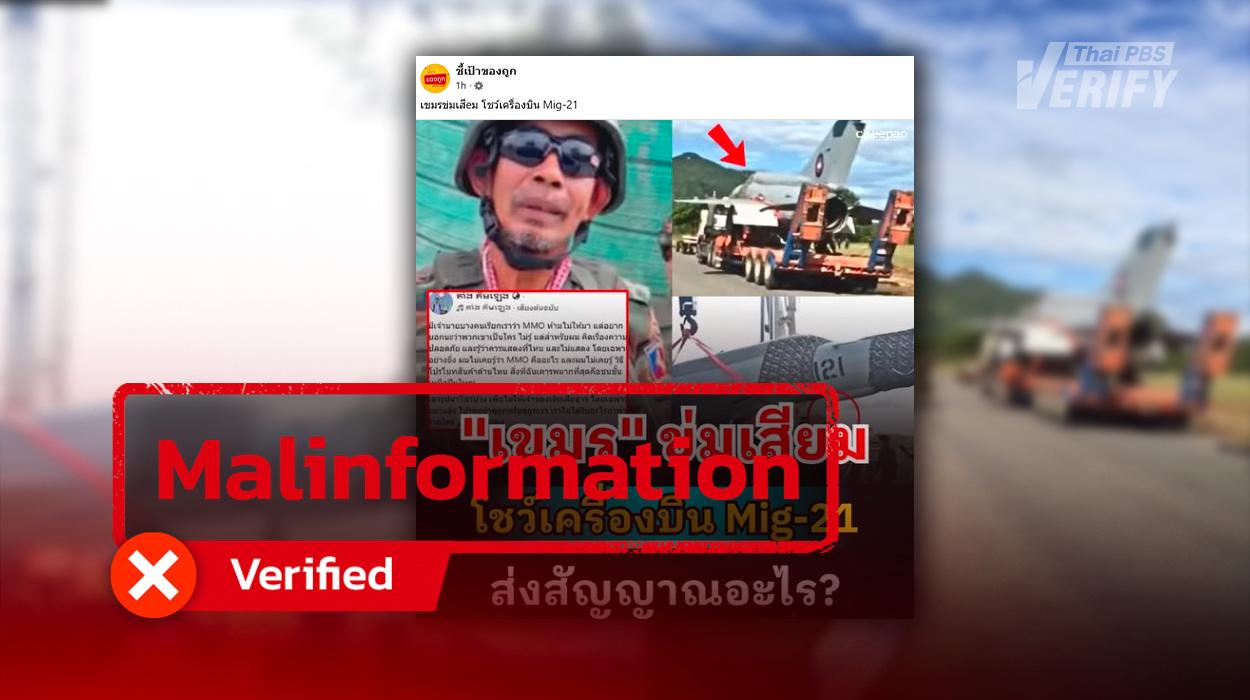
The post reads: “Cambodia intimidates Siam, showing off MiG-21 aircraft,” accompanied by a video from the Facebook page “Chee Pao Khong Tuk (ชี้เป้าของถูก).”
Thai PBS Verify found the post from a Facebook page called “Chee Pao Khong Tuk (ชี้เป้าของถูก)” on January 21, 2026, which shared a message and video claiming “Cambodia intimidates Siam by showing MiG-21 aircraft.” The clip, however, was simply footage of an aircraft being transported. The caption further said:
“Cambodia intimidates Siam by showing MiG-21 fighters. What you see is not just metal flying in the sky — it is a signal, a message delivered without words.
Yes, it may be an old aircraft that many consider outdated, but when flown at a sensitive time, it ignites drama instantly.
The question is: what message are they sending to Thailand?
Some may say, “just a military drill, don’t overthink,” but in international politics, nothing is mere coincidence. Choosing the MiG-21, allowing media coverage, releasing the news — it is clearly staged.
And don’t forget that the MiG‑21 is no longer used to win battles on the field today. Instead, it was used to win over people in its own country—to stir patriotic sentiment and to reassure citizens that the nation is strong and unafraid.
When these images cross the border and reach Thai audiences, the question becomes: how should we feel? Fear, indifference, or anger? Every emotional response is part of the game.
This game isn’t played with bullets, but with images, headlines, and interpretations. Some media outlets may frame the story as if war is imminent, when in reality it remains only at the level of signals. Yet signals themselves can be the most dangerous, gradually eroding trust and embedding the perception that they are intimidating us, they are challenging us.
From another perspective, Thailand itself must tread carefully. Responding too aggressively could escalate tensions, while remaining too passive might be seen as weakness. Striking the right balance is the hardest part.
The key question is: who benefits from this drama? The answer is clear — those in power. Those who want to capture public attention, those who need an external enemy to overshadow domestic problems.
Meanwhile, ordinary people like us risk becoming mere consumers of emotion — absorbing fear and anger without realizing we are being drawn into a larger game.
In the end, the MiG-21 will return to base, the news will gradually fade, but the feelings planted will remain. Without mindfulness and discernment, we may be carried further than we think.
This is not just about fighter aircrafts. It is about political power and the manipulation of public sentiment. And that is the true heart of the ‘Cambodia intimidates Siam’ drama — a story that we want everyone to look deeper than the images in the sky. That’s all from the two of us for now — don’t forget to subscribe us.
The found video
In addition, we found an image from the same angle as the video that appeared on another Facebook page ‘Song Khmer (ส่องเขมร)’ on January 20, 2026. The post carried the headlines ‘Brought out and displayed just to show that once we had it…?’ and ‘Cambodia’s MiG‑21 scrap yard.’
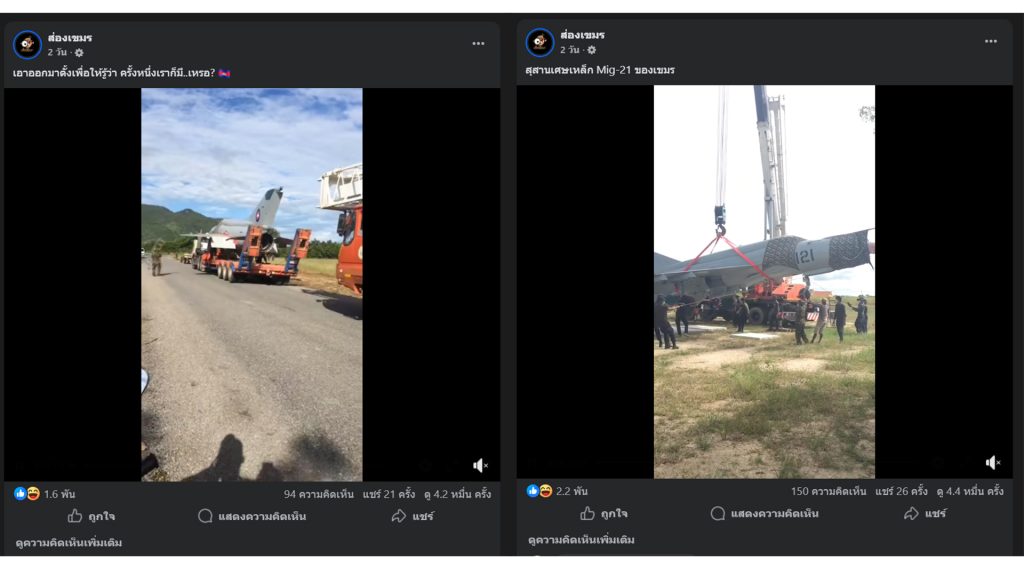
A screenshot shows a post from the Facebook page ‘Song Khmer (ส่องเขมร),’ which had uploaded two original videos.
Where did Cambodia’s MiG-21 images come from?
Observation of the footage used in the news content shows that the emblem on the aircraft’s tail is truly the official one of the Royal Cambodian Air Force, and the numbering matches to its system. However, the scene in question was simply the relocation of MiG-21 aircraft number 7121.
By searching with the keyword “យន្តហោះចម្បាំង MiG-21 (fighter aircraft MiG-21)”, we also found a video on YouTube uploaded by សុខហេង on October 18, 2022. The footage shows MiG-21 aircraft number 7121 being loaded onto a truck for relocation to an unspecified site in Cambodia.
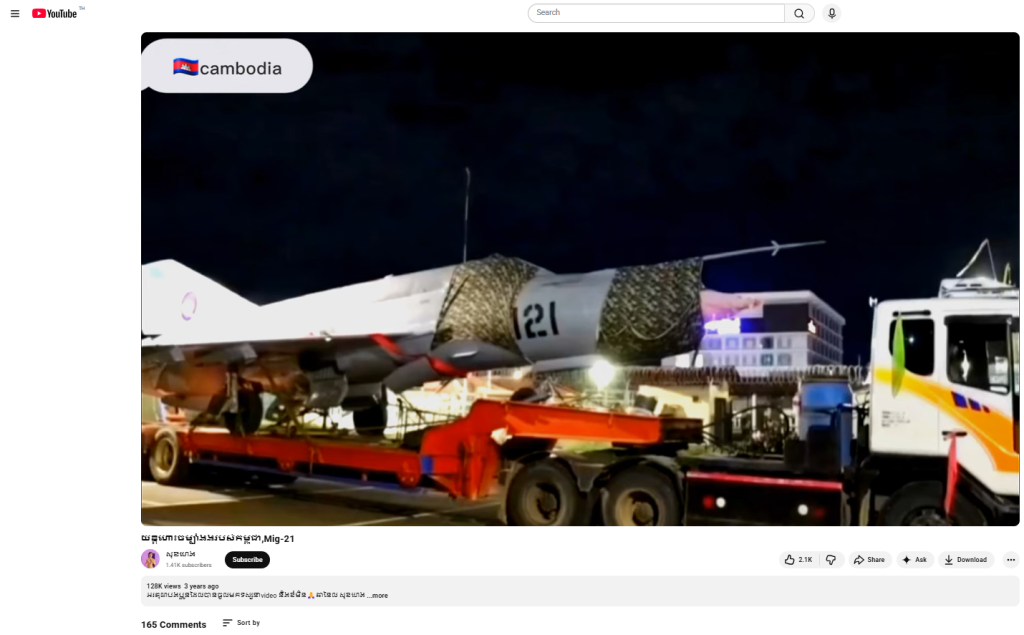
A video showing the relocation of MiG-21 aircraft number 7121 onto a truck was published on a YouTube channel on October 18, 2022.
Thai PBS Verify investigated the source of the incident further, using the same keywords as the video title. This led to a news report published by Khmer Times on October 25, 2021, which stated the following:
The Royal Gendarmerie has started the transportation of one expired MIG-21 jet, registration number MF-7121 to be stored at the Phnom Chum Gendarmerie Training Center.
The jet will be housed in the Museum of the Gendarmerie as an exhibit.
According to earlier reports from Swift News, the aircraft departed from its earlier resting place at the air force base at Phnom Penh International Airport through Road 5.
Roads along the way were closed to traffic to enable the smooth transportation of the wartime workhorse jet fighter.
Unit 701 flew MiG-21 s; its pilots were trained in the USSR and Vietnam. Unit 701, was declared operational in mid-1989.
By 2000 IAI of Israel had upgraded at least six of Cambodia’s MiG-21s. Although two aircraft were delivered in 1997, work on the other four was suspended, pending resolution of some issues.
The MiG-21-2000 upgrade included a service life extension, a HUD, an improved weapons system and new cockpit, GPS-based navigation and Western communications equipment.
The upgrade also included the Python 3 AAM and the Griffin LGB. There was speculation that the contract covered conversion of nine single-seat and one twin-stick MiG-21.
None of the jets are said to be flight worthy at this point in time.
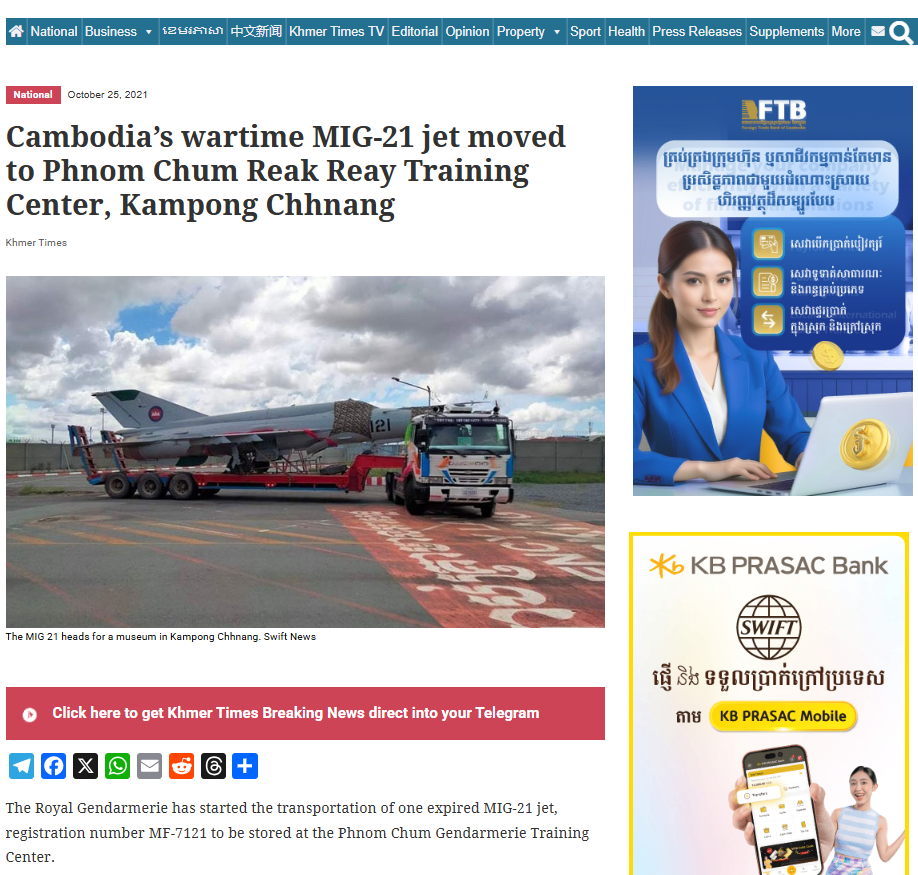
(Image from: Khmer Times)
A Google Earth photo of the Phnom Chum military training center in Kampong Chhnang Province, taken on February 28, 2023, showing the aircraft still on display to this day.
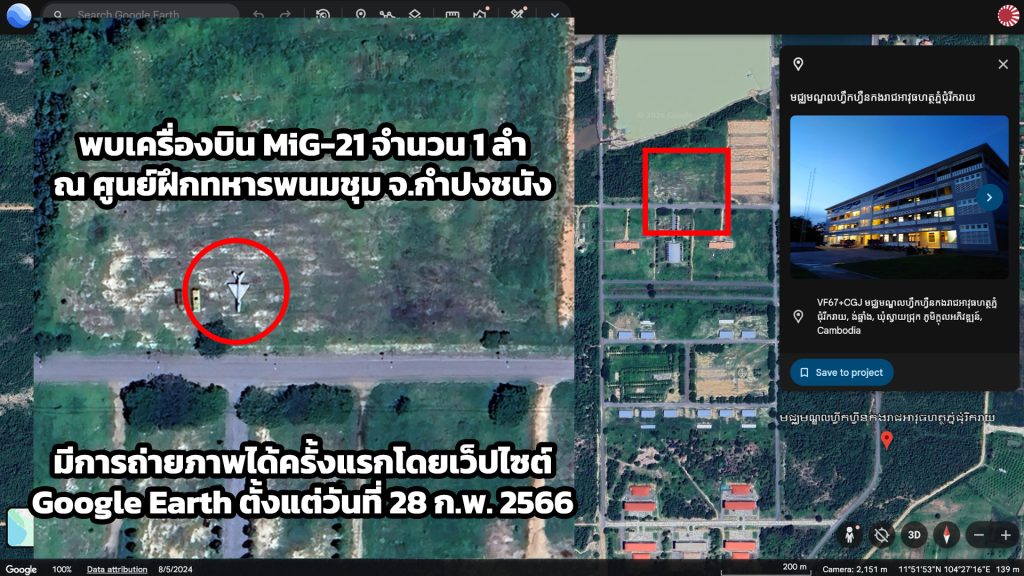
An image from Google Maps showing a MiG‑21 aircraft parked at the Phnom Chum military training center in Kampong Chhnang Province.
What is the condition of MiG‑21 in the Royal Cambodian Air Force?
During the Khmer Rouge Revolution in 1970, Cambodia increasingly aligned itself with communist allies. From then on, Cambodia received support from allied countries such as China and the Soviet Union. In 1977, the country received 16 Shenyang F-6 aircraft from China, followed by the purchase of second-hand MiG-21s from the Soviet Union in 1986. The MiG-21s made their final flights in 1992.
Today, none of Cambodia’s MiG-21s remain airworthy. According to Khmer Times, the Cambodian Air Force has faced budgetary constraints that prevent proper maintenance or upgrades of its MiG-21 fleet.
This reality is visible on Google Earth. At Phnom Penh International Airport, numerous aircraft wrecks can be seen lined up within the air force base area — including 15 MiG-21s.
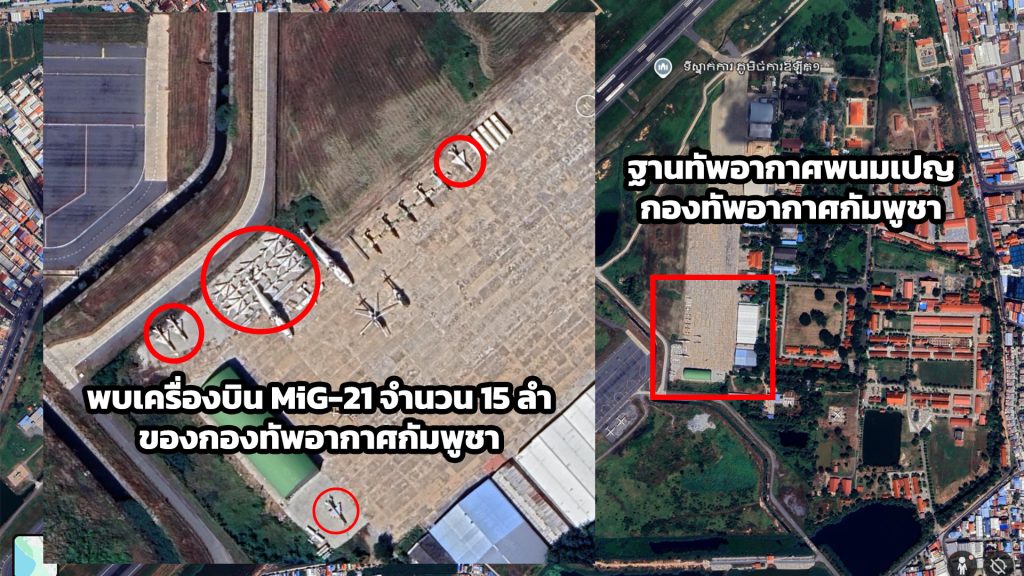
At the Cambodian Air Force base in Phnom Penh, 15 abandoned MiG‑21 aircraft can be seen alongside Mil Mi‑8 and Mil Mi‑26 helicopters, as well as L‑39 Albatros jets parked nearby.
The map image indicates the MiG-21 parking site of the Royal Cambodian Air Force.
What is the truth?
The MiG-21 aircraft number 7121 of the Cambodian Air Force seen in the images was real. However, it was merely a decommissioned plane being transported from Pochentong Airport via Highways 4, 51, and 54 to be placed on display at Cambodia’s Phnom Chum Gendarmerie Training Center.
It has no connection whatsoever to signaling or escalating the Thai-Cambodian border conflict.
Verification Process
- Observation of image details: visual details were examined and Google Lens was used to trace the source.
- Keyword search: Thai PBS Verify translated the term “MiG-21 fighter aircraft” into Khmer and continued searching across different search engines, which led to reports from Nakorwat News Daily and a YouTube video by the mentioned user.
- Data comparison: we cross-checked origins and compared information with the website Scramble.nl, which documented the history of Cambodia’s MiG-21 fleet and confirmed that the aircraft are no longer operational.
- Map confirmation: by comparing information and using the timeline feature on Google Earth, it was found that the Cambodian Air Force had abandoned this aircraft model since 2000, before later relocating them to be lined up with other decommissioned airframes.
Impacts of this false information
- Emergence of misinformation: these pages often rely on clickbait headlines or ambiguous wording, misleading audiences into believing that Cambodia is “preparing for war” or “showing military strength,” when in reality it was only the relocation of “decommissioned aircraft” for museum display.
- Fuel of cross-border conflict: comment sections frequently become battlegrounds between Thai and Cambodian netizens. It does not generate any informational benefit, but instead aims to accumulate hatred.
- Erosion of factual values: sensational or mocking posts gain more traction than accurate information (such as the aircraft model or the purpose of its relocation), pushing facts into obscurity.
- Engagement built on misunderstanding: such pages often achieve high likes and shares by stirring emotions, allowing false news to spread far more quickly than real reports.
What to do with this misinformation?
- Check the “context”: don’t rely only on the image. Ask whether a combat-ready aircraft would really have its wings removed and be dragged by a tractor or truck along a public highway. In reality, you would expect to see test flights or discreet transport methods.
- Verify the original source: military news in Cambodia usually comes with official announcements or from the Ministry of Defense. If mainstream outlets do not report on “military exercises” but clickbait pages do, assume it is likely distorted information.
- Separate “facts” from ‘opinions”:
-
- Fact: A MiG-21 was indeed relocated.
- Opinion/Spin: Claims such as “Cambodia ready for war” or “showing world-shaking military power” (These parts should be cautious).
- Use search tools: check Google or other search engines for reports from credible news agencies or satellite imagery.
Related Content