Claim of Iran sinking US aircraft carrier found to be US warship fire incident in 2020
Thai PBS Verify found the piece of malinformation on: Threads
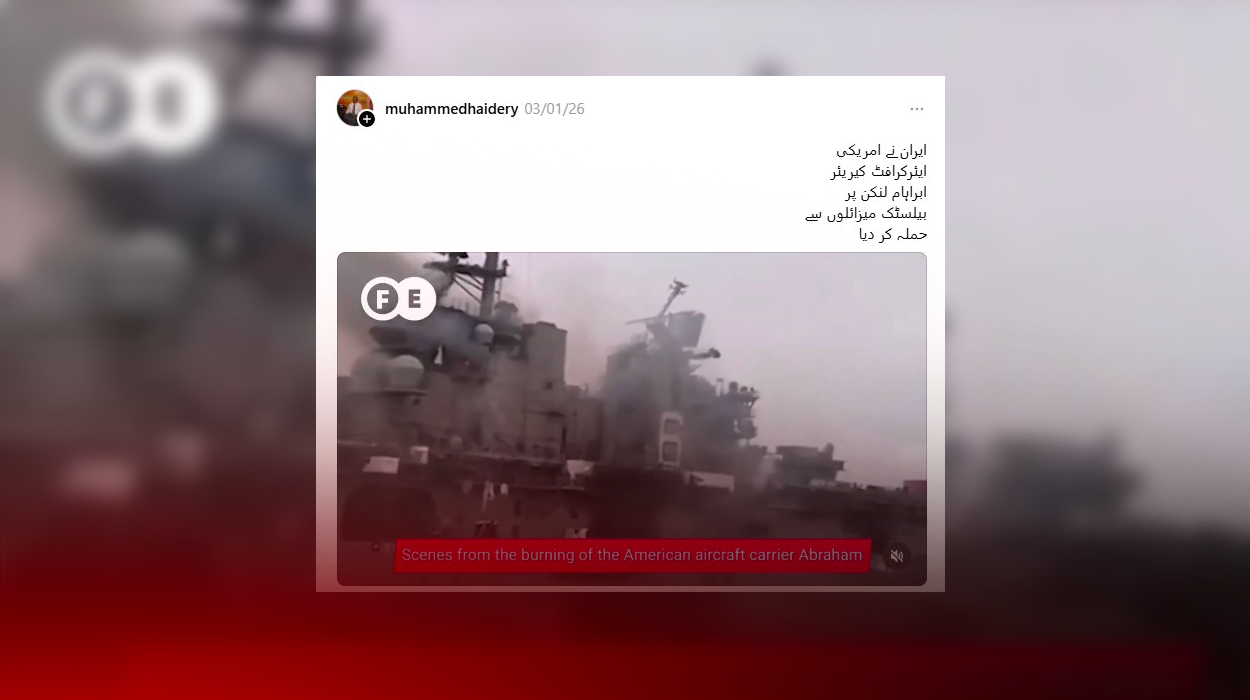
On March 1, 2026, a Threads user “muhammedhaidery” claimed Iran had sunk a US aircraft carrier.
Thai PBS Verify identified a video post on Threads by user ‘ muhammedhaidery,’ on March 1, 2026. The post alleged that Iran had sunk the US aircraft carrier Abraham Lincoln (CVN–72). The caption reads:
ایران نے امریکی
ایئرکرافٹ کیریئر
ابراہام لنکن پر
بیلسٹک میزائلوں سے
حملہ کر دیا
With the help of Threads translation feature, the post says:
“Iran defeated America.
The aircraft carrier
USS Abraham Lincoln
was struck by missiles.”
The post gained significant traction with over 1,200 likes, 61 comments, 154 reposts, and 400 shares. Most comments supported the claim that Iran had defeated the US, though some users challenged the details and pointed out inconsistencies in the video.
The USS Abraham Lincoln was not attacked
Thai PBS Verify examined the video with Google Lens and found that the footage came from the 2020 fire aboard USS Bonhomme Richard (LHD-6). Therefore, the incident was not related to the USS Abraham Lincoln (CVN-72) as claimed.

An analysis of the video found on Threads shows that the footage actually originated from the fire aboard US Navy’s USS Bonhomme Richard (LHD-6).
What happened to the USS Bonhomme Richard (LHD-6)?
Thai PBS Verify reviewed a report published by Navy.mil on October 20, 2021, which summarized the findings of the US Navy’s investigation into the fire aboard USS Bonhomme Richard. The report identified four main categories that led to the failure to contain the blaze, resulting in prolonged damage and the ship’s eventual decommissioning, as repairs were deemed uneconomical:
- Deteriorated ship condition
- Lack of crew training in emergency response
- Ineffective coordination among personnel
- Failure to follow established fire-response procedures

An image of the USS Bonhomme Richard (LHD-6) fire incident on July 13, 2020.
What does the real USS Abraham Lincoln look like?
In addition, the team discovered other images of both US Navy warships. Photos archived on Seaforce.org show a distinct difference between the two vessels. The USS Abraham Lincoln has the number 72 painted on both sides of its command tower, while the USS Bonhomme Richard displays the number 6 on the same location.

USS Abraham Lincoln (top) and USS Bonhomme Richard (bottom)
What is the current condition of the aircraft carrier?
Thai PBS Verify conducted further research into the ongoing conflict and the actual status of the USS Abraham Lincoln. This led to a report found on the official X account of US Central Command (CENTCOM).

Image of USS Abraham Lincoln CVN-72
CENTCOM clarified:
Iran’s IRGC claims to have struck USS Abraham Lincoln with ballistic missiles. LIE.
The Lincoln was not hit. The missiles launched didn’t even come close. The Lincoln continues to launch aircraft in support of CENTCOM’s relentless campaign to defend the American people by eliminating threats from the Iranian regime.
What is the truth?
Iran used old footage of the USS Bonhomme Richard (LHD-6) — which suffered a fire in 2020 — to claim it had attacked the US aircraft carrier USS Abraham Lincoln (CVN-72). In reality, the video was misrepresented, and the official X account of US Central Command (CENTCOM) publicly denied the claim.
Verification Process
- Video observation in details: Closer inspection of the footage revealed inconsistencies in the ship’s markings. For example, the vessel in the video displayed hull number 6, whereas the USS Abraham Lincoln should carry the number 72 on both sides of its command tower. With an analysis by Google Lens, the video was traced back to reports of the 2020 fire aboard USS Bonhomme Richard.
- Information comparison: Searches and comparisons were carried out between the details of the ship shown in the video and official battle reports from the US Central Command (CENTCOM) account on X. These reports stated that Iran’s claim was false.
Impacts of this disinformation
- Escalation of conflict: False information of this kind can be used as a political tool (aka propaganda) to stir up hatred or justify the use of violence between nations.
- Distortion of past events: The images often come from real incidents in the past — such as the 2020 fire aboard USS Bonhomme Richard — but are repurposed and misrepresented as new events to generate views and shares.
- Erosion of trust in social media: When fake war news spreads easily, users struggle to distinguish between real crises and fabricated stories. As a result, when genuine emergencies occur, the public may ignore warnings or fail to remain vigilant.
What to do with this misinformation?
-
Check reliable sources from intelligence agencies or major outlets only
-
-
- An attack on an aircraft carrier would amount to a “declaration of war.” If it were real, global outlets such as CNN, Reuters, or AP would issue breaking news within minutes.
- If such a major story appears only on personal posts or unverified X (Twitter) accounts, treat it as “fake news” by default.
-
-
Look for anomalies in images or videos
-
-
- Pay attention to hull numbers: the USS Abraham Lincoln carries 72, but the ship in the clip may actually be a different vessel, with a hull number that does not match.
- Use reverse image search tools like Google Lens to check whether the footage has appeared in older reports — most often, it’s recycled content from past incidents.
-
-
Verify the account which has posted the claim
-
-
- Accounts that spread this type of news often have hidden agendas — such as manipulating public sentiment or boosting engagement metrics in order to sell the account later.
- Check how credible the account is. Review whether it has a history of sharing false information before trusting or reposting its content.
-
-
“Not Share” means stopping the damage
-
- Sharing fake war news can cause unnecessary panic among those around you.
- Once you identify the information as false, leave a warning comment (if it’s safe to do so) or report the post so the platform can take action.
Editor: Nuttapoln Toomma
Translation edited by: Peerachai Pasutan

Related Content