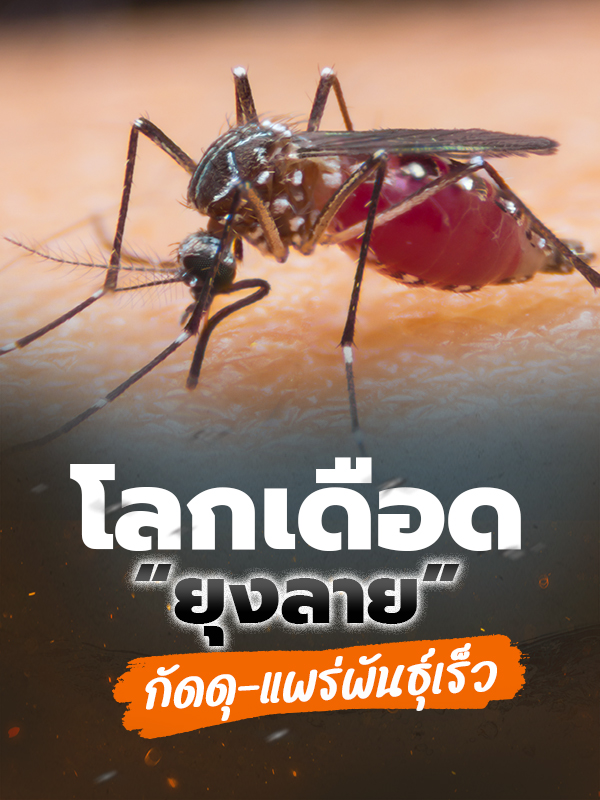
The news of the first mosquito discovered in the forests of Iceland—a country located on an island marked by extreme natural phenomena and climates, where active volcanoes and massive glaciers coexist—has startled many people.
It raised concerns about the impacts of climate change, which continues to intensify, with this case seen as one of the warning signs!
The Visual by Thai PBS spoke with Dr. Siriporn Yongchaitrakul, Senior Public Health Specialist and Head of the Entomology and Vector Control Group at the Department of Disease Control, Ministry of Public Health, to better understand this phenomenon and to provide an update on the mosquito situation in Thailand.
How Iceland Got Mosquitoes for the First Time
The Head of the Entomology and Vector Control Group described areas of the world where
mosquitoes have never been found. Apart from Iceland, Antarctica is also mosquito-free due to its extremely cold climate.

Entomology and Vector Control Group, Department of Disease Control, Ministry of Public Health.
Dr. Siriporn explained that in the past, mosquitoes could not survive in very cold climates.
However, the species now discovered is one that can be found in cold regions. In the case of Iceland, as reported in the news, it is possible that mosquitoes arrived by ship or container. Whether they can survive to complete their life cycle or establish a permanent population remains unknown.
“There is a possibility—or at least a suspicion—that because Iceland’s temperatures have risen significantly in recent years, living organisms now have a greater chance of survival when temperatures increase.”
“This is a signal that, if even Iceland’s temperatures are rising, then across the world—where we already know the climate is warming—living organisms such as mosquitoes will be able to expand their habitats. If those mosquitoes are capable of carrying diseases, it will create more breeding grounds for transmission.”
However, Dr. Siriporn acknowledged that the three mosquitoes found in Iceland, based on currentresearch, have not been shown to transmit diseases such as malaria or Zika.
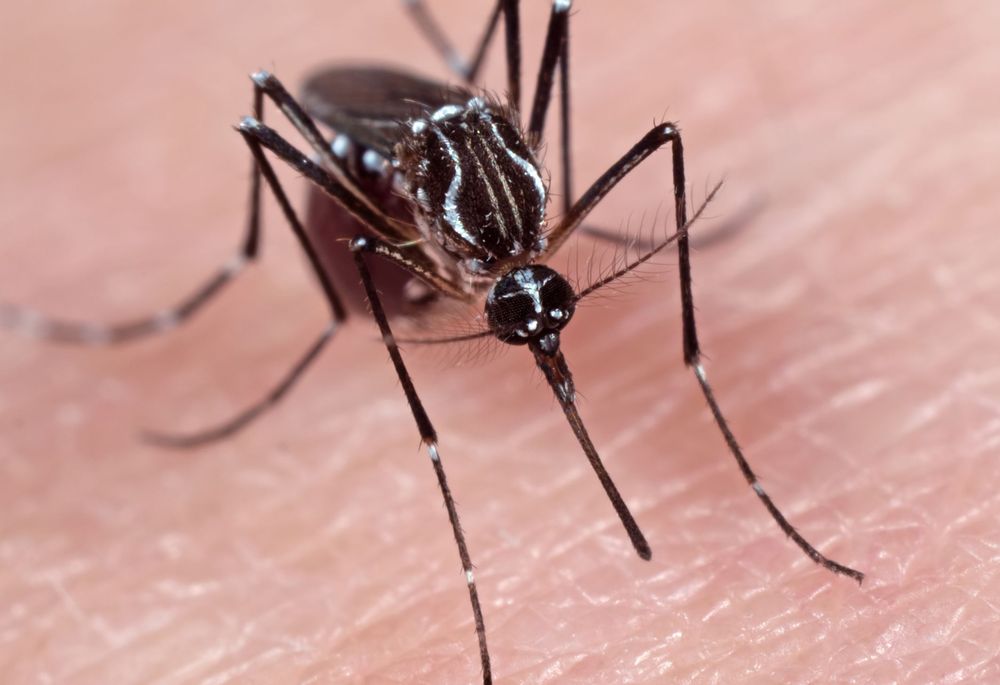
secondary vector of chikungunya, Zika, and yellow fever.
Dr. Siriporn explained that in the past, mosquitoes could not survive in very cold climates.
However, the species now discovered is one that can be found in cold regions. In the case of Iceland, as reported in the news, it is possible that mosquitoes arrived by ship or container. Whether they can survive to complete their life cycle or establish a permanent population remains unknown.
What kind of environments do mosquitoes normally prefer?
Although mosquitoes can be found in almost every region, there are some areas where they do not thrive—particularly places with extremely cold climates. Low temperatures affect the development of eggs, larvae, and the transmission of pathogens within mosquitoes.
Most mosquitoes prefer temperatures around 20–30° or higher, which are relatively warm and humid.
Exceptions include certain groups of mosquitoes that have adapted to colder climates, such as the species recently reported in the news. These are endemic mosquitoes found in the cooler climates of Europe, North Africa, and parts of Asia. Even survive in cold regions, they do not fly around freely; instead, they tend to hide in warmer shelters such as barns or basements.
At what temperatures do mosquitoes die?
On average, mosquitoes thrive at temperatures of about 20–30°. When the temperature drops below 10°C for a prolonged period, research indicates they gradually die because eggs and larvae stop developing. Conversely, if the temperature rises above 40°C, mosquitoes also gradually die.
How are mosquitoes evolving in the global warming era?
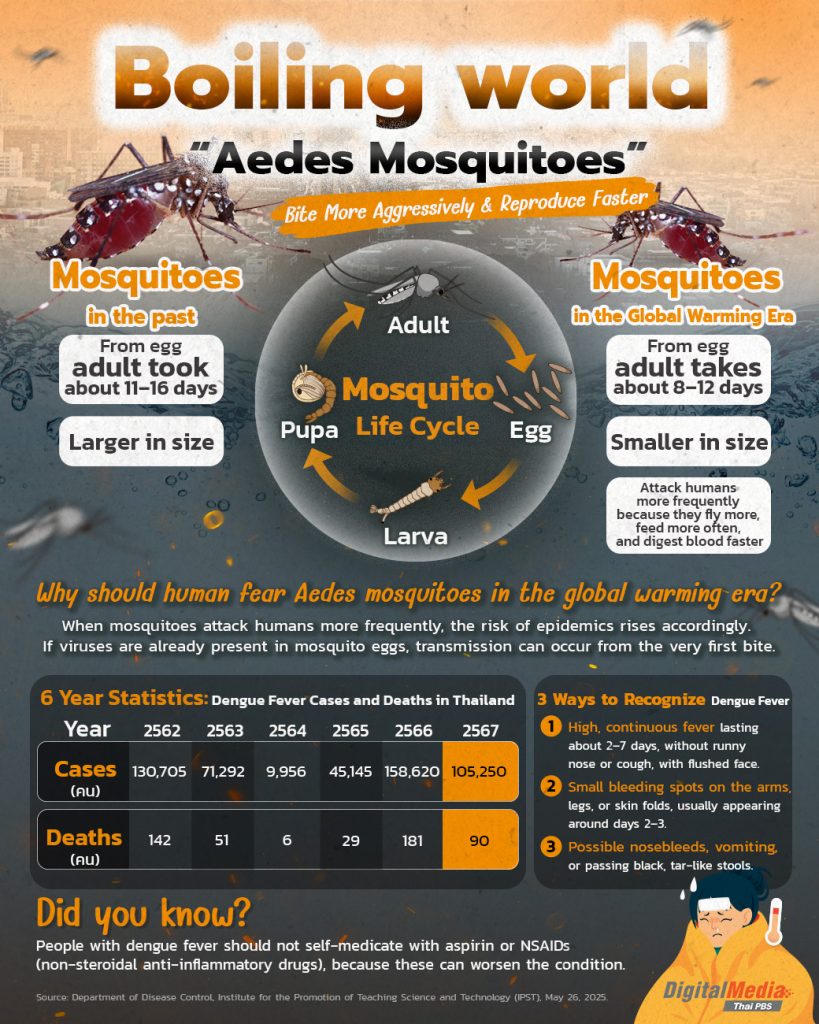
Rising temperatures shorten the mosquito life cycle. Normally, the stages from egg to larva, pupa, and adult take about 10–15 days, but this may be reduced to 7–10 days. A faster cycle means quicker reproduction, leading to a rapid increase in mosquito populations.
If those mosquitoes are capable of transmitting diseases, their efficiency as vectors also increases. This raises concerns about the spread of diseases into regions where they have never been seen before. Local populations may lack experience in controlling such mosquito‐borne diseases, makingsurveillance even more critical.
“Mosquitoes are gradually changing their behavior to adapt to warmer environments. In Thailand, where temperatures already range from 18–38°C, we may not see dramatic behavioral changes. But what is noticeable is that mosquitoes’ life cycle shortens, they grow faster, live longer, or bite more frequently.”
Dr. Siriporn elaborated that in hotter conditions, mosquitoes tend to bite more often. Heat acts as a stimulus, increasing their activity. With shorter life cycles, mosquitoes are observed to be smaller in size but more energetic, adaptive, and aggressive in biting humans.
What is the best way to prevent mosquitoes?
Everyone is reminded to be cautious about water sources around the home. Regularly eliminate mosquito larvae every week to stop disease outbreaks at the source, especially under changing climate conditions.
“The best way to prevent mosquitoes is to eliminate breeding sites so they have no place to live, combined with protecting yourself from bites—for example, applying mosquito repellent, sleeping under a net, and wearing long‐sleeved shirts and long pants.”
Other methods include releasing fish that eat larvae, or using larvicide sand (such as Abate sand) in water containers that cannot be emptied, like cement basins or bathroom tanks. These are safe if used in the recommended amounts indicated on the label. For containers that can be emptied, they should be turned over. Such measures help prevent mosquito‐borne diseases such as dengue fever and malaria.
What kind of people do mosquitoes prefer to bite?
Although mosquitoes bite people in general, certain groups attract them more strongly. People who wear dark clothing, such as black, tend to draw mosquitoes. Likewise, individuals with higher body temperatures—for example, those who have just exercised and not yet showered—are easier for mosquitoes to detect, since mosquitoes follow carbon dioxide emissions.
As for whether overweight individuals are bitten more often than others, Dr. Siriporn explained that there is no clear evidence. It depends more on body temperature. People whose skin retains heat, or those with a high metabolism, are more likely to attract mosquitoes.
Are there other insects evolving because of global warming?
Dr. Siriporn explained that yes, there are. Research reports show examples such as male dragonflies in North America, which have adapted to changing climates. Dragonflies normally have melanin pigments on their wings, but when temperatures rise, the pigments fade. This reduces heat absorption from sunlight, helping the insects stay cooler.
Male dragonflies need to fly under direct sunlight to chase rivals and mate. If their wings remain dark and absorb too much heat, their body temperature rises too high and they cannot fly for long. This is one example of evolutionary adaptation, and it is believed that other insects may be undergoing similar changes.
How might animal evolution under global warming affect future epidemics or human life?
Dr. Siriporn explained that in the case of mosquitoes, although no dramatic changes have yet been observed, they are clearly adapting well. Researchers and entomologists must closely monitor whether, in the future, mosquitoes or other nuisance insects develop new traits or behaviors—for example, shifting from biting indoors to biting outdoors more often. Such changes would directly affect insect control strategies, so continued surveillance is essential.
As for mosquito-borne diseases such as dengue fever, the situation in Thailand this year has improved. One reason is the intensive public campaigns that have raised awareness and encouraged people to protect themselves. Even though many areas experienced stagnant floodwaters, the incidence of mosquito-borne epidemics has not sharply increased.
Ultimately, don’t panic about how mosquitoes may evolve. What matters most is protecting yourself—by eliminating breeding sites and preventing mosquito bites.
อ่านเพิ่มเติม