Fake news on PM Anutin launching ‘unlimited refueling policy’ in Buriram
Thai PBS Verify found the piece of disinformation on: Facebook

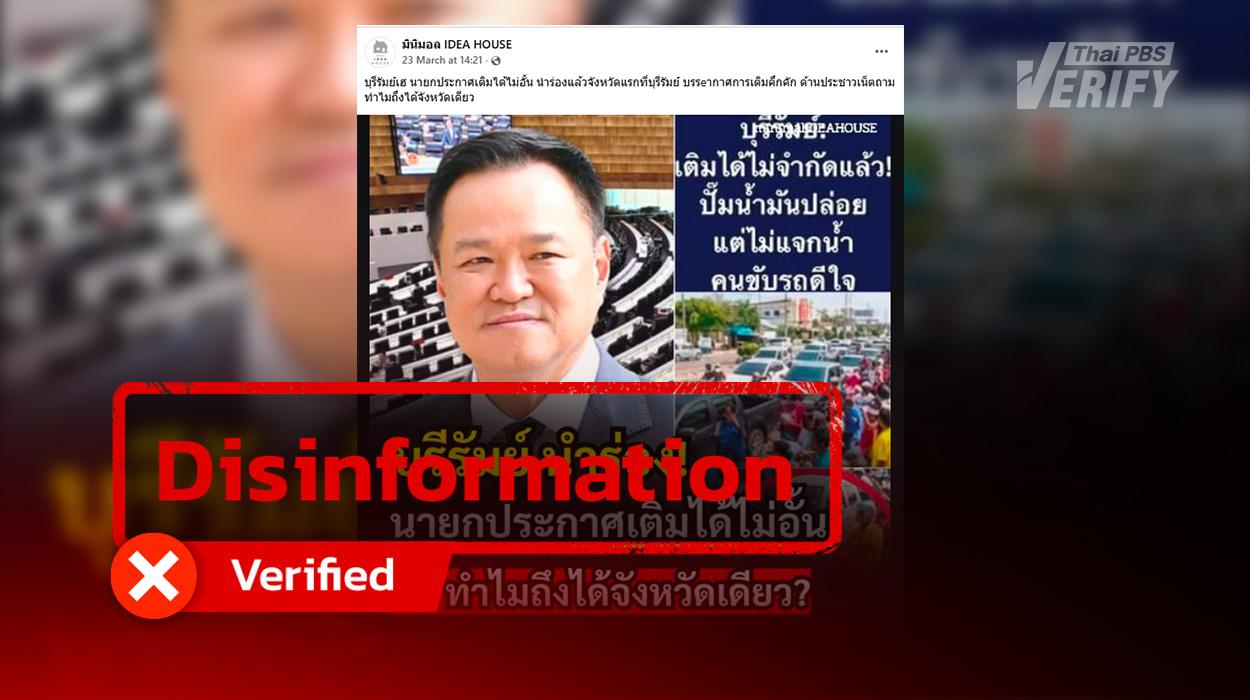
A social media post featuring an image of Anutin Charnvirakul claimed: “Excitement builds in Buriram as the Prime Minister has authorized the unlimited refueling policy, starting in Buriram.”
Thai PBS Verify found a Facebook page sharing an image of Mr. Anutin Charnvirakul with a caption stating:
“Excitement builds in Buriram as the Prime minister has authorized the unlimited refueling policy, starting in that province. However, netizens are asking why the policy has not been extended nationwide.”
The post was dated March 23, 2026. With 1,300 reactions and 2,000 comments, the post has been shared more than 205 times. Most of the feedback reflects public discontent over the issue.
The ‘unlimited refueling policy’ claim in Buriram is not true
A keyword search for ‘Buriram unlimited fuel’ led Thai PBS Verify to a video from the Buriram Provincial Public Relations Office. The Provincial Energy Office dismissed the rumors as baseless, asserting that refueling remains capped to maintain effective and equitable management of resources.

A screenshot of the video of the Buriram Provincial Public Relations Office debunking the rumors.
Regarding social media reports claiming that gas stations in Buriram were offering unlimited fuel to the public, the Buriram Provincial Energy Office pointed out that this information was false. Currently, fuel limits remain in place to ensure that supplies are distributed fairly and sufficiently for everyone.
Mr. Prasopchoke Wannakhao, the Acting Buriram Provincial Energy Officer, stated that some gas stations have adjusted their refueling limits to better reflect current conditions and public needs. The guidelines are as follows:
- For 4-wheel vehicles, the refueling limit has been increased from 500 baht to a maximum of 1,000 baht.
- For 6-wheel vehicles, the limit has been adjusted from 1,000 baht to a maximum of 1,500 baht.
However, specific service details remain subject to the management of each gas station.
These measures, similar to those in many other provinces, remain in place to prevent stockpiling and safeguard against potential fuel shortages in the area. The official also asked for the public’s cooperation in staying calm and relying on official government channels for the most reliable and up-to-date information.
Additionally, Thai PBS Verify conducted another keyword search for ‘refueling limits.’ The result revealed that on March 14, 2026, the Department of Energy Business proposed similar guidelines for gas stations nationwide. These measures aim to ensure appropriate fuel management, with the details as follows:
- For 4-wheel vehicles, it is recommended that fuel sales be limited to a maximum of 500 baht per vehicle.
- For vehicles with 6 wheels or more, it is recommended that fuel sales be limited to a maximum of 1,000 baht per vehicle.
- For government vehicles or those on public service missions, gas stations may provide fuel as deemed appropriate based on the situation.
The sale of fuel in separate containers is to be suspended, with exceptions made for farmers or business operators with essential needs. In such cases, sales are limited to a maximum of 3,000 baht per person per day.
PM Anutin did not make any announcement on ‘unlimited refueling’ policy in Buriram
Thai PBS Verify further investigated the claim that Anutin had announced unlimited refueling policy in Buriram. The team found no official statements, documents, interviews or records to support this claim. Instead, reports confirm that Mr. Anutin stated that despite international tensions, Thailand reported a stable fuel supply and no current shortages. The government is actively monitoring oil imports and the safe passage of tankers through the Strait of Hormuz. With ample production and reserves in place, officials assure the public that fuel supplies will be fully available for the upcoming Songkran holidays.
At the same time, authorities are tightening measures to prevent fuel stockpiling and price manipulation to protect consumers. Beyond immediate price controls, the government is preparing additional support through tax relief and price interventions. Efforts to encourage energy-saving habits and the adoption of EVs are also being ramped up to mitigate energy impacts in the long run. The Prime Minister remains confident that the country can effectively navigate these energy challenges, even as global tensions persist.
What is the current fuel situation?
Mr. Phiphat Ratchakitprakarn, Deputy Prime Minister and Minister of Transport, announced following a Center for Administration and Monitoring of the Middle East Conflict Situation meeting that the government was taking urgent action to address fuel shortages. The Prime Minister ordered the release of oil reserves from Section 7 traders and refineries into the market to meet current demand, which surged to 82–84 million liters per day—exceeding domestic production.
The goal is to ensure no gas station remains without fuel by the end of the week. Refineries will operate at 100% capacity, and B20 biodiesel is being introduced as an alternative for the industrial and fishing sectors to mitigate impacts. Additionally, authorities are strictly monitoring hoarding and distribution nationwide. While no widespread hoarding has been detected, certain areas remain under investigation. The public is encouraged to report any irregularities for further action.
However, on March 26, 2026, reporters noted that following the announcement of a price hike—6 baht per liter for gasoline and 8 baht for diesel, effective at 5:00 AM—long queues of cars and motorcycles began forming at gas stations nationwide on the evening of March 25 as citizens rushed to refuel before the increase took effect.
Service stations on key thoroughfares, particularly the inbound lanes of Vibhavadi Rangsit, experienced massive congestion as hundreds of vehicles lined up to refuel. Stations belonging to PTT and Bangchak were among those hit hardest, with several outlets depleted of supplies and forced into early closure by the rapid spike in consumer demand. This price hike stems from a resolution by the Oil Fuel Fund Administration Committee (OFFAC) to reduce subsidy rates, resulting in an immediate increase in retail prices across all fuel types.
Most motorists acknowledged that filling their tanks early was a necessary step to save costs. They expressed concern that the sharp rise in fuel prices would undeniably raise living expenses, especially for transport-dependent professions—including taxi drivers, delivery couriers, and the logistics sector.
Major thoroughfares in several districts, including Phra Pradaeng, experienced severe traffic jams caused by vehicles lining up at gas stations. Although some outlets continue to provide services as usual, they are operating with restricted fuel stocks due to the high demand.
In Pattaya City and along major routes such as Bang Na-Trat, Thepharak, and Srinakarin, a steady stream of people continued to queue for fuel. This caused surrounding traffic to slow down significantly, leading to a rapid depletion of certain fuel types—particularly diesel.
In Ayutthaya, gas stations along Rojana Road were packed with vehicles, causing intermittent traffic congestion. Meanwhile, emergency rescue teams have had to adjust their operational plans by scouting for stations with available fuel and refueling in advance to ensure they remain mission-ready. Furthermore, they are considering reducing the number of active deployment units at certain locations should fuel costs continue to rise.
Retailers insist that fuel is being sold as soon as it arrives, denying any reports of stockpiling. Despite these efforts, many outlets have run out of fuel because of the massive, concurrent influx of motorists. As a result, several stations have been forced into temporary closures after being operational for only a brief period.
There is a widespread public demand for government intervention to mitigate the rising cost of living and to safeguard the long-term sustainability of business operations.
What is the truth?
Thai PBS Verify has determined that the post claiming ‘Buriram celebrates as PM announces unlimited refueling policy’ is false. It incorrectly suggests that the province is offering unrestricted fuel supplies. In reality, the Buriram Provincial Energy Office has clarified that these rumors are untrue, confirming that refueling limits remain in effect to ensure fair and widespread distribution.
In the latest update, fuel prices are set to rise by 6 baht per liter for gasoline and 8 baht for diesel, with the new rates taking effect at 5:00 AM.
Based on the team’s verification, no official records exist of any statement from the Prime minister authorizing unlimited fuel in Buriram.
Verification Process
- Keyword search: A search for the phrase “Unlimited Fuel in Buriram” led to a post by the Buriram Provincial Public Relations Office Facebook page. The post featured a video of the Buriram Provincial Energy Officer clarifying that rumors of “unlimited refueling” were false. He confirmed that spending limits remained in effect to ensure fair and nationwide distribution.
- Verification of claims: After a thorough review, no evidence on the rumor of Mr. Anutin’s “unlimited fuel” policy announcement was found. The only relevant records, dated March 14, 2026, show the Department of Energy Business advising stations to implement refueling caps (500 baht for small cars and 1,000 baht for large vehicles). This measure aims to ensure sufficient supply for the current situation, with exemptions for official and agricultural use.
- Keyword search: A search for the phrase “PM announces unlimited refueling” yielded no interviews or statements from Mr. Anutin Charnvirakul regarding this issue. Instead, official reports confirm that Prime Minister Anutin Charnvirakul has reassured the public that Thailand’s fuel situation remains stable and there is no shortage.
Impacts of disinformation
- Panic buying and crowded service stations: Misleading claims triggered panic among the public, leading to a simultaneous rush to refuel. This overwhelmed service stations, creating lengthy wait times and disrupting local traffic.
- Artificial shortage: While total fuel reserves may be sufficient, the simultaneous rush to refuel caused supplies at individual stations to deplete at an abnormal rate. This led to temporary closures, creating a public perception of a genuine fuel crisis.
- Impacts on essential and emergency services: disinformation hampers those with urgent fuel needs, such as ambulances, logistics providers, and essential workers. Delays in refueling can directly disrupt critical operations and public services.
- Unnecessary financial burden: Believing disinformation leads some individuals to hoard fuel or refuel beyond their immediate needs. This results in large, unplanned lump-sum payments that can disrupt their monthly budget and overall financial management.
- Risks for hoarding and price gouging: rumors incite certain groups to stockpile goods for profit or resale at inflated prices, leading to market unfairness.
- Hoarding and opportunistic behavior: Rumors incentivize certain groups to stockpile fuel for speculative gains or to resell at inflated prices. This creates market distortions and results in unfair treatment of regular consumers.
- Socio-economic disruption: False claims create a ripple effect throughout society, negatively impacting daily commutes, the transportation of goods, and the cost of business.
What to do with this misinformation?
- Take a break and verify: If a report involves sensitive topics like energy costs or fuel limits, take a moment to ensure its accuracy. Avoid instant sharing to prevent the spread of misinformation and unnecessary social anxiety.
- Look into the source: Check whether the information originates from official authorities, such as the Ministry of Energy, the Provincial Energy Office or reputable news outlets. If a post lacks a clear and verifiable source, there is a high probability that it is misinformation.
- Cross-check with multiple sources: Compare information across various platforms. A significant piece of news is typically reported consistently by several reputable and independent sources.
- Beware of sensational headlines: Misinformation often employs provocative language—such as ‘Urgent!’, ‘Unlimited!’, or ‘Refuel Now!’—to trigger emotional responses and encourage rapid sharing.
- Verify timing and location: Always look at the timestamps and the specific location mentioned. Old news or incidents from other provinces can be taken out of context and reshared, creating a false impression of a new crisis.
- Follow official channels directly: For matters regarding fuel supplies or energy prices, prioritize information from government agencies or formal public announcements as your primary source of truth.
Translation edited by: Peerachai Pasutan

Related Content