No oil tanker anchored in Gulf of Thailand hoards supplies as claimed
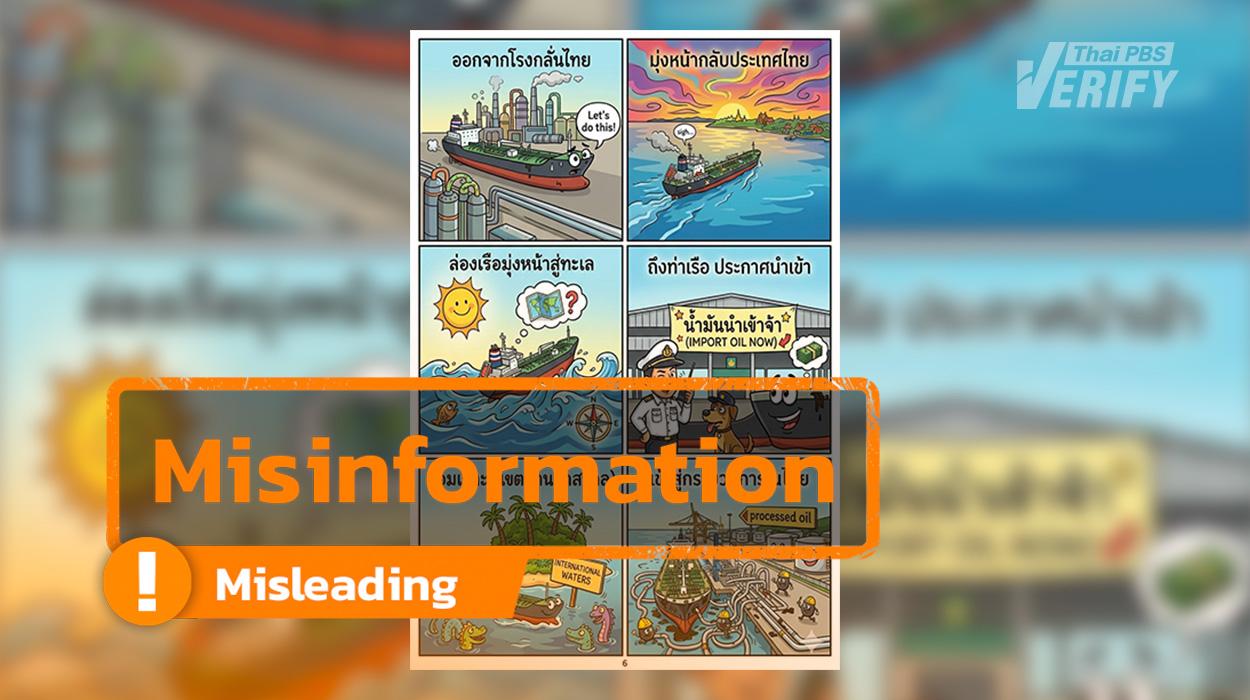
However, a verification with the Royal Thai Navy and the Maritime Enforcement Command Center (MECC) confirms this is not true. In reality, the dense points seen on the tracking system were not oil tankers, but the positions of petroleum production platforms and navigation buoys, which must broadcast signals for maritime safety.
Thai PBS Verify found the piece of misinformation on: Facebook
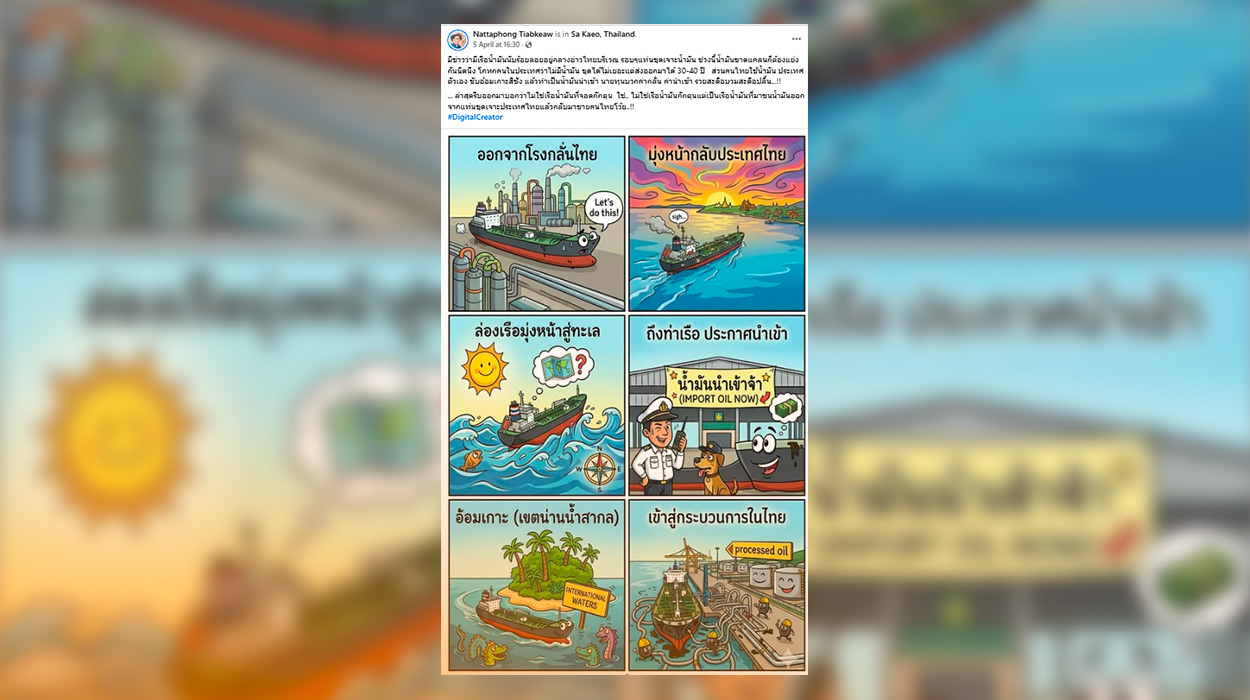
A Facebook page ‘Nattaphong Tiabkeaw’ shared an illustrative image of oil transport along with text: “Reports say hundreds of oil tankers are floating in the Gulf of Thailand.”
Thai PBS Verify found that the Facebook page under the name ‘Nattaphong Tiabkeaw’ shared an image of oil transport along with the following caption:
“Reports claim hundreds of oil tankers are floating in the Gulf of Thailand around oil rigs. Since oil is scarce right now, there’s competition. They lie to the public, saying there’s no oil. Production is limited, but exports have continued for 30–40 years. Meanwhile, Thais use oil from their own country, shipped around Koh Sichang, disguised as imported oil. Investors add refining and import costs, getting rich off the deception…!!
… Recently, they have rushed to say these are not tankers hoarding oil. Yes… not hoarding tankers, but tankers transporting oil from Thailand’s rigs and then selling it back to Thais!!”
The post received 482 reactions, 108 comments and 85 shares.
Are oil tankers really anchored in the Gulf of Thailand?
Thai PBS Verify checked the claim about “around Koh Sichang” by reviewing vessel positions on the MarineTraffic website. The data showed only passenger vessels in the Koh Sichang area — no oil tankers were detected. This was confirmed by the color of the icons displayed.
- Red: Oil or chemical tankers
- Green: General cargo ships (e.g., container vessels)
- Blue: Passenger or tourist ships
- Yellow : Service ships such as tugboats or crew transfer vessels for oil rigs
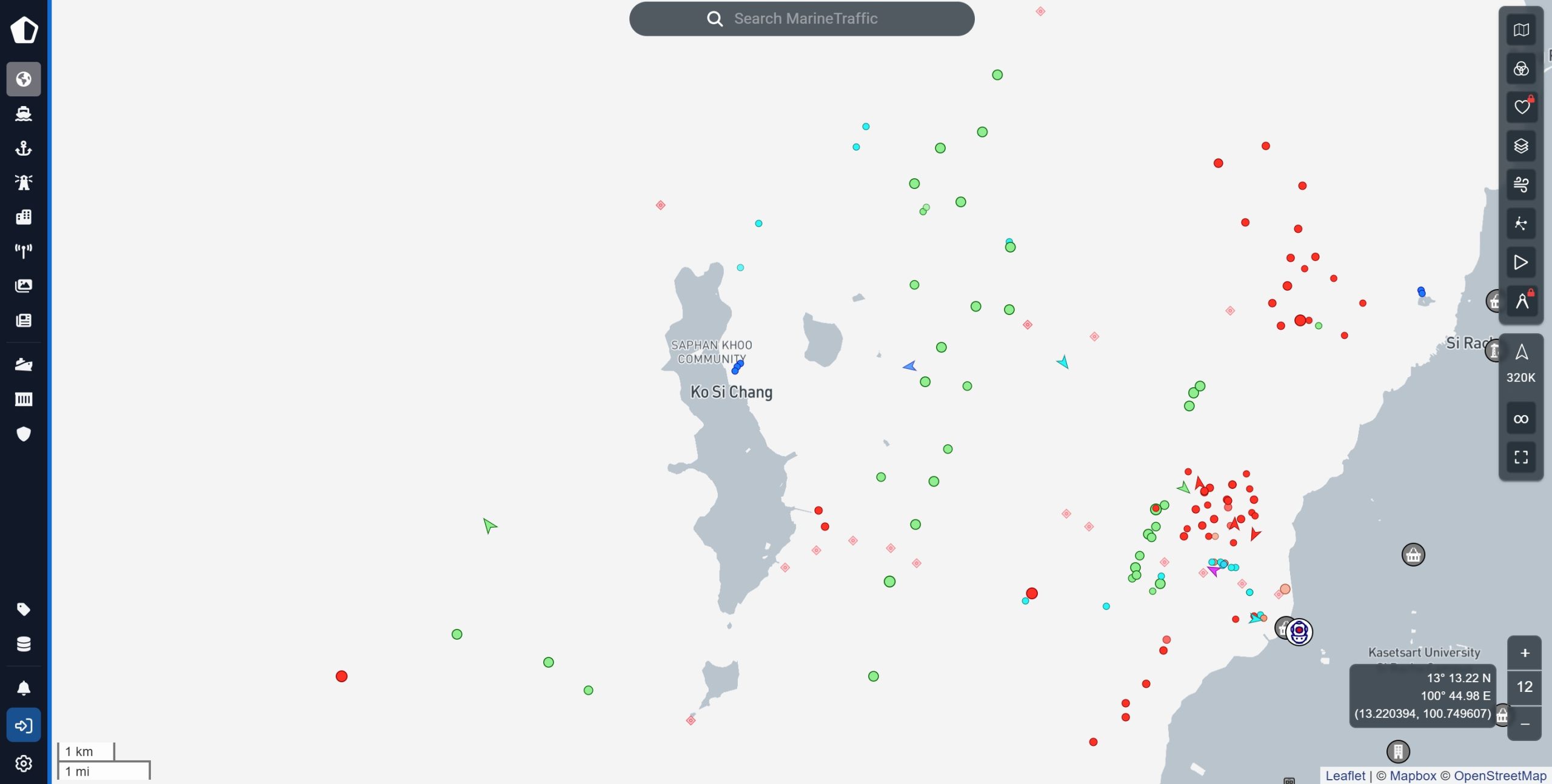
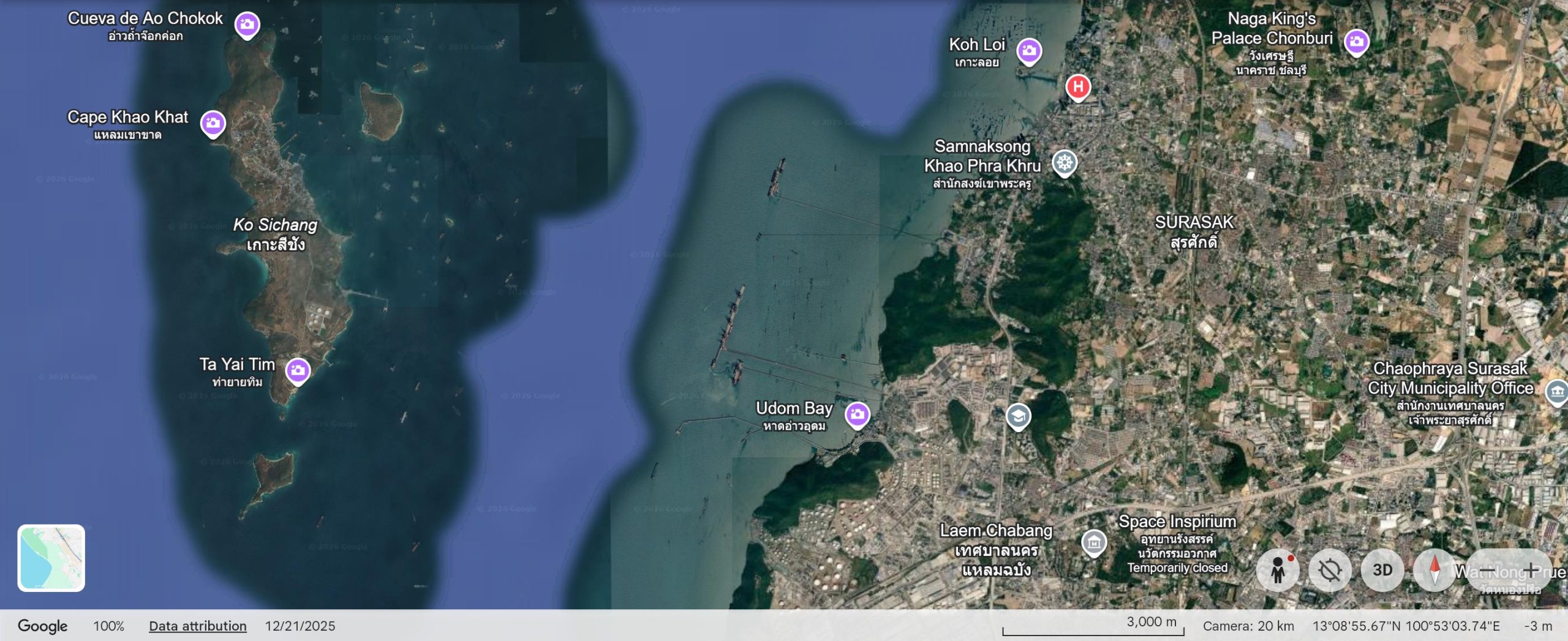
Further checks with Google Maps revealed that the area contained cargo-ship transfer platforms and numerous buoys.
MECC clarifies: Dense ship symbols in the Gulf of Thailand are petroleum platforms and navigation buoys
The Facebook page of the Maritime Enforcement Command Center (MECC) stated that the MECC deployed a patrol aircraft to investigate symbols resembling dense clusters of ships in the Gulf of Thailand shown on the AIS system, after the images were widely shared on social media.
The inspection confirmed no irregular activity. Fishing vessels and cargo ships were operating normally.
The MECC explained that the dense points appearing on the system were, in fact, petroleum production platforms, navigational buoys and designated danger zones equipped with signal transmitters for maritime safety. The agency emphasized that the maritime situation remains normal and urged the public to rely on information from official sources.
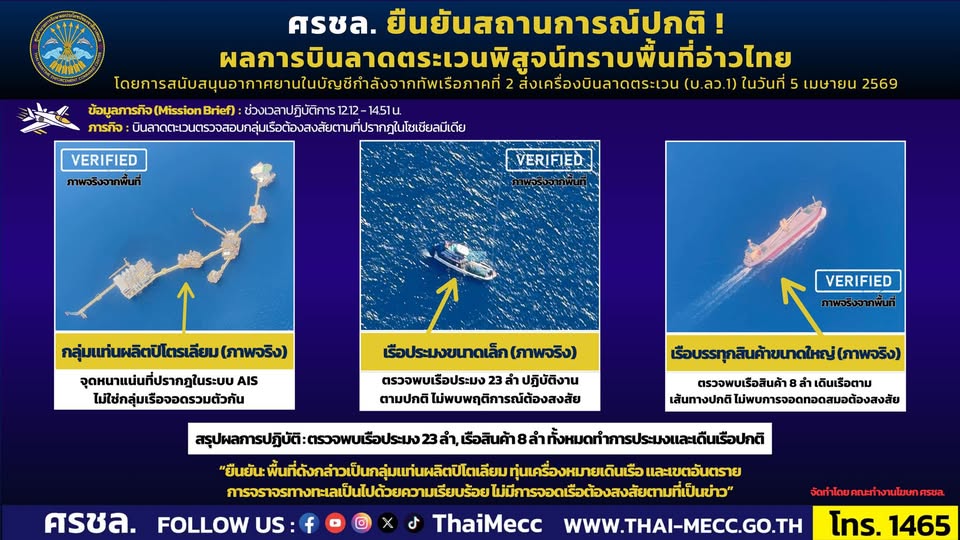
The alleged “oil tankers anchored in the Gulf of Thailand” are, in reality, petroleum platforms and navigation buoys (Photo: Thai MECC).
Royal Thai Navy clarifies AIS images as energy platforms, not clustered oil tankers
In addition, the Royal Thai Navy explained that the vessel tracking system images (AIS/UAIS), criticized as showing “large numbers of oil tankers gathering in the middle of the sea,” were a misunderstanding.
Rear Admiral Parach Rattanachaiyapan, Navy spokesperson, stated that the images actually displayed the positions of offshore energy production platforms. The vessels shown were specially authorized ships tasked with transporting raw materials from petroleum resource production processes — not commercial fuel stations or tankers hoarding oil.
The area around the platforms is designated as a special control zone with high safety risks. Access is restricted, and boundary buoys are installed to alert and ensure caution for other vessels.
At the same time, the Royal Thai Navy ordered aerial patrols to verify the facts. On April 5, 2026, from 12:12 to 14:51 o’clock, the Second Naval Area Command conducted surveillance flights and observed 23 fishing vessels and 8 cargo ships operating normally. No abnormal clustering was detected, nor were large numbers of oil tankers found as claimed.
The Royal Thai Navy affirms that it closely monitors, inspects, and oversees maritime safety to safeguard national interests and ensure secure navigation. The Navy calls on the public and media to exercise judgment when receiving and disseminating information, avoid sharing unverified reports, while upholding accurate, transparent, and verifiable communication. This is emphasized as essential to protecting Thailand’s maritime interests in a stable and sustainable manner.
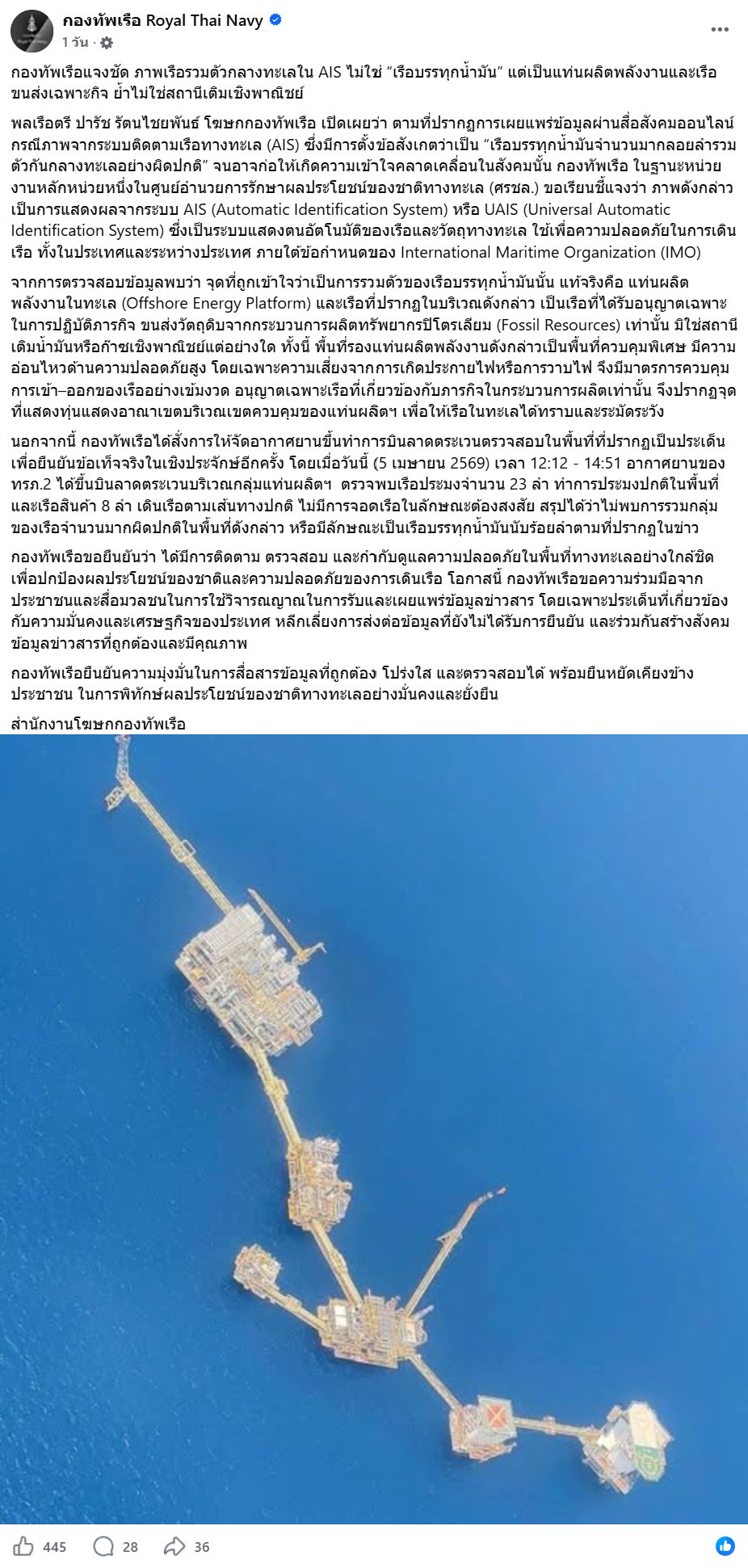
The Royal Thai Navy’s Facebook page clarified that the AIS/UAIS vessel-tracking images, criticized as showing “large numbers of oil tankers clustered in the middle of the sea,” were a misunderstanding.
How much oil does Thailand produce?
A search using relevant keywords led to the Thailand Energy Situation Report 2025 from the Ministry of Energy, which stated that Thailand can produce about 81,000 barrels of crude oil per day.
However, this production volume is insufficient for domestic consumption, meaning Thailand must rely primarily on crude oil imports. The majority comes from the Middle East, accounting for around 47–51%, and when combined with other sources, imports make up about 70–80% of total oil use.
Thailand imports an average of 971,000–972,000 barrels of crude oil per day, while exports amount to only about 19,000 barrels per day.
As for Thailand’s Petroleum Resources, according to data from the Department of Mineral Fuels, Thailand’s production volume does not depend solely on the number of wells. Most petroleum fields are small and scattered, meaning each well produces relatively little compared to large fields overseas. As of March 2022, there were 1,757 active production wells out of a total of 5,535 wells, with the majority producing natural gas in the Gulf of Thailand. For Infrastructure, Thailand has seven oil refineries with a combined refining capacity of about 1.245 million barrels per day, including the Fang Refinery, which is used for military purposes.
Although Thailand has both domestic crude oil production fields and refineries, the output is still insufficient to meet demand. As a result, the country remains heavily dependent on crude oil imports, particularly from the Middle East.
What is the truth?
Thai PBS Verify investigated the post claiming that hundreds of oil tankers were in the Gulf of Thailand. After checking vessel movements via the MarineTraffic website and Google Maps, the team found that the points identified as ships were in fact oil platforms and navigation buoys. In addition, both the Royal Thai Navy and the Maritime Enforcement Command Center (MECC) clarified that the images actually showed the positions of offshore energy production platforms, and the vessels present were specially authorized ships tasked with transporting raw materials from petroleum production processes — not commercial fuel stations or hoarding tankers.
Verification Process
- Vessel-tracking website: In response to the post’s claim that ships were “sailing around Koh Sichang,” Thai PBS Verify examined vessel positions on MarineTraffic. The data showed only passenger vessels in the Koh Sichang area — no oil tankers were detected.
- Google Maps: It revealed that the area contained cargo-ship transfer platforms and numerous buoys.
- Official sources: The Maritime Enforcement Command Center (MECC) and the Royal Thai Navy clarified that the widely shared images actually showed offshore energy production platforms.
- Keyword search: A search using relevant keywords found the Thailand Energy Situation Report 2025 from the Ministry of Energy, which stated that Thailand produces about 81,000 barrels of crude oil per day.
Impacts of misinformation
- Causing public panic: Misleads people into believing abnormal incidents or maritime threats exist, when in fact they are only production platforms and navigation buoys.
- Distorting public perception: Fake news affects understanding and decision-making, leading people to believe incorrect information and misinterpret situations.
- Undermining trust in government agencies: May create suspicion about maritime security management if the public believes information is being concealed.
- Damaging national security and economic image: Rumors about large numbers of ships or oil platforms can be misinterpreted as linked to conflict or energy crises.
- Promoting widespread sharing of false data: Fake news tends to spread rapidly on social media, often faster than verified information.
- Increasing the burden on agencies: Authorities must spend resources clarifying and correcting misunderstandings.
- Risking poor public decision-making: False information may cause panic or lead some people to prepare responses based on incorrect facts.
What to do with this misinformation?
- Do not believe or share immediately: Stay calm, as images or text can easily be misleading.
- Check the source: Verify whether the information comes from official agencies such as the Royal Thai Navy or MECC.
- Compare multiple news outlets: Look for reports from credible media to see if they are consistent.
- Be cautious with system or technology images: Data from AIS or maps may show symbols that can be misinterpreted, such as platforms or buoys.
- Check the date and context: Sometimes images are old or used in the wrong situation.
- Follow official clarifications: In this case, authorities have confirmed that the images show petroleum production platforms and navigation buoys, not suspicious vessels.
Translation edited by: Peerachai Pasutan

Related Content