The claim that “senators still have the power to vote for the prime minister in 2026” is misleading.

Thai PBS Verify found the source of the information from: Facebook
Thai PBS Verify found a claim by Cambodian social media user “Makaraboy” or “บอยเขมร,” who asserted that elections in Thailand are pointless because 250 senators still take part in the final decision. The video was published on 27 November 2025.
The caption of the clip reads: “Why even hold elections? 😂”
The video states:
“I don’t know why this country even holds elections. When we vote, what do we get out of it? According to this country’s constitution, if you like someone, you vote for them, hoping they’ll become the government or the prime minister.
After voting, the people’s voices become a burden, and you still have to win support from the 250 senators. If those 250 people agree and like you, then you get the job. What we voted for aligns with the intent. But if they don’t agree and won’t raise their hands for you, that’s it. They’ll just pick someone else we’ve never chosen.
The reason there are so many ‘cobras (snakes in the grass)’ in our parliament is because of this constitution. During the campaign, they’re with one party, but once people vote and they get elected, they change the party. It’s like we voted, but it was pointless — we gain nothing. It’s a waste of budget. Seeing this, I think our country’s constitution is way better than theirs. Much better.
I’m amazed at the person who wrote this constitution — Meechai [Ruchuphan], right? Professor Meechai? His ideas are incredible. Everything’s locked in. No matter how skilled or determined someone is, if the ‘uncles’ don’t want them, if Uncle P. (Prayut Chan-o-cha, Prawit Wongsuwan) doesn’t want them, then they’re done. Think about it. We vote and just waste the budget, waste money. So they burn money like it’s nothing. It’s ridiculous. MPs in this country are traded like cattle in a marketplace. No one even knows where the money comes from — grey money, black money. Whoever has more gets more, gets to be a minister. How can you fight corruption like this? How can you eliminate it when we don’t even get to choose good people? And good people can’t get in because they have no money.”
At present, do senators have the power to vote for the prime minister?
Currently, the Senate consists of 200 members and does not have the authority to vote for the prime minister, in accordance with the 2017 Constitution of the Kingdom of Thailand.
However, during the initial period of this constitution (2019–2024), a transitory provision allowed for a 250-member Senate to be appointed for the first five years. That Senate had special authority, including the power to vote in the selection of the prime minister, along with other roles specified in the transitional clauses.
When the five-year term ended on 11 May 2024, the mandate of the 250 appointed senators and the special powers under the transitory provisions expired. A new 200-member Senate was then selected, operating strictly under the regular powers defined in the 2017 Constitution.
This provision states that the appointment of 250 senators was defined in the Transitory Provisions of the 2017 Constitution, Section 269, and the 2018 Organic Act on the Acquisition of Senators.
It specifies that, during the first five years from the inauguration of the first Parliament under this Constitution, senators had the authority to take part in approving the appointment of the prime minister.
Details are as follows:
Section 269:
“During the initial period, the Senate shall consist of two hundred and fifty members appointed by the King upon the advice of the National Council for Peace and Order. Selection and appointment shall conform to the following rules and procedures…”
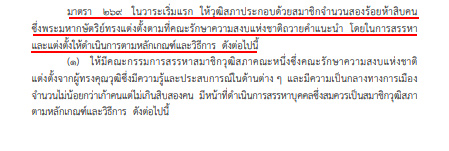
Section 269 of the 2017 Constitution
Section 272:
“In the period of five years from the date of installation of the first National Assembly under this Constitution, an approval of a person suitable to be appointed as the Prime Minister shall be done in accordance with section 159, except for the consideration and approval under section 159 paragraph one, which shall be done by a joint sitting of the National Assembly, and the resolution approving the appointment of any person as the Prime Minister under section 159 paragraph three must be made by the votes of more than one-half of the total number of existing members of both Houses.”
Powers and duties of the previous and current Senates
For the previous Senate, additional powers were granted under the Transitory Provisions, including the authority to co-vote for the prime
minister. Beyond the regular powers defined in the main body of the 2017 Constitution, the Transitory Provisions assigned special duties as follows:
1. Monitoring, recommending, and accelerating national reform (Section 270)
This provision empowered the transitory Senate to monitor, provide recommendations, and accelerate national reform to achieve the objectives under Chapter XVI National Reform, and the preparation and implementation of the National Strategy.
In this regard, the Council of Ministers shall report the progress of implementing the national reform plan to the National Assembly every three months.
2. Considering bills related to national reform (Section 270)
The bill to be enacted for the implementation of Chapter XVI National Reform shall be submitted to and considered by the joint sitting of the National Assembly. When the Council of Ministers deems any bill as a bill to be enacted for the implementation of Chapter XVI National Reform, it shall notify the President of the National Assembly and submit such bill thereto.
3. Considering of a bill withheld by the Senate or the House under Section 137 (2) or (3) of the 2017 Constitution (Section 271)
This provision states that during the initial five-year term of the first Senate under the transitory chapter (Section 269), the consideration of a bill withheld by the Senate or the House of Representatives under section 137 (2) or (3) shall be done by a joint sitting of the National Assembly, if such bill relates to:
- amendment to penalties or elements of malfeasances in public office or in judicial office, or offences of officials in an organisation or agency of the State, if such amendment causes the offender to be exonerated from the offence or be excused from the penalty;
- a bill that the Senate has resolved, with a vote of not less than two-thirds of the total number of existing members, that such bill seriously affects the administration of justice.
4. Approving a person to be appointed as the prime minister (Section 272)
Under the Transitory Provisions, in the period of five years from the date of installation of the first National Assembly under this Constitution, an approval of a person suitable to be appointed as the Prime Minister shall be done by a joint sitting of the National Assembly. And the resolution approving the appointment of any person as the Prime Minister must be made by the votes of more than one-half of the total number of existing members of both Houses.

Powers and duties of senators under the Transitory Provisions
Powers and duties of senators under the main provisions of the Constitution (current Senate)
After the term of the 250 appointed senators under the transitory chapter expired, a new Senate was selected. The current Senate performs its duties strictly under the main provisions of the 2017 Constitution, with roles both individually assigned to senators and jointly exercised with members of the House of Representatives, as follows:
- Serving as representatives of the Thai people
Members of the House of Representatives and Senators are representatives of the Thai people and free from any mandate, commitment, or control. They shall perform duties honestly for the common interest of the Nation and the happiness of Thai people as a whole, without conflict of interest. (Section 114)
- Having authority to attend parliamentary sessions
The Constitution specifies two ordinary sessions of the National Assembly each year. Each of them shall last one hundred and twenty days but the King may prolong this time period. (Section 121, paragraph 2)
Additionally, Members of both Houses – or Members of the House of Representatives comprising not less than one-third of the total number of existing members of both Houses – have the right to lodge with the President of the National Assembly their petition to report to the King for the issuance of a Royal Command convoking an extraordinary session of the National Assembly. (Section 123, paragraph 1)
The Constitution also provides that any senator who has been absent for more than one-fourth of the meeting days during a session of at least 120 days, without permission from the President of the Senate, will lose their membership. (Section 111(5))
For the consideration of bills
1. Considering general bills, the Senate has the duty to consider the bills forwarded from the House of Representatives within 60 days. But if such bill is related to financial matters, it must be considered within 30 days, unless the Senate votes to extend the period as a special case, which must not exceed 30 days.
2. Considering supplementary budget bills and budget transfer bills after consideration by the House of Representatives, the Senate must either approve or disapprove within 20 days from the date the bill reaches the Senate and may not make any amendments. If the deadline expires, it shall be deemed that the Senate approves. In such a case, and in the case where the Senate approves, the prime minister shall proceed to submit it for the King’s signature (Section 81). But if the Senate disapproves the bill. the House of Representatives shall forthwith reconsider the bill. (Section 143, paragraph 4).
3. For the consideration of Emergency Decrees, when the King issues an Emergency Decree upon the recommendation of the Cabinet under Section 172, it is the duty of the Cabinet to submit the Emergency Decree to the National Assembly for approval or disapproval. Therefore, the role and authority in considering Emergency Decrees is part of the Senate.
Duties of the Senate regarding giving opinions on various matters
1. The giving of advice in the selection and appointment of various important positions as follows:
- Giving approval in the appointment of persons selected or nominated to serve as “judges of the Constitutional Court” with the votes of not less than one-half of the total number of existing senators. (Section 204, final paragraph)
- Giving approval in the appointment of persons appointed to hold positions in Independent Organs. (Section 217)
- Giving advice in the appointment of the “Election Commission.” (Section 222)
- Giving advice in the appointment of the “State Audit Commission.” (Section 238) For the position of “Auditor General,” it is also the duty of the Senate to give approval with the votes of not less than one-half of the senators. (Section 241)
- Giving advice in the appointment of the “National Human Rights Commission.” (Section 246)
2. The right to submit opinions to the Constitutional Court for the Court to consider actions that violate the provisions under Section 144, paragraph two.
3. The right to submit opinions in cases where a draft bill contains provisions that are inconsistent with or contrary to the Constitution, or is enacted not in accordance with constitutional provisions.
4. The right to sign and submit opinions to the President of the House to which one belongs in cases where an Emergency Decree is not in accordance with Section 172, paragraph one.
5. The right to express opinions in the administration of state affairs when the Cabinet requests opinions in cases involving important problems regarding state administration, and Parliament resolves on issues that may not be debated; senators may give opinions. (Section 165)
6. Giving opinions in the establishment of ethical standards, where the Constitutional Court and Independent Organs jointly determine ethical standards. (Section 219)
What is the truth
At present, members of the Senate (senators) number 200 and do not have the power to vote for the prime minister, which is different from the period 2019–2024, when under the Transitory Provisions of the 2017 Constitution of the Kingdom of Thailand, there were 250 senators who had the right to participate in approving the appointment of the prime minister. But when the five-year term under the Transitory Provisions ended (on 11 May 2024), that system terminated, and a new set of senators was selected under the main provisions. The claim that “250 senators still decide who becomes prime minister” is therefore misleading information.
Verification Process
Verification of legal facts: Referencing facts from the 2017 Constitution of the Kingdom of Thailand
- Sections 269–272 clearly state that senators may participate in voting for the prime minister only during the first five years of the first Parliament.
- The term of the 250 senators ended on 11 May 2024.
● At present, there are 200 senators who do not have the right to vote for the prime minister and perform duties under the main provisions of the 2017 Constitution.
Impacts of this false information
- Creating confusion among the public: it leads to misunderstanding that in the next election, senators still have the power to choose the prime minister.
- Serving as distorted information: it may be used to create further fake news or misinformation, affecting election decisions and voter behavior.
- Spreading incorrect information: misleading claims made by online users with large followings may lead to widespread sharing of incorrect information in society.
What to do with this misinformation?
- Verify information before sharing: check the date and source of the information, and compare with reliable news sources or official websites.
- Do not rush to share or comment before verifying: it is to prevent the spread of fake news in society.
- Use official information sources: check with the Parliament website or the Royal Thai Gazette announcement.