Image claiming to depict People’s Party IO is actually AI-generated
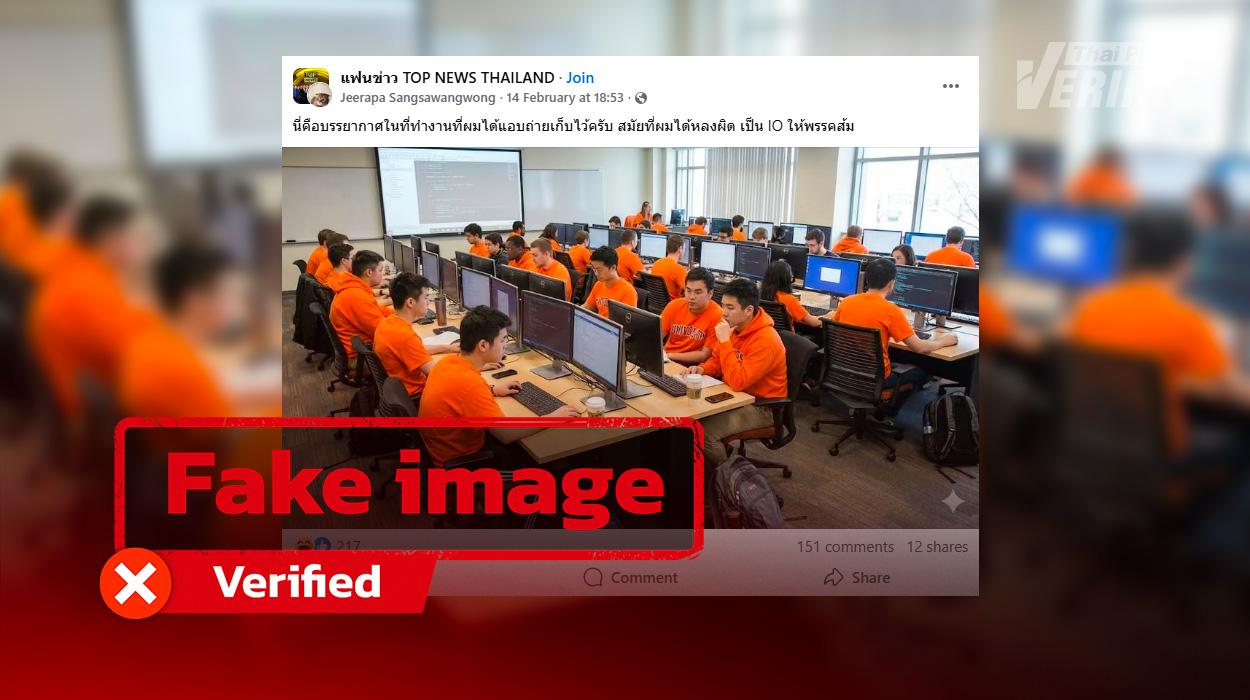
Thai PBS Verify found the fake image from: Facebook
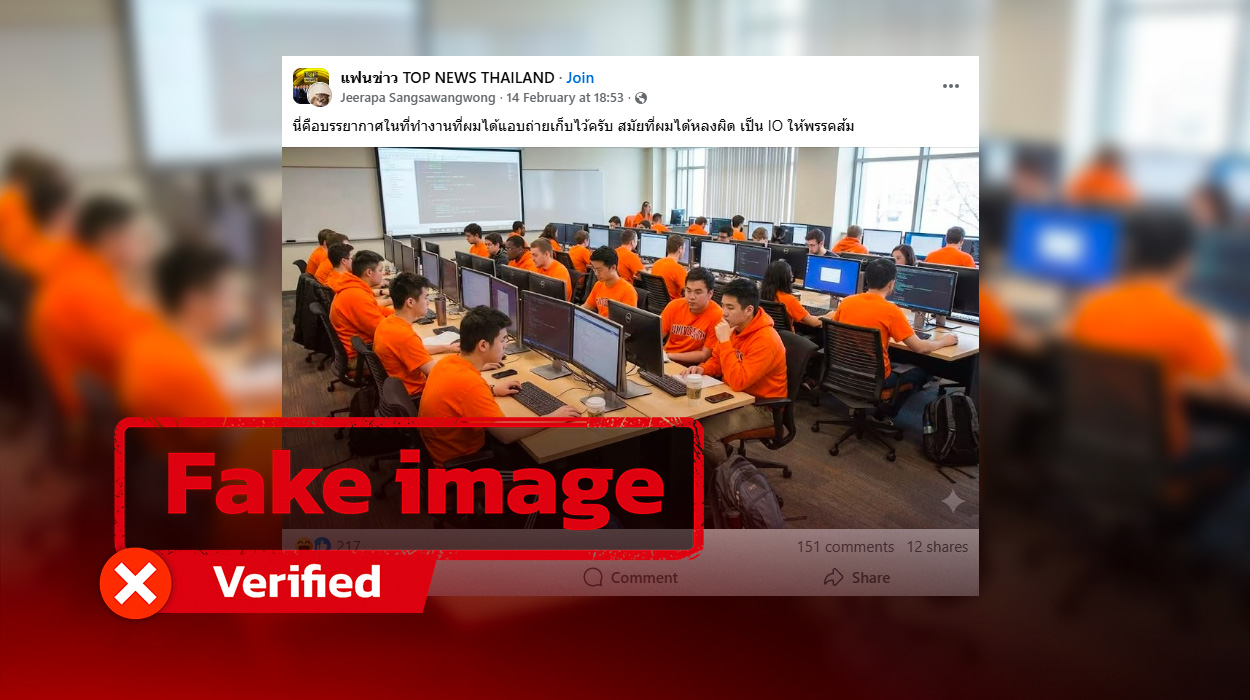
A Facebook page called ‘TOP NEWS THAILAND Fan News’ shared an image of an office with staff wearing orange shirts. The caption said: “This is the atmosphere in the workplace that I secretly photographed back when I was misguided and served in the ‘Orange’ [People’s] Party’s IO team.”
Tisana Choonhavan, former MP of the Move Forward Party (now the People’s Party), accused the People’s Party of involvement in “information operations (IO).” She claimed the party had hired a private company, Specter C, to carry out such activities. She further alleged that the fourth floor of the party headquarters served as the IO team’s base of operations, and that the company had been contracted to attack other individuals, including herself, following internal conflicts. In addition, she pointed to connections between the company’s major shareholders and figures within the party.
Later, Thai PBS Verify found a Facebook page ‘TOP NEWS THAILAND Fan News’ sharing an image of an office with staff wearing orange shirts, which is the color of the People’s Party. The post was captioned: “This is the atmosphere in the workplace that I secretly photographed back when I was misguided and served in the ‘Orange’ Party’s IO team.”
The post received 208 reactions and 142 comments.
Real or fake image?
Thai PBS Verify analyzed the image with Google tools, and found that it was AI-generated by Google services. The image was first published online on February 15, 2026.
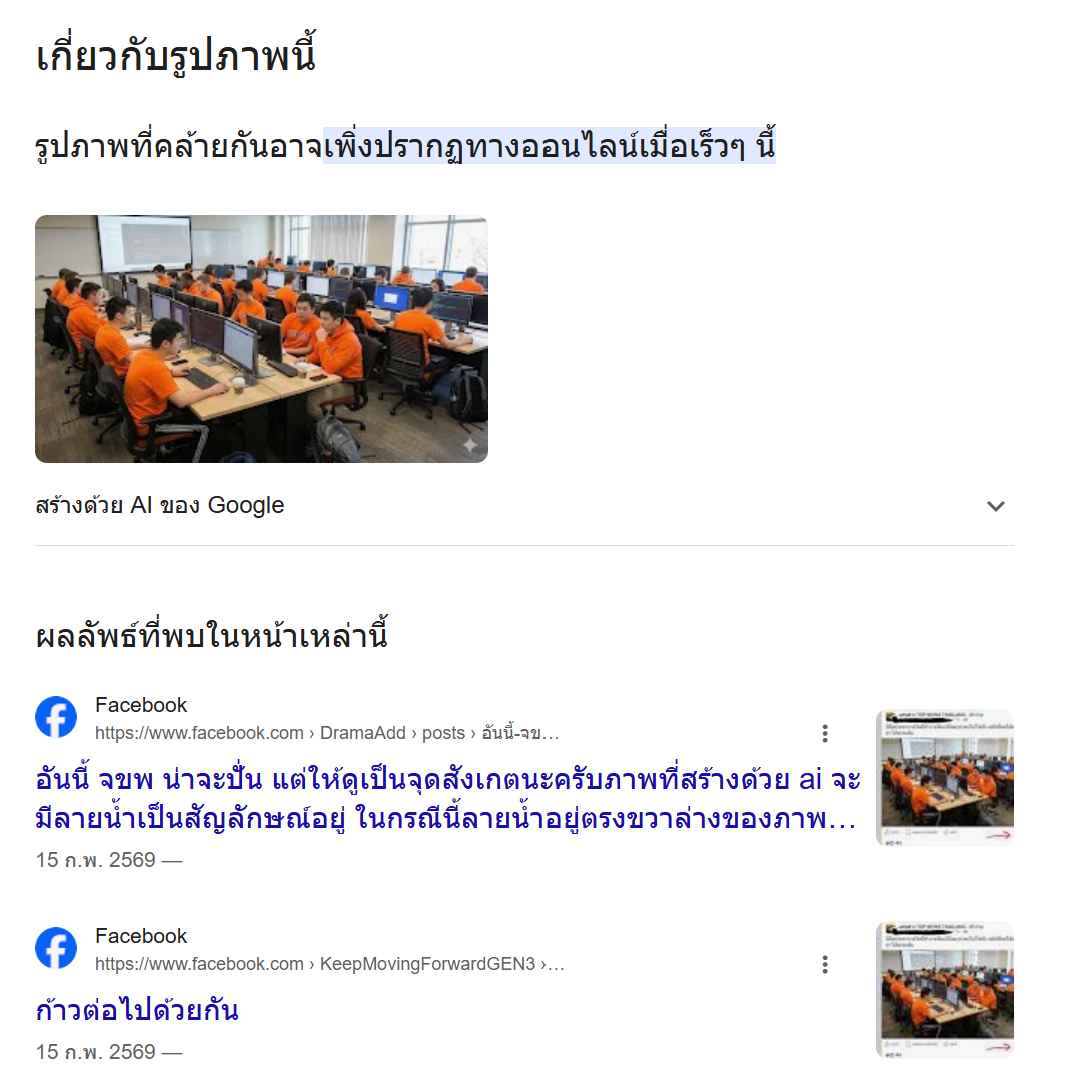
An image verification shows that the picture was AI‑generated.
How to spot AI‑generated images by yourself?
On closer examination, several features suggest the image was AI‑generated. For instance, faces of the people in the background appear blurred or distorted rather than sharp, as in real photographs. Text on computer screens or devices often shows up as unreadable characters, random code, or smudged writing, even when it should be in focus.
Symbols and logos, such as lettering on shirts, attempt to mimic real words but are misshapen and illegible. The overall scene looks unnaturally perfect, with soft, unrealistic lighting and repeated elements like identical shirt colors or similar poses. This makes the image resemble a graphic rather than a genuine photo. In the bottom right corner, a four‑pointed star (sparkle) is visible, which serves as a watermark indicating the use of AI features, whether for text generation, image editing, or summarization. This watermark originates from Gemini.
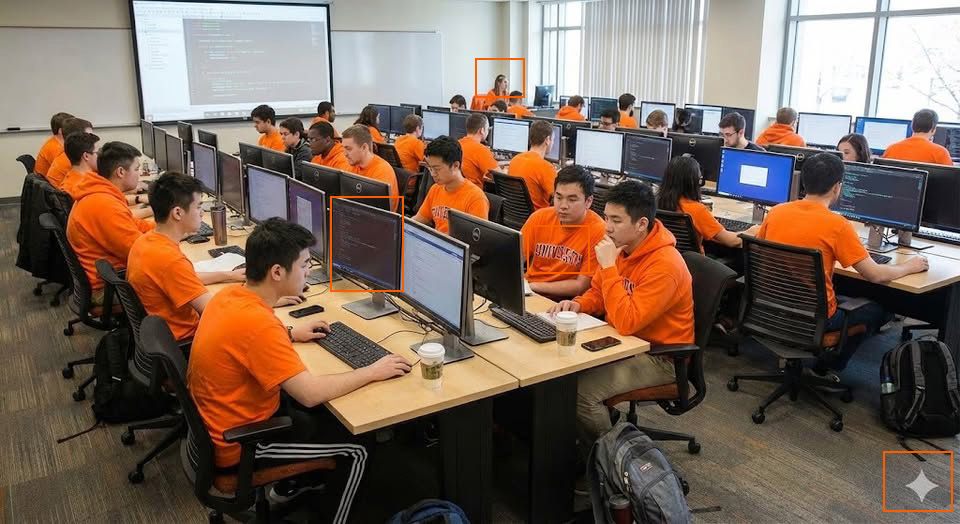
Visible irregularities in the image can be detected by the naked eye.
People’s Party denies hiring any company to conduct IO
On February 14, 2026, the People’s Party spokesperson Parit Wacharasindhu responded to accusations by former MP Tisana Choonhavan, who alleged that the party had contracted Specter C to carry out information operations. Parit insisted that no IO activities were undertaken. He acknowledges only that the company had been hired to produce media content for the party’s page using funds from the Election Commission’s Political Party Development Fund.
He also opened the fourth floor of the party’s headquarters—the area cited in the allegations—for media inspection. It was under air‑conditioning repair with equipment covered. Parit clarified that the room served as office space for various party departments. He emphasized that any misunderstanding must be publicly addressed, while adding that legal proceedings were not under consideration at the time.”
What is the truth?
Thai PBS Verify confirmed that the image was AI-generated, not a real photo. It was used as a tool for political discrediting. The People’s Party also reiterated that it had no involvement in any information operations.
Verification Process
- Google check: when the image was traced back using Google’s search tools, no evidence was found that it depicted a real event. Instead, it was identified as an AI‑generated picture, first appearing online on February 15, 2026.
- Information check: on February 14, 2026, the People’s Party spokesperson, Parit Wacharasindhu, responded to accusations by Tisana Choonhavan, who alleged the party had hired the Specter C company to conduct information operations (IO). Parit insisted that no IO activities had taken place.
Impacts of the fake image
- Undermining credibility of individuals and organizations: although the party denied the allegations and explained that the company was only hired to produce media content, the realistic‑looking AI image may have already convinced some members of the public that the party was conducting IO. This undermines the party’s long‑term image of transparency. Once misinformation spreads rapidly, even opening the fourth floor for media inspection could be perceived as mere “staging” by those who had already accepted false information.
- Escalating political tensions: the use of an AI‑generated image as false evidence fuels hostility between supporters and opponents of the party, intensifying arguments and deepening divisions on social media.
- Discrediting opponents: false information has been used as a tool to undermine party members or former members with differing views, such as in the case of Ms. Tisana, leading to attacks based on untrue claims.
- Distracting from genuine scrutiny: the controversy over the AI image may divert public attention from the real issue—examining how the Political Party Development Fund was used to hire a private company to produce media, which should be subject to normal oversight mechanisms.
What to do with this misinformation?
- Don’t share impulsively: false information is often designed to trigger emotions such as anger or surprise, encouraging people to share it immediately without checking.
- Look at the source: confirm whether the news comes from a credible outlet or simply from an anonymous social media account.
- Look closely into photos and videos: spot visual anomalies. In AI‑generated images, details may appear distorted, such as misshapen fingers, unreadable text on walls or shirts, or unusually blurred faces in the background.
- Use reverse image search tools: upload the image to Google to see if it has appeared elsewhere before, or if it is an old photo from another event being repurposed.
- Cross‑check with multiple sources: verify whether the organizations mentioned (such as the Election Commission or political parties) have actually issued statements on the matter.

Related Content



Popular Content