Fact-check: 3,000-baht “People’s Pension” policy from Thai Sang Thai Party. Three sectors agree the elderly allowance must be increased
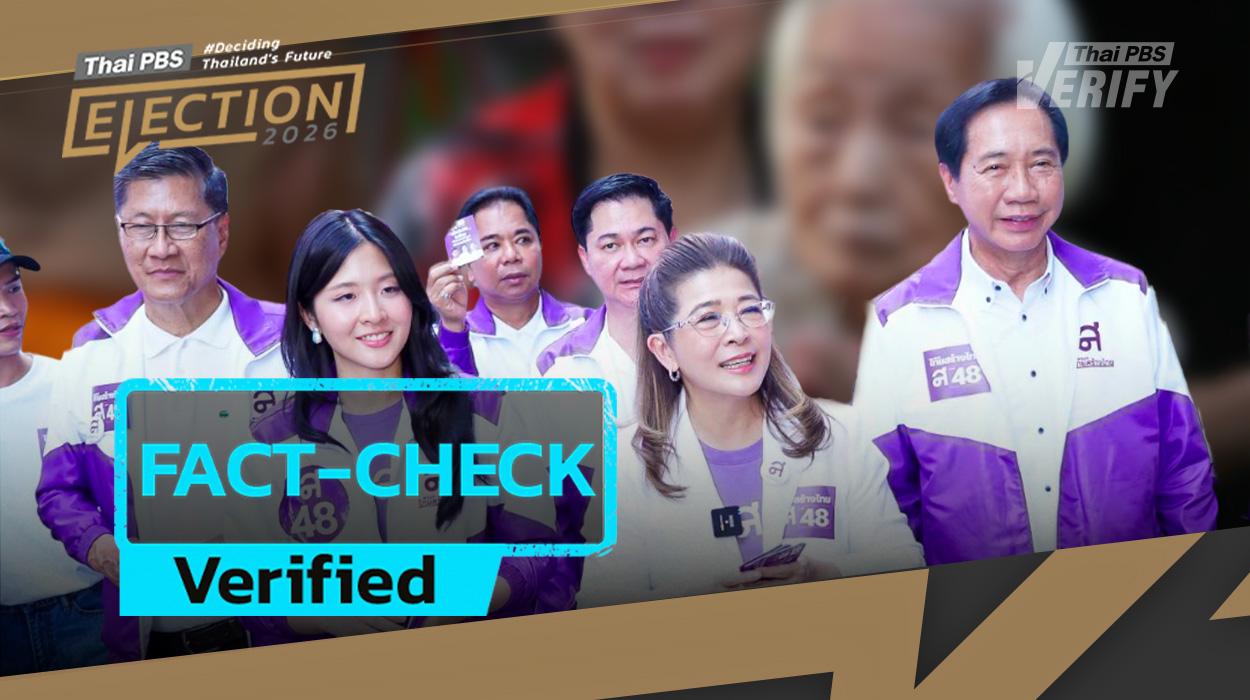
In the upcoming 2026 election, one of the policies political parties are using in their campaigns concerns the elderly. Thai Sang Thai Party has proposed the idea of its “People’s Pension” policy, a form of welfare for senior citizens in retirement age. Elderly people aged over 60, who do not have sufficient income to sustain their lives, would receive a “People’s Pension of 3,000 baht per person per month.” Although policies involving financial assistance for the elderly are not new, this kind of pension measure is considered another key proposal, especially as Thai society has now entered a “complete aging society.”
What would this policy of Thai Sang Thai’s look like, what are its details, and how does it differ from existing measures? Thai PBS Verify has traced the timeline of Thailand’s pension policies to show their development, feasibility, and limitations that have kept them a subject of debate until today.
The evolution from the “elderly allowance” to the “People’s Pension”
To understand the overall picture of elderly welfare in Thailand, it is necessary to look back at the development of the “elderly allowance,” which has evolved from a system of “assistance for the poor” to a form of “universal welfare.” This development can be divided into four phases as follows:
Phase 1: Assistance for the poor (1993–2008)
- 1993: First introduced during the administration of Chuan Leekpai, with financial assistance allocated to elderly people who were poor and had no caregivers, at 200 baht per month (later increased to 300 and 500 baht, respectively).
- 2003: The Act on the Elderly was enacted to provide broader protection of the rights of older persons, but the allowance remained limited to low-income groups only.
Phase 2: Transition to universal welfare (2009–2010)
- 2009: A major turning point during the government of Abhisit Vejjajiva, when the policy was changed to a “universal elderly allowance,” granting eligibility to all elderly people aged 60 and over (except those receiving pensions from the state or state enterprises). The payment was set at an equal rate of 500 baht per month for everyone.
Phase 3: Tiered system (2011–2022)
- 2011: Under Yingluck Shinawatra’s term, a “tiered” payment system was introduced to better reflect the cost of living and increasing age. The allowance was adjusted to range from 600 to 1,000 baht per month and has not been increased for more than 10 years.
Phase 4: Adjustment of criteria and debate over “universality” (2023–2025)
- August 2023: The Ministry of Interior issued new regulations on the payment of the elderly allowance, adding a condition that recipients must be “those with no income or with income insufficient for subsistence,” as defined by the National Elderly Committee. This sparked criticism that the move amounted to a “reduction of universal welfare,” reverting the system back to targeted assistance.
- 2025–2026: There was a push for a “People’s Pension bill” to increase payments to 3,000 baht per month, in line with the poverty line. However, in April 2025, the citizen-proposed bill was rejected by Prime Minister Paetongtarn Shinawatra due to the high budgetary burden, estimated at 400 billion baht per year.
What are the details of the 3,000-baht-per-month People’s Pension ?
Thai PBS Verify examined Thai Sang Thai Party’s policy, which proposes “People’s Pension” providing elderly people with a monthly allowance of 3,000 baht to ensure sufficient income for subsistence after retirement. This policy would replace the current elderly allowance system, which provides payments of 600–1,000 baht per month.
According to details published on the Thai Sang Thai Party website, the policy states:
Thailand is the first developing country to have the highest proportion of elderly people in the world. What is even more unfortunate is the fact that most Thai elderly people are “aging before becoming wealthy.” It means that they are poor and in poor health. We cannot allow Thailand to be filled with poor, unhealthy elderly people, because if this continues, our country will not be able to develop further. In addition to a significant decline in the working-age population, the state will also face the problem of having to bear enormous healthcare costs for the elderly.
Therefore, Thai Sang Thai has created the People’s Pension policy as a form of welfare provided by the state to serve as income security for elderly people in retirement. Elderly people aged over 60 who do not have sufficient income for subsistence would receive a “People’s Pension” of 3,000 baht per person per month.
The core ideas of the policy are as follows:
- A monthly pension of 3,000 baht for elderly people provides adequate income security and enables them to live with dignity.
- It reduces the burden on children and families in caring for the elderly, while helping working-age people to “establish themselves” more quickly.
- Recipients of the 3,000-baht pension must participate in health promotion programs at community health centers near their homes, so that elderly people can maintain good health and potentially return to work. The policy also provides Re-skill and Up-skill training for the elderly, enabling them to take better care of their own health and use new skills to earn a living.
- The people’s pension budget, amounting to more than 300 billion baht per year, would directly increase purchasing power for local communities, strengthening the grassroots economy and contributing to sustainable economic growth nationwide.
The policy places emphasis on income security for the elderly and is intended to be a universal pension system covering all older persons, not only low-income groups. However, key financial details—such as the overall budget and methods of budget allocation—have not been disclosed, nor are they clearly explained on the party’s website.
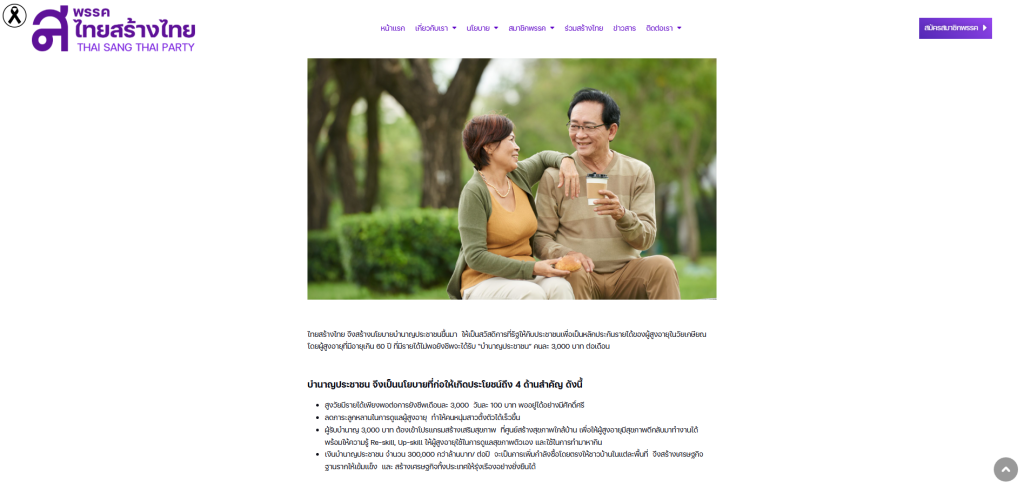
Details of the “people’s pension” policy of 3,000 baht per person per month as presented on Thai Sang Thai Party’s website
What pension-related welfare policies does Thailand currently have for its citizens ?
The current welfare system is the state “elderly allowance,” under which the government provides financial assistance to elderly people as a living allowance. Payments range from 600 to 1,000 baht per month, based on a tiered structure as follows:
- Ages 60–69: 600 baht per month
- Ages 70–79: 700 baht per month
- Ages 80–89: 800 baht per month
- Ages 90 and over: 1,000 baht per month
How do other political parties approach pension welfare policies for the public?
Several Thai political parties have recently proposed ideas related to pensions or elderly welfare, with differences as follows:
People’s Party
- Proposes to increase universal elderly allowance to 1,000 baht per month (the same amount for everyone), with a plan to further raise it to 1,500 baht per month by 2030, in line with the cost of living and to help the poorest groups rise above the poverty line.
Democrat Party
- Proposes universal elderly allowance of 1,000 baht per month, along with other forms of support for the elderly, such as a home improvement program for senior citizens worth 50,000 baht per house, schemes to convert housing into lifelong income, and accelerating access to dental services for the elderly.
Palang Pracharath Party
- Proposes a “tiered elderly allowance” policy, increasing payments to 3,000–4,000–5,000 baht according to age groups (60, 70, and 80 years), aimed at generating income and promoting the social value of older persons.
Bhumjaithai Party
- Proposes four measures, namely: “Senior Plus 1,” hiring elderly workers with employment expenses deductible at twice the amount, up to a maximum of 30,000 baht; “Senior Plus 2,” elderly people with annual income not exceeding 1.5 million baht are entitled to tax deductions of up to 50 percent; establishing “elderly care centers nationwide” by using state land and opening opportunities for the private sector to invest in building comprehensive elderly care centers, with investment promotion (BOI) and tax incentives; and “60 Plus, happy retirement with work.”
Efforts at the legal level toward a universal pension
There have been movements by civil society networks and some groups of Members of Parliament to submit legislation drafts on universal basic pension to Parliament. The aim is to require the state to provide pensions for the elderly at no less than the poverty line and to adjust the amount every three years, but several drafts have been “rejected.”

The People’s Network for Welfare State collected 43,826 signatures to propose the Elderly and National Basic Pension Act.
What should an appropriate model of a people’s pension look like?
Universal pension vs. targeted pension
Ms. Worawan Phlikamin, Deputy Secretary-General of the Office of the National Economic and Social Development Council (NESDC), shared her views on the issue of choosing between universal pension and pension targeted at low-income groups. She stated that, personally, she believes that pensions or elderly allowances should be provided in a targeted manner rather than universally, as this would be more appropriate, especially under current economic conditions. However, if a universal pension were to be implemented, she noted that the state does not yet have sufficient revenue to support it, nor can it generate enough income through tax collection at this time.
She also noted that there are still factors that make it unclear how to classify the eligibility status of beneficiaries, such as defining eligibility only for “low-income earners,” for which there is still no clear benchmark as to what level of income qualifies as low. In addition, there is the issue of income differences across provinces, as each province currently has a different cost-of-living standard.
“A universal pension system in Thailand has not yet been implemented as an actual government policy because issues of budget, allocation, and fiscal sustainability still need to be considered together.”
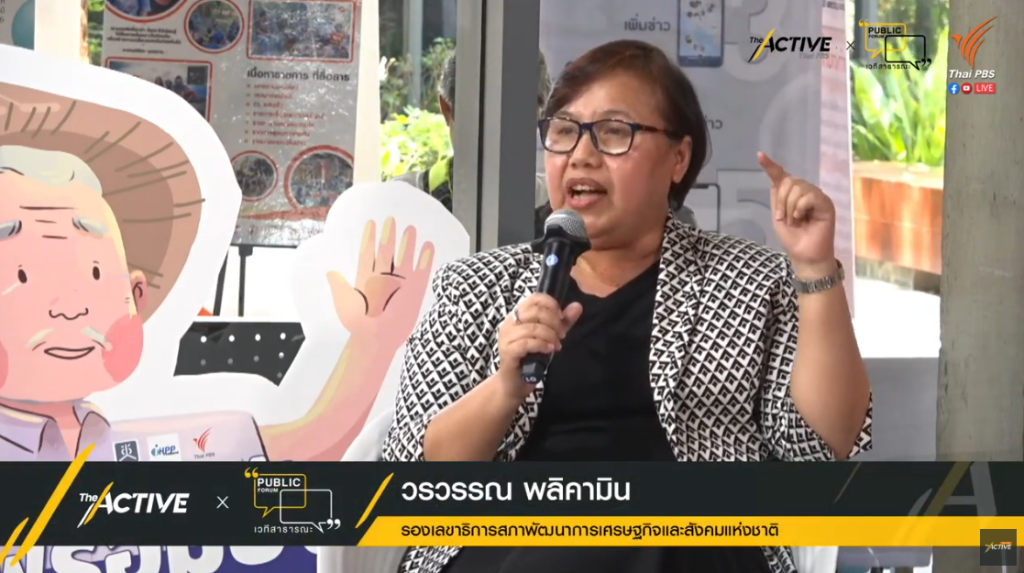
Worawan Phlikamin, Deputy Secretary-General of the Office of the National Economic and Social Development Council
Hybrid universal pension
Dr. Somchai Jitsuchon, Director of Inclusive Development Research at the Thailand Development Research Institute (TDRI), gave an interview to Thai PBS Verify. He stated that, in his personal view, the provision of people’s pension or elderly allowance should take a hybrid approach. That is: those who currently receive the existing elderly allowance should be able to continue receiving it. However, if the state assesses that the allowance given is still insufficient, or if recipients are poor and have no children to provide care, additional allowance should be provided. He referred to this model as a “hybrid.”
“Do not look at whether someone is poor or not poor at the outset, but first provide the elderly allowance to people aged 60 and over according to the current age-based system. As for additional payments, there must be criteria to assess whether a person is poor. At this point, complications may arise, because in practice, screening who is poor or not poor often faces ongoing problems.”
Regarding the necessity of increasing People’s Pension or elderly allowance, he believes that an increase is needed, because Thailand’s new poverty line, set by NESDC for 2025, has been raised to 3,078 baht per person per month. In addition, costs of living have also increased, and urban lifestyles have continued to expand beyond their previous scope.
“Areas that appear to be rural, or have been designated as rural areas, may later be reclassified as urban areas, resulting in higher living costs. Therefore, over time, what was once sufficient may no longer be adequate. This is especially true for elderly people who have no caregivers and no children or relatives to look after them like others do.”

Dr. Somchai Jitsuchon, Director of Inclusive Development Research, Thailand Development Research Institute
As for whether the figure of 3,000 baht would be sufficient in relation to Thailand’s new poverty line, he believes it would probably not be enough. However, the goal should not be to expect that providing money alone would immediately lift elderly people out of poverty. Rather, it could help cushion their basic living needs at the initial stage. For example, providing 2,000 baht—even if there is still a shortfall of 1,000 baht—could allow them to supplement their income through support from children, people in the community, or other forms of assistance.
“The poverty line is constructed based on the assumption that ‘no one helps at all,’ meaning the money received must be used to buy food, pay rent, and cover all other expenses. In reality, however, there are still other forms of assistance, such as support from the Ministry of Social Development and Human Security in areas like housing, or other agencies that provide welfare through different channels. When combined with an additional 2,000 baht, this could still enable people to get by at a level close to the poverty line.”
A universal pension without differentiation
Meanwhile, Mr. Somchai Kratangsaeng, President of the Association for the Protection of the Insured’s Rights, gave an interview to Thai PBS Verify on the necessity of adjusting the elderly allowance from 600–1,000 baht to a higher pension of 3,000 baht. He stated that this is highly necessary because Thailand has entered an aging society, and the main sources of income for the elderly fall into three categories:
- Income from work (which is often informal labor or farming without social security)
- Income from relying on children
- Income from elderly allowance
“If the state can support this amount, the elderly will be lifted out of poverty immediately.”
As for his view on choosing between a “universal” or “targeted” approach, he believes it should be “universal,” as providing benefits in a targeted manner or only to the poor is akin to “charity,” which often results in truly poor people being excluded from surveys, or those living just above the poverty line not receiving benefits despite their hardship. Pension should therefore be considered a state welfare benefit that everyone is entitled to, as it is funded by taxpayers’ money.
“If the government faces financial constraints, it may need to adjust the approach. A feasible initial proposal could be to start with a universal payment of 1,000 baht, and then gradually ‘scale up’ toward the 3,000-baht target within 3–5 years.”

Mr. Somchai Kratangsaeng, President of the Association for the Protection of the Insured’s Rights
Regarding the issue of funding sources, Mr. Somchai affirmed that such a program can be achieved through “tax structure reform,” such as collecting taxes on capital gains from stock sales, land tax, inheritance tax, or reducing tax incentives for foreign investors (BOI), in order to channel these funds into a “pension pool.”
Current status of the pension bill
The People’s Pension bill (citizens’ draft), which was endorsed by more than 40,000 signatories, was decided to be “not endorsed” (rejected) by former PM Paetongtarn Shinawatra, on the grounds that it was related to financial matters, in early April 2025.
Main reasons for rejection
- It was a bill related to financial matters: Under Section 133 of the Constitution, any bill involving financial matters must receive endorsement from the Prime Minister before it can be considered by parliament.
- Enormous budgetary burden: Relevant agencies (such as the Ministry of Finance and the Budget Bureau) expressed the view that providing universal pension of 3,000 baht would require a budget of up to 400 billion baht per year, which the government considered to be beyond fiscal capacity at the time.
- Other mechanisms already in place: The government at that time explained that it was pushing forward alternative measures, such as the “retirement lottery” scheme and targeted increases in the elderly allowance, instead.
Verification Process
1. Reviewing information through the policy timeline
This process began by tracing back the foundations of the welfare system to show the shift from “assistance” to “basic welfare,” divided into four main phases:
- Phase 1 (1993–2008): Assistance provided only to the poor (200–500 baht).
- Phase 2 (2009–2010): The first transition to a “universal” system, with an equal payment of 500 baht for everyone.
- Phase 3 (2011–2022): Development into a “tiered” system (600–1,000 baht), which has been in place for more than 10 years.
- Phase 4 (2023–2025): Attempts to adjust the criteria back toward “targeting only the poor,” leading to ongoing debate today
2. Verification of official sources
Thai PBS Verify examined the content directly from the communication channels of political parties and relevant agencies:
- Thai Sang Thai Party: Details were reviewed from the party’s website, which proposes a 3,000-baht monthly payment to ensure subsistence in line with the poverty line. However, an observation was that “clear details on the source of funding have not yet been presented” on the website.
- Comparison with other parties’ election campaigns: Information was compiled to identify differences, such as:
- People’s Party: Emphasizes a universal allowance of 1,000–1,500 baht.
- Palang Pracharath Party: Emphasizes a higher tiered system (3,000–5,000 baht).
- Bhumjaithai Party: Emphasizes measures to promote employment and tax deductions.
3. Verification through expert perspectives
The team interviewed sources from three sectors with differing views to assess fiscal sustainability:
- Government perspective (NESDC): Recommended a “targeted assistance for low-income groups” approach, as the state does not yet have sufficient revenue to provide universal payments.
- Academic perspective (TDRI): Recommended a “hybrid” approach—providing a basic benefit to everyone while topping up only for those who are genuinely poor—and points out that the figure of 3,000 baht may still be insufficient compared to the newly adjusted poverty line.
- Civil society perspective: Recommended a “universal” approach to prevent people from being left out, and proposes reforming the tax structure (inheritance tax/land tax) to support pension funds.
4. Verification of legal status
The final step was to examine feasibility from legal and administrative perspectives:
- Current status: The citizens’ draft bill was “not endorsed” (rejected) by former Prime Minister Paetongtarn Shinawatra in April 2025.
- Key reason: It was determined to be a “bill related to financial matters,” requiring a budget of up to 400 billion baht per year, which was beyond fiscal capacity at the time.