“Trump” Bans Visas to People with Diabetes and Obesity — In Reality, It Is Only Temporary Suspension of “Permanent Visas”
Thai PBS Verify found the news source from: Facebook
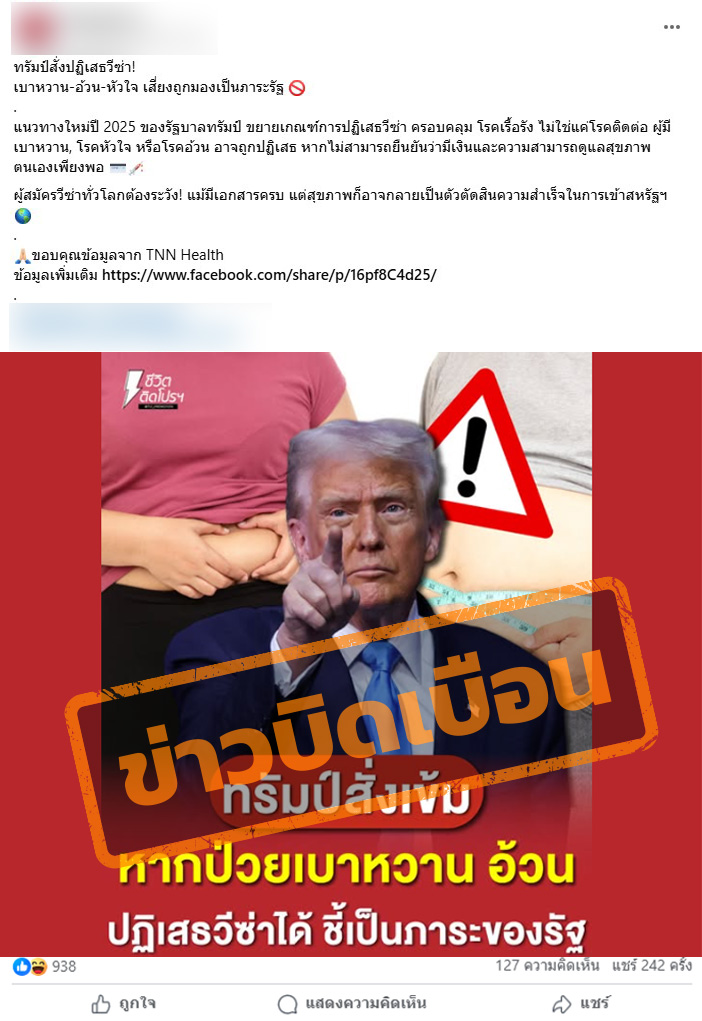
A Facebook page posted a picture claiming that Trump ordered visa denials to people with diabetes, obesity, and heart disease, since they might be considered a burden to the state.
Thai PBS Verify found that a Facebook post shared an image of President Donald Trump with the caption:
“Trump orders visa denials! Visa denials! Diabetes, obesity, and heart disease are seen as a burden to the state. A new 2025 policy from the Trump administration expands visa rejection criteria to include chronic illnesses, not just communicable diseases. Applicants with diabetes, heart disease, or obesity may be denied if they cannot prove sufficient funds and ability to manage their own health. Visa applicants worldwide should be aware! Even with complete documentation, health could determine success in entering the U.S.”
The post received 938 reactions and 172 comments, and was shared more than 242 times. However, some comments included criticism of Trump and his alleged policy.
Which are the countries affected by Trump’s temporary “halt on immigrant visas”
Thai PBS Verify reviewed the U.S. Department of State’s official website, travel.state.gov, and found that on January 14, 2025, an announcement was issued regarding the suspension of permanent immigrant visas.
“Immigrant Visa Processing Updates for Nationalities at High Risk of Public Benefits Usage President Trump has made clear that immigrants must be financially self-sufficient and not be a financial burden to Americans. The Department of State is undergoing a full review of all policies, regulations, and guidance to ensure that immigrants from these high-risk countries do not utilize welfare in the United States or become a public charge.
Effective January 21, 2026, the Department of State is pausing all visa issuances to immigrant visa applicants who are nationals of the following countries:
Afghanistan, Albania, Algeria, Antigua and Barbuda, Armenia, Azerbaijan, Bahamas, Bangladesh, Barbados, Belarus, Belize, Bhutan, Bosnia and Herzegovina, Brazil, Burma, Cambodia, Cameroon, Cape Verde, Colombia, Cote d’Ivoire, Cuba, Democratic Republic of the Congo, Dominica, Egypt, Eritrea, Ethiopia, Fiji, The Gambia, Georgia, Ghana, Grenada, Guatemala, Guinea, Haiti, Iran, Iraq, Jamaica, Jordan, Kazakhstan, Kosovo, Kuwait, Kyrgyz Republic, Laos, Lebanon, Liberia, Libya, Moldova, Mongolia, Montenegro, Morocco, Nepal, Nicaragua, Nigeria, North Macedonia, Pakistan, Republic of the Congo, Russia, Rwanda, Saint Kitts and Nevis, Saint Lucia, Saint Vincent and the Grenadines, Senegal, Sierra Leone, Somalia, South Sudan, Sudan, Syria, Tanzania, Thailand, Togo, Tunisia, Uganda, Uruguay, Uzbekistan, and Yemen”
The White House confirms Trump’s order to suspend permanent visa process from 75 countries
Thai PBS Verify reviewed a post on the Facebook page ‘The White House’ and found that on January 15, 2025, a message was published stating this claim.
“AMERICA FIRST: The Trump administration will PAUSE immigrant visa processing from 75 countries until the U.S. can ensure that incoming immigrants will not become a public charge or extract wealth from American taxpayers.”
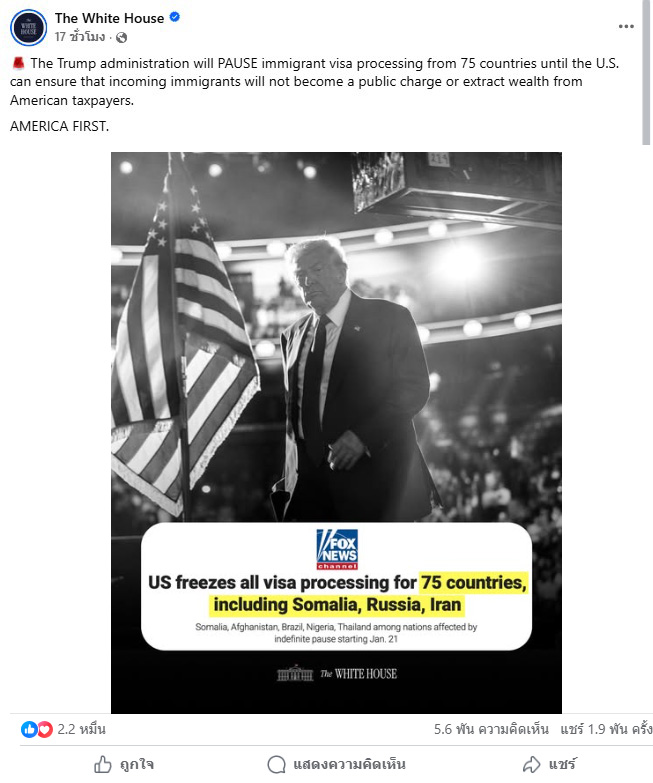
The White House’s Facebook posted a message, “The Trump administration will PAUSE immigrant visa processing from 75 countries until the U.S. can ensure that incoming immigrants will not become a public charge or extract wealth from American taxpayers. AMERICA FIRST,” on January 15, 2025.
People with diabetes, obesity and heart disease — Are they really banned from entering the United States?
According to the Federal Register, foreign nationals who fall under the following categories are ineligible to receive a visa and are not permitted to enter the United States.
Health-related grounds — Foreign nationals shall be considered inadmissible to the United States if, for instance;
- Diagnosed with a communicable disease of public health significance, as defined by regulations issued by the Secretary of Health and Human Services.
- Falling to provide vaccination documentation of having received required vaccinations against diseases such as mumps, measles, rubella, polio, tetanus and diphtheria, pertussis, Haemophilus influenzae type B, and hepatitis B.
Adopted children under the age of 10 are exempt from vaccination requirements: such exemption also applies for adopted children 10 years of age or younger who seek an immigrant visa as an immediate relative.
What is an Immigrant Visa?
A search using the keyword “Immigrant Visa” found information in The Daily Journal of the U.S. Government stating that an Immigrant Visa (permanent visa) is a visa for individuals who wish to relocate and reside permanently in the United States and who intend to apply for a “Green Card” (Permanent Resident Card).
Holders of this type of visa are entitled to:
■ Enter the United States as a “lawful permanent immigrant.”
■ Obtain a Green Card after arrival (or, in some cases, immediately).
■ Legally reside, work, pursue education, or conduct business in the United States.
An Immigrant Visa differs from a Non-Immigrant Visa (such as tourist B1/B2, student F, exchange J, or temporary work H-1B) because an Immigrant Visa is the process for permanent residence, not temporary stay.
Immigrant visas are broadly divided into two main categories:
- Family-Based Immigrant Visa — for family connections, such as spouses of U.S. citizens, children or parents of U.S. citizens, and Green Card holders who wish to sponsor a spouse or child.
- Employment-Based Immigrant Visa — for work or employer sponsorship, such as individuals with extraordinary ability (EB-1, EB-2), specialized professionals, or investors (EB-5).
Other categories include: Refugees/Asylees, the Diversity Visa Lottery, and Special Immigrant visas.
“Robin Hood Politics” makes the U.S. view Thailand as a highly dependent on state welfare
Assistant Professor Dr. Prapee Apichatsakol, lecturer at the Law Program, Faculty of Social Sciences, Srinakharinwirot University, stated that the Trump announcement on visa denials from 75 countries—including Thailand—caused significant confusion among Thais living in the U.S. and those in Thailand.
The confusion arose because the initial report came from Fox News, which the public tends to trust less than official U.S. government sources. However, after some time, the White House issued an official announcement, clarifying the information and providing details about screening measures for individuals seeking entry into the country, especially those with a history of overstaying visas.
Asst. Prof. Dr. Prapee further explained that part of the confusion stemmed from many people mistakenly thinking the measure concerned tourist visas, when in fact it applied to immigrant visas—entry for permanent settlement, not tourism.
However, this measure was only a “temporary suspension” to assess the security risks of visa applicants from each country, under the “America First” framework as stated by the White House.
“Personally, when I saw the list of countries in the announcement, I felt disheartened that Thailand was grouped with some nations perceived as having low security standards. It raised questions about the dignity of our country,” Dr. Prapee added.

Assistant Professor Dr. Prapee Apichatsakol, lecturer at the Law Program, Faculty of Social Sciences, Srinakharinwirot University
Asst. Prof. Dr. Prapee also noted that Thailand’s international image is currently unfavorable, due to political issues, the forced repatriation of refugees to China, and problems with Thai workers entering the U.S. illegally—often referred to as the “Robin Hood” group. These factors contribute to perceptions that many Thais rely heavily on U.S. welfare programs, which may influence American security assessments and immigration policy toward Thailand. Overall, Dr. Prapee observed that the Thai–U.S. relation is now more distant than even in the period following the coup.
She emphasized that this situation directly affects ordinary people, unlike past cases that mainly impacted the government. It could cause significant hardship and anxiety, particularly regarding travel, settlement, and economic opportunities. Although final details of the impacts remain unclear, Dr. Prapee stressed that the overall relationship between the two countries has clearly deteriorated.
What’s the truth?
Thai PBS Verify found that the claim was a distortion of information. Trump did not order a ban on people with chronic illnesses such as diabetes, heart disease, or obesity. In fact, he ordered the cancellation of immigrant visas for those seeking permanent residence in the United States. Regarding the claim that people with chronic illnesses are considered a burden on the state, U.S. law specifies only contagious diseases as grounds for exclusion.
Verification Process
- Check with official sources: the U.S. Department of State announced a suspension of permanent visa (Immigrant Visas) reviews from 75 countries, including Thailand.
- Check with the data sources: when verifying via the White House Facebook page, the Trump administration declared a temporary halt on processing immigrant visas from 75 countries until the U.S. could ensure that incoming migrants would not become a public burden.
- Check with the data sources: the Daily Journal of the U.S. Government specifies that individuals with contagious diseases are not eligible for immigrant visas.
- Check with a keyword: searching the term “Immigrant Visa” from the Daily Journal of the U.S. Government, it revealed that an Immigrant Visa is a visa for those seeking permanent residence in the United States and applying for a “Green Card” (Permanent Resident Card).
- Check with the interview source: Thai PBS Verify interviewed Assistant Professor Dr. Prapee Apichatsakol from the Faculty of Social Sciences, Srinakharinwirot University. She explained that Trump’s measure was a temporary suspension of immigrant visas, not tourist visas. It
- was a screening process for permanent settlers from 75 countries, including Thailand. She added that Thailand’s inclusion reflects a declining national image—linked to politics, illegal labor issues, and refugee controversies. The measure directly affects citizens and highlights the increasing distance in the Thai–U.S. relation.
Impacts of False Information
- Excessive anxiety: rumors that people with diabetes or obesity would be banned created fear among those with chronic illnesses, who worried about losing their right to travel or live abroad. In reality, the rule only concerned financial burden screening for “permanent visas.”
- Poor decision‑making: visa applicants might cancel travel or business plans simply because they believed distorted information.
- Misunderstanding of the destination country: false claims fostered negative attitudes toward the U.S. beyond the facts, undermining people‑to‑people relations and raising doubts about Thailand’s dignity and security image.
- Opportunities for fraud: scammers could exploit public fear, falsely claiming to offer “shortcuts” or to “clear health records” for visa approval, and charge fees from those who are worried about being denied a visa.
- Phishing and data theft: fake news often comes with malicious links, pretending to verify eligibility or update taxpayer/visa applicant information, in order to steal personal data.
What to do with this misinformation?
- Verify the “type” of information clearly: false information often mixes truth with distortion (a half‑truth). For example, the rumor about banning people with diabetes or obesity exaggerated the U.S. “public charge” policy into something frightening. In reality, it was only a “temporary visa denial” to assess applicants’ income and welfare criteria—not a ban on tourist visas or health conditions.
- Check official sources: do not rely solely on social media posts or a single news outlet (for example, Fox News, which scholars note may differ in credibility compared to direct government information). Instead, verify through the U.S. Department of State website (travel.state.gov), the White House’s official page or website, and Announcements from the U.S. Embassy in Thailand.
- Observe the “language” and “headlines”: false information often uses sensational language, creates panic, or employs clickbait headlines such as “Trump bans overweight people.” If you encounter content that strongly provokes negative emotions, assume at the outset that it may be distorted or misleading.

Related Content




Most Viewed