Unpacking the “Lottery” Policies of Pheu Thai, Thai Sang Thai, and People’s Party Ahead of 2026 Election

As the 2026 general election approaches, policies related to “lotteries” have been brought forward as one of the campaign tools of political parties. These policies are framed around addressing social issues, promoting savings, and managing state revenue, drawing in large sums of money circulating among the public.
To enable voters to assess the facts and feasibility of these proposals in a well-rounded manner, Thai PBS Verify has gathered and examined the lottery-related policies of Pheu Thai Party, Thai Sang Thai Party, and the People’s Party. We will look into their origins and underlying concepts. We will also study how well each policy aligns with factual realities before voters cast their ballots.
Pheu Thai Party’s retirement lottery
Pheu Thai Party is regarded as the political party that first pushed the concept of the “retirement lottery” as early as the 2023 general election. At that time, the party was led by Ms. Paetongtarn Shinawatra and became the core of the government coalition after winning the election. The idea was later presented in the form of the National Savings Fund (NSF) lottery tickets, or the so-called “retirement lottery,” with the aim of ensuring that buying lottery tickets is not only about winning prizes, but that the money spent would also become savings for retirement.
Under the Paetongtarn administration, this policy began to be seriously advanced through the legislative process. Dr. Paopoom Rojanasakul, who serves as Deputy Minister of Finance, played a key role in pushing for amendments to laws related to the National Savings Fund to better accommodate the “retirement lottery” scheme.
The bill was reviewed and approved by the Parliament at its first reading, and has proceeded through subsequent stages – with the Senate endorsing it by an overwhelming majority. This has allowed the legislative process to move forward, paving the way for the “retirement lottery” to be officially issued and used as a practical tool to promote savings in the future.
Reintroducing the “retirement lottery” as part of the policy platform for the 2026 election reflects Pheu Thai Party’s effort to reaffirm its role as the initiator of the policy and to build credibility on the basis of its previous work. It is intended to demonstrate that the policy can genuinely move forward if the party is given another opportunity to govern the country.
How did the retirement lottery come about?
The “retirement lottery,” or asset-accumulation lottery for retirement savings, is a policy initiative of the Ministry of Finance and the National Savings Fund (NSF). The Cabinet (led by Pheu Thai Party at the time) approved the policy in principle on 16 July 2024.
The key objective is to promote long-term savings among informal workers, insured persons under Section 40 of Social Security, NSF members, and the general public, by using “the chance to win prizes” as an incentive, under the concept that money is not lost but transformed into savings.
The scheme stipulates that digital lottery tickets will be sold at 50 baht each, with purchases capped at 3,000 baht per person per month. Draws will be held every week, with a maximum prize of 1 million baht. All money spent on purchasing the tickets will be accumulated as individual savings, kept in a separate account from the existing NSF savings system. The sum will be transferred to the holder with investment returns when he reaches the age of 60, or in cases of death, disability, or loss of Thai nationality.
For those aged over 60, purchases are also permitted, and the funds will be returned after five years from the date of the first purchase.
Even if no prizes are won, saving at the maximum limit of 3,000 baht per month continuously from around the age of 30 could still result in the accumulation of savings worth a million baht in the future. The original plan expected the scheme to begin in 2025, but amendments to the National Savings Fund Act B.E. 2554 (2011) were required to grant the NSF the authority to issue and sell lottery tickets. Later, the National Savings Fund Act (No. 2) B.E. 2568 (2025) was published in the Royal Gazette on 7 November 2025 and came into force 60 days after its publication.
The key provisions of the amended law include adding definitions for “NSF lottery,” “saver,” and “savings,” expanding the objectives, powers, and role of the National Savings Fund to enable it to issue and sell savings lottery tickets for financial security in old age, and stipulating procedures for sales, payments, prize payouts, and benefits for savers, as well as systematic financial and accounting management under a framework that protects principal and emphasizes low-risk investment.
As a result, the NSF is preparing to officially launch the retirement lottery in early 2026 through the NSF application. Registration and ticket purchases will use the 13-digit national ID number, and prize money will be transferred instantly via PromptPay.
From a policy perspective, the government views the retirement lottery as one of the key mechanisms to reduce the risk of poverty in old age, support Thailand’s transition into an ageing society, and help ease the long-term fiscal burden related to elderly welfare.
What is the current status of the retirement lottery?
The latest progress of the retirement lottery scheme shows that the framework law is already in force. The National Savings Fund Act (No. 2) B.E. 2568 (2025) was published in the Royal Gazette on 7 November 2025 and took effect in January 2026.
However, the project is still awaiting the issuance of approximately one to two pieces of subordinate legislation (ministerial regulations) to set out technical details, such as the prize-draw mechanism and the allocation of prize budgets. As a result, the original timeline to begin sales in January 2026 was postponed. It was also affected by the dissolution of Parliament and the transition into the election period at the end of 2025 through early 2026.
Policy authorities and the National Savings Fund have reassessed the timeline and estimate that, once a new government is successfully formed, the first round of ticket sales could begin within the first quarter, or no later than mid-2026.
Meanwhile, the digital system has been highly prepared, with the NSF application already more than 95% developed. It is set to be integrated with online channels such as the Tang Rath app, TrueMoney, ShopeePay, and myAIS, as well as offline channels including Counter Service, Big C, Lotus’s, and Boonterm vending machines. Cooperation agreements have already been signed with a total of 17 relevant organizations.

The retirement lottery policy and the 2026 Election
For the upcoming election scheduled for February 2026, Pheu Thai Party has elevated the “retirement lottery” from a government policy to a flagship campaign policy. Additional details and greater clarity have been introduced to turn it into a core selling point under the campaign slogan, “Retirement Lottery – Debt Relief with Full Stomachs, Money to Spend, Dignity and Self-Respect.”
The party highlights that this policy aims to address the problem of “growing old without savings” among Thai people, while maintaining the original principle that “buying lottery tickets does not mean losing money, but turning it into savings.”
■ The party has announced that if it is elected to form a government again, it will push for the first round of ticket sales to begin within three months (as the framework law had already passed the House and the Senate in late 2025).
■ Digital scratch cards: priced at 50 baht per ticket, available for purchase via applications (the NSF app and partner apps), with a maximum purchase limit of 3,000 baht per month.
■ Prize draws will remain every Friday at 5:00 p.m., in line with Thai consumer behavior that favors frequent prize draws.
■ Prize structure:
- First prize: 1,000,000 baht (5 prizes)
- Second prize: 1,000 baht (10,000 prizes)
- Prize money can be withdrawn for immediate use.
In addition, the policy is expanded to new target groups, such as informal workers (street vendors, motorcycle taxi drivers, farmers who are NSF members), insured persons under Section 40 of Social Security, and those aged 60 and above. For the latter group, a new condition requires savings to be held for five years before withdrawal, ensuring that older people still have a lump sum set aside for use in times of need.
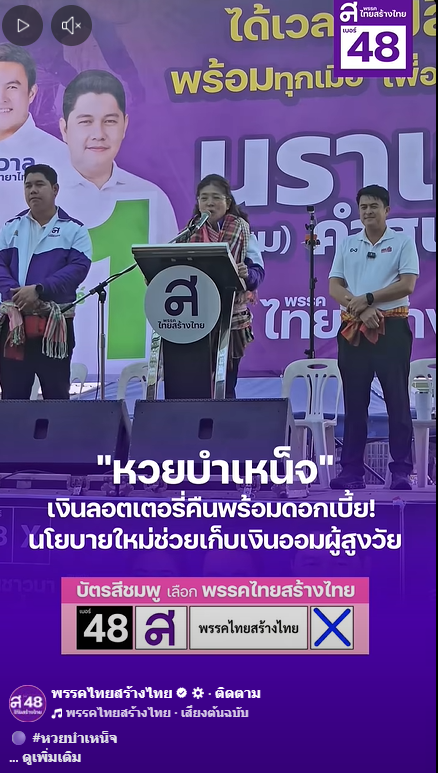
Thai Sang Thai Party’s gratuity lottery
The “gratuity lottery” policy was first coined in 2019 by Khunying Sudarat Keyuraphan when she was a prime ministerial candidate of Pheu Thai Party. The policy aims to transform the money people spend on lottery tickets into retirement savings, instead of it disappearing without returns, while also linking the idea to solving grassroots economic problems.
During the campaign at that time, Khunying Sudarat visited Kamphaeng Phet province to listen to public concerns about the cost of living and economic conditions. She emphasized that if Pheu Thai Party were able to form a government, it would be able to accelerate economic recovery and deliver tangible results within six months.
Later, the policy was revived and promoted again under Thai Sang Thai, a new party formed and led by Khunying Sudarat Keyuraphan. This brought the “gratuity lottery” back into the political spotlight, while also prompting public debate and scrutiny over whether the policy was merely an adaptation of an existing idea to a new political context, and questions over who originally initiated the concept and which party may have copied whose policy.
■ 5 December 2022: Khunying Sudarat officially launched the policy in Chiang Rai province, promoting the “gratuity lottery” alongside the “3,000-baht people’s pension” to address the ageing society. The policy specified conditions for the return of principal at the ages of 60, 70, and 80.
■ January – May 2023: The party used the gratuity lottery as one of its key policies in the general election campaign, holding rallies nationwide to build public understanding of turning lottery spending into savings.
■ 6 June 2024: The Ministry of Finance (under the Pheu Thai–led government) officially launched the “retirement lottery” policy.
■ 7 June 2024: Mr. Chatchawal Phatthaya Thai, Secretary-General of the Thai Sang Thai Party, issued a statement noting that the “retirement lottery” closely resembled the “gratuity lottery” previously campaigned on by Thai Sang Thai. While he did not object to the government implementing it, he urged adherence to proper principles.
■ 23 July 2025: As the retirement lottery bill entered its second and third readings in parliament, Thai Sang Thai Party, in its role as the opposition, scrutinized and criticized the draft. The party emphasized that the scheme should be open to all groups without restrictions, so it could genuinely compete with the underground lottery in line with the original intent of the “gratuity lottery.”
The new election and the gratuity lottery
■ 1 January 2026: The Thai Sang Thai Party announced the revival of the “gratuity lottery” policy in preparation for the 2026 election, adjusting the conditions to make it more accessible than the previous government’s “retirement lottery,” which it viewed as still constrained by a monthly purchase cap of 3,000 baht.
■ 2 January 2026: A press conference was held to “bundle lottery policies,” highlighting and comparing the strengths of the gratuity lottery to build recognition among lottery buyers and informal workers.

The People’s Party and its receipt lottery
The “receipt lottery” policy of the People’s Party (formerly the Move Forward Party) is based on a different concept from other parties. Rather than focusing on retirement savings, it emphasizes “creating advantages for SMEs” and drawing small retailers into the tax system.
- February 2023 (Move Forward Party era): The Move Forward Party first proposed this policy ahead of the 2023 election, adapting the successful model from Taiwan’s Uniform Invoice Lottery. The aim was to incentivize consumers to shop at small and medium-sized enterprises (SMEs) rather than large department stores or major conglomerates, using a “lottery” as a reward for participation.
- 2023 general election: The policy was included as a core campaign platform. In May 2023, during the campaign period, the Move Forward Party announced details stating that consumers who spent 500 baht at SME shops would be able to exchange their receipts for one digital lottery ticket (with a monthly cap on entitlements). When a shop’s sales reached 5,000 baht, the retailer would also receive one lottery ticket to enter prize draws and would be entitled to additional tax benefits.
- 25 December 2025: Following the transition from the Move Forward Party to the People’s Party, the party launched its policy website for the 2026 election, listing the “receipt lottery” as one of its 10 flagship policies. The People’s Party bundled the receipt lottery with the “Half-Half Plus” policy, which provides 1,000 baht to citizens via an application (similar to the original Half-Half scheme but focused on small shops). When spending at SME stores, consumers would automatically receive lottery entries.
- January 2026: Party leaders campaigned on the ground, emphasizing that the receipt lottery would be a more “sustainable” tool for supporting SMEs than direct cash handouts alone. The party also announced plans to use the system to bring small retailers into a simplified tax framework (Simplify Tax) by raising the VAT registration threshold from 1.8 million baht to 3.6 million baht per year, in order to ease concerns among small business owners.
How do the lottery policies from these three parties differ?
All three political parties share a key common ground in using “lotteries” as a policy instrument rather than viewing them merely as gambling. They acknowledge the Thai public’s strong inclination toward games of chance and choose to design systems that keep money circulating within state-regulated structures, instead of imposing outright bans.
These policies all rely on digital mechanisms to enhance transparency and accountability, with the shared objective of bringing off-system money—or funds that previously went untracked—back into the formal economy. At the same time, they aim to reduce the role of illegal underground lotteries while increasing the state’s role as regulator.
However, despite these similar starting points, the ultimate policy objectives of each party differ clearly from one another.
Pheu Thai’s retirement lottery
Pheu Thai Party proposes the concept of the “retirement lottery” with the primary goal of creating financial security after retirement and addressing old-age poverty. The core idea—“buy lottery tickets, money is not lost but turned into savings”—reflects a structural view that many Thais enter old age without sufficient savings.
This policy uses digital lottery tickets in conjunction with the National Savings Fund (NSF). Prize money can be withdrawn immediately, while the savings portion must be held over the long term, making it an indirectly designed welfare policy of the state. During the 2026 election, the policy has been elevated to a flagship platform, tied to the campaign narrative of “Debt Relief with Dignity and Self-Respect.”
The strengths of Pheu Thai Party lie in the clarity of its savings system, its linkage to existing state structures and legal frameworks, as well as its accessible communication with grassroots communities and informal workers. However, the policy still faces limitations due to purchase caps and its focus on specific age groups or statuses.
Thai Sang Thai: an open approach to savings lotteries
Thai Sang Thai Party proposes the “gratuity lottery” with the main objective of returning the principal while offering greater flexibility to buyers. The party has promoted the idea of “turning lottery spending into savings” since 2019 and emphasizes the term “gratuity” to signify receiving a lump-sum payout at certain age milestones.
This policy is linked to the concept of a “people’s pension” and is based on the view that the system should be open, without restrictions on eligible groups or purchase caps, in order to genuinely compete with underground lotteries. The strengths of the Thai Sang Thai Party lie in positioning itself as the conceptual originator, highlighting fairness for all buyers, and scrutinizing the government from the perspective of the policy’s “original intent.”
However, a key limitation is that the concept has not yet been implemented at the state level, and the mechanisms involved still require further design and clarification in the future.
Lotteries as an economic stimulus and tax reform tool
Meanwhile, the People’s Party proposes the “receipt lottery,” which primarily aims to stimulate the grassroots economy and reform the tax system, rather than focusing on retirement savings. The policy uses lotteries as an incentive for consumers to purchase goods from small retailers and to bring shops into a simplified tax system.
The concept draws on Taiwan’s Uniform Invoice Lottery model and is linked to the “Half-Half Plus” scheme, as well as value-added tax reform. Its strengths lie in creating a cycle of economic circulation in which consumers, retailers, and the state all benefit, while requiring relatively limited direct government spending. However, the policy does not directly address retirement savings, and some retailers remain concerned about potential tax burdens.
Retirement lottery vs. receipt lottery: how far can gambling money drive the economy?
Associate Professor Dr. Pornpen Worasitta, Director of the ASEAN Economic Community Research Center at the National Institute of Development Administration, said that a large amount of Thai people’s money is lost to lotteries. This is why politicians have been promoting lottery-based policies—to reclaim money that previously disappeared into illegal lottery operators or was siphoned off from the state lottery system, and put it to use in some beneficial way, which could be seen as a positive development.
However, she noted that this also raises a public concern over whether such policies might further encourage people to become overly fixated on lotteries.
“At the beginning, when this idea was first proposed, there was a great deal of resistance to overcome. In the past, people did not accept it because it was seen as a vice. But we asked why lotteries could not be used for something beneficial. Personally, I think this is money that simply disappears—the poor’s money just vanishes. From research I previously conducted, a single village spends at least hundreds of thousands of baht per year on lottery tickets, and that money is lost.
If, instead, the government were to give that hundred thousand baht directly to the people, they would likely be much happier. But in reality, poor people buy lottery tickets and the money disappears into illegal lottery operators or the state lottery. The chances of winning are already very small, but it represents hope—the hope that they might win. You cannot simply ban it, because attempts have been made before and they were ineffective,” Assoc. Prof. Dr. Pornpen said.
Retirement lottery vs. receipt lottery: how far can gambling money drive the economy?
Associate Professor Dr. Pornpen Worasitta, Director of the ASEAN Economic Community Research Center at the National Institute of Development Administration, said that a large amount of Thai people’s money is lost to lotteries. This is why politicians have been promoting lottery-based policies—to reclaim money that previously disappeared into illegal lottery operators or was siphoned off from the state lottery system, and put it to use in some beneficial way, which could be seen as a positive development.
However, she noted that this also raises a public concern over whether such policies might further encourage people to become overly fixated on lotteries.
“At the beginning, when this idea was first proposed, there was a great deal of resistance to overcome. In the past, people did not accept it because it was seen as a vice. But we asked why lotteries could not be used for something beneficial. Personally, I think this is money that simply disappears—the poor’s money just vanishes. From research I previously conducted, a single village spends at least hundreds of thousands of baht per year on lottery tickets, and that money is lost.
“If, instead, the government were to give that hundred thousand baht directly to the people, they would likely be much happier. But in reality, poor people buy lottery tickets and the money disappears into illegal lottery operators or the state lottery. The chances of winning are already very small, but it represents hope—the hope that they might win. You cannot simply ban it, because attempts have been made before and they were ineffective,” Assoc. Prof. Dr. Pornpen said.
Designing a digital lottery-based savings system
Assoc. Prof. Dr. Pornpen further suggested the management of lottery ticket sale revenues—whether the buyers win or not—should be locked into a digital system. The funds would be divided into three parts: one portion allocated for prizes, another for administrative costs, and the remaining portion—around 40–70%—managed by professional fund managers, such as the Government Pension Fund or provident funds.
Even in a worst-case scenario, the returns should be around 2–3%, and in good years they could reach as high as 5%.
Lottery-based pensions as income security in old age
With such lotteries, the funds would then be accumulated and returned upon retirement to citizens. “Personally, I would prefer it to be structured as a pension, because it can provide long-term, lifelong payments. At the very least, poor people would have a regular source of happiness or security—whether the amount is large or small would depend on how much they contributed, ” Assoc. Prof. Dr. Pornpen added. “Another option is a lump-sum gratuity, which the public seems to prefer. However, gratuities are not a long-term solution. Still, if they serve as a starting point, that is better than not starting at all.”
Gratuity: a popular option, but not a long-term solution
As for using purchase receipts to generate lottery numbers, the objective would be to stimulate tax collection and encourage higher consumer spending. When spending increases, the government could collect more taxes, as every transaction is recorded.
Receipt lottery: the challenge of bringing SMEs into the tax system
There remains an issue that some SME sellers are reluctant to participate due to concerns about tax liabilities, similar to what occurred during the Half-Half scheme. Nevertheless, this policy is likely to be effective for certain groups, as seen in the case of Taiwan, where implementation led to higher tax collection, increased state revenue, and the ability to fund prizes without placing a burden on the national budget.
From a broader economic perspective, Assoc. Prof. Dr. Pornpen viewed these lotteries as tools to stimulate the economy. Thais, like people in many other countries, enjoy anticipation and risk-taking. When outright bans are ineffective, the alternative is to work with these behaviors—similar to how many companies offer prize draws tied to product purchases. If there were no tangible benefits, such schemes would not attract participation on such a large scale.
How far can the retirement lottery and receipt lottery go?
Dr. Nonarit Bisonyabut, Research Fellow at the Thailand Development Research Institute (TDRI), said that most people approaching retirement lack sufficient savings. Combined with the idea that Thais enjoy gambling—whether through legal or illegal lotteries—this led to the concept of setting aside part of the money spent on lottery tickets into an account earmarked for retirement savings.
If implemented effectively, this approach could create additional savings products that align well with public behavior. In that case, it could be beneficial. However, he cautioned that the policy should not be expanded to such a scale that it ends up encouraging excessive gambling or misleading the public.
Receipt lottery and the conditions for SMEs to enter the system
As for the receipt lottery, SME shops must first enter the formal system in order to be able to issue receipts. Once they are in the system and reach a certain sales threshold, they will then receive lottery entries to try their luck, similar to participating in a prize draw.

Dr. Nonarit Bisonyabut, Research Fellow at the Thailand Development Research Institute (TDRI)
“However, from my perspective, I find it quite interesting. There are many countries—Taiwan, for example—where when you buy goods and a receipt is issued, it automatically comes with lottery numbers. This helps stimulate consumer spending, and small businesses in particular also benefit from this spillover effect.
The challenge lies in whether such a system can actually be implemented. There are legal provisions that need to be reviewed, including whether this type of risk-based product is permitted. For instance, lotteries usually come with conditions—people must pay to buy lottery tickets, and formulas must be calculated to ensure that the state does not lose out in the end. If these issues can be addressed, then such a product could be introduced,” Dr. Nareit said.
The role of the State, incentives, promotions, and questions of enforcement
At the same time, the State would need to step in to provide incentives and promotions. This, however, raises questions about whether such measures can realistically clear existing legal hurdles, and whether the incentives will be strong enough to bring SMEs into the system. It is understood that policymakers are attempting to bundle this with other policies in order to encourage as many SMEs as possible to enter the formal system.
It must be acknowledged that this is a long-standing, accumulated issue—particularly among many small SME operators who are not yet ready or willing to enter the system. Some engage in tax avoidance, while others face practical constraints related to regulatory compliance, such as preparing and maintaining accounting and tax records. These are all structural obstacles that require careful consideration.
Structural barriers facing small SMEs
Although this type of policy concept has examples from abroad, and if properly designed may not require a large budget while still having the potential to stimulate the economy, its ultimate success depends on actual implementation. There remain many conditions and challenges that need to be systematically addressed before the policy can be effectively carried out.
Verification Process
- Review on the policy timeline of Pheu Thai Party: Pheu Thai has promoted the flagship “retirement lottery” policy for the 2026 election, continuing the 50-baht digital lottery scheme that turns lottery spending into savings to be returned at the age of 60. At present, the framework law has already been passed, and the scheme is ready to begin actual sales within the first three months after a new government is formed, covering informal workers and existing elderly groups.
- Review on the policy timeline of Thai Sang Thai Party: Thai Sang Thai has put forward the “gratuity lottery” to contest the 2026 election, highlighting the return of principal with interest and the absence of a purchase cap in order to directly compete with underground lotteries. The party has also adjusted conditions to make the policy more accessible, aiming to address the ageing society issue in a sustainable way.
- Review on the policy timeline of the People’s Party: The People’s Party has promoted the “receipt lottery” for the 2026 election, focusing on creating advantages for SMEs by converting every 500 baht of purchases into lottery entries to incentivize consumers to shop at small businesses.
- Source verification: Thai PBS Verify interviewed Assoc. Prof. Dr. Pornpen Worasitta, Director of the ASEAN Economic Community Research Center at the National Institute of Development Administration. She explained that the retirement lottery and receipt lottery policies aim to transform money wasted on gambling into digital savings managed by professionals, in order to create retirement pensions and stimulate tax collection. While these policies could help draw the informal economy into the system and strengthen financial security for low-income groups, challenges remain, particularly concerns among SMEs about entering the tax system and the need to prevent the public from being misled or over-encouraged to gamble.
- Additional source verification:Thai PBS Verify also interviewed Dr. Nonarit Bisonyabut, Research Fellow at the Thailand Development Research Institute (TDRI). He viewed the “retirement lottery” and “receipt lottery” as attempts to turn gambling behavior into savings and to bring SMEs into the tax system to stimulate the economy. However, he emphasized that success would depend on policy designs that offer real incentives, address legal constraints, and adjust structural conditions to reduce barriers for small businesses.

Related Content



Most Viewed