Fact-check: MP candidates with pending legal cases are not considered disqualified under election law
Thai PBS Verify found the source from: Facebook
As the election approaches, questions have emerged on social media regarding why certain candidates with pending court cases are still permitted to run for office and campaign as usual. These doubts have led to public criticism over whether this constitutes a legal loophole or reflects unfairness within the electoral process.
Which candidates currently have pending legal cases?
Thai PBS Verify has identified candidates whose qualifications have been questioned due to ongoing legal matters, such as:
Bhumjaithai Party
- Traithep Ngamkamol, constituency candidate for the party from Buriram Province
- Case about procurement of fertilizer by the Buriram Provincial Administrative Organization (PAO)
According to reports by Isra News Agency, the case involves allegations against executives of the Buriram PAO regarding a corruption scandal in a career promotion project for the fiscal years 2012–2015. It is alleged that organic fertilizer was procured at 150–260 Baht per sack to support the project, but it was recorded and billed at 500 Baht per sack.
The Criminal Court for Corruption and Misconduct Cases Region 3 has formally accepted the lawsuit against three defendants, including Mr. Traithep Ngamkamol. The case is currently undergoing the judicial trial process.
Isra News Agency report further notes that the National Anti-Corruption Commission’s (NACC) ruling on the grounds of an offense is not yet final. All three accused remain innocent until a final judgment is delivered by the court.
- Natchanon Srikokeu, constituency candidate for Bhumjaithai from Songkhla province.
According to reports by Isra News Agency, Sirichok Sopha, former Democrat Party MP for Songkhla, has called for the acceleration of the investigation into two cases involving Mr. Natchanon:
- Allegations of accepting assets or other benefits reducible to a monetary value – This involves the claim that a third party settled medical expenses on his behalf, totaling 1,335,778 Baht, for heart disease treatment at Phyathai 2 Hospital between September 23 and October 18, 2019. The NACC has already ruled that there are grounds for the allegations. The case is currently in the process of being forwarded to the Supreme Court and the Office of the Attorney General for legal proceedings.
- The 30-million-baht financial trail case involving a contractor – It is claimed that investigators have gathered all necessary evidence and are currently awaiting a resolution from the main board of the NACC
Klatham Party
- Boonying Nitikanchana, party member
The court has delivered a verdict of 6 years and 8 months in prison. However, the court has granted temporary release pending appeal, with bail set at 250,000 Baht. The case is currently under consideration by the Court of Appeal.
Do MP candidates with pending legal cases meet the criteria for disqualification?
Thai PBS Verify sought clarification from Assoc. Prof. Somchai Srisutthiyakorn, former member of the Election Commission (ECT). He stated that election candidates are eligible to run for a seat in the House of Representatives even if they have pending legal cases, as long as the cases have not reached a final judgment. Such circumstances do not fall under the disqualification criteria or prohibited characteristics stipulated by the election law.
The legal process may continue following the election. A candidate or Member of Parliament will only be disqualified if the court delivers a guilty verdict that includes a revocation of political rights or a prison sentence where bail is denied.
“Furthermore, even if a Court of First Instance has delivered a judgment, if the individual is not in custody and remains on temporary release, they are not yet considered legally disqualified.
However, if bail is not secured in time and the individual is imprisoned by the Court of First Instance, they will be deemed disqualified from running for office.”
Regarding the issue of suitability, this remains at the discretion of the voting public. Legally, a candidate is not yet considered disqualified when referencing the Organic Act on the Election of Members of the House of Representatives, B.E. 2561 (2018). Under Chapter 4 (Candidates and Candidacy), Part 1 (Election Candidates), Section 41 specifies the qualifications for
- Those eligible to stand for election.
- Section 42, which outlines the prohibited characteristics for exercising the right to stand for election as a Member of Parliament, contains key provisions in Subsections (8) and (9), stating that being sentenced to imprisonment by a court judgment constitutes a disqualification for candidacy.
While the law does not disqualify them, political parties may exercise discretion in screening candidates
Even though Thai election law allows individuals with pending legal cases and no final judgment to retain their right to run for the House of Representatives, certain political parties choose to implement measures based on suitability and internal party guidelines.
A case in point is Boonyarit Raorungroj, a People’s Party candidate for Bangkok’s 33rd Constituency, who was issued an arrest warrant for money laundering following an investigation into a narcotics network. Subsequently, Natthaphong Ruengpanyawut, leader of People’s Party, clarified that the warrant was issued on December 17, 2025, which is why it did not appear in earlier background checks.
Mr. Natthaphong issued a public apology for the incident and emphasized that, although the case has not reached a legal conclusion, the party decided to immediately remove Mr. Boonyarit from its candidate list.
Why can individuals with pending cases still run for Member of Parliament?
Asst. Prof. Prinya Thaewanarumitkul of the Faculty of Law, Thammasat University, explains that because Thailand is a democracy, it adheres to a fundamental principle of the justice system: the Presumption of Innocence. This is the principle that “everyone is innocent until proven guilty by a court of law.”
The Presumption of Innocence exists to prevent state power, particularly law enforcement, from being weaponized to eliminate political opponents. Since anyone can be accused or defamed, only the court—acting as an independent body—has the authority to determine guilt through a proper judicial process.
“A fundamental principle of the justice system is that everyone who is accused is presumed innocent. When the police make an arrest, it is an accusation. When the prosecutor indicts and the court accepts the case, the individual becomes a defendant, but it is still merely an accusation. In a democratic system, we have the principle of Separation of Powers, meaning the judiciary is independent of the executive and legislative branches. The judiciary must hold that an indictment alone is not grounds for conviction; it remains only an allegation. This is the democratic principle known as the Presumption of Innocence.”
“The fact that police have pressed charges or even issued an arrest warrant does not mean a person is guilty. As stipulated in Section 29, Paragraph 2 of the Constitution, in a criminal case, a suspect or defendant shall be presumed innocent. Before a final judgment is delivered, an individual cannot be treated as a guilty party. This is a universal principle recognized by the United Nations under Article 11 of the Universal Declaration of Human Rights, which states that everyone is presumed innocent until proven guilty. This principle has been enshrined in every Thai constitution since the 1949 edition to the present.”
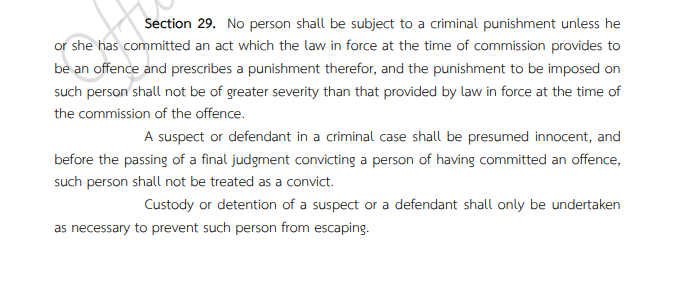
The Constitution of the Kingdom of Thailand, B.E. 2560 (2017), Section 29, Paragraph 2, stipulates: “A suspect or defendant in a criminal case shall be presumed innocent, and before the passing of a final judgment convicting a person of having committed an offence, such person shall not be treated as a convict. ”
In cases where concerns arise regarding wrongful arrests or unfair allegations, the court does not automatically accept police charges as proof of guilt. The accused must be given a full opportunity to contest the case. Whether an individual is guilty is a matter for the court to decide. While in the status of a suspect or defendant, they are not yet considered to have committed an offense and remain eligible to run for election as a Member of Parliament.
However, according to the provisions on prohibited characteristics, if the court delivers a prison sentence and issues a detention order by court warrant, the individual will be disqualified from running for election. This disqualification applies even if it is a judgment from the Court of First Instance and the case is currently under appeal, as the person is effectively under detention by court order.
However, Asst. Prof. Prinya noted that beyond legal requirements, the issue of suitability is a matter of political discretion for political parties and the voting public. Legally, being charged or undergoing judicial proceedings does not constitute grounds for disqualification. This principle exists to prevent state authorities or those in power from weaponizing the justice system to eliminate political opponents, as anyone can be accused or defamed, and only the court, as an independent body, possesses the authority to determine guilt.
Furthermore, the Universal Declaration of Human Rights (UDHR) states in Article 11 that
(1) Everyone charged with a penal offence has the right to be presumed innocent until proved guilty according to law in a public trial at which he has had all the guarantees necessary for his defense.
(2) No one should be held guilty of any penal offence on account of any act or omission which did not constitute a penal offence, under national or international law, at the time when it was committed. Norshall a heavier penalty be imposed than the one that was applicable at the time the penal offence was committed.
Examples of individuals with pending cases who are not disqualified as MPs:
In 2023, BBC Thai reported the case of Ms. Rukchanok Srinork, constituency candidate for People’s Party. While serving as a Bangkok MP for Move Forward Party at that time, the Ratchada Criminal Court sentenced her to 6 years in prison without probation for offenses under Section 112 of the Criminal Code and the Act of Computer Crime. However, the court granted her bail pending appeal with a security of 500,000 Baht. As a result, her status as a Member of Parliament did not terminate.

Subsequently, in 2024, Ms. Rukchanok arrived at the Criminal Court to hear the ruling regarding the revocation of bail in the royal defamation case (Black Case No. O.683/2565), filed by the Office of the Special Prosecutor for Criminal Litigation 10. The Criminal Court delivered a verdict of three years of imprisonment for each of the two counts, totaling six years without probation. However, the court granted bail pending appeal with a security of 500,000 Baht, under the condition that she must not engage in similar conduct again.
This case reflects that even if a candidate or an MP receives a conviction from the Court of First Instance and is currently contesting the case, they are not considered disqualified or subject to the termination of their legal rights to hold office or run for election, provided they are granted bail and are not detained under a court order.
What is the truth?
The investigation confirms that MP candidates with pending legal cases do not yet fall under the disqualification criteria. This is because their cases have not reached a final verdict and they have not been sentenced to imprisonment without the right to bail. This principle is consistent with election laws and Section 29, Paragraph 2 of the Thai Constitution, which states that “A suspect or defendant in a criminal case shall be presumed innocent ” before a final judgement. Consequently, individuals who have been accused or are undergoing legal proceedings retain their legal right to stand for election and campaign. Nevertheless, the issue of suitability remains a matter of political discretion for each party and the decision of the voting public.
Verification Process
1.Examination of election law
Section 41 of the Organic Act on the Election of Members of the House of Representatives, B.E. 2561 (2018) outlines the qualifications for those eligible to stand for election. Meanwhile, Section 42, which details the prohibited characteristics, specifically states in Subsection (8) that being sentenced to imprisonment by a court judgment constitutes a disqualification for candidacy.
Furthermore, a former member of the Election Commission (ECT) clarified that MP candidates with pending legal cases are not yet classified as disqualified under election law. This is because their cases have not reached a final judgment, and they have not been sentenced to imprisonment without the right to bail.
2.Examination of the Constitution of the Kingdom of Thailand, B.E. 2560 (2017)
Section 29, Paragraph 2 explains that regarding the Presumption of Innocence, which stipulates that in a criminal case, a suspect or defendant shall be presumed innocent until a final judgment is delivered.