Methodology
The Thai PBS Verify Fact-Checking Methodology is conducted in accordance with the principles of the International Fact-Checking Network (IFCN), with a strong commitment to accuracy, political neutrality, transparency and public accountability. This methodology is designed to ensure that every stage of the verification process is transparent and traceable, from the selection of claims for review to the publication of complete and publicly accountable fact-checking reports.
The process begins with the selection of claims and issues that are considered significant to the public interest and relevant to public understanding. These may include topics related to politics, public policy, economics, health, national security, social issues, disasters, emergency situations or digital content created through emerging technologies. Thai PBS Verify documents the origin, circulation, and contextual background of each claim in order to establish a reliable foundation for the verification process.
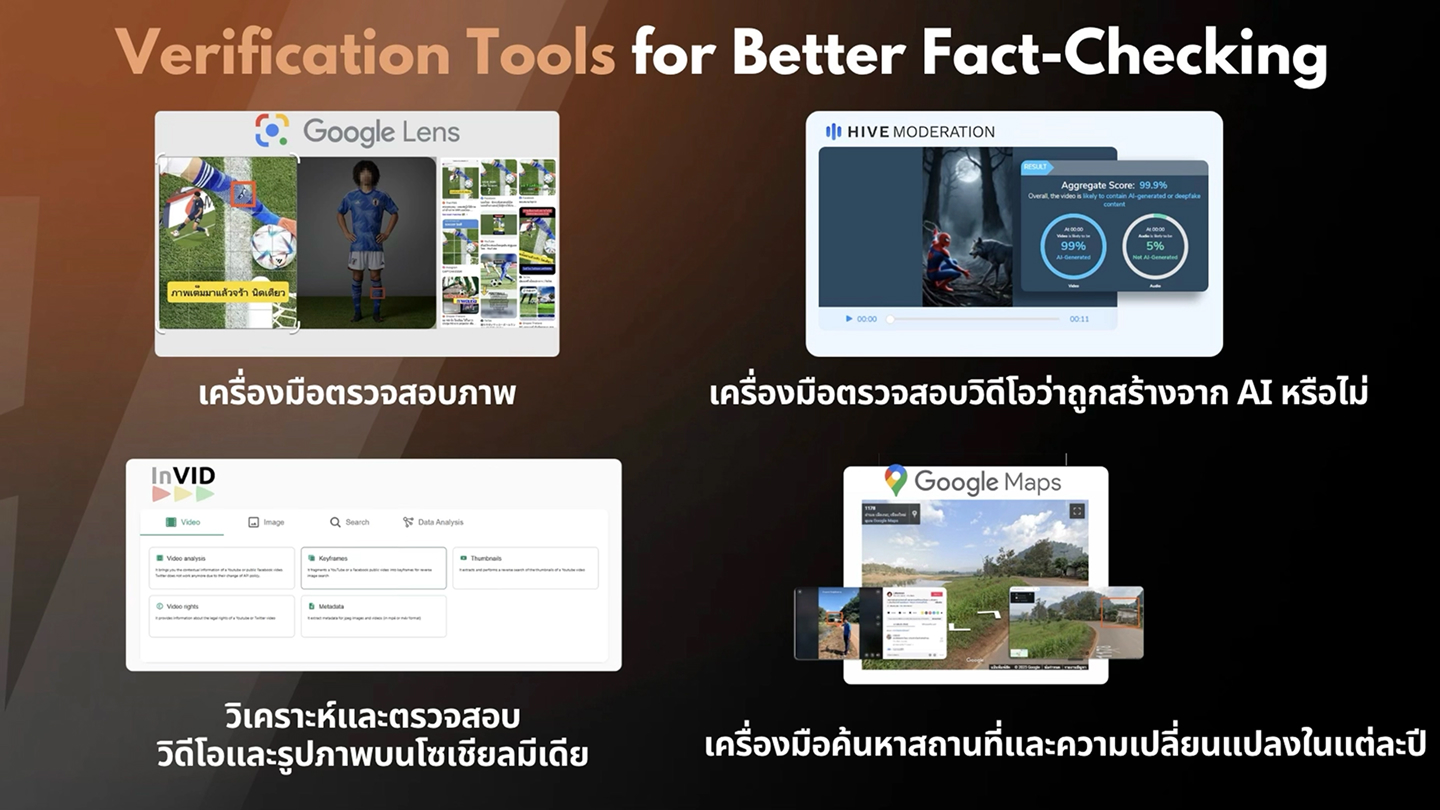
During the verification stage, Thai PBS Verify applies a multi-source verification approach based on evidence gathered from a wide range of reliable and verifiable sources. These sources may include official government information, academic publications, public databases, research studies, reports from credible organizations, field evidence and digital materials verified through internationally recognized tools, such as Reverse Image Search, Metadata Analysis, and other Open-Source Intelligence (OSINT) techniques. When issues involve specialized or technical knowledge, Thai PBS Verify consults subject-matter experts and provides individuals or organizations referenced in the report with a fair opportunity to clarify or respond before conclusions are finalized.
All conclusions are based solely on verifiable evidence and are produced independently from personal opinions, political preferences, or ideological positions. Thai PBS Verify applies a standardized classification system consisting of the following categories: Truth, Misinformation, Disinformation, Malinformation, Fake Image and neutral Fact-Check. Each label includes a clear explanation of the evidence and reasoning that support the conclusion in order to help audiences understand the basis of the assessment.
All published fact-checking reports include transparent source attribution and accessible references whenever possible. Prior to publication, each report undergoes editorial review to ensure factual accuracy, fairness, and compliance with professional standards. If errors are identified after publication, Thai PBS Verify will implement corrections in accordance with its Corrections Policy, including clear public notices explaining the nature of the correction and the updated information.
The entire verification process is governed by the principles of editorial independence and non-partisanship. All personnel involved in fact-checking operations are required to comply with the unit’s Conflict of Interest Guidelines and must avoid political activities or external interests that could compromise impartiality. These safeguards are intended to ensure that all work produced by Thai PBS Verify remains independent from political influence, external pressure or personal interest.
Thai PBS Verify regularly reviews and updates this methodology to ensure alignment with IFCN standards, technological developments and the evolving information environment in Thai society. It remains committed to maintaining accuracy, transparency, and public trust as a public service fact-checking unit in Thailand.
How Thai PBS Verify Fact-Checks
Step 1: Issue Selection
There are two levels of issue selection:
- High-Priority Level – issues that arise during sensitive situations and spread rapidly, or issues that may affect people’s lives and property.
- Standard Level – general issues that may not yet have severe impacts, but are still circulating within social media trends at the time.
Both levels include monitoring trends, patterns, and news related to fact-checking and misinformation circulating across social media platforms.
Step 2: Fact-Checking Based on Accuracy and Transparency
Fact-checkers conduct thorough verification through multiple methods and several stages, using advanced communication technologies and/or interviews with experts relevant to the issue in question.
Step 3: Editorial Review
Fact-checking editors conduct an additional review and verification process before publication to ensure accuracy, fairness, and transparency.
Step 4: Publication and Distribution
Verified content is published across multiple social media platforms in order to reach wider audiences and maximize public access to accurate information.