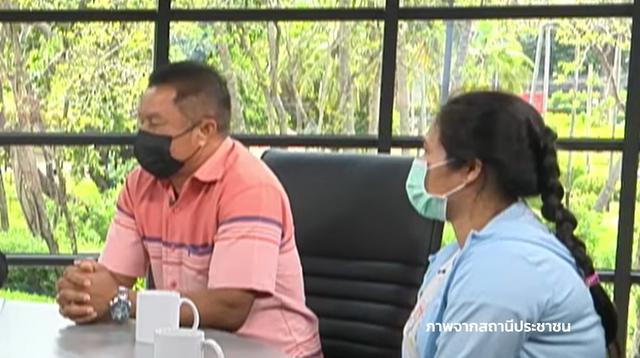
The shared quote of Pita cutting the budget for civil servants’ pensions is actually old misinformation from 2022
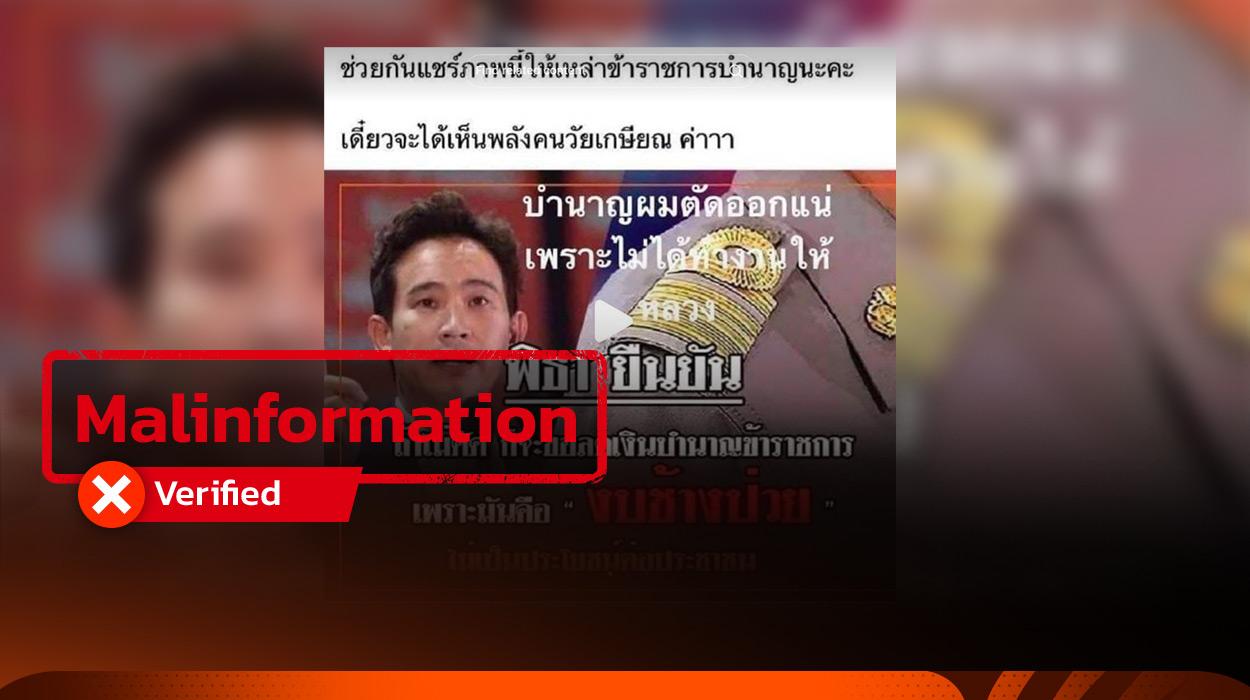
Thai PBS Verify found the source from: TikTok
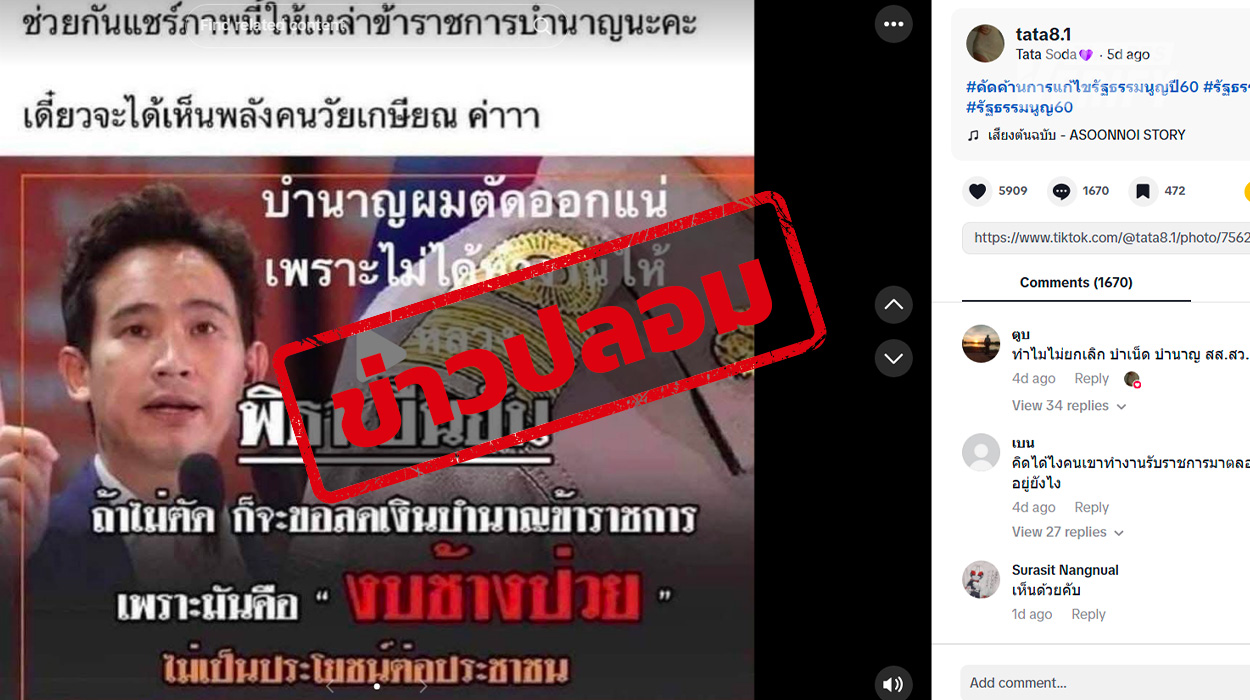
A screenshot showing a TikTok user sharing a post featuring Mr. Pita Limjaroenrat, along with the hashtag: #OpposeTheAmendmentOfThe2017Constitution
Thai PBS Verify found a TikTok account user sharing a picture of Mr. Pita Limjaroenrat with a caption: “I will definitely cut the pensions because they do not work for the state.” Pita affirms that if it cannot
be cut, he will ask to slightly reduce the pensions because they are a ‘sick elephant budget’ and not beneficial to the public.” The post also included an additional message stating: “Please share this image with all civil service retirees. We will soon see the power of the retired generation!” The post was accompanied by the hashtags: #OpposeTheAmendmentOfThe2017Constitution #AntiCorruptionConstitution #2017Constitution
The post, which is a static image set to background music in a video clip format, was published on 18 October 2025. It has gathered 569,500 views, 5,732 reactions, and 1,624 comments. The majority of the comments showed that users believe the text written in the clip is true. The clip was also found to be shared on Threads.
When Thai PBS Verify investigated, the posting account was tata8.1 with 9,478 followers. The content on this channel primarily features images and quotes of politicians from various political parties.

Profile image of the TikTok account named tata8.1.
5 Events Refuting the ‘Sick Elephant Budget’ Misinformation Pita Never Proposed Cutting Pensions.
When searching using the keyword “Sick Elephant Budget (in Thai งบช้างป่วย),” it was found that the issue regarding Pita Limjaroenrat denying the policy to cut civil servant pensions has been seen in five different periods:
- On 31 May 2022, Pita Limjaroenrat addressed the 2023 Budget Bill, citing the rapidly increasing budget for personnel and pensions. He compared this budget item to a “sluggish/sick elephant budget.”
- On 7 June 2022, Pita Limjaroenrat formally confirmed through a letter to civil servant retiree representatives, stating clearly, “No cuts, no reductions to pensions.” He clarified that the “Sick Elephant Budget” referred to the government’s budget management method, not the retirees themselves, in order to counter the spread of rumors and fake news, particularly among the retiree community.
- On 14 September 2022, Pita Limjaroenrat held a press conference alongside the Civil Servant Retiree Network, reiterating that he had never proposed cutting welfare or pensions.
- On 30 January 2023, Pita Limjaroenrat posted and held a press conference to re-affirm his stance after the fake news about pension cuts (click to view the archived original content) resurfaced, coinciding with the approaching 2023 general election. This fake news was heavily disseminated for political attacks.
- On 3 April 2025, the official Pita Limjaroenrat – พิธา ลิ้มเจริญรัตน์ Facebook page clarified the matter of cutting the civil servant pension budget. The page stated that the Move Forward Party, which was dissolved in August 2024, had never proposed cutting civil servant pensions, but aimed to “eradicate the Sick Elephant Budget”– referring to the outdated budget system — to restructure public tax money for efficient use in public welfare.
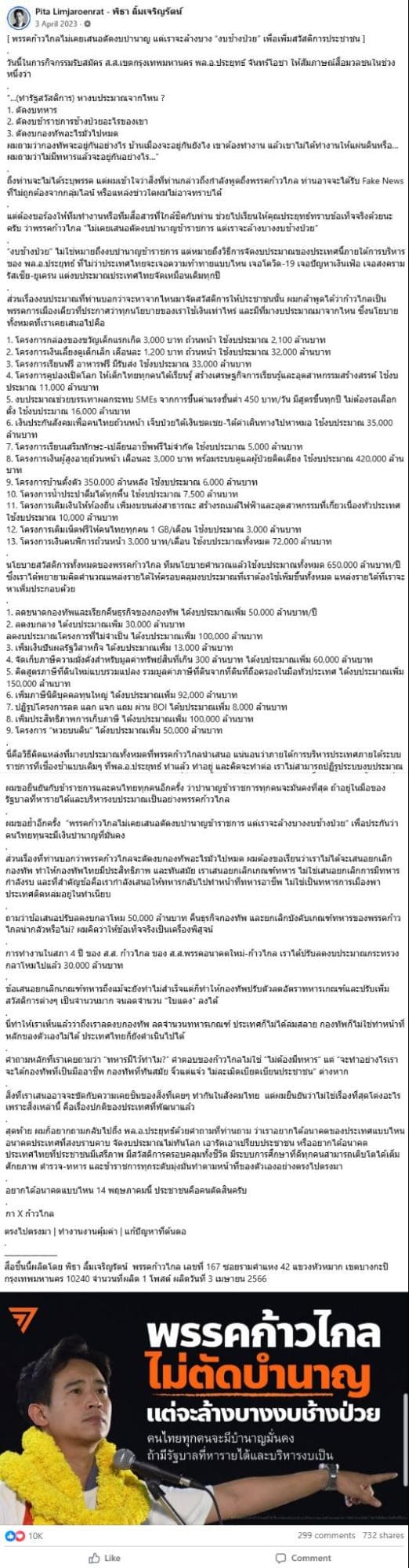
An image of Pita Limjaroenrat – พิธา ลิ้มเจริญรัตน์ Facebook Page explaining the case regarding civil servant pension cuts.
Reviewing Pita’s 2023 Budget Debate Speech Reflecting Old Burdens Consume New Budget Space with No Proposal to Cut Pensions
Subsequently, upon checking the debate on the 2023 Budget Expenditure Act by Mr. Pita Limjaroenrat, who was then the leader of the Move Forward Party (click to view the archived original content), at the Parliament on 31 May 2022, the content of the speech addressed how the country’s budget structure did not meet the needs of post-crisis recovery.
He noted that state revenue was volatile, tax collection was lower than expected, and the country relied on old economic models. Furthermore, the majority of the expenditure was recurring expenses, accounting for over 75% of the total budget, with 70% of the budget being used for past obligations.
Pita then suggested guidelines for budget management and generating additional income to cover expenditures.
Regarding the issue of civil servant pensions, the video clip contained no statement or proposal to cut the civil servant pension budget. The debate was merely a suggestion and a reflection aimed at guiding the government on how to manage and administer the budget effectively to balance both past obligations and future development projects.
2023 Budget Data Reveals 30% Spike in National Spending, ‘Recurring Expenditure’ Still Accounts for 75%.
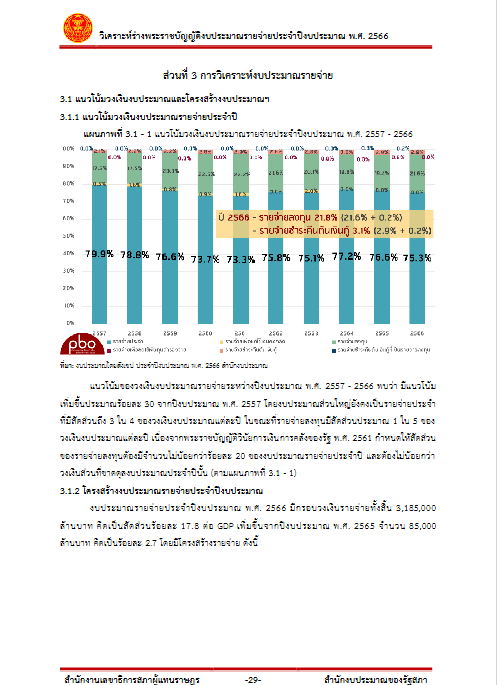
Thai PBS Verify also investigated the document Mr. Pita Limjaroenrat used during his parliamentary debate and identified it as the Analysis of the Draft Budget Expenditure Act for Fiscal Year 2022, published by the Bureau of the Budget of the Parliament. The report analyzed the trend in budget expenditure between Fiscal Years 2014-2023, revealing that national expenditure had increased by 30%. The budget structure remained static, with Recurring Expenditure high at 75% of the total budget and Investment Expenditure standing at only 20%.
YouTube Thai PBS Reports: “Pita” Slams the Inflexible Sluggish Elephant Budget Structure, Wasted on Recurring Expenditures and Past Policies (31 May 2022)
“Sick Elephant Budget” is a phrase that Mr. Pita Limjaroenrat used during his debate to compare and criticize the structure and preparation of the Fiscal Year 2023 Budget Expenditure Bill by the then-government.
Warning: Recycled Old News Incites Emotion and Undermines Opponents’ Credibility
Asst. Prof. Dr. Janjira Sombatpoonsiri, from Chulalongkorn University’s Institute of Asian Studies and the German Institute for Global and Area Studies, and an economist, stated that when viewed in political terms, news that is re-shared in this manner is similar to the “economics of attention seeking” by those running social media campaigns. This means that most people who see such headlines, without checking the publication date, tend to have an emotional reaction—such as anger, dissatisfaction, or making accusations without first checking the facts. This is merely a way of “tugging at people’s emotions” through headlines or by spinning old news to look like current news, ensuring it returns to the stream of social media feeds that people regularly use.
“Sometimes I observe that it appears on private channels, because there is no space for others to enter and challenge or express opinions, unlike on Facebook or X, where people can write comments saying that the news is ‘old news’ or ‘not true,’ ” Asst. Prof. Dr. Janjira noted.
When news like this is forwarded, people who see the image or headline may immediately become emotional and share it without checking. This allows those who spread this type of news to achieve their ultimate goal: to undermine the credibility of the person being referenced.

Asst. Prof. Dr. Janjira Sombatpoonsiri, from Chulalongkorn University’s Institute of Asian Studies and the German Institute for Global and Area Studies, and an economist
Furthermore, the nature of sharing this type of news is not merely the accidental sharing of fake or old news due to the sharer’s ignorance. Instead, it is a “process” that has been in place for a long time and continuously develops “patterns of information manipulation.”
“We have seen this since the Korat mass shooting incident. Following that, reports emerged during the election period and also during the 2020 protests. In Parliament itself, there have been several debates on this matter, particularly regarding ‘IO or Information Operations,’ which are used to manipulate news currents,” Asst. Prof. Dr. Janjira said.
Therefore, these forms are considered “patterns” that are frequently repeated and usually have political goals: either to undermine the credibility of opponents or to prepare the electoral field in advance.
In Thailand, IO campaigns are similar to those seen internationally and typically pursue two to three objectives as follows:
- During protests, the campaigns aim to discredit demonstrators.
- During elections, they are used to discredit one political faction or boost the credibility of another they seek to support.
- During debates or court rulings, they influence public perception and support for the individuals or parties involved.
This time is particularly interesting because the “nationalist sentiment” is surging, which contrasts with the previous election period that followed mass protests, when the prevailing social mood was a “pro‑democracy sentiment.”
At that time, the Move Forward Party — whose remaining members later founded the People’s Party after the 2024 dissolution — faced numerous accusations and charges. Yet, because the social context favored democracy, the impact was limited.
Now, however, the situation is different. Border conflicts have fueled nationalist sentiment. When people are emotionally engaged in this way, many may “forget to pause and think” about whether the messages or news they encounter have political objectives behind them. Therefore, news or posts that refer to political figures during this period are generally used with “the expectation of achieving political objectives.”
Regarding media literacy, Asst. Prof. Dr. Janjira observed that most people now feel angry and dissatisfied with many issues. When they read the news, they tend to be less cautious, letting their emotions guide them before verification. The key is to “pause for a moment and take a deep breath.” Then, check “the headline” to see whether it uses strong emotional triggers or encourages bias. Next, check “the publication date,” because many times old news is recycled to stir emotions again. Even though today’s technology can alter or refresh content to make it look new, it is still easy to verify by simply searching on Google for the date and context. This takes only 1–2 minutes to help us see whether the news was intended to ‘manipulate information.’
What’s the truth?
Thai PBS Verify found that the news about Pita Limjaroenrat allegedly cutting civil servant pensions had already been discussed back in May 2022, when the Move Forward Party was still in opposition during the government of Gen. Prayut Chan‑o‑cha. Now, however, as the country prepares for a new election, the issue has resurfaced on social media.
Verification Process
- Keyword check: When the term “งบช้างป่วย (sick elephant budget)” was searched, it revealed that the issue was linked to claims about Pita Limjaroenrat denying a policy to cut civil servant pensions. Activity around this topic was found in five different periods between 31 May 2022 and 3 April 2025, most of which coincided with election campaigns.
- Academic check: Scholars observed that this was a case of old news being reposted, intended to undermine credibility, and such tactics often occur during election periods.
Impact of Receiving False Information
- Anxiety and insecurity in life: This distorted news caused severe panic among retired civil servants and their families. Since pensions are the final income guarantee in life after retirement, the false information made them feel that their financial security was being threatened by political policies.
- Sense of Devaluation: The distortion of the term “Sick Elephant Budget” to refer to individuals (retired civil servants) made this group feel insulted and demeaned. They were portrayed as a “burden” or an “obstacle to the nation’s progress,” despite having devoted their entire lives to serving the country.
- Distrust in Information: Many elderly people rely on online channels (such as LINE groups) to receive news. When they repeatedly encounter false information, it leads to a loss of confidence in political news and increases the likelihood that they will accept and share other fake news in the future.
- Damage to Image and Electoral Support: This fake news was used as a key weapon to undermine the credibility of the Move Forward Party, especially among voters who are civil servants and the elderly. These groups represent a large voter base and are highly sensitive to welfare issues.
- Loss of Time and Resources in Clarification: The Move Forward Party had to spend significant time, resources, and political energy repeatedly clarifying, countering, and reaffirming the facts. This diverted their efforts from presenting policies or carrying out other work.
- Conflict with Professional Groups: The fake news forced the Move Forward Party into a defensive mode and created conflict with retired civil servants, even though the party had no intention of undermining their welfare benefits.
- Creating Political Division: This fake news has caused severe polarization, using the issue of civil servant welfare as a tool for political attacks. It has fueled hatred and undermined social unity.
- Undermining the Quality of Elections: When false information is repeatedly shared and circulated, citizens end up receiving distorted data to base their voting decisions on. As a result, elections are no longer grounded in facts or genuine policies.
What to do with this misinformation?
- Check the source: Who is publishing this news? Is it a credible mainstream outlet (such as a major news agency), or is it from a personal social media account or an anonymous group? News designed to stir strong emotions often comes from unreliable sources.
- Consider the date and context: Old information that is reposted is a common disinformation tactic. Always check the publication date. If the event happened months or years ago, be cautious — it may be taken out of context.
- Observe language and emotional tone: Fake news often uses emotionally charged language (panic, anger, fear), excessive exclamation marks, or direct personal attacks. If the content focuses more on stirring emotions than presenting facts, it is likely misleading.

Related Content