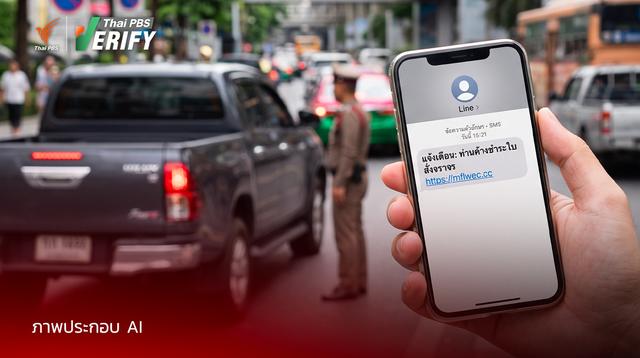
From Fact-Checking to Public Trust: Lessons Learned for the Public Sector and the Media
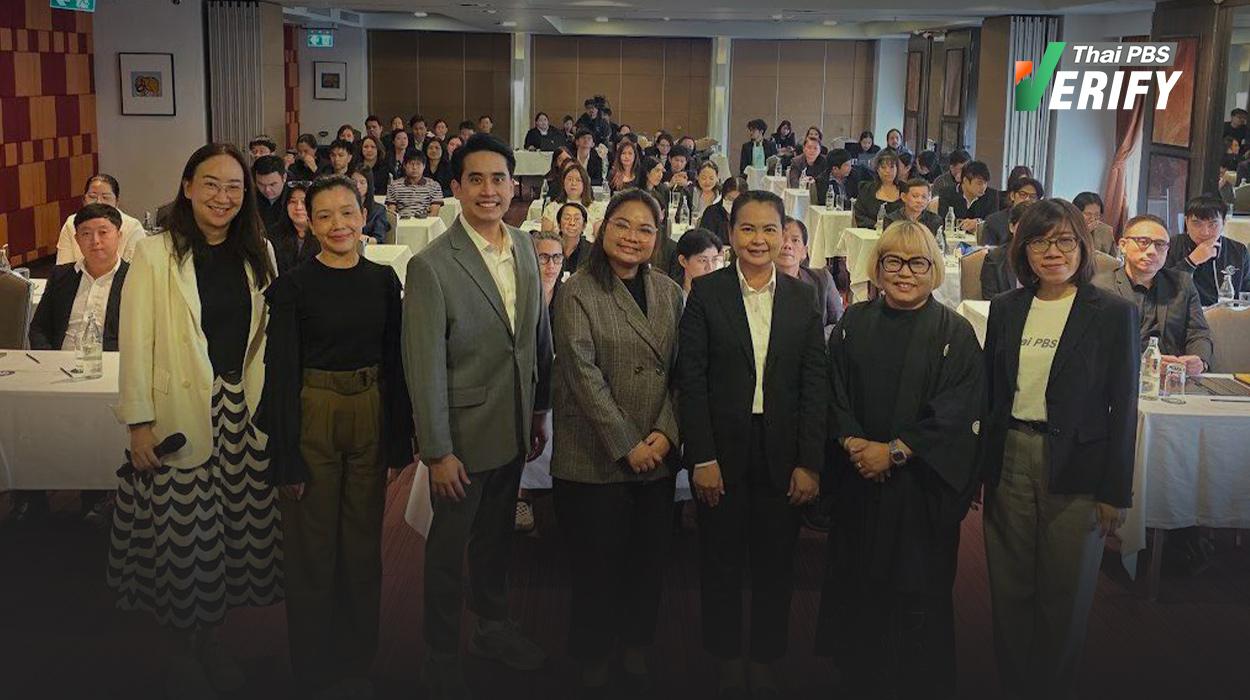
In an era where AI accelerates the spread of fake news, how can government bodies, media outlets, and tech developers collaborate to restore trust in society? Discover key takeaways from a panel discussion dedicated to addressing misinformation and restoring public trust in the digital era.
As artificial intelligence becomes deeply integrated into every aspect of society, a key challenge for both governments and the media is defining how to use AI responsibly. Equally crucial is their role in building a trustworthy information ecosystem—especially amid the growing difficulties of fact-checking in an era where AI can generate and spread misinformation at unprecedented speed.
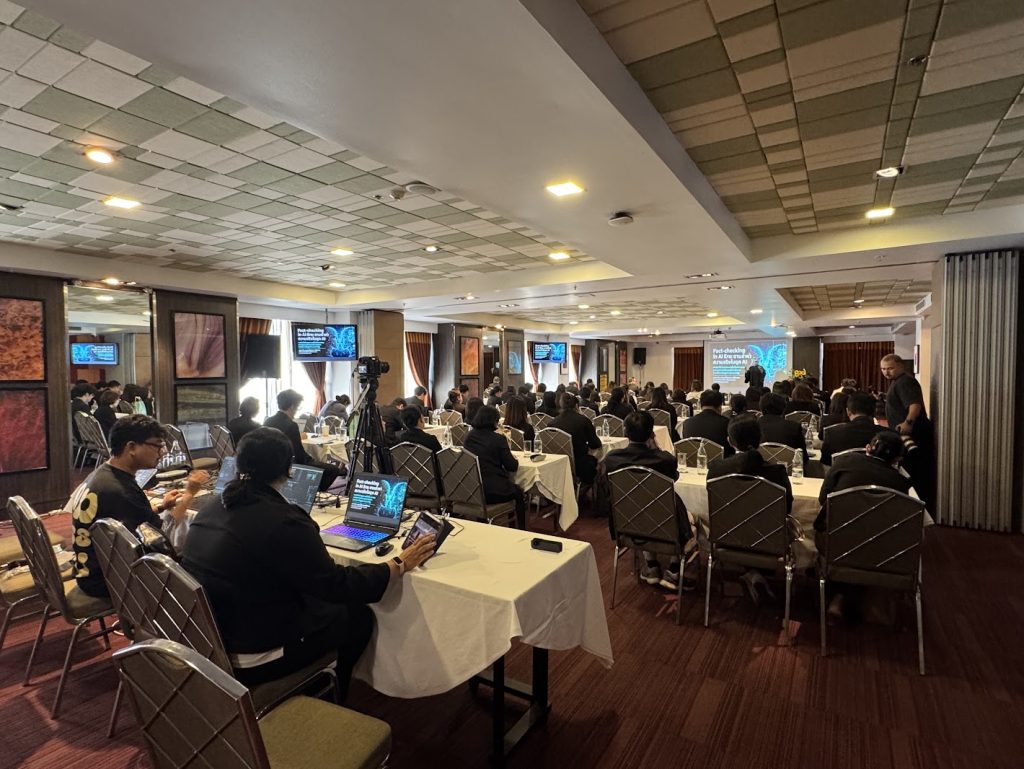
The Office of the Public Sector Development Commission (OPDC), together with Thammasat University, organized a special seminar themed “When Truth Is Challenged… How Can the Public Sector Build Trust?” on July 22, 2026, at the Siam@Siam Design Hotel Bangkok. The forum provided a platform to exchange insights on tackling misinformation, defining the roles of the public sector and media, and fostering public confidence in the AI era.
Join us in exploring key insights from a special panel discussion on “The Challenges Facing Media, Government, and AI Technology in Combating Fake News and Building Trust.”
Featured speakers included Asst. Prof. Dr. Akapon Thianthavorn from the Faculty of Journalism and Mass Communication, Thammasat University; Ms. Kanokporn Prasitphol, Director of the Digital Media Center at Thai PBS and Head of Thai PBS Verify; and Dr. Watcharatiya Watcharobol, Senior Computer Technical Officer at the Public Relations Department (PRD). The session was moderated by Ms. Kanklon Raktham from UNDP Thailand, focusing on strategies to counter fake news, the roles of government and the media in fact-checking, and how AI can be leveraged to ensure data credibility in the digital age.
Can AI truly help detect fake news today, and what are the key challenges it faces
“Technology cannot be stopped—we must simply learn to coexist with it.”
No one can halt the progress of AI technology,” said Ms. Kanokporn Prasitphol, Director of Thai PBS Digital Media Center. “The key is learning to coexist with it and using it mindfully and responsibly.
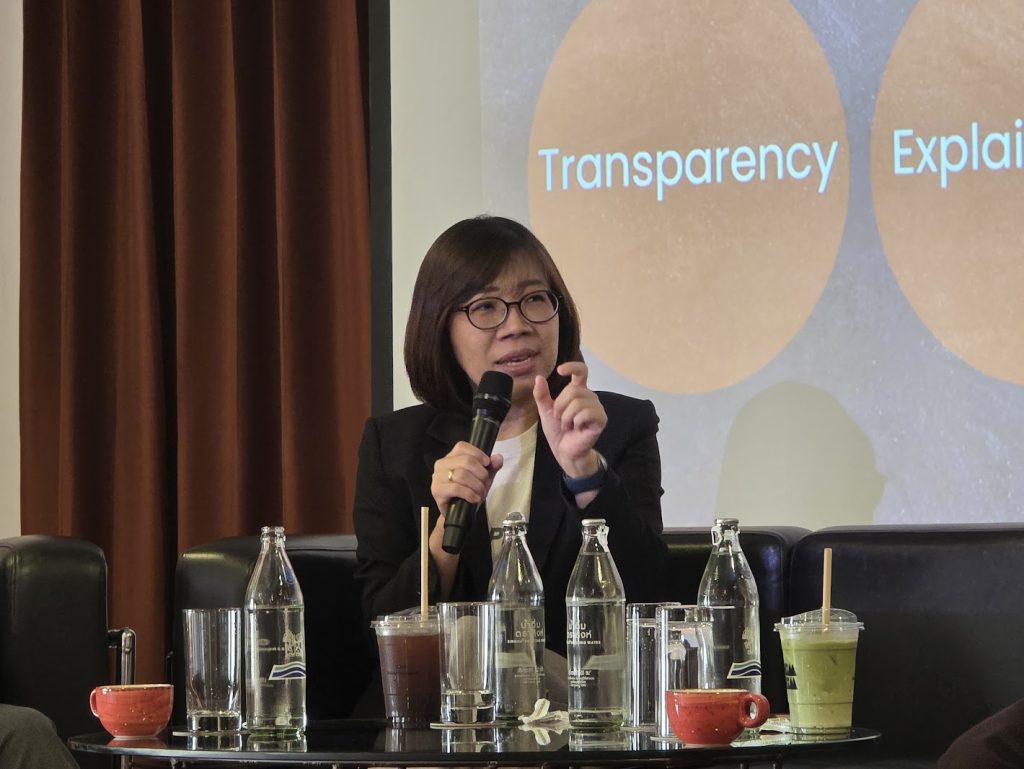
Kanokporn Prasitphol, Director of Thai PBS Digital Media Center.
She pointed out that while some fake news may seem harmless at first, repeatedly exposing the public to false information desensitizes society and gradually degrades people’s ability to distinguish fact from fiction in the long run.
Ms. Kanokporn emphasized that present-day fact-checking must strike a balance between “speed” and “accuracy.” When the public faces uncertainty, verified facts should be published immediately, followed by incremental details and context as further evidence comes to light. This enables media and relevant agencies to seamlessly amplify verified information across multiple platforms.
“Surprisingly, the stories that require the most time to fact-check are not AI-created misinformation, but subjects that lack binary ‘true or false’ conclusions. These often relate to personal convictions, lived experiences, or contested political viewpoints. Consequently, verification is not merely about fact-checking—it demands an appreciation of human context and diverse viewpoints. Likewise, health news remains exceptionally complex, requiring substantial academic data to verify.”
“The public sector must prioritize issues affecting the public during critical situations.”
Ms. Kanokporn highlighted that during major events—including natural disasters, national security concerns, and border developments—the public sector must focus on delivering information of direct public relevance. Policies, operational measures, and welfare assistance should be communicated clearly to provide the public with precise and prompt updates.
In periods of calm, public institutions must prioritize proactive communication strategies. Efforts should center on policy advocacy, corporate reputation, personnel-driven outreach, and tailoring public relations campaigns to align with platform-specific audience behaviors.
Addressing the issue, Dr. Watcharatiya Watcharobol, Senior Computer Technical Officer from the Digital Technology Division of the Public Relations Department, highlighted that AI systems can be used to detect AI content; however, no single detection tool offers 100% precision.
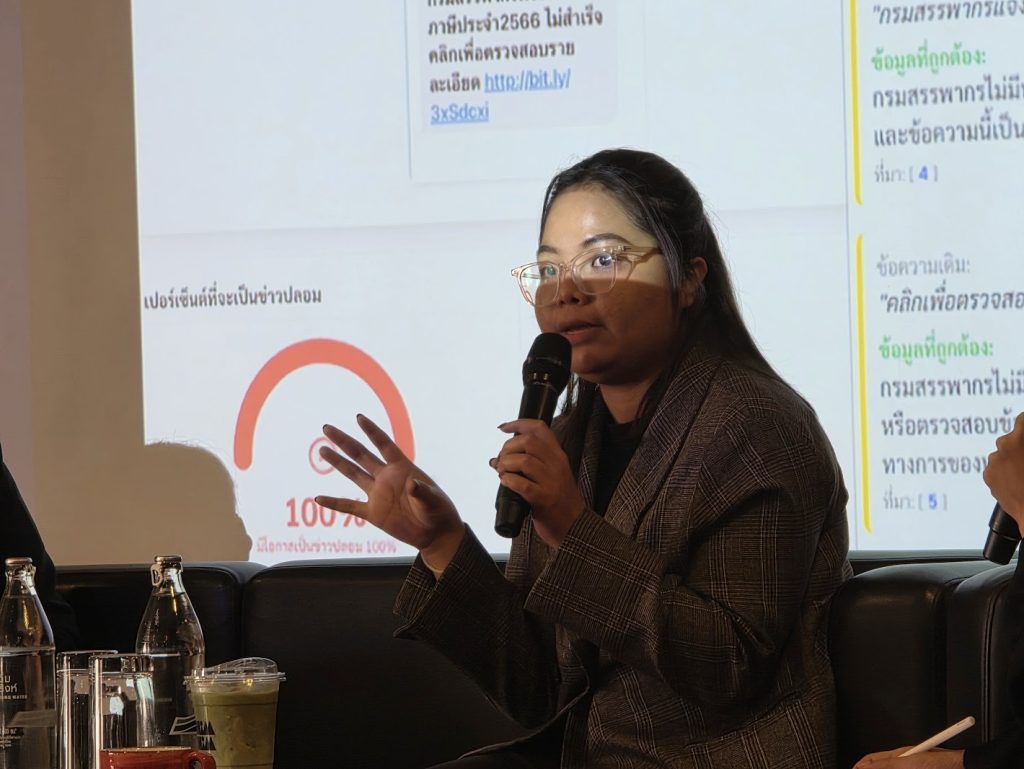
Dr. Watcharatiya Watcharobol, Senior Computer Technical Officer from the Digital Technology Division of the Public Relations Department
“AI content detection is inherently nuanced, making reliance on any single tool insufficient. Each system exhibits unique technical strengths—some demonstrate high accuracy in evaluating Western face deepfakes, whereas others offer superior performance for Asian demographics.”
She also cited a study from Australia, which revealed that while 89% of participants believed they could identify AI-generated images, only 42% accurately did so when tested. This highlights a clear gap between human confidence and reality.
Dr. Watcharatiya noted that AI detection models must be trained on diverse datasets because regional contexts vary significantly. A model that performs well in Europe may not be as effective in detecting fake content within Asia.
Development of “Fake News Deep Verify” for Real-Time Verification of Fake Text, Images, and Fraudulent SMS
Highlighting the readiness and adaptation of public sector bodies such as the Public Relations Department amid the AI era, Dr. Watcharatiya unveiled “Fake News Deep Verify”—a collaborative development with a research team. Leveraging AI optimized for local Thai contexts, the platform provides real-time verification of text, visual screenshots, infographics, and deceptive SMS communications.
The system won the top prize at the WSIS Forum, beating out over 1,700 submissions from more than 80 countries.
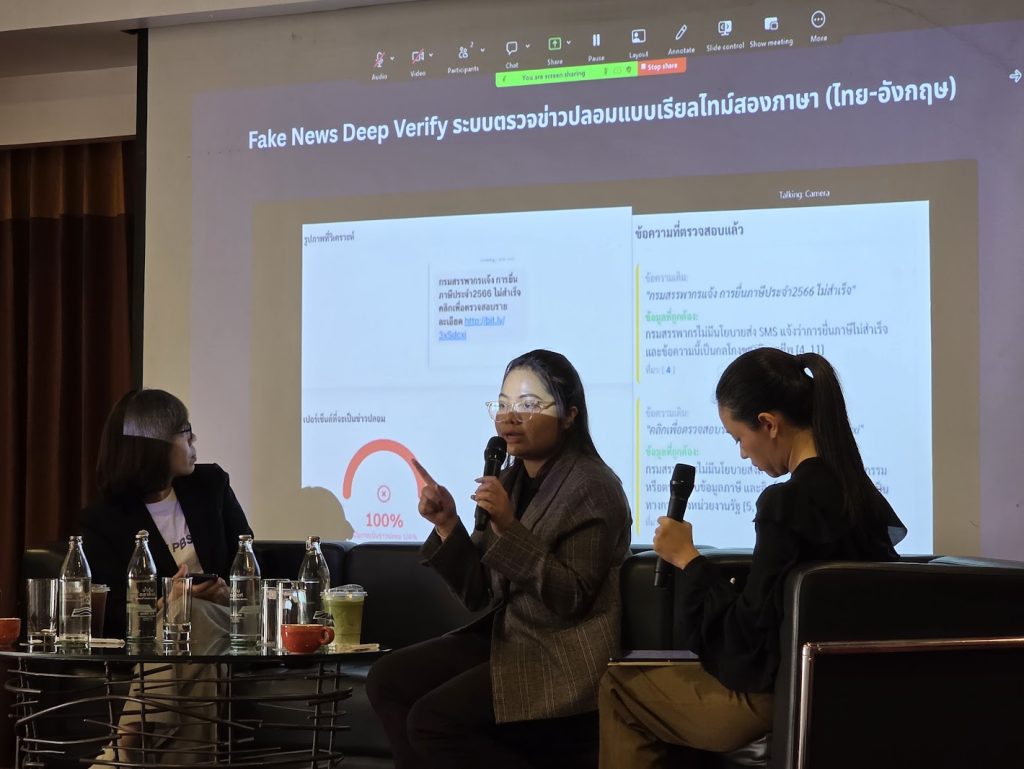
Nevertheless, she stressed that AI cannot guarantee 100% precision. As a result, users should avoid depending entirely on the system’s output and instead treat it as a supplementary decision-making aid. Additionally, the system offers recommendations for correcting inaccuracies, with plans to link operations with pertinent organizations to route information for deeper investigation.
In addition, the system significantly reduces fact-checking time. While verifying foreign news previously took as long as 7 to 8 hours, this system can aggregate data from multiple sources and deliver results in under a minute for text or infographics. This eliminates the need for fact-checkers to manually search across various websites, allowing them to access relevant information quickly and efficiently from a single dashboard.
Fostering Public Trust Amidst the Rise of Fake News
According to Ms. Kanokporn Prasitphol, Director of the Digital Media Center at Thai PBS, cultivating public trust hinges on multiple core pillars.
First is Transparency: people are willing to accept mistakes as long as organizations do not hide or cover up information, but are ready to disclose the facts openly and honestly.
Second is Explainability: being able to explain the verification process. In fact-checking, simply labeling information as “true” or “false” is no longer enough. Fact-checkers must explain which tools were used, what evidence was gathered, and the limitations of each tool, allowing the public to understand how conclusions were reached.
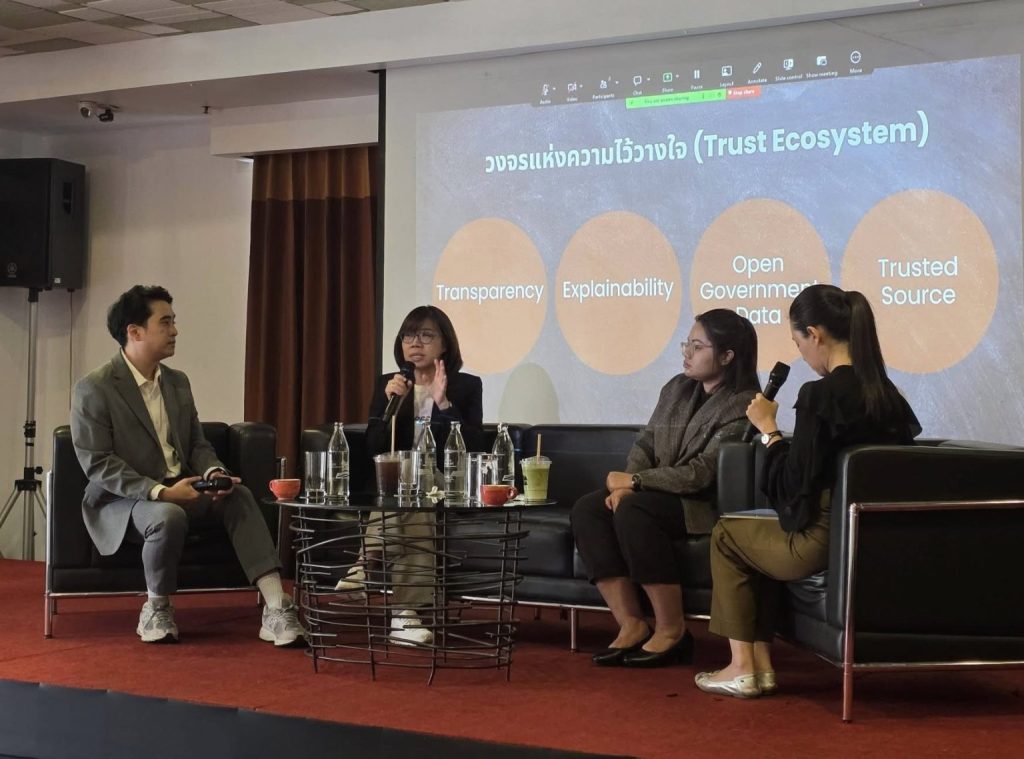
Equally important, the public sector ought to proactively disclose essential public information as Open Data. Empowering citizens to seamlessly access and repurpose this data functions as a fundamental public service, reinforcing long-term public trust in government.
Moreover, the public sector has a core duty to act as an authoritative information hub, empowering citizens to access accurate and actionable data during key moments of crisis.
” Swiftly inform the public about what we know—and be equally clear about what we do not. “
Asst. Prof. Dr. Ekkapol Thiarathavorn, a faculty member at Thammasat University’s Faculty of Journalism and Mass Communication, stated that combating misinformation in times of crisis does not require having all the answers before speaking out. Rather, organizations should promptly disclose what they currently know, acknowledge what remains unknown, and specify when to expect subsequent updates.
He emphasized that this strategy represents a highly effective mechanism for countering misinformation. During crises or natural disasters, public demand for information surges. Should state agencies fail to deliver prompt updates, a communication gap inevitably opens up, enabling rumors and misleading narratives to proliferate rapidly.
Therefore, if agencies can communicate immediately about what is happening, what information is confirmed, what is still being investigated, and when the next update will occur—such as within a specified number of hours—while assuring the public that they will report only verified facts and be honest about unconfirmed details, it will significantly boost their credibility.
” The most important thing is sincerity: if you know, say you know; if you don’t, say you don’t,” said Asst. Prof. Dr. Ekkapol.
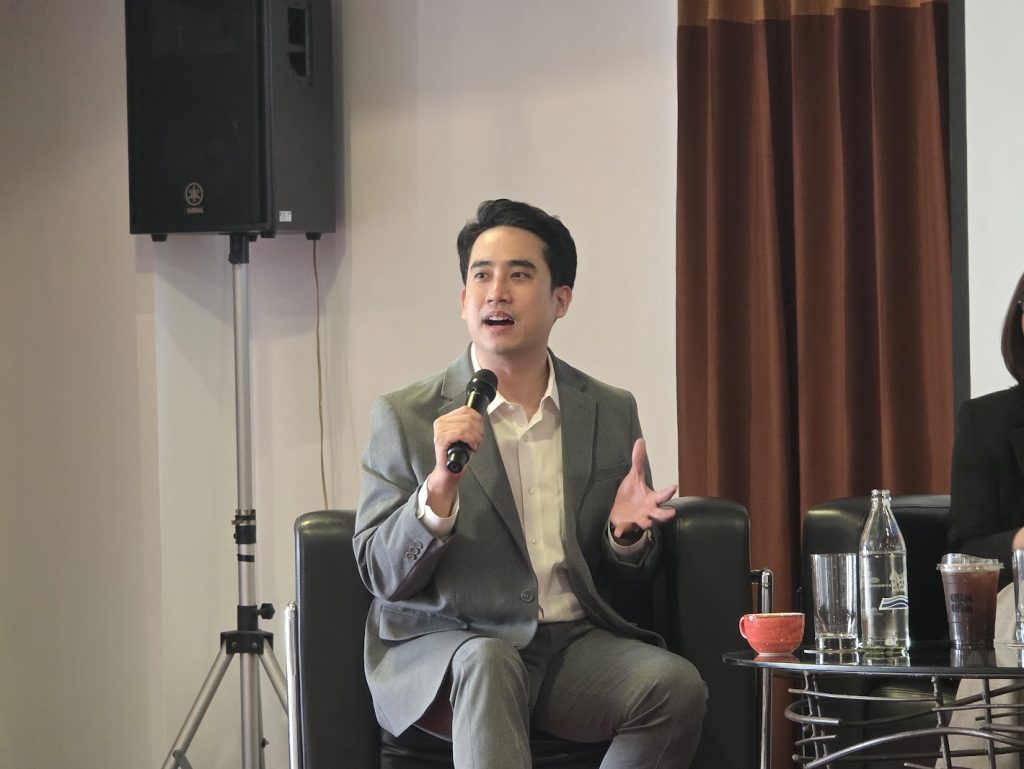
Asst. Prof. Dr. Ekkapol Thiarathavorn, a faculty member at Thammasat University’s Faculty of Journalism and Mass Communication
Dr. Watcharatiya Watcharobol, Senior Computer Technical Officer at the Public Relations Department’s Digital Technology Division, emphasized that in major events, citizens demand immediate information.
Consequently, government bodies need to accurately read the situation, identify public information needs, and engage in proactive communication to stay ahead of unfolding events.
While precision is paramount, delayed messaging from public authorities invariably allows fake news to gain early traction. Hence, all departments must operate proactively and drive the “Verify Before You Share” initiative—prompting the public to authenticate information before dissemination—alongside accelerating internal workflows to ensure accurate data reaches citizens without delay.
Cultivating public trust fundamentally begins with establishing credibility internally.
According to Ms. Kanokporn, policy-related visuals and information are often redistributed, triggering widespread misinterpretations. While the primary government entity holds the definitive truth, containment and course-correction are difficult after broad dissemination—most notably within closed-loop ecosystems such as LINE, where direct official clarification is restricted.
Consequently, government bodies must actively monitor discussions concerning their core responsibilities and deliver prompt, factual responses to set the record straight.
Moreover, Ms. Kanokporn illustrated this with Thai PBS’s operational standards, which mandate stringent verification protocols to prevent the organization from becoming a vector for fake news. Under this framework, all media assets are subjected to cross-departmental review prior to dissemination.
At the same time, organizations must not overlook external factors, such as the unauthorized use of news anchors’ images or video clips. These incidents directly impact the organization’s reputation and credibility.

In government institutions, building public trust is not confined to the PR department. Rather, the entire workforce—from frontline security personnel to executive leadership—must undergo reskilling to embrace organizational communication principles. As every individual acts as a face of the agency, all employees fundamentally shape public confidence.
Ms. Kanokporn cited the Central Investigation Bureau (CIB) as an example. Although it comprises various divisions and handles diverse missions, the CIB maintains a unified identity and standardized uniforms, making the organization easily recognizable and building public trust.
“ Trust isn’t built on content alone; it stems from every aspect of the brand—from its people and communication style to its overall corporate image—all of which reflect its credibility,” concluded Ms. Kanokporn.
Implement a proactive anti-disinformation system today—before a crisis forces your hand.
Asst. Prof. Dr. Ekkapol Thiarathavorn, a faculty member at Thammasat University’s Faculty of Journalism and Mass Communication, stated that the immediate step for agencies addressing misinformation is to set up an internal preparedness framework. Every unit must evaluate its vulnerability—specifically mapping out an action plan should misleading content concerning its mandate emerge over the next few days.
To illustrate, a health ministry should formulate contingency plans for outbreak-related misinformation. Conversely, a transportation authority must develop response protocols for fraudulent driver’s licensing schemes or fake updates regarding agency services.
” We should start by asking ourselves: if an incident occurs today, are we ready? If not, what system do we need? This is something we can begin doing right now,” said Asst. Prof. Dr. Ekkapol.
Furthermore, Ms. Kanokporn Prasitphol, Director of the Digital Media Center at Thai PBS, highlighted that public entities should not act reactively after casualties or incidents arise. While fake news detection frameworks typically depend on precedent data for optimization, agencies can adopt a proactive posture through “Prebunking”—a preventive approach designed to inoculate against potential misinformation.
Preventive communication helps build immunity among the public, letting people know in advance where to verify information if they encounter content of that nature—eliminating the need to wait for damage to occur before issuing clarifications.
Moreover, Ms. Kanokporn highlighted that AI integration has accelerated the volume and evolution of synthetic disinformation, compounding the challenges of verification. To mitigate this, AI-driven fact-checking systems must undergo continuous optimization to match the pace of evolving manipulation tactics.