Attacked Iranian warship video distorted to claim Iran’s strikes on Indian tankers in Strait of Hormuz
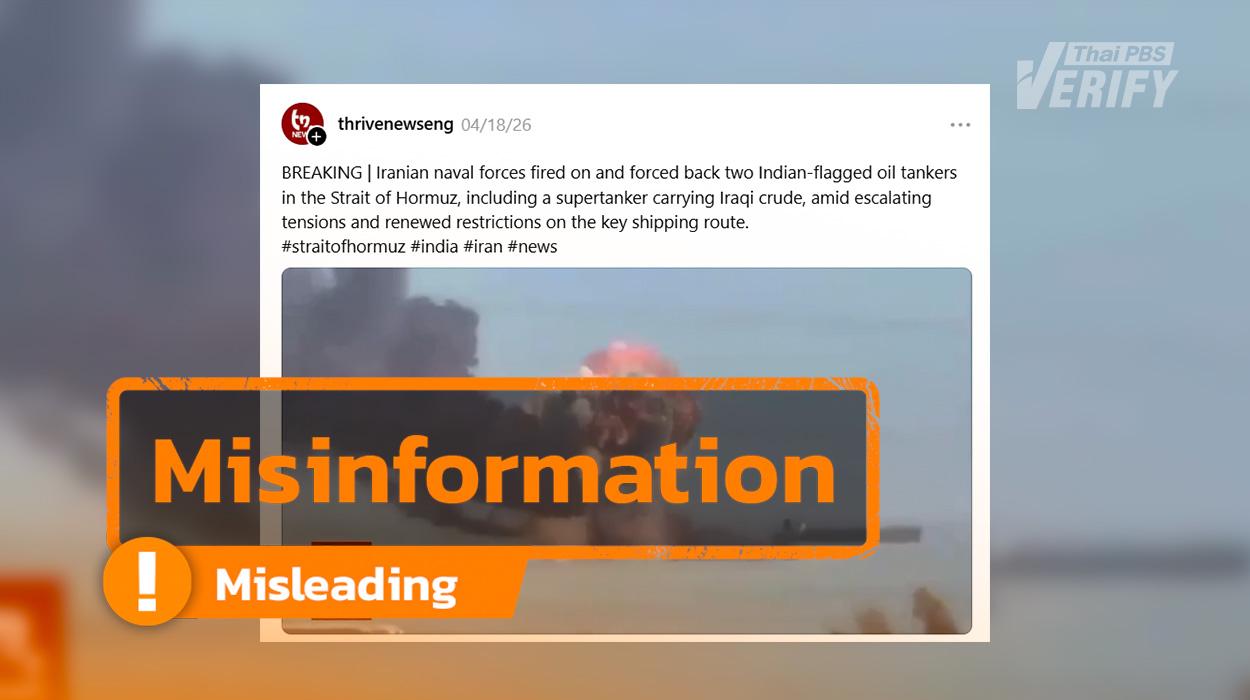
Thai PBS Verify found the piece of misinformation on: Threads
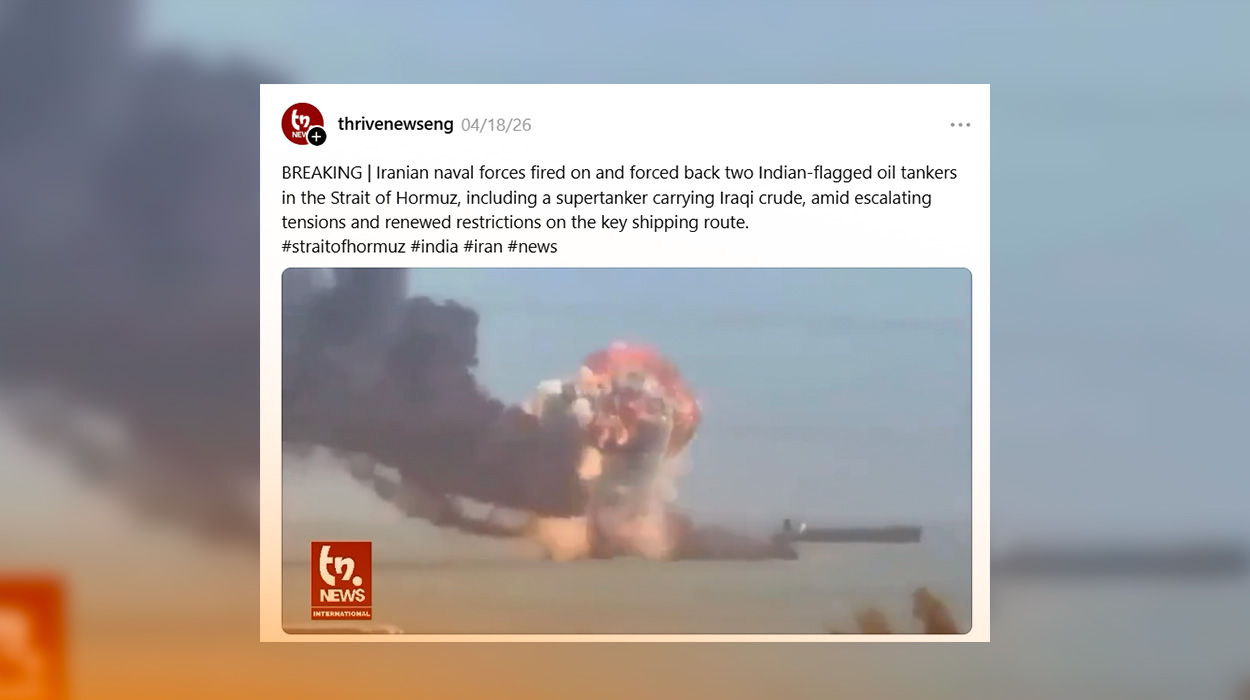
A misleading post by user ‘thriveneweng,’ was published on April 18, 2026.
On April 18, 2026, a video was shared on Threads by ‘thriveneweng.’ It depicts a violent explosion on the deck of a ship after being attacked. It includes the following caption:
“BREAKING | Iranian naval forces fired on and forced back two Indian-flagged oil tankers in the Strait of Hormuz, including a supertanker carrying Iraqi crude, amid escalating tensions and renewed restrictions on the key shipping route.
“#straitofhormuz #india #iran #news”
The post gained 386 likes, 28 reposts, 42 shares and 79 comments. The majority of commentors suggested that the footage was fake, while some presented their argumentative thoughts.
The video in question is real, but decontextualized
Thai PBS Verify checked the video’s authenticity via Google Lens. The results revealed that the clip was misrepresented. Far from being an attack on Indian vessels, the footage actually captures an Iranian naval ship under fire from U.S. missiles on March 8, 2026, shortly after the onset of hostilities.
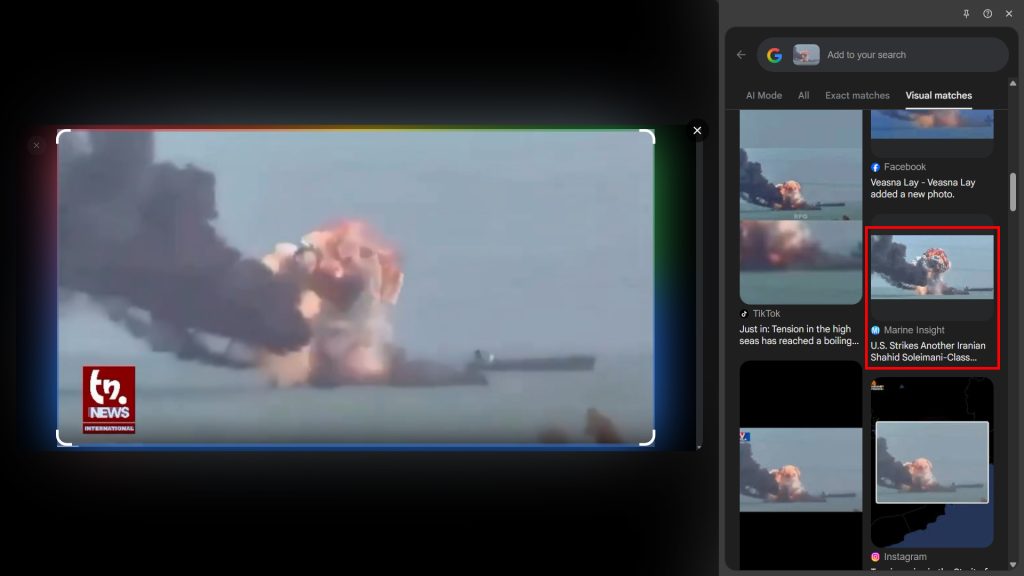
Search results from Google Lens show that this image corresponds with events from March 8, 2026, at the start of the Middle East conflict.
Additional reports from Marine Insight on March 11, 2026, also featured the same video, sourced from the X account ‘OSINTdefender.’ Their report states the following:
“United States forces have struck another Iranian missile corvette from the Shahid Soleimani class in the Persian Gulf, according to open-source reports.
“The vessel, identified as IRIS Haj Qasem, was reportedly hit on March 8, 2026, while anchored off Bandar Lengeh on Iran’s southern coast.
“Visual analysis of footage shared on social media confirmed the identity of the catamaran-style warship.
“Open-source claims suggested that three vessels were targeted in the strike, although only the Shahid Soleimani-class corvette has been visually confirmed so far.
“Images and video footage circulating online appear to show an explosion on a vessel believed to belong to the Islamic Revolutionary Guard Corps Navy (IRGCN).
“The footage was shared by the OSINTdefender account, which said the blast happened after a US strike off the coast of Bandar Lengeh.”
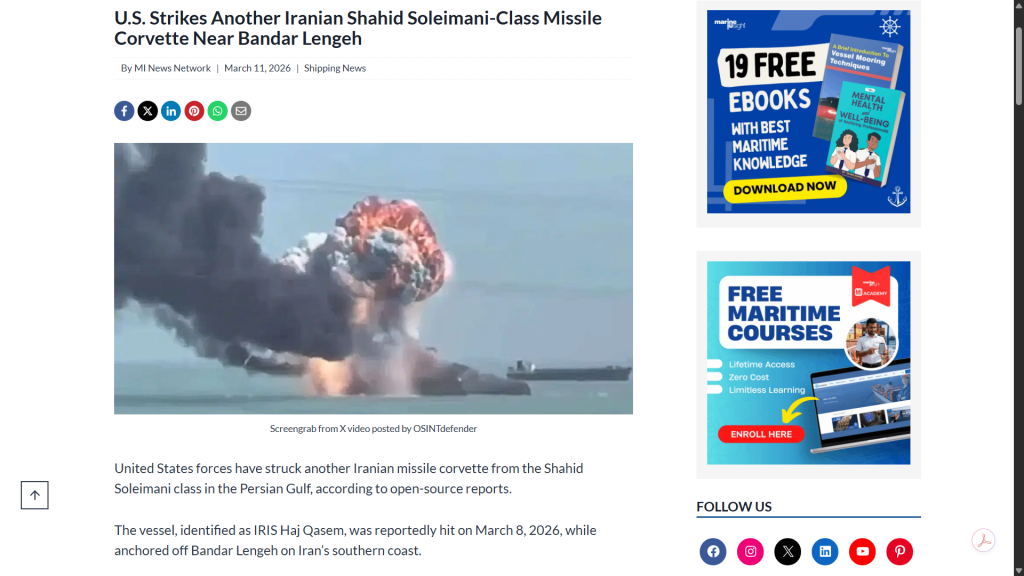
A screenshot of the Marine Insight article, dated March 11, 2026.
What model was the destroyed Iranian vessel?
Thai PBS Verify conducted further research into the ‘Shahid Soleimani’ corvette mentioned in the Marine Insight report. Our investigation led to additional data from the TV SSN website, which can be summarized as follows:
The IRIS Shahid Soleimani (hull number FS 313-01) is a guided-missile corvette developed by the Shahid Mahallati Marine Industries in collaboration with the Iranian Ministry of Defense. It was officially commissioned into the Islamic Revolutionary Guard Corps Navy (IRGC Navy) in 2022.
This Iranian-designed catamaran uses a sharp, angular hull to lower its radar visibility and is built from aluminum alloy for improved performance. It is the first Iranian vessel to feature a Vertical Launch System, carrying missiles with a 700 km range. Additionally, it is outfitted with 24 decoy systems and an internal hangar located in the ship’s midsection.
The success of this lead vessel paved the way for the construction of subsequent ships within the same class. In the following years, additional vessels were commissioned as follows:
- IRIS Hassan Bagheri FS 313-02
- IRIS Shahid Sayyad Shirazi FS 313-03
- IRIS Shahid Rais-Ali Delvari FS 313-04
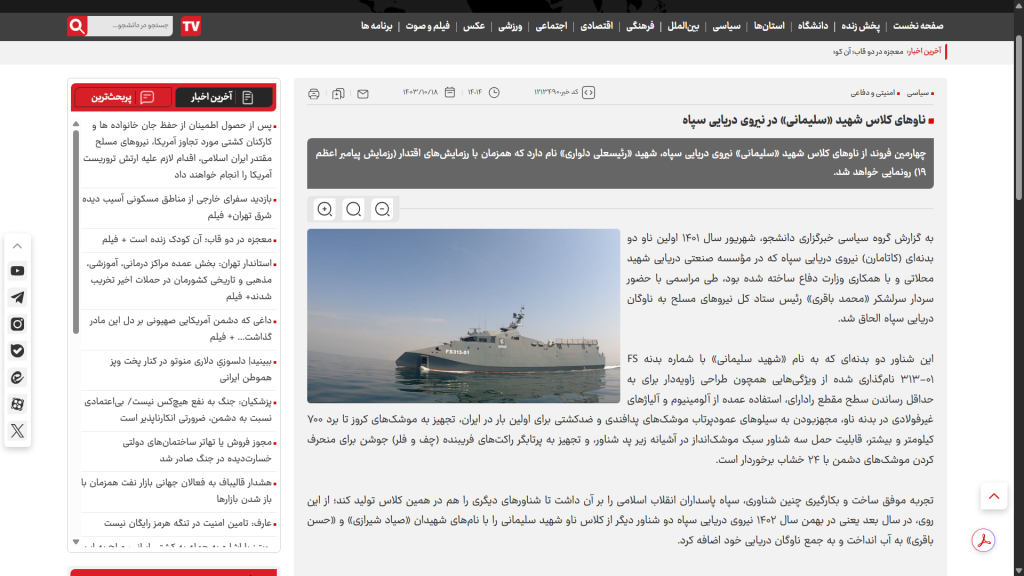
A news report featuring the Shahid Soleimani corvette, published by TV SSN on October 18, 2023.
Is it true that Indian oil tankers were attacked?
Thai PBS Verify conducted further research into the alleged Iranian attack on Indian oil tankers, and identified a report published by Reuters on April 18, 2026. The details are below:
“Two Indian-flagged vessels carrying crude oil were on Saturday attacked while attempting to cross the Strait of Hormuz, India’s Ministry of External Affairs confirmed in a statement.
“Tehran’s ambassador to New Delhi, Mohammad Fathali, was called in for a meeting with India‘s Foreign Secretary Vikram Misri during which Misri conveyed India’s deep concern at the shooting incident involving two Indian-flagged ships in the Strait of Hormuz.
“One of the vessels attacked was identified as the Sanmar Herald, an Indian government source said. The crew on board and the vessel were safe, the source said.”
What is the truth?
Thai PBS Verify has flagged a viral post from April 18, 2026, as misleading. The video, which purports to show the Iranian Navy attacking two Indian-flagged tankers, is a clear case of decontextualized media. The explosion captured in the video is actually from an operation on March 8, 2026, where U.S. forces struck an Iranian naval vessel, the IRIS Haj Qasem, near Bandar Lengeh. It is not, as claimed, an attack on Indian commercial shipping.
Nevertheless, the claims are based on a real event. Reuters confirmed that on April 18, 2026, two Indian-flagged oil tankers, one being the Sanmar Herald, were indeed fired upon by the Iranian Navy in the Strait of Hormuz, sparking a diplomatic summons in New Delhi. However, the video used in the Threads post is not footage of that encounter, but rather an entirely different military operation.
Verification Process
- Image verification: By performing a reverse image search via Google Lens, the team identified the true source of the footage. The visuals align with an incident involving an Iranian naval vessel targeted on March 8, 2026—a fact supported by Marine Insight’s coverage and a video shared by ‘OSINTdefender’ on X.
- Keyword search & authentication: A targeted keyword search was conducted, leading to the identification of the actual Shahid Soleimani-class corvette targeted by U.S. forces. This process confirmed that the vessel in the footage was indeed a legitimate asset of the Iranian Navy.
- Comparative analysis: We cross-referenced the video with international news reports from Reuters and Marine Insight. While these agencies confirmed the reality of an attack on Indian ships, their verified documentation proves that the viral footage is being used out of context and is not related to that specific incident.
Potential impacts of misinformation
- Causing misunderstanding on tactics and weaponry: Misidentifying a corvette as an oil tanker misleads the audience regarding the nature of the damage and the specific targets involved in actual combat operations.
- Provoking conflict through decontextualized evidence: Using the wrong footage to depict a real diplomatic crisis can incite undue anger and push for military escalation. It is a prime example of how misinformation can be weaponized to demand retaliation based on false premises.
- Eroding public trust in current reporting: When footage from one event is misrepresented as another, it breeds public confusion and undermines the credibility of legitimate news reports concerning ongoing global events.
- Using sensationalism for engagement: The strategic use of ‘BREAKING’ headlines paired with dramatic explosion footage is often designed to maximize reach and social sharing. This prioritizes virality and engagement over factual accuracy and journalistic integrity.
What to do with this misinformation?
- Verify visual and contextual consistency: Always observe whether the vessel’s characteristics in the video align with the type mentioned in the report. For instance, the structural design and armament of a warship are distinctly different from those of a commercial oil tanker.
- Cross-reference with reputable news agencies: When encountering footage of violent incidents, it is essential to verify it against reports from high-credibility global outlets such as Reuters or AP. This ensures that the visuals are authentic and accurately correspond to the event being reported.
- Utilize visual search tools: If a video of an attack appears suspicious, take a screenshot and perform a reverse search via Google Lens. This allows you to determine if the footage was previously published in a different context or if it originally depicted an entirely different vessel.
- Exercise caution with heavily-hashtagged posts: Accounts involved in disseminating misinformation often employ trending hashtags—such as #straitofhormuz, #india, and #iran—to artificially broaden their reach. This tactic is designed to inject their content into the feeds of audiences who are actively following those specific news topics.
- Follow fact-checking channels: It is highly recommended to consult dedicated fact-checking organizations. These entities provide information that has undergone rigorous comparative analysis and careful cross-referencing from multiple reliable sources.