Cambodia’s request to Thailand to open checkpoint found to be baseless claim
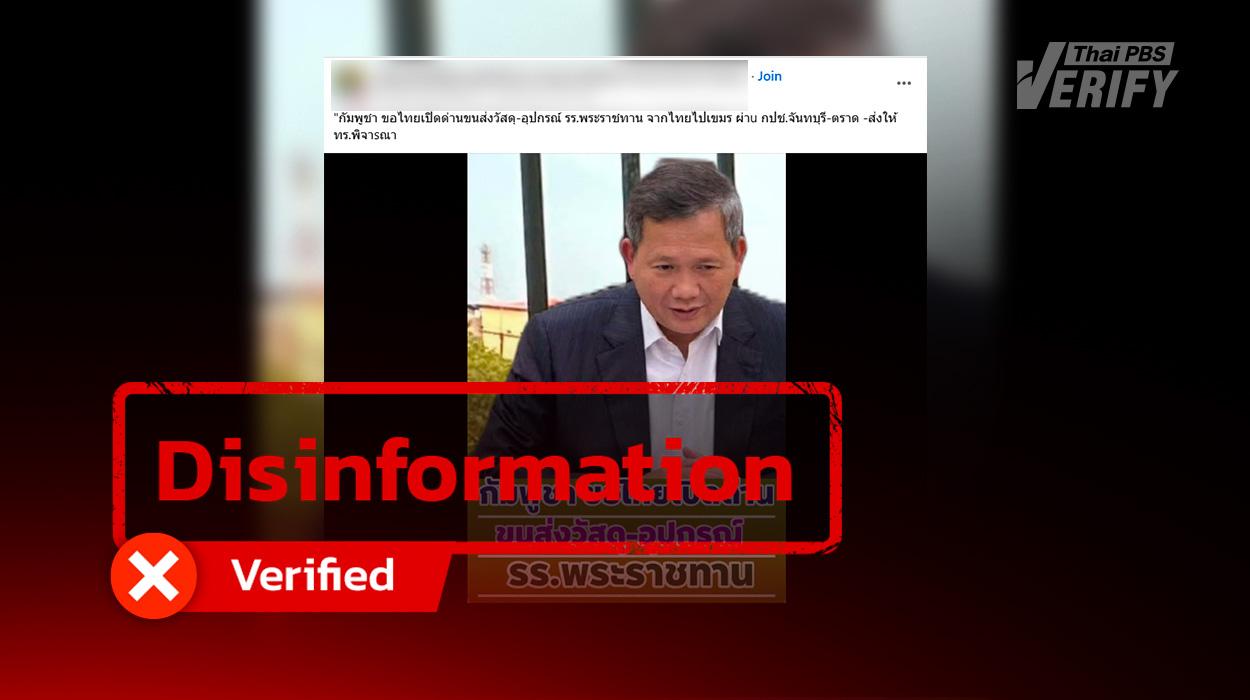
Thai PBS Verify found the piece of disinformation on: Facebook
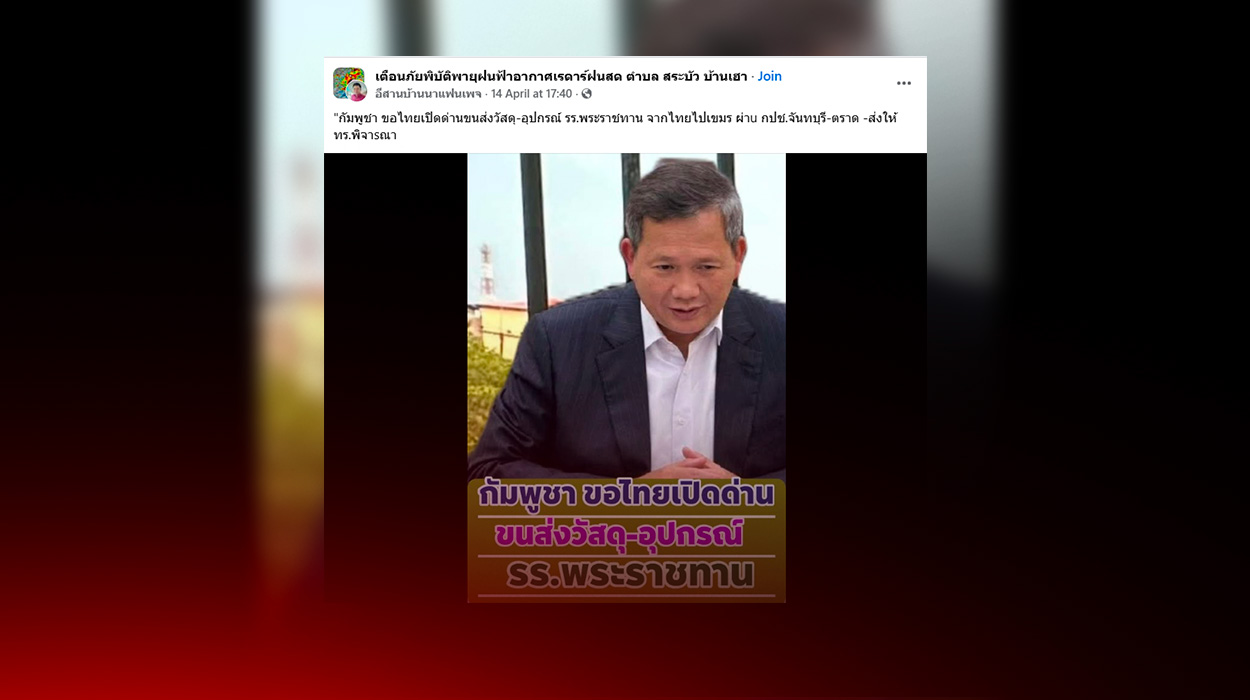
A screenshot of the claim in question on a Facebook group.
Thai PBS Verify found that the Facebook page “Isan Banna Fanpage (อีสานบ้านนาแฟนเพจ)” shared this image on a Facebook group. The post features the image of Cambodian PM Hun Manet, along with the text: “Cambodia asks Thailand to open a checkpoint to transport materials and equipment for a royal school.”
In addition, the caption states: “Cambodia asks Thailand to open a checkpoint to transport materials and equipment for a school under the royal patronage, from Thailand to Cambodia via the Chanthaburi–Trat Border Defense Command, forwarded to the Royal Thai Navy for consideration.”
The post received 53 reactions, 58 comments, and was shared more than 3 times.
Do schools under the Royal patronage in Cambodia exist?
Thai PBS Verify used the keyword search “schools under the royal patronage in Cambodia (โรงเรียนพระราชทาน ในกัมพูชา)” and found that there are two such institutions:
1) Kampong Chheuteal Institute of Technology
This is a project bestowed by Her Royal Highness Princess Maha Chakri Sirindhorn to the people of Cambodia, as a gesture of goodwill and to promote sustainable educational development.
The project began operations in 2001 in Kampong Thom Province.
The support includes school buildings, academic and vocational curricula, teacher training programs, and scholarships for students to continue their studies in Thailand.
The location on Google Maps
2) Kampong Speu Institute of Technology (KSIT)
This is the second institution under the royal initiative to provide assistance to Cambodia, located in Kampong Speu Province.
It was established in 2016, focusing on bachelor’s degree and diploma programs in technology, agriculture, and electrical engineering. Also, the Thai government and private sector jointly support infrastructure, teaching equipment and academic experts.
The location on Google Maps
Thailand does not open a checkpoint to transport materials and equipment for any schools
Thai PBS Verify searched the keywords “Thailand opens route to send goods to Cambodia (ไทยเปิดทางส่งของไปกัมพูชา),” and found that on April 14, 2026, the Royal Thai Navy spokesperson’s Facebook page stated the following:
“Rear Admiral Parach Rattanachaiyapan, spokesperson for the Royal Thai Navy, addressed rumors on social media claiming that Thailand would open a route to transport relief supplies from Thailand to Cambodia via the Chanthaburi–Trat border area. The Royal Thai Navy confirms that such information is ‘not true’ and is ‘fake news.’ If Cambodia requires assistance due to the hardship of its people facing unemployment and poverty as a result of misguided decisions by its leadership, it should proceed through existing diplomatic channels.
“The Royal Thai Navy has no policy to open any checkpoints or routes. It continues to strictly enforce border control measures in accordance with the law and national security framework. The spokesperson acknowledged that such information is currently being circulated in a way that could mislead the public and may be an ongoing attempt to stir sentiment from the Cambodian side, from the period of past clashes up to the present. The Royal Thai Navy is in the process of investigating the source of this information and will take legal action against those who disseminate false information. The public is urged to exercise discretion, verify information from official sources before sharing, and refrain from spreading fake news, especially disinformation originating from opposing sides.”
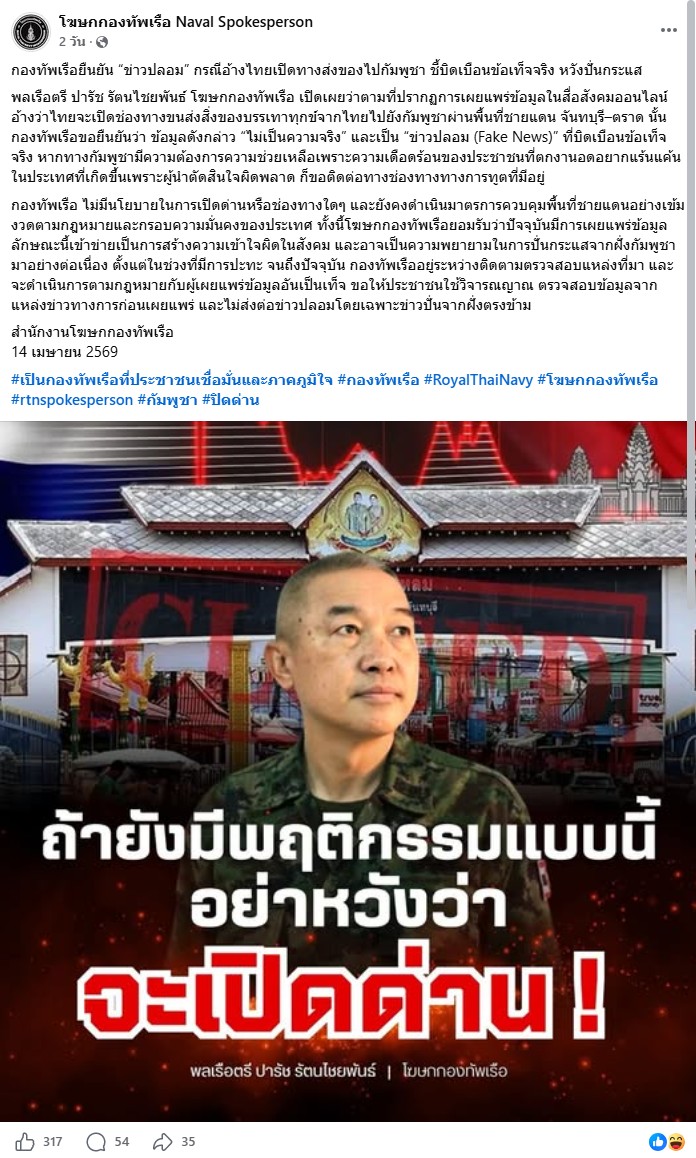
A screenshot of the Royal Thai Navy spokesperson’s statement regarding the rumored opening of the Chanthaburi–Trat border checkpoint.
Meanwhile, on April 15, 2026, Prime minister Anutin Charnvirakul confirmed that Thailand has not opened any border checkpoints in the Chanthaburi–Trat area, and that there has been no discussion or coordination with Cambodia on this matter. He stated that he has not received any report regarding this issue, and that diplomatic processes have not yet begun. Any potential action would need to start with restoring bilateral relations first, emphasizing that it is not yet the time to reopen border checkpoints.
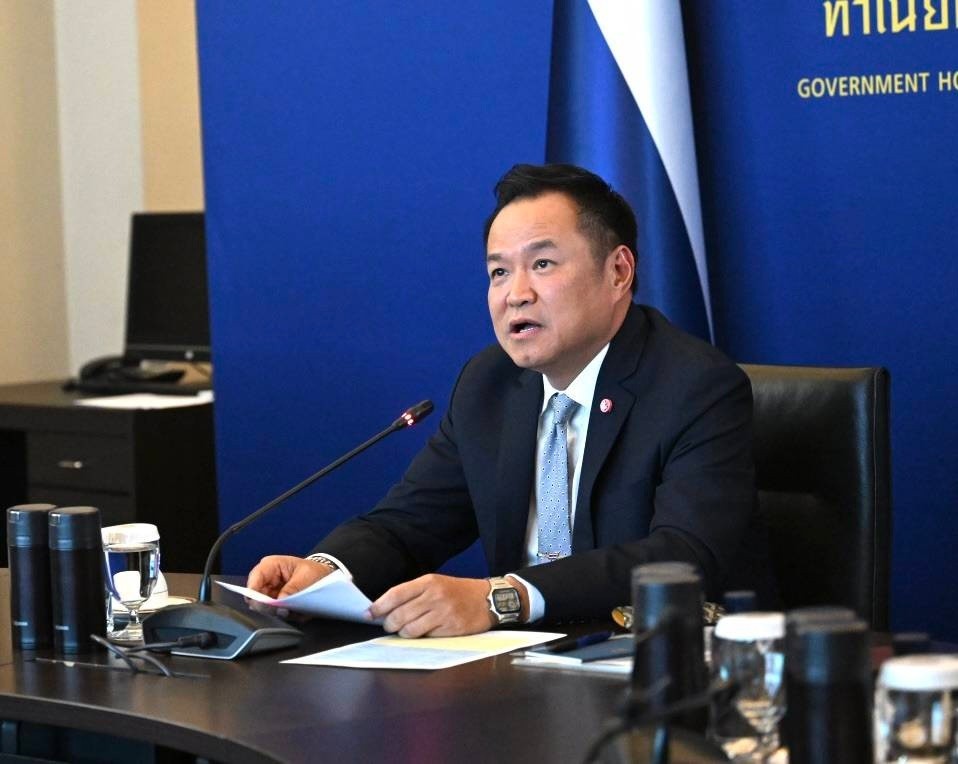
Anutin Charnvirakul, Prime minister of Thailand
Cambodia responds to the claim, denying such checkpoint request
Thai PBS Verify further conducted a keyword search with “Cambodia” and found that the Cambodian news website khmertimeskh reported that the Cambodian Ministry of Defense denied the claim that “Cambodia requested the opening of a border checkpoint to receive and send emergency supplies.” It confirmed that such claim is false information intended to mislead both domestic and international audiences.
The statement also noted that the border closure was a unilateral decision by Thailand, and therefore any reopening would depend solely on Thailand. Cambodia affirmed that it stands ready to act appropriately according to the situation and urged the public to exercise discretion and not believe or spread distorted information.
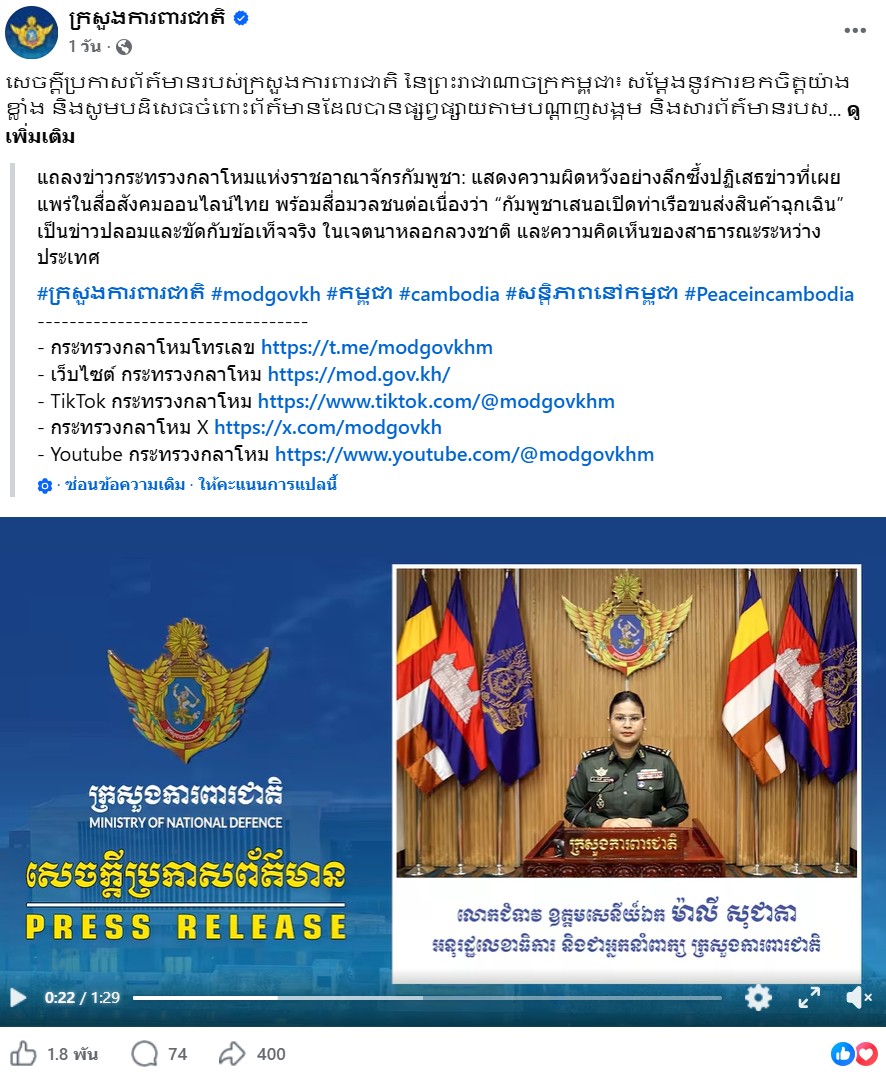
A screenshot of the Ministry of Defense’s communication on its Facebook page
What is the truth?
Thai PBS Verify investigated the claim on social media that Cambodia had asked Thailand to open a checkpoint to transport materials and equipment for a school under the royal patronage. The team found that it was fake news. Keyword searches show that Thailand has confirmed it will not open the border, while the issue of schools under the patronage is indeed a genuine cooperation between Thailand and Cambodia, but it has been used to construct this misleading claim to make it appear more credible.
Verification Process
- Keyword search: Thai PBS Verify used the keyword “schools under the royal patronage in Cambodia,” and found that there are two institutions: Kampong Chheuteal Institute of Technology and Kampong Speu Institute of Technology.
- Keyword search: Thai PBS Verify looked for “Thailand opens route to send goods to Cambodia” on a search engine, and found that on April 14, 2026, the Royal Thai Navy Facebook page issued a denial of any border opening.
- Keyword search: The Cambodian Ministry of Defense confirmed that the issue of requesting the opening of a border checkpoint is fake news.
Potential impacts of disinformation
- Affecting international relations: Misinformation may create misunderstandings between Thai and Cambodian people and put pressure on diplomatic relations if one side is believed to have “requested” or “denied” something that is not true.
- Creating confusion in society: The public may misunderstand border policies, such as believing that checkpoints have already been opened when in fact they have not, leading to widespread misinformation.
- Undermining trust in government agencies: When conflicting information appears between fake news and official statements, it may cause some people to lose trust in official sources or become uncertain about what is true.
- Affecting security and safety: Border issues are sensitive. Fake news may be interpreted in a security context, causing unnecessary panic or fueling nationalist sentiment.
- Confusing decision-making to the public: People living or working in border areas may make incorrect plans, such as in travel, trade or transportation of goods.
What to do with this misinformation?
- Do not believe or share immediately: News related to “borders” or “foreign countries” can be easily distorted. Always pause before sharing.
- Check the source: Verify whether it comes from official media or if it has been confirmed by government agencies or reliable news organizations.
- Compare information with multiple sources: Search for the same news from different outlets, especially official statements from relevant authorities.
- Be cautious of misleading headlines: Fake news often uses strong or vague wording such as “urgent,” “secret,” or “opened” to encourage sharing.
- Check date and context: Sometimes old news or unrelated events are reused and mixed together, causing misunderstanding.
- Examine supporting evidence: Images or videos may be edited or taken out of context. Always verify whether they match the information provided.
- Follow official clarifications: In cases like this, rely on information from government or security agencies as primary sources.
- Do not share unverified information: Even with good intentions, sharing unconfirmed news can help spread misinformation further.