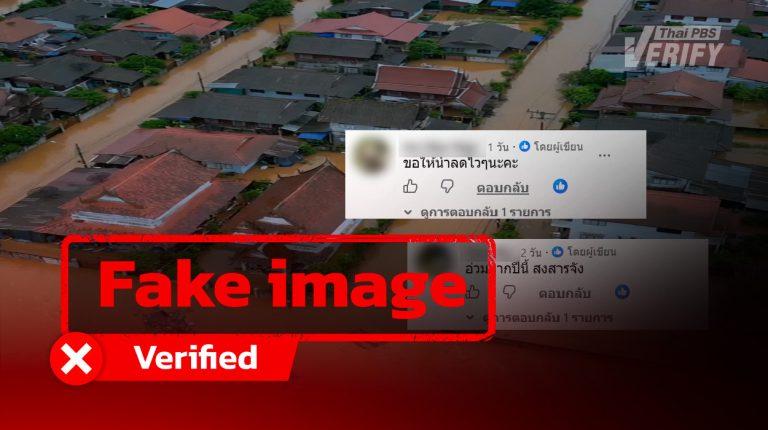
Clip claims “water overflowing at Khun Dan Prakan Chon Dam” — but it is only waves and wind causing water to flow out
Thai PBS Verify found the source of the information from: Facebook.
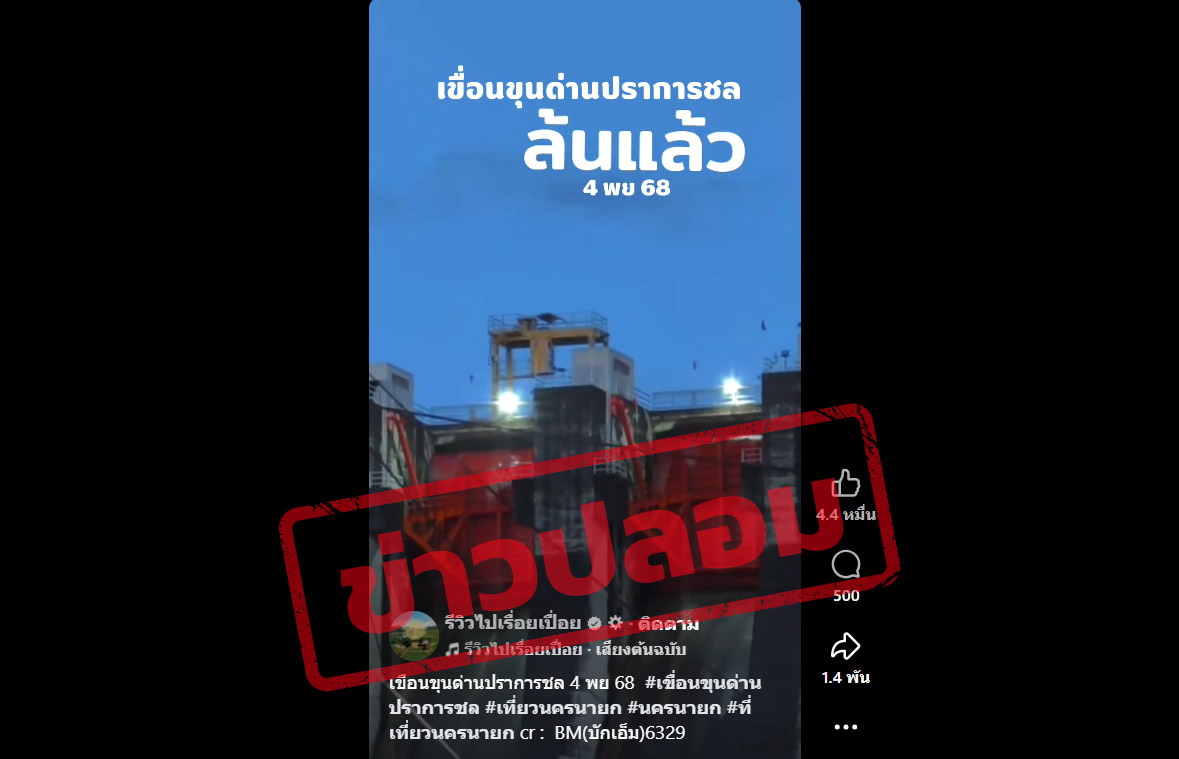
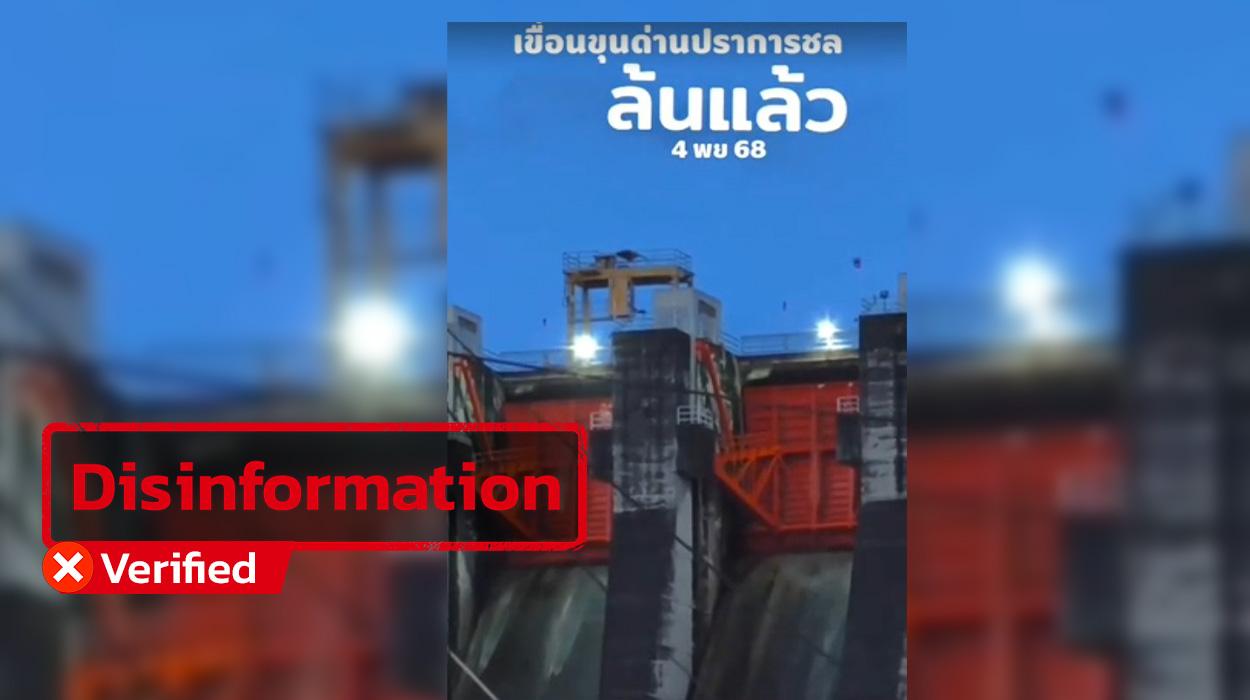
Checks found a clip claiming that water was overflowing at Khun Dan Prakan Chon Dam in Nakhon Nayok. The footage shows water flowing over the dam’s spillway, drawing more than 2 million views, over 40,000 likes, and more than 1,000 shares. Similar clips were also found on TikTok, posted with the caption:
Khun Dan Prakan Chon Dam, 4 November 2025.
Is Khun Dan Prakan Chon Dam really overflowing?
Thanes Somboon, Director of the Office of Water Management and Hydrology at the Royal Irrigation Department, told Thai PBS Verify that the water seen flowing from the spillway is due to the reservoir being full. The slight splashing through the side gaps of the spillway gates was caused by wind and wave action, not by water overflowing the spillway crest or the dam itself. Therefore, the situation poses no danger.

Thanes Somboon, Director of the Office of Water Management and Hydrology, Royal Irrigation Department.
“Normally, when a dam reaches full capacity and strong winds create waves, some splashing or slight overflow may be visible. This is a natural phenomenon that can occur in large dams holding water at full capacity.”
“The situation that would be considered dangerous is when water actually spills over the spillway gate or over the crest of the dam, which would be uncontrollable. But the Royal Irrigation Department will not allow such an event to occur, and at present the dam’s spillway structures remain in good condition.”
“The overall water situation is still normal. At the end of the rainy season, it is common for dams to reach full capacity. Currently, the dam is releasing more water than is flowing in each day. Even with Tropical Storm Kalmagi approaching, the dam can still store and release water sufficiently.”
The normal storage level of some dams is 100%, but they also have a maximum capacity that allows them to temporarily hold additional water during periods of heavy rainfall or when storms move in, without posing any danger to the dam’s structure.
At Khun Dan Prakan Chon Dam, as of 7 November 2025, the amount of stored water was at 99.13% of its total capacity, meaning the reservoir was almost completely full.
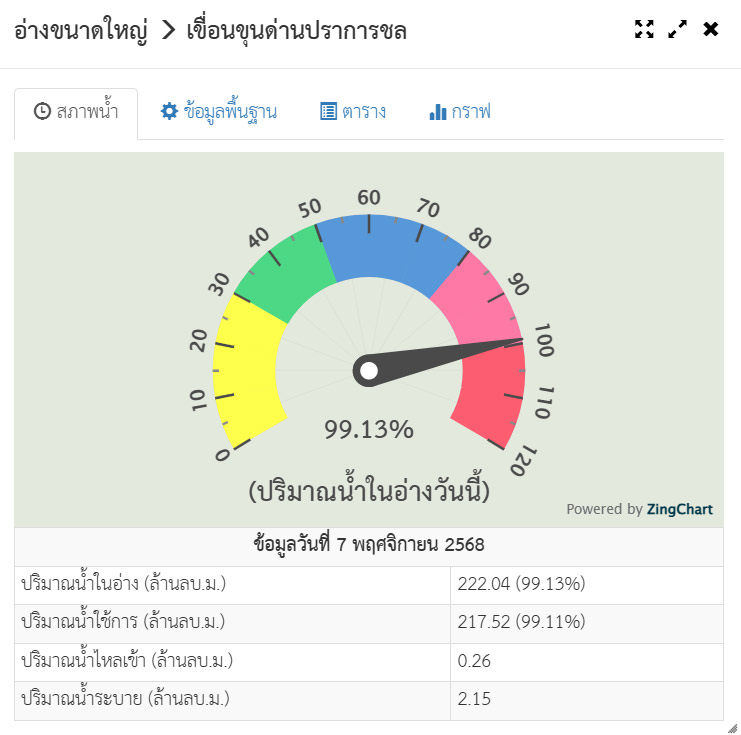
The image shows the current status of Khun Dan Prakan Chon Dam, which, as of 7 November 2025, had a stored water volume at 99.13% of its total capacity — nearly full — according to the Central Water and Irrigation Data Center.
How does Khun Dan Prakan Chon Dam release water?
The dam has multiple water-release systems designed to discharge water into the Nakhon Nayok River through three main channels, each serving a different purpose:
- River Outlet:
This is the water outlet located in the lower part of the dam. It is used to release water to maintain appropriate water levels in the Nakhon Nayok River, ensuring the ecological balance and supporting water use for downstream communities. It is commonly used during the dry season or normal conditions to release water according to irrigation plans.
- Bottom Outlet:
Located at the base of the dam (the lowest part of the concrete structure), this outlet releases water from the bottom of the reservoir or in emergency situations to control water levels. It can also be used to flush sediment or relieve water pressure behind the dam. It is controlled by large high-pressure steel gates.
- Service Spillway:
This is the main spillway used when the reservoir’s water level exceeds the normal storage level. At Khun Dan Prakan Chon Dam, it can release up to 1,454 cubic meters per second through its four spillway gates.
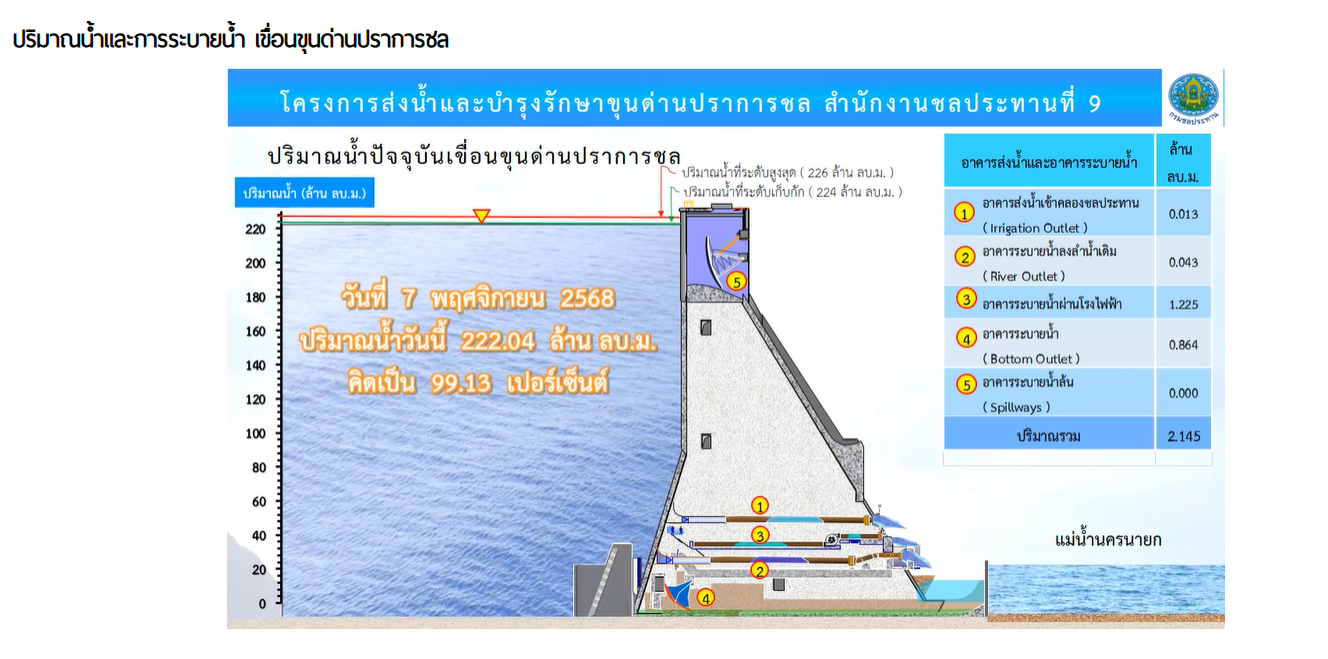
An example image of the water delivery and water discharge structures of Khun Dan Prakan Chon Dam.
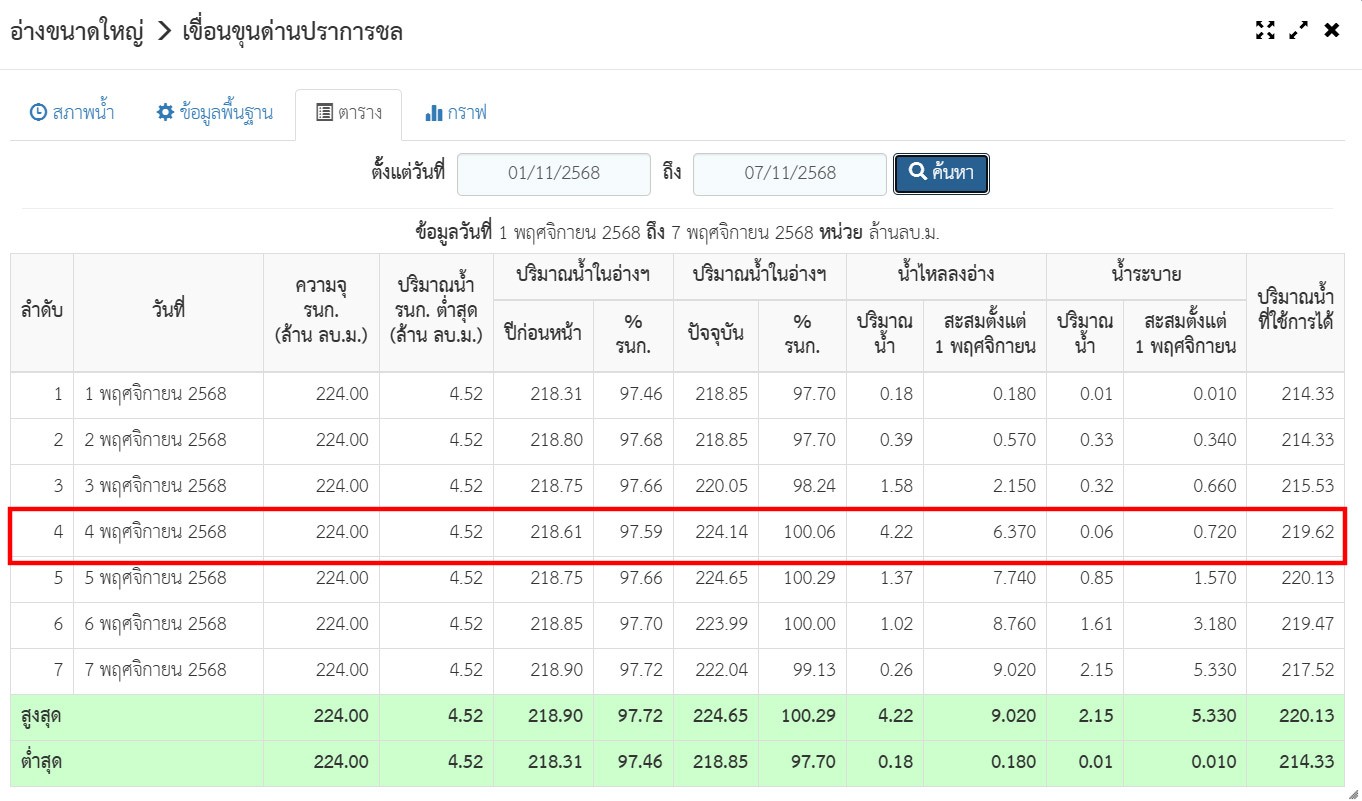
An image showing the overall water volume of Khun Dan Prakan Chon Dam on 4 November 2025, according to the Central Water and Irrigation Data Center.
Summary of the situation and monitoring
The Royal Irrigation Department’s summary of the water situation and monitoring for Friday, 7 November 2025 (data as of 6 November 2025) reported a total water volume of 68,617 million cubic meters, or 90% of reservoir capacity nationwide — 5,165 million cubic meters more than the same period last year. The amount of usable water was 44,668 million cubic meters. Large reservoirs across the country held a combined 63,809 million cubic meters (90%), with usable water at 40,270 million cubic meters (85%).
There were 21 reservoirs with water levels exceeding 80%, including Khun Dan Prakan Chon Dam in Nakhon Nayok. Another 12 reservoirs were above the Upper Rule Curve threshold.
Only one reservoir had less than 30% water volume, and two reservoirs were below the minimum control threshold (Lower Rule Curve): Khlong Siyad Dam, Chachoengsao, Bang Lang Dam, Yala. Overall, the water situation remains favorable, but close monitoring is necessary for reservoirs with high water levels approaching critical thresholds.
What’s the real story?
Thai PBS Verify investigated the clip claiming that “Khun Dan Prakan Chon Dam is overflowing” and found that it is not true. The Director of the Office of Water Management and Hydrology at the Royal Irrigation Department explained that the water seen flowing from the spillway occurs because the reservoir is full. The slight splashing through the side gaps of the spillway gates was caused by wind and wave action, not by water overflowing the spillway or the crest of the dam. Therefore, the situation is not dangerous, and the reservoir still has room within its maximum storage capacity.
Source: Basic Dam Safety Management — Royal Irrigation Department
Verification Process
- Image and video check using Google Lens:
Google Lens was used to search key frames from the clip. The results showed no matches from foreign sources or earlier posts, indicating that the footage was filmed on-site in Thailand and there was no sign of images taken from elsewhere.
2. Verification with Google Maps:
The physical features of the dam in the clip match those of Khun Dan Prakan Chon Dam.
3. Checking official data:
Information from the Central Water and Irrigation Data Center (Royal Irrigation Department), dated 4 November 2025, shows:
- Stored water volume: 219.62 million m³ (100.06%)
- Reservoir water level: 100.35 meters (MSL)
- Water flowing over the spillway: 4.22 million m³
- Water discharged: 0.06 million m³
These figures align with the Royal Irrigation Department’s explanation that “the reservoir is full but still manageable, and water can be released normally.”
4. Interview with the Office of Water Management and Hydrology, Royal Irrigation Department:
The Director confirmed that the water seen in the clip is splashing caused by wind and wave action, not water overflowing the spillway gates. He emphasized that Khun Dan Prakan Chon Dam remains safe and its structure is still in good condition.
Impacts of this false information
- Public panic in the area: The circulation of a clip claiming the dam was “overflowing” caused people in Nakhon Nayok and downstream areas to mistakenly fear a sudden flood, even though the dam was still in a safe and controlled condition.
- Disruption to government water management: When false news spreads widely, officials must spend time clarifying and addressing public concerns, which can slow down communication during actual emergencies.
- Amplification on social media: Footage showing strong water flow or alleged overflow can easily be altered or captioned with misleading statements, leading to further misleading clips that spread across multiple platforms.
- Misunderstanding about dam safety: Some people may believe the dam has broken, even though the spillway is a normal, purposely designed water-release structure. Such misunderstandings can fuel fear and lead to repeated sharing of inaccurate information.
What to do with this misinformation?
- Verify with official agencies before sharing: Before forwarding or posting clips related to dams, check updates from official pages or websites of the Royal Irrigation Department or the Department of Disaster Prevention and Mitigation (DDPM), which provide daily water situation reports.
- Use tools to verify images or videos: Tools like Google Lens can help identify where a clip was previously posted and whether it is genuine.
- Pay attention to clip captions: Fake news clips often use sensational phrases such as “It’s broken!”, “Water is bursting out!”, or “Prepare to flee!” If you see such wording, consider it a warning sign and verify the information.
- Help share accurate information: When you encounter false information, share verified updates to stop the spread of misinformation and reduce public panic.