“Hun Manet” claimed that the Thai–Cambodian JBC meeting had agreed to use the 1:200,000 map, but verification found no record of this in the meeting minutes.
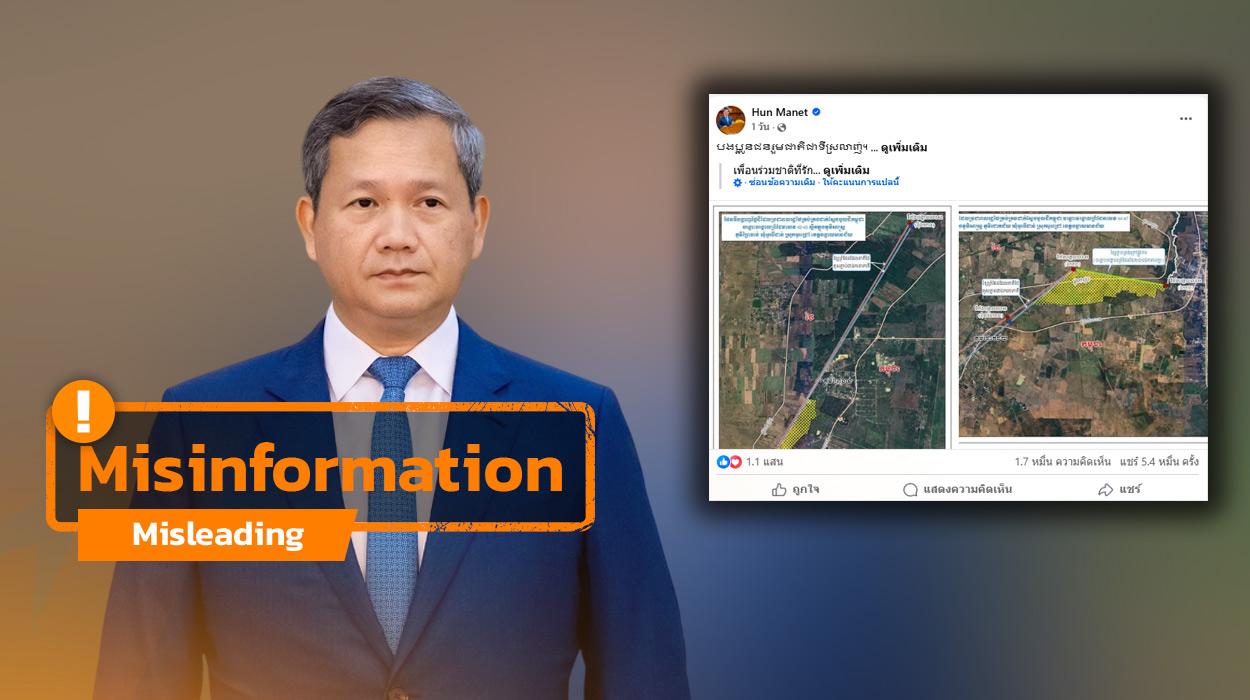
Thai PBS Verify found the source of this claim from: Facebook
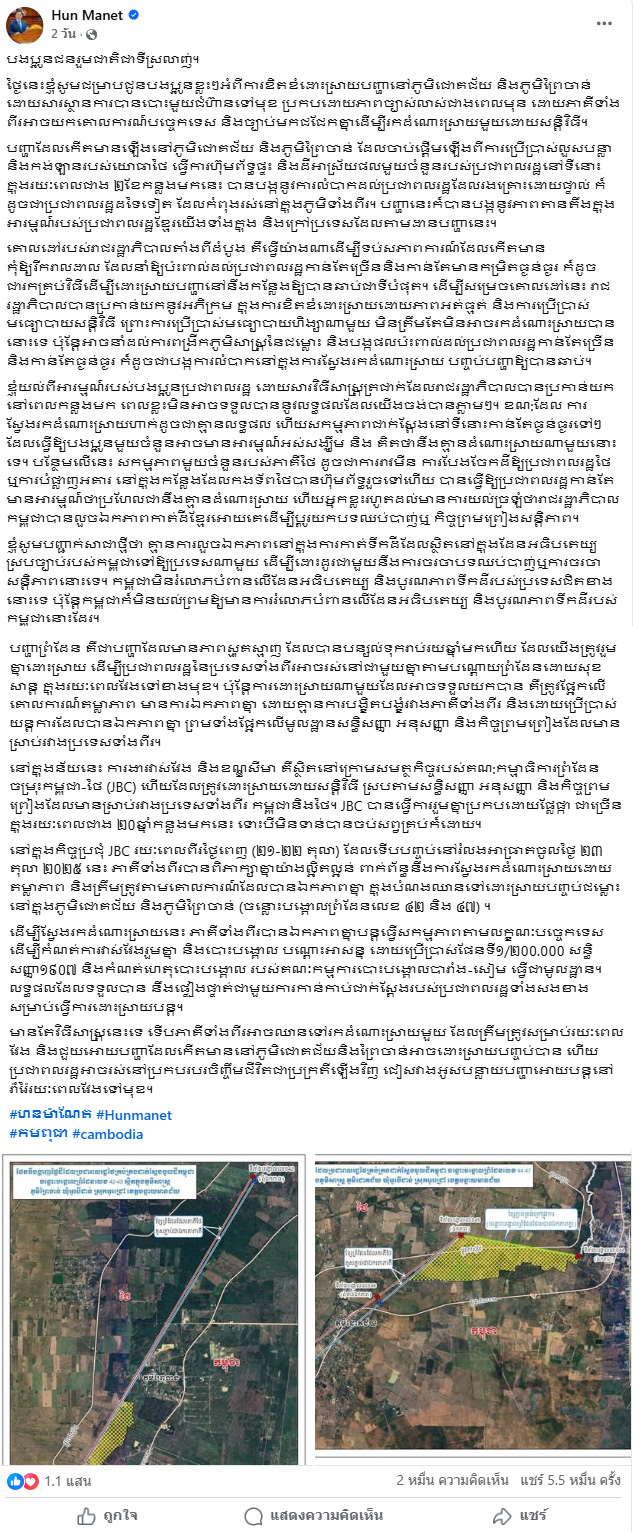
A Facebook account of Hun Manet posted a statement on progress in resolving the Thai–Cambodian border issue in the areas of Chokchai village and Prey Chan village.
On 21–22 October 2025, the Joint Boundary Commission (JBC), Thailand–Cambodia convened in Chanthaburi Province, Thailand.
Thai PBS Verify found that on Hun Manet’s official Facebook account, he issued a statement on progress in resolving the Thai–Cambodian border issue in the areas of Chokchai village and Prey Chan village. The Prime Minister of Cambodia stated that the situation was becoming clearer and more advanced, with both sides discussing solutions based on technical and legal principles to ensure a peaceful resolution. He reaffirmed that Cambodia had never ceded or exchanged territory with any country and would not allow its sovereignty to be violated.
Border problems are complex and require transparent cooperation through the JBC. At the meeting held on 21–22 October 2023, both sides agreed to conduct joint surveys, define boundary lines, and establish temporary border markers based on the 1907 map. The aim is to find a sustainable solution so that people of both countries can live together peacefully. A map image was shared along with the post and the following statement.
“បងប្អូនជនរួមជាតិជាទីស្រលាញ់។
ថ្ងៃនេះខ្ញុំសូមជម្រាបជូនបងប្អូនខ្លះៗអំពីការខិតខំដោះស្រាយបញ្ហានៅភូមិជោគជ័យ និងភូមិព្រៃចាន់ ដោយសារស្ថានការបានបោះមួយជំហ៊ានទៅមុខ ប្រកបដោយភាពច្បាស់លាស់ជាងពេលមុន ដោយភាគីទាំងពីរអាចយកគោលការណ៍បច្ចេកទេស និងច្បាប់មកជជែកគ្នាដើម្បីរកដំណោះស្រាយមួយដោយសន្តិវិធី។
បញ្ហាដែលកើតមានឡើងនៅភូមិជោគជ័យ និងភូមិព្រៃចាន់ ដែលចាប់ផ្ដើមឡើងពីការប្រើប្រាស់លួសបន្លានិងកង់ឡានរបស់យោធាថៃ ធ្វើការហ៊ុមព័ទ្ធផ្ទះ និងដីអាស្រ័យផលមួយចំនួនរបស់ប្រជាពលរដ្ឋនៅទីនោះ ក្នុងរយៈពេលជាង ២ខែកន្លងមកនេះ បានបង្កនូវការលំបាកដល់ប្រជាពលរដ្ឋដែលរងគ្រោះដោយផ្ទាល់ ក៏ដូចជាប្រជាពលរដ្ឋដទៃទៀត ដែលកំពុងរស់នៅក្នុងភូមិទាំងពីរ។ បញ្ហានេះក៏បានបង្កនូវភាពតានតឹងក្នុងអារម្មណ៍របស់ប្រជាពលរដ្ឋខ្មែរយើងទាំងក្នុង និងក្រៅប្រទេសដែលតាមដានបញ្ហានេះ។
គោលដៅរបស់រាជរដ្ឋាភិបាលតាំងពីដំបូង គឺធ្វើយ៉ាងណាដើម្បីទប់សភាពការណ៍ដែលកើតមានកុំឱ្យរីករាលដាល ដែលនាំឱ្យប៉ះពាល់ដល់ប្រជាពលរដ្ឋកាន់តែច្រើននិងកាន់តែមានកម្រិតធ្ងន់ធ្ងរ ក៏ដូចជារកគ្រប់វិធីដើម្បីដោះស្រាយបញ្ហានៅនឹងកន្លែងឱ្យបានឆាប់ជាទីបំផុត។ ដើម្បីសម្រេចគោលដៅនេះ រាជរដ្ឋាភិបាលបានប្រកាន់យកនូវអភិក្រម ក្នុងការខិតខំដោះស្រាយដោយភាពអត់ធ្មត់ និងការប្រើប្រាស់មធ្យោបាយសន្តិវិធី ព្រោះការប្រើប្រាស់មធ្យោបាយហិង្សាណាមួយ មិនត្រឹមតែមិនអាចរកដំណោះស្រាយបាននោះទេ ប៉ុន្តែអាចនាំដល់ការពង្រីកភូមិសាស្ត្រនៃជម្លោះ និងបង្កផលប៉ះពាល់ដល់ប្រជាពលរដ្ឋកាន់តែច្រើន និងកាន់តែធ្ងន់ធ្ងរ ក៏ដូចជាបង្កការលំបាកនៅក្នុងការស្វែងរកដំណោះស្រាយ បញ្ចប់បញ្ហាឱ្យបានឆាប់។
ខ្ញុំយល់ពីអារម្មណ៍របស់បងប្អូនប្រជាពលរដ្ឋ ដោយសារវិធីសាស្ត្រត្រជាក់ដែលរាជរដ្ឋាភិបាលបានប្រកាន់យកនៅពេលកន្លងមក ពេលខ្លះមិនអាចទទួលបាននូវលទ្ធផលដែលយើងចង់បានភ្លាមៗ។ ខណ:ដែល ការស្វែងរកដំណោះស្រាយហាក់ដូចជាគ្មានលទ្ធផល ហើយសកម្មភាពជាក់ស្តែងនៅទីនោះកាន់តែធ្ងន់ធ្ងរទៅៗ ដែលធ្វើឱ្យបងប្អូនមួយចំនួនអាចមានអារម្មណ៍អស់សង្ឃឹម និង គិតថានឹងគ្មានដំណោះស្រាយណាមួយនោះទេ។ បន្ថែមលើនេះ សកម្មភាពមួយចំនួនរបស់ភាគីថៃ ដូចជាការរាវមីន ការបែងចែកដីឱ្យប្រជាពលរដ្ឋថៃ ឬការបំផ្លាញអគារ នៅក្នុងកន្លែងដែលកងទ័ពថៃបានហ៊ុមព័ទ្ធរួចទៅហើយ បានធ្វើឱ្យប្រជាពលរដ្ឋកាន់តែមានអារម្មណ៍ថាប្រហែលជានឹងគ្មានដំណោះស្រាយ ហើយអ្នកខ្លះរហូតដល់មានការយល់ច្រឡំថារាជរដ្ឋាភិបាលកម្ពុជាបានលួចឯកភាពកាត់ដីខ្មែរអោយគេដើម្បីប្ដូរយកបទឈប់បាញ់ឬ កិច្ចព្រមព្រៀងសន្តិភាព។
ខ្ញុំសូមបញ្ជាក់សាជាថ្មីថា គ្មានការលួចឯកភាពនៅក្នុងការកាត់ទឹកដីដែលស្ថិតនៅក្នុងដែនអធិបតេយ្យ ស្របច្បាប់របស់កម្ពុជាទៅឱ្យប្រទេសណាមួយ ដើម្បីដោះដូរជាមួយនឹងការចរចាបទឈប់បាញ់ឬការចរចាសន្តិភាពនោះទេ។ កម្ពុជាមិនរំលោភបំពានលើដែនអធិបតេយ្យ និងបូរណភាពទឹកដីរបស់ប្រទេសជិតខាងនោះទេ ប៉ុន្តែកម្ពុជាក៏មិនយល់ព្រមឱ្យមានការរំលោភបំពានលើដែនអធិបតេយ្យ និងបូរណភាពទឹកដីរបស់កម្ពុជានោះដែរ។
បញ្ហាព្រំដែន គឺជាបញ្ហាដែលមានភាពស្មុគស្មាញ ដែលបានបន្សល់ទុករាប់រយឆ្នាំមកហើយ ដែលយើងត្រូវរួមគ្នាដោះស្រាយ ដើម្បីប្រជាពលរដ្ឋនៃប្រទេសទាំងពីរអាចរស់នៅជាមួយគ្នាតាមបណ្ដោយព្រំដែនដោយសុខសាន្ត ក្នុងរយៈពេលវែងទៅខាងមុខ។ ប៉ុន្តែការដោះស្រាយណាមួយដែលអាចទទួលយកបាន គឺត្រូវផ្អែកលើគោលការណ៍តម្លាភាព មានការឯកភាពគ្នា ដោយគ្មានការបង្ខិតបង្ខំរវាងភាគីទាំងពីរ និងដោយប្រើប្រាស់យន្តការដែលបានឯកភាពគ្នា ព្រមទាំងផ្អែកលើមូលដ្ឋានសន្ធិសញ្ញា អនុសញ្ញា និងកិច្ចព្រមព្រៀងដែលមានស្រាប់រវាងប្រទេសទាំងពីរ។
នៅក្នុងន័យនេះ ការងារវាស់វែង និងខណ្ឌសីមា គឺស្ថិតនៅក្រោមសមត្ថកិច្ចរបស់គណ:កម្មាធិការព្រំដែនចម្រុះកម្ពុជា–ថៃ (JBC) ហើយដែលត្រូវដោះស្រាយដោយសន្តិវិធី ស្របតាមសន្ធិសញ្ញា អនុសញ្ញា និងកិច្ចព្រមព្រៀងដែលមានស្រាប់រវាងប្រទេសទាំងពីរ កម្ពុជានិងថៃ។ JBC បានធ្វើការរួមគ្នាប្រកបដោយផ្លែផ្កា ជាច្រើនក្នុងរយៈពេលជាង ២០ឆ្នាំកន្លងមកនេះ ទោះបីមិនទាន់បានចប់សព្វគ្រប់ក៏ដោយ។
នៅក្នុងកិច្ចប្រជុំ JBC រយៈពេលពីរថ្ងៃពេញ (២១–២២ តុលា) ដែលទើបបញ្ចប់នៅរំលងអាធ្រាតចូលថ្ងៃ ២៣ តុលា ២០២៥ នេះ ភាគីទាំងពីរបានពិភាក្សាគ្នាយ៉ាងល្អិតល្អន់ ពាក់ព័ន្ធនឹងការស្វែងរកដំណោះស្រាយដោយតម្លាភាព និងត្រឹមត្រូវតាមគោលការណ៍ដែលបានឯកភាពគ្នា ក្នុងបំណងឈានទៅដោះស្រាយបញ្ចប់ជម្លោះនៅក្នុងភូមិជោគជ័យ និងភូមិព្រៃចាន់ (ចន្លោះបង្គោលព្រំដែនលេខ ៤២ និង ៤៧) ។
ដើម្បីស្វែងរកដំណោះស្រាយនេះ ភាគីទាំងពីរបានឯកភាពគ្នាបន្តធ្វើសកម្មភាពតាមលក្ខណៈបច្ចេកទេស ដើម្បីកំណត់ការវាស់វែងរួមគ្នា និងបោះបង្គោល បណ្ដោះអាសន្ន ដោយប្រើប្រាស់ផែនទី១/២០០.០០០ សន្ធិសញ្ញា១៩០៧ និងកំណត់ហេតុបោះបង្គោល របស់គណៈកម្មការបោះបង្គោលបារាំង–សៀម ធ្វើជាមូលដ្ឋាន។ លទ្ធផលដែលទទួលបាន នឹងផ្ទៀងផ្ទាត់ជាមួយការកាន់កាប់ជាក់ស្ដែងរបស់ប្រជាពលរដ្ឋទាំងសងខាង សម្រាប់ធ្វើការដោះស្រាយបន្ត។
មានតែវិធីសាស្ត្រនេះទេ ទើបភាគីទាំងពីរអាចឈានទៅរកដំណោះស្រាយមួយ ដែលត្រឹមត្រូវសម្រាប់រយៈពេលវែង និងជួយអោយបញ្ហាដែលកើតមាននៅភូមិជោគជ័យនិងព្រៃចាន់អាចដោះស្រាយបញ្ចប់បាន ហើយប្រជាពលរដ្ឋអាចរស់នៅប្រកបរបរចិញ្ចឹមជីវិតជាប្រក្រតីឡើងវិញ ជៀសវាងអូសបន្លាយបញ្ហាអោយបន្តនៅរ៉ាំរ៉ៃរយៈពេលវែងទៅមុខ។
#ហនម៉ាណែត #Hunmanet
#កមពុជា #cambodia”
It can be translated that:
“Dear beloved Cambodian people,
Today, I wish to inform some of you about the efforts to resolve the problems that have arisen in Chokchai Village and Prey Chan Village. The situation has now advanced to a clearer stage, as both sides have been able to discuss solutions based on technical and legal principles, seeking a peaceful resolution.
The problems in Chokchai and Prey Chan villages began when Thai military forces placed barbed wire and vehicles around some homes and farmland in the area for more than two months. This has caused hardship for directly affected residents, as well as other villagers in both communities. The issue has also generated anxiety among Cambodians both inside the country and abroad who are following the situation.
From the outset, the government’s goal has been to prevent the situation from escalating and affecting a wider population, while finding a solution as quickly as possible in the area. We have adhered to patience and peaceful methods, because violence not only fails to solve the problem but may also expand the conflict, cause greater harm to the people, and make resolution even more difficult.
I understand the feelings of our people who may be dissatisfied with the government’s approach of patience and peaceful negotiation, since results are not always immediate and the situation on the ground may appear to worsen, leaving some feeling hopeless or believing there is no solution at all.
Furthermore, certain actions by the Thai side—such as mine clearance, land allocation to Thai citizens, or demolition of structures in areas already cordoned off by Thai troops—have deepened despair among some residents. Some have even misunderstood that the Cambodian government might secretly cede territory to Thailand in exchange for a ceasefire or peace agreement.
Let me reaffirm clearly once again:
There has been no secret ceding of Cambodian territory to any country in exchange for ceasefire or peace talks. Cambodia has never violated the sovereignty of its neighbors. But at the same time, Cambodia will not allow anyone to violate our sovereignty and territorial integrity.
Border issues are complex, having persisted for centuries, and both countries must cooperate to resolve them so that people on both sides can live together peacefully in the long term.
A sustainable solution must be based on transparency, mutual agreement without coercion, and mechanisms jointly established, with reference to treaties, conventions, and agreements between Cambodia and Thailand.
In this matter, the measurement and demarcation of boundaries fall under the authority of the Thai–Cambodian Joint Boundary Commission (JBC), which is tasked with conducting its work peacefully in line with treaties and agreements signed by both countries. The JBC has been working together for over 20 years. Although not yet complete, progress has been continuous.
During the two full days of JBC meetings (21–22 October 2025), which concluded at midnight entering 23 October, both sides held detailed discussions to find a transparent and principled solution, aiming to end disputes in the area of Chokchai and Prey Chan villages (between boundary markers 42 to 47).
Both sides agreed to proceed with technical measures such as joint surveys, defining temporary boundary lines, and placing temporary border markers, using the 1:200,000 scale map from the 1907 treaty and records of the Franco–Siam boundary commission as references.
The results will be cross‑checked against the actual occupation of residents on both sides to determine further solutions.
Only this approach can lead both sides to a sustainable resolution and truly solve the problems in Chokchai and Prey Chan villages, allowing people to return to normal life without letting the issue drag on indefinitely.
#ហនម៉ាណែត #HunManet
#កម្ពុជា #Cambodia”
The post received 110,000 reactions, 17,000 comments, and was shared more than 53,000 times. Most of the comments disagreed with the 1:200,000 scale map and only accepted the 1:50,000 scale
Government Spokesperson Clarifies Results of Thai–Cambodian JBC Meeting, Affirms No Agreement to Use 1:200,000 Map or Set Temporary Border Markers
At the same time, Mr. Siripong Angkasakulkiat, spokesperson for the Thai Prime Minister’s Office, clarified the results of the Thai–Cambodian Joint Boundary Commission (JBC) meeting (click to see original archived content), which was held on 21–22 October 2025 in Chanthaburi Province, Thailand. He stated that there was no agreement regarding the use of map scales or consent to set temporary boundary markers, contrary to the information disseminated in the Facebook post of Hun Manet, Prime Minister of Cambodia, which claimed:
“The Thai and Cambodian sides agreed to proceed according to technical principles for surveying and setting temporary boundary markers, using the 1:200,000 scale map and the 1907 Franco–Siam Treaty.”
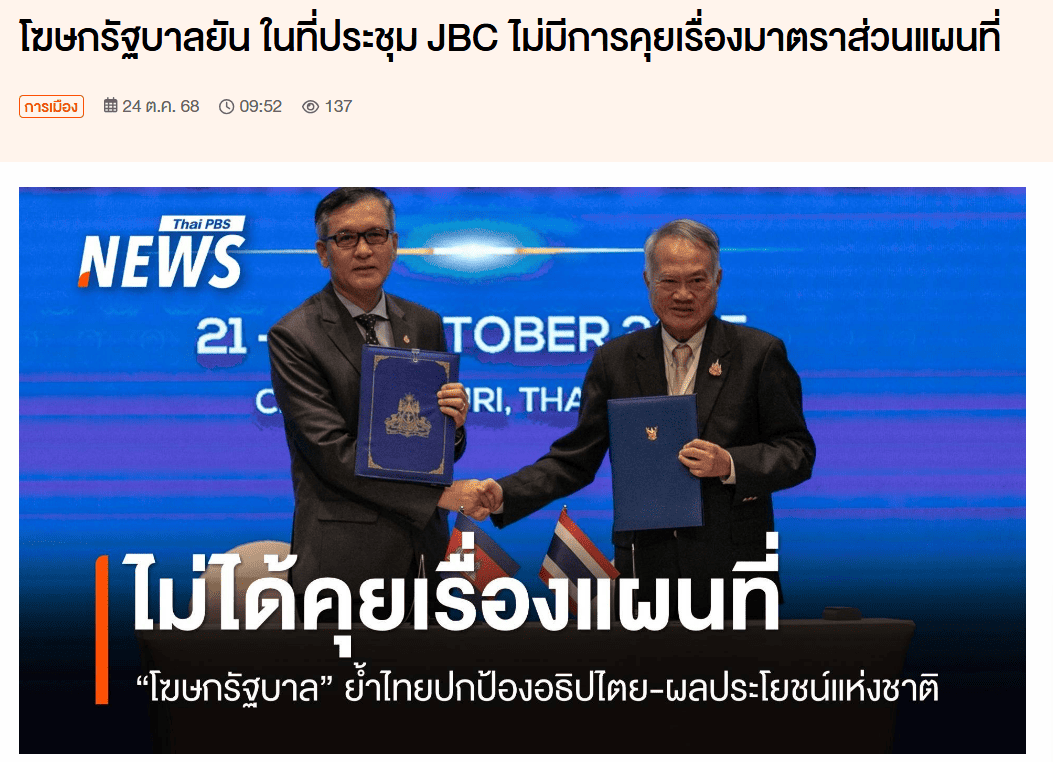
Mr. Siripong affirmed that the statement was not true and could cause misunderstanding both domestically and internationally. He clarified that in this JBC meeting, there was no discussion or agreement regarding the use of the 1:200,000 scale map or the establishment of temporary boundary markers in disputed areas.
What both sides did agree upon was to assign the Joint Technical Sub‑Commission (JTSC) to construct new boundary markers to replace 15 markers that were damaged or missing, using the original positions mutually recognized by both sides. They also agreed to create new markers to replace three that had been submerged, with the positions to be jointly determined later.
In addition, the meeting approved accelerating the revision of the 2003 TOR in order to produce an orthophoto map using modern technology such as LiDAR, to improve the accuracy of area surveys.
For the area between boundary markers 42–47 (Ban Nong Chan–Ban Nong Ya Kaeo), both sides agreed to conduct surveys and install temporary markers only in urgent areas, with the sole purpose of providing baseline information for future discussions.
Mr. Siripong further stated that the Thai government will not allow distortion of facts. Prime Minister Anutin Charnvirakul reiterated four key principles:
- Protecting of national sovereignty
- Establishing stability along the border
- Safeguarding the security of people in the area
- Adhering to peaceful methods
he government spokesperson emphasized that Thailand would not accept the dissemination of distorted information that could affect the atmosphere of cooperation and mutual trust between countries. He also urged the public not to believe false information from the Cambodian side, which may serve domestic political purposes.
The JBC meeting contained no report of Thailand and Cambodia agreeing to use the 1:200,000 scale map.
When Thai PBS Verify checked with the Ministry of Foreign Affairs, it found the meeting minute, “Joint Press Statement of the Special Meeting of the Thai–Cambodian Joint Commission on Demarcation for Land Boundary (JBC), Chanthaburi, Thailand, 21–22 October 2025,” available in both Thai and English.
The report mentioned that the extraordinary session of the Thai–Cambodian Joint Boundary Commission (JBC) was held on 21–22 October 2025 in Chanthaburi Province, Thailand. It was chaired on the Thai side by Mr. Prasat Prasatwinichai, Advisor to the Ministry of Foreign Affairs, and on the Cambodian side by Mr. Lam Chea, Minister attached to the Secretariat of National Border Affairs of Cambodia.
The meeting took place in a friendly atmosphere. Both sides agreed to assign the Joint Technical Sub‑Commission (JTSC) to construct new boundary markers to replace 15 markers that were damaged or missing, and to create new markers to replace 3 submerged markers. They also agreed to accelerate the revision of the 2003 TOR for using modern technology LiDAR to produce orthophotography maps with greater efficiency. In addition, both sides agreed to place temporary markers between boundary markers 42–47 (Ban Nong Chan–Ban Nong Ya Kaeo area) for survey purposes only, without affecting rights under international law, and to jointly ensure the safety of survey teams from landmines in accordance with the 2000 MOU.
Furthermore, both sides agreed to convene the next JBC meeting in the first week of January 2026 in Siem Reap, Cambodia.
It should be noted that no discussion or agreement regarding the use of the 1:200,000 scale map was found in the meeting report.
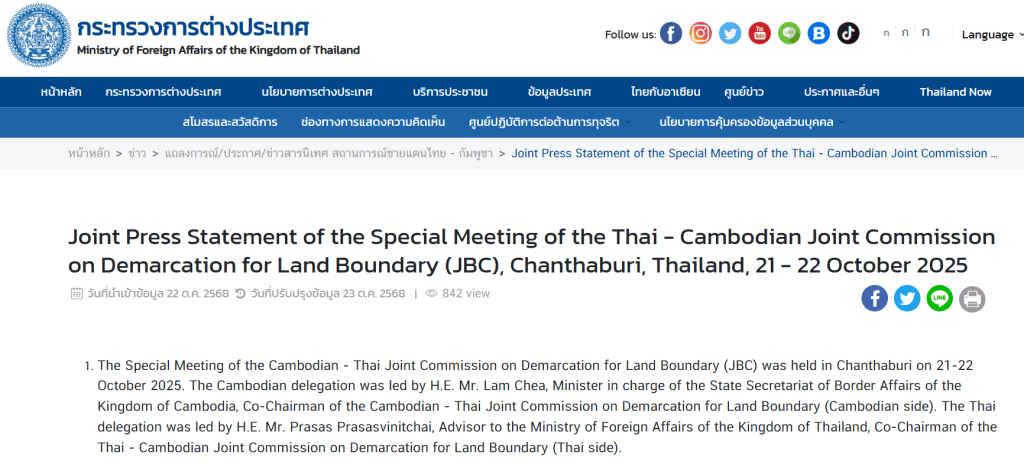
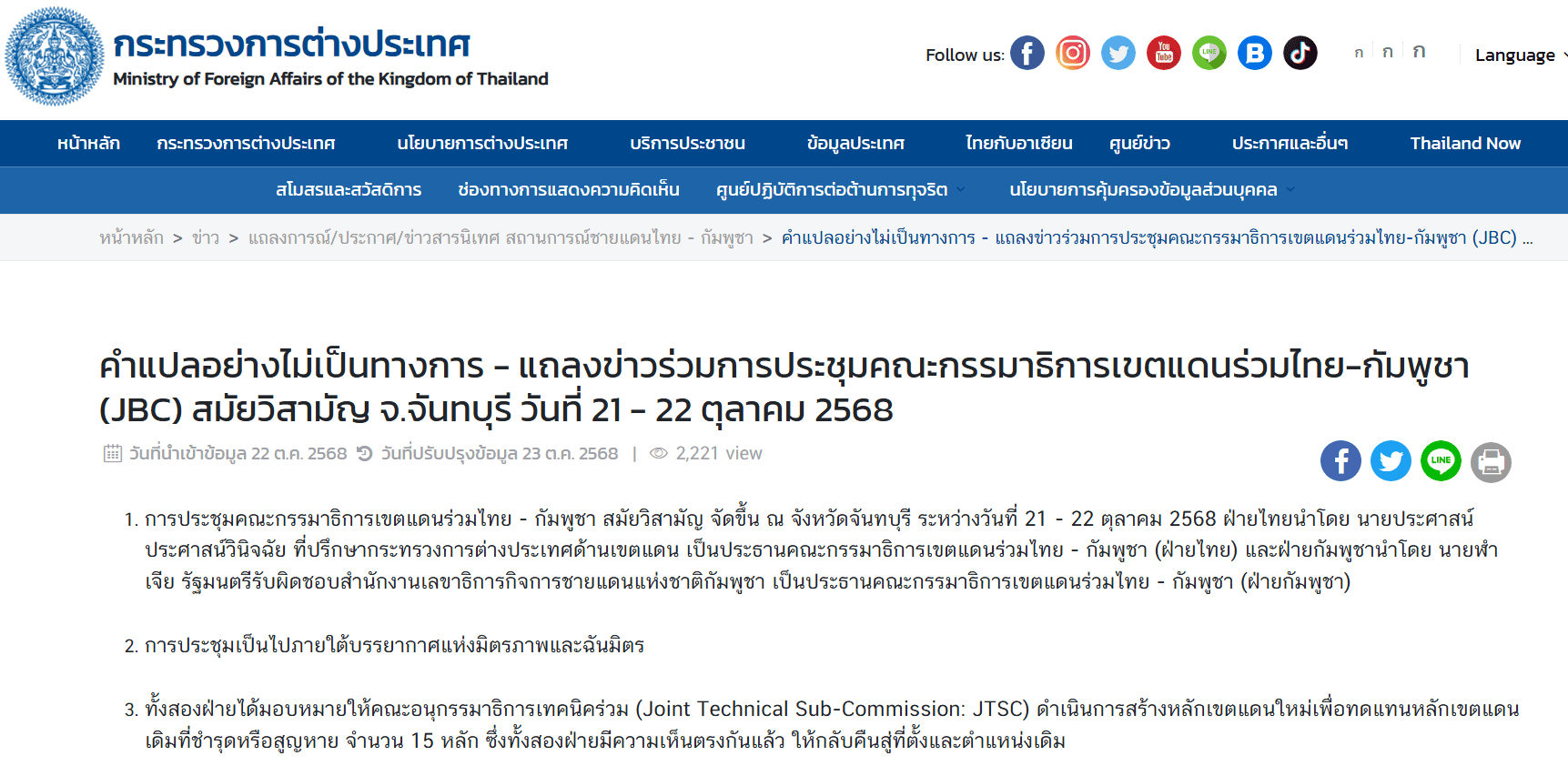
Minutes of Joint Press Statement of the Special Meeting of the Thai – Cambodian Joint Commission on Demarcation for Land Boundary (JBC), Chanthaburi, Thailand, 21 – 22 October 2025
Scholars Point Out: Thai–Cambodian JBC Meeting Still Lacks Clear Agreement
Associate Professor Dr. Pittaya Suvakunta, lecturer at the College of Interdisciplinary Studies, Thammasat University, observed that the JBC meeting showed the two sides reaching different conclusions, to the point that it seemed as if no real negotiation had taken place. Each side adhered to its own reasoning, which prolonged issues that should otherwise have been resolved.
He noted that the details of the problem are quite complex, causing negotiations to be repeatedly delayed in order to prepare information for future talks. Moreover, both the Cambodian and Thai sides, including their working groups, still lack sufficient coordination.
At the same time, there are pressing issues such as call‑center gangs and scammers, which must be resolved before negotiations can proceed fully. Another factor is that the balance of bargaining power in the negotiations has become unequal, leading to attempts to postpone or reject talks for now. If negotiations are to move forward under a joint agreement, there must be a simultaneous announcement by both sides.
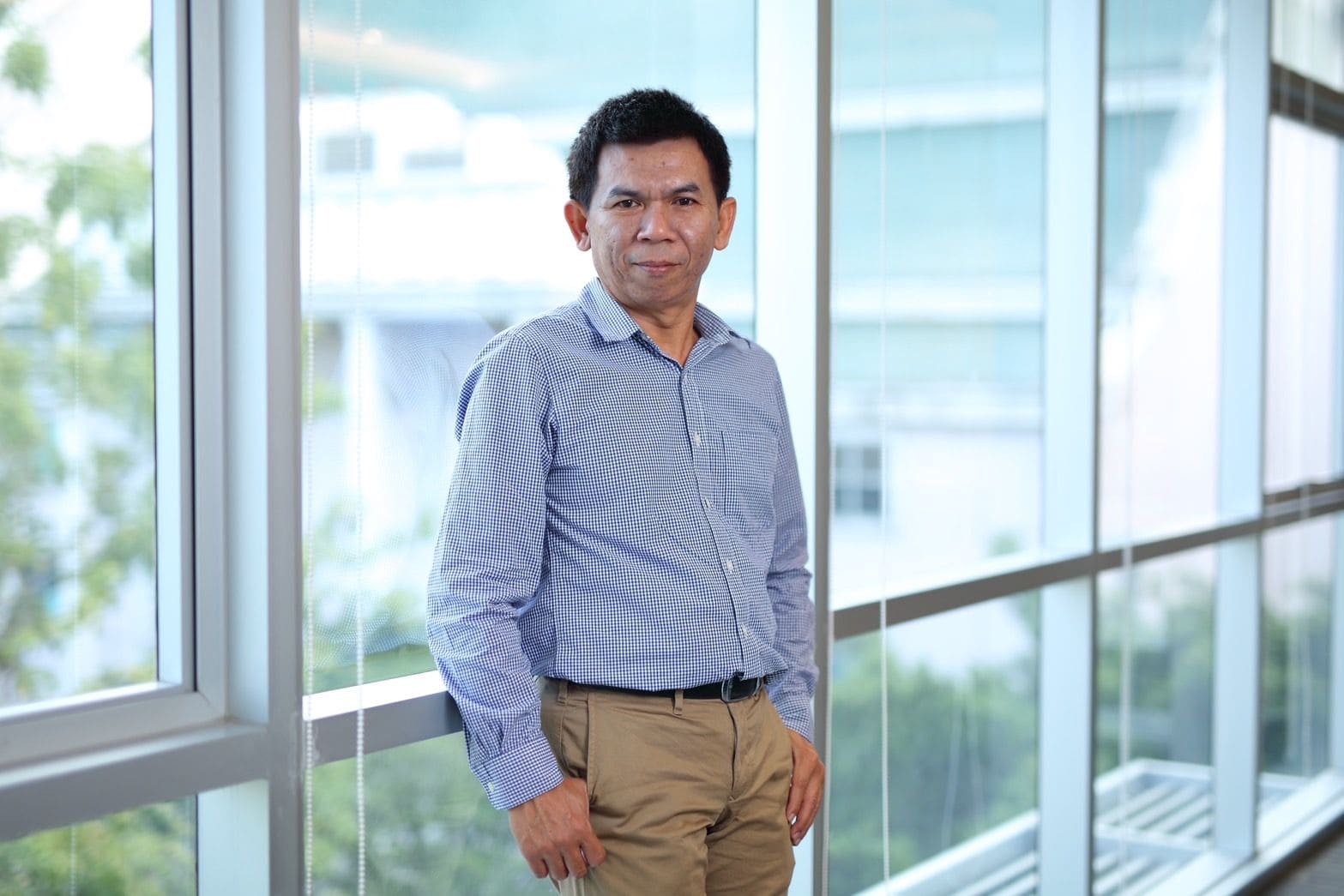
Associate Professor Dr. Pittaya Suvakunta, lecturer at the College of Interdisciplinary Studies, Thammasat University
“Sometimes the posts made by each leader are intended to present information so that the opposing side perceives how negotiations have taken place, and to see how their supporters will respond. This is about creating an image through information for society to recognize on their side,” said Assoc. Prof. Dr. Pittaya Suvakunta.
However, the current agreements are not yet binding or formal treaties between the two countries. The working groups of each side therefore need to establish a clearer timeline. In particular, the Thai side must gather complete information and work in unity. Security agencies, the government, and border authorities should coordinate closely to ensure that information does not contradict across agencies.
From a strategic perspective, pressure is mounting from several major political and economic powers, including the United States and the United Kingdom. Economic powers have also begun to influence the conflict, as regional interests are increasingly destabilized. Countries with significant investments in Cambodia—particularly Thailand, Laos, and Vietnam—are inevitably affected by these situations.
What Is the Truth?
Thai PBS Verify found that the post by Hun Manet, which claimed:
“The temporary boundary line and the placement of provisional border markers were agreed upon using the 1:200,000 scale map from the 1907 treaty and the records of the Franco–Siam Boundary Commission,”
was not mentioned at all in the official statements of Thailand or the Thai Ministry of Foreign Affairs.
Verification Process
- Checking against the government spokesperson’s statement: upon verification, the Thai government spokesperson confirmed that in the JBC meeting, there was no mention of using the 1:200,000 scale map.
- Checking against the Ministry of Foreign Affairs report: the official JBC meeting statement noted that both sides agreed to place temporary boundary markers between 42–47 (Ban Nong Chan–Ban Nong Ya Kaeo area) for survey purposes only. It did not mention any agreement on the 1:200,000 scale map.
- Checking against academic analysis: scholars pointed out that the Thai–Cambodian JBC meeting still lacks clear agreements.
Impacts of False Information
- On International Relations
Such publications may create misunderstandings at both the public and governmental levels, since the issue of “border demarcation” is highly sensitive. If people in both countries believe that a “temporary boundary line” has been agreed upon—while the Thai side has not confirmed this—it could generate political pressure and undermine trust between the two governments.
- On Domestic Politics
In Thailand, such information may be interpreted as “the government having accepted a secret agreement or conceded territorial interests,” which could then be exploited for political purposes. Meanwhile, in Cambodia, this type of communication may be used to project the image that Prime Minister Hun Manet’s government is “making progress” in resolving border issues with Thailand, thereby boosting domestic popularity.
- On Security and Border Communities
Conflicting information may confuse people living in border areas, especially in provinces with disputes such as Sa Kaeo (Thailand) and Battambang (Cambodia). This can lead to suspicion, anxiety, or mobilization by local interest groups in those areas.
- On Image and Credibility of the JBC Mechanism
The release of information before official documents or conclusions are available may undermine the credibility of the Joint Boundary Commission (JBC), which is a key mechanism for resolving disputes peacefully. It could also make future negotiations more difficult to carry out.
- On Information and Social Media
Posts made by national leaders carry significant weight and spread rapidly across social media. If the Thai authorities do not provide timely clarification, inaccurate information may be amplified and evolve into “policy misinformation,” which can distort public understanding in both countries.
What to do with this misinformation?
-
Verify with official sources before believing or sharing
-
Check information from the Ministry of Foreign Affairs, the government spokesperson, or the Thai JBC Commission. Border issues are highly sensitive; rely on official documents and statements only.
2. Consider the “wording” and “context” of the post
-
Leaders or foreign officials may communicate to “create an image” or “send political signals” rather than provide technical details.
-
Do not interpret terms like “approved” or “agreed” as formal agreements until there is a joint announcement from both sides.
3. Exercise judgment; avoid sharing emotionally
-
Border issues are directly tied to international relations. Sharing unverified information may cause public misunderstanding and strain bilateral relations.
-

Related Content