Distorted WHO briefing falsely claims 149 Hantavirus infections
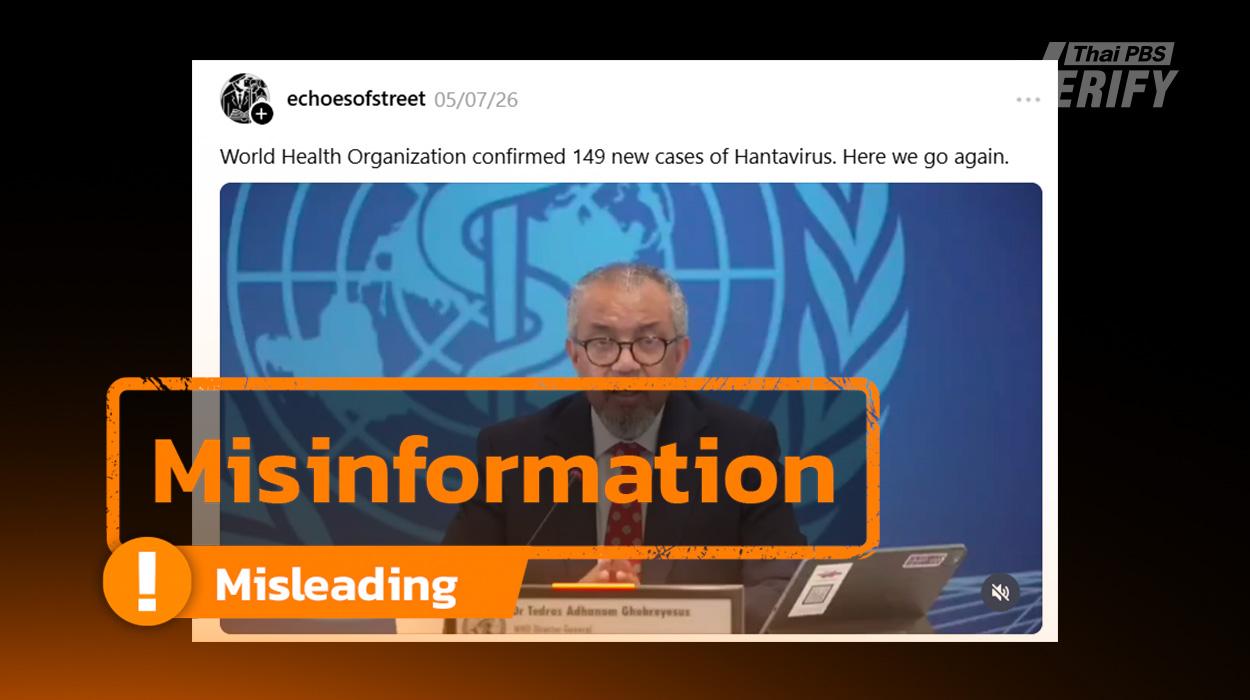
Thai PBS Verify found the piece of misinformation on: Threads
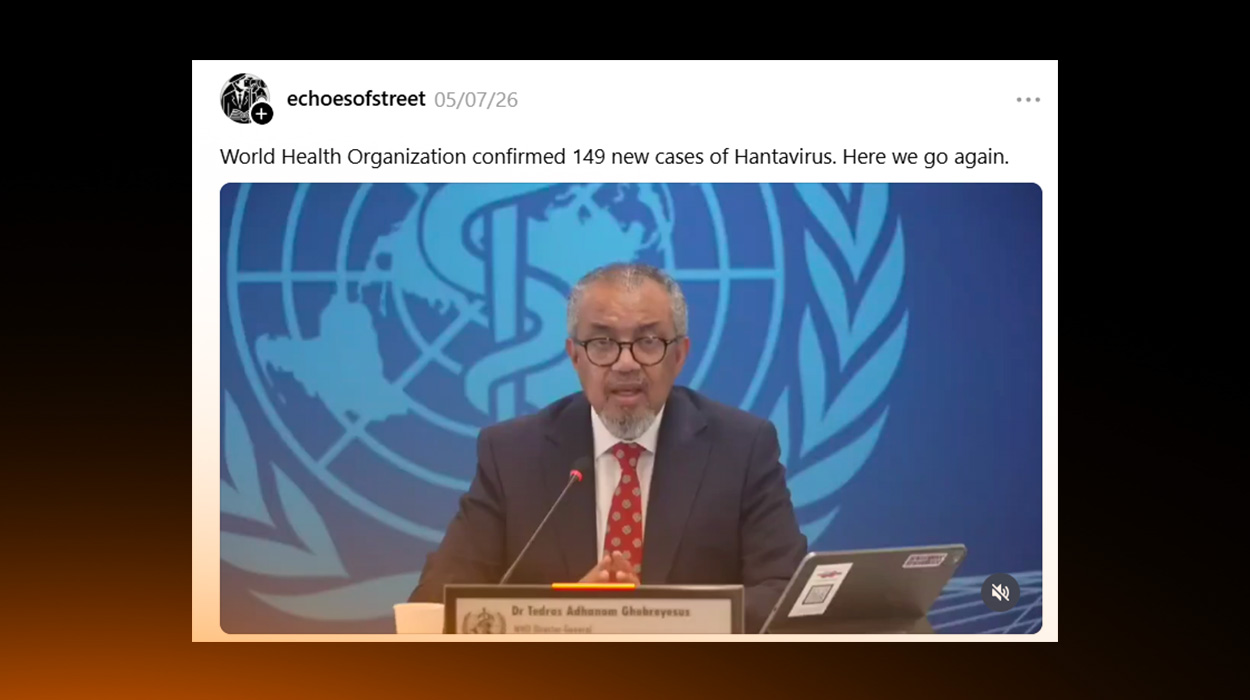
A Threads users shared a manipulated WHO briefing video.
Thai PBS Verify found a post on Threads, featuring a video with the following claim: “World Health Organization confirmed 149 new cases of Hantavirus. Here we go again.”
The post, published on May 7, 2026, has garnered 70,000 reactions, 625 comments, 1,700 reposts, and has been shared over 32,000 times.
It is not true WHO has reported 149 new Hantavirus cases
Thai PBS Verify analyzed the video on Hiya Voice Protector and Hive Moderation, and the team found that the clip was not AI-generated.
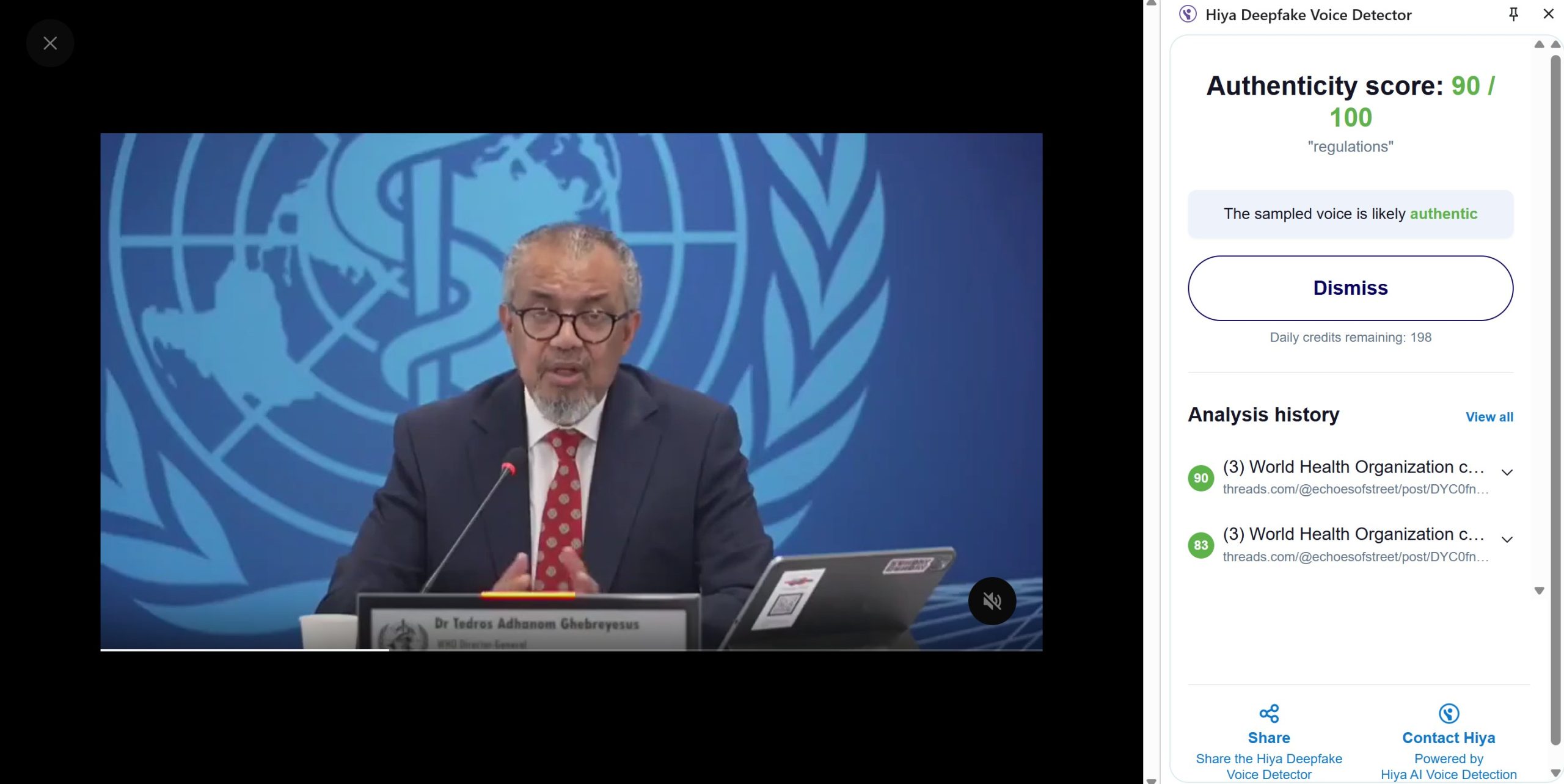
Analysis results from Hiya Voice Protector.
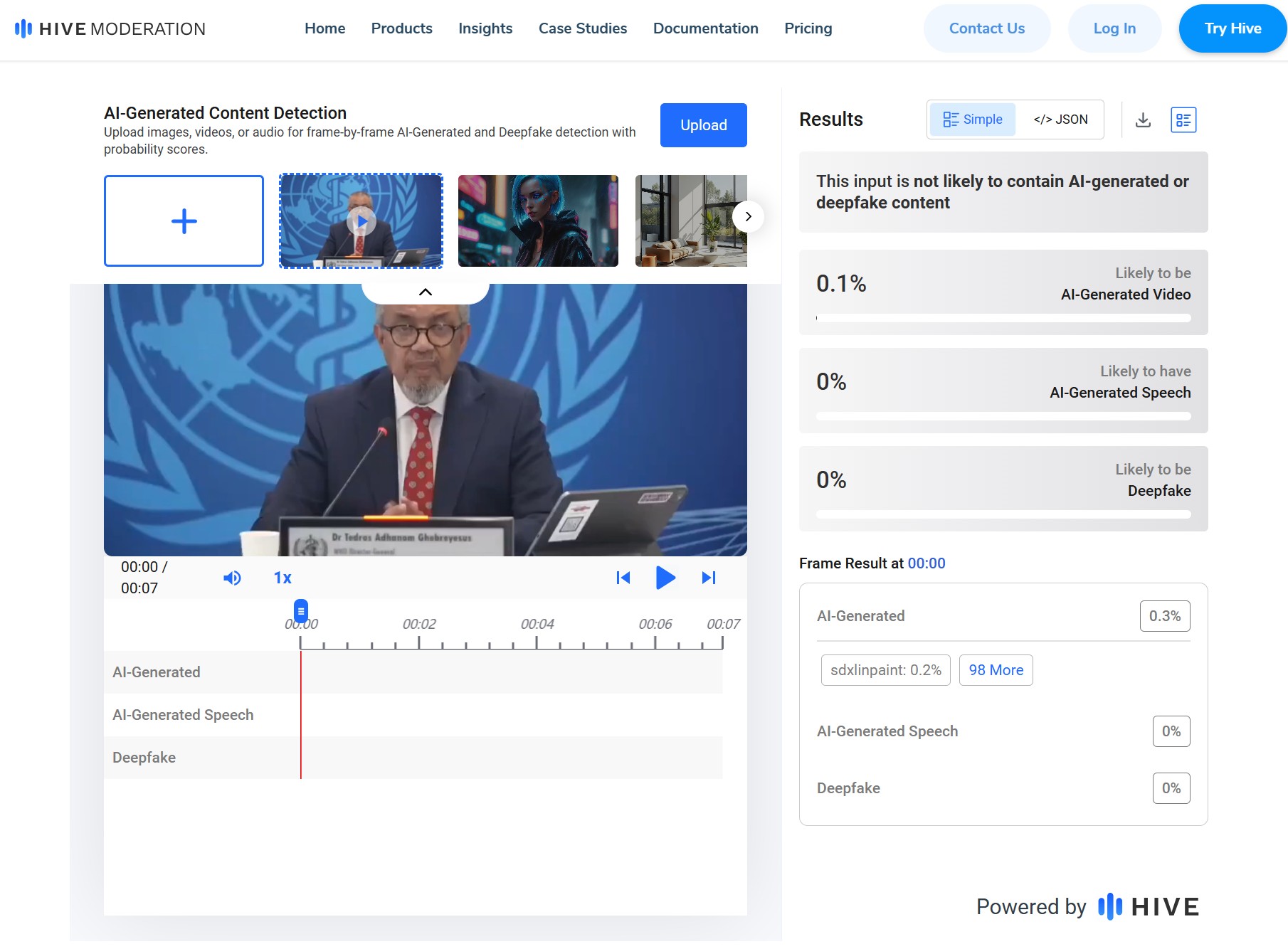
Analysis results from Hive Moderation.
Furthermore, Thai PBS Verify performed a keyword search for ‘World Health Organization’ and identified a video titled ‘Media briefing on #hantavirus hosted by Dr Tedros.’ The video, published on the WHO’s official YouTube channel on May 7, 2026, was confirmed to be the same footage shared by the Threads account ‘echoesofstreet’.
The content is summarized as follows:
1) Outbreak on a cruise vessel
WHO Director-General Tedros Adhanom Ghebreyesus announced the discovery of a cluster of severe respiratory illnesses aboard the cruise ship MV Hondius during its voyage from Argentina to Cape Verde. A total of 8 cases were reported, resulting in 3 fatalities. Among these, 5 cases have been confirmed as Hantavirus (Andes virus strain), while the remaining 3 are currently under investigation.
This particular strain is distinguished by its capacity for human-to-human transmission. However, such transmission is limited to instances of prolonged, close contact, such as within households or between patients and their caregivers.
Timeline of Fatalities:
- First case: Fell ill on April 6 and passed away on board on April 11, 2026.
- Second case: The wife of the first patient; passed away on April 26, 2026, while traveling to Johannesburg.
- Third case: Fell ill on April 28 and passed away on May 2, 2026.
The investigation reveals that the initial cluster of patients likely contracted the infection during a birdwatching excursion in South America, where they may have been exposed to rodent vectors.
The World Health Organization has categorized the current public risk as ‘low’.
2) Patient care and disease control
Patients have been transferred for treatment across several countries, including South Africa, the Netherlands, Germany, and Switzerland.
Spain has granted the vessel permission to dock at the Canary Islands on humanitarian grounds, with the WHO confirming that the risk to the local population remains extremely low.
Onboard Protocols:
- Passengers are requested to remain in their cabins.
- Face masks must be worn at all times when outside of cabins.
- Symptomatic individuals will be placed in immediate isolation.
- Rigorous disinfection is being carried out continuously.
3) This is not a COVID-scale pandemic.
The WHO emphasizes that this event does not mark the start of a pandemic on the scale of COVID-19.
This assessment is based on the following factors:
- Limited airborne transmission: The virus does not spread easily through the air.
- Requirement of close contact: Transmission only occurs through prolonged and intimate contact.
- Localized cluster: The outbreak is confined to a closed environment
The situation reflects the 2018–2019 events in Argentina, characterized by a limited number of infections.
4) Contact tracing
The incubation period for the virus can extend up to six weeks (42 days). Consequently, those who have been exposed are required to:
- Closely monitor for any symptoms.
- Adhere to observation without the need for strict, full-time quarantine.
Authorities are currently monitoring fellow airline passengers and medical personnel; to date, no additional infections have been detected. Furthermore, the WHO has notified 12 countries where passengers disembarked to ensure they are prepared with appropriate response measures.
5) Global collaboration and partnerships
Despite ongoing tensions between the United States and the WHO, the U.S. continues to collaborate closely with the Centers for Disease Control and Prevention (CDC) to exchange vital data and maintain effective disease control.
6) Treatment and Vaccination Currently, there are:
- No specific antiviral medications.
- No approved vaccines available.
The primary clinical approach consists of:
- Supportive care.
- Timely admission to Intensive Care Units (ICU).
The content in the viral post was excerpted from the full video titled ‘Media briefing on #hantavirus hosted by Dr Tedros,’ specifically from the segment where he stated:
“Given the incubation period of the Andes virus, which can be up to six weeks, it’s possible that more cases may be reported. While this is a serious incident, WHO assesses the public health risk as low.
It also shows why the international health regulations exist and how they work. WHO is working with multiple governments and partners on the response under those regulations. Our priorities are to ensure the affected patients receive care, that the remaining passengers on the ship are kept safe and treated with dignity, and to prevent any further spread of the virus.” (extracted from 07.17- 08.21)
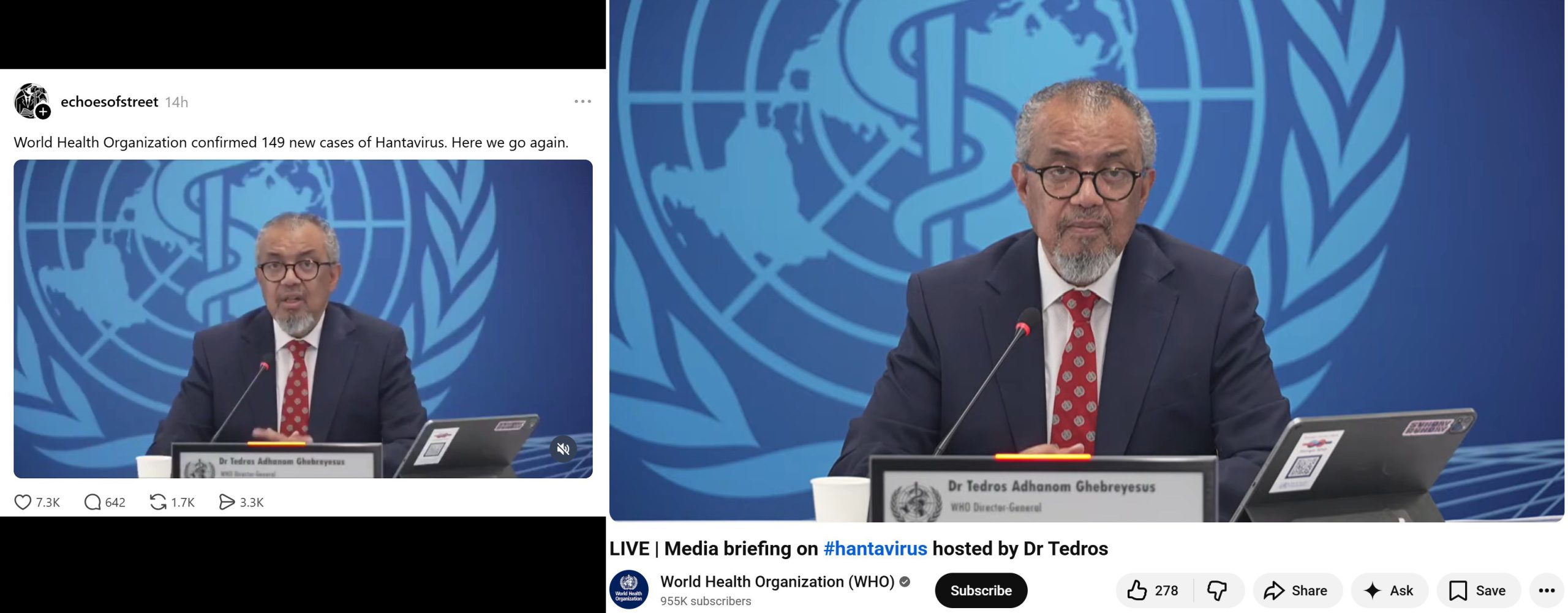
A comparison between the clip from the Threads post in question (left) and the original video from the WHO YouTube channel (right).
What is the current status of Hantavirus?
A report from the WHO indicates that at least five Hantavirus cases have been linked to fatalities aboard a cruise ship in the Atlantic Ocean. Including three suspected cases, the total stands at eight infections and three deaths. Although the situation is concerning, the WHO assesses the overall public risk to be low.
The outbreak occurred on the cruise ship Hondius during its voyage from Cape Verde to Tenerife, Spain. WHO Director-General Tedros Adhanom Ghebreyesus revealed that the organization was alerted by the United Kingdom regarding a cluster of passengers suffering from severe respiratory illness on the vessel.
The pathogen identified is the Andes virus, a strain prevalent in Latin America. It is distinguished by its capacity for limited human-to-human transmission, contrasting with typical Hantaviruses that are usually contracted from rodents through contact with secretions. Person-to-person spread is generally restricted to instances of prolonged close contact, such as between family members, partners, or healthcare providers.
The timeline of the fatalities began with a male passenger who fell ill on April 6 and died five days later, though his condition was not immediately identified as Hantavirus. Following this, his wife—who had left the ship at St. Helena—contracted the virus and passed away on April 25. The third death involved a female passenger whose illness began in late April, leading to her passing within a week.
The WHO has noted that because the incubation period can extend to 42 days, there is still a possibility of finding more cases in the coming weeks. Before their voyage, the first two victims had traveled for birdwatching across Chile, Argentina, and Uruguay. Since these areas are known habitats for the rodents that carry the virus, health officials believe this is likely where the initial exposure occurred.
Simultaneously, the WHO has issued alerts to 12 countries whose citizens disembarked at St. Helena, advising them to maintain close surveillance for symptoms. The organization emphasized that the situation remains under control and does not constitute a pandemic. However, continuous monitoring is essential, as further cases may emerge during the virus’s incubation period.
What is the truth?
Thai PBS Verify examined the Threads post through AI-driven audio analysis tools and keyword searches. The team found no evidence to support the claim made in the post in question that the World Health Organization had reported “149 new Hantavirus infections.”
To clarify, the accurate data reported by the WHO indicates only a single cluster on a cruise ship, consisting of eight cases. This total includes five laboratory-confirmed infections and three suspected cases, with three fatalities reported. All cases are linked exclusively to the Andes virus strain of Hantavirus.
Moreover, the circulated clip was taken out of context from a WHO briefing, wrongly suggesting a major pandemic. The actual discussion focused on the “potential for new cases” given the disease’s six-week incubation window. It certainly does not confirm a spike in infections reaching the hundreds as claimed.
The WHO reiterated that the current situation is localized to a cruise ship cluster and is not a global pandemic on the scale of COVID-19. Furthermore, the overall public health risk remains evaluated as low.
Verification Process
- AI Audio Verification: Thai PBS Verify examined the video clip through Hiya Voice Protector and Hive Moderation. Its analysis confirmed that the audio is authentic and was not AI-generated.
- Keyword Verification: A search for the term ‘World Health Organization’ led to a video titled ‘Media briefing on #hantavirus hosted by Dr Tedros’ on the official WHO YouTube channel. Published on May 7, 2026, the briefing reported only a ‘cruise ship patient cluster’ consisting of eight cases—five laboratory-confirmed and three suspected—with three fatalities. These cases are strictly associated with the Andes strain of the Hantavirus.