New COVID variant ‘Cicada’ is not caused by eponymous insect

Thai PBS Verify found the piece of misinformation on: Facebook

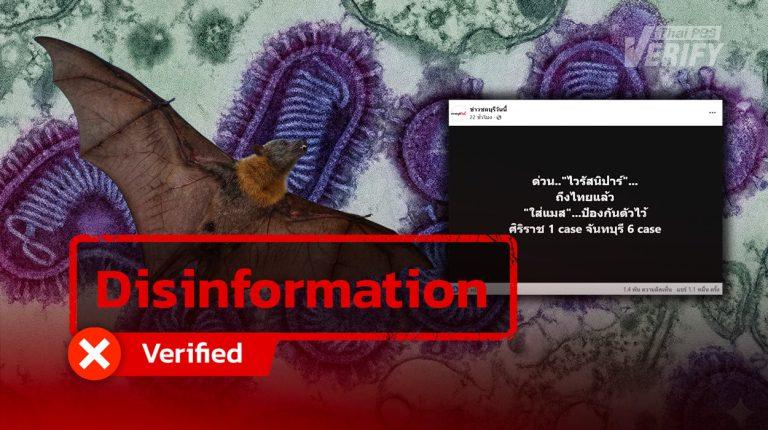
Thai PBS Verify recently flagged a viral Facebook post stating: “Urgent: A new COVID variant called ‘Cicada,’ derived from crickets, has been found in no fewer than 23 countries.”
Thai PBS Verify has identified a Facebook post claiming that: ”Urgent: A new COVID variant called ‘Cicada,’ derived from crickets, has been found in no fewer than 23 countries.”
The post reached significant engagement, with 12,000 reactions and 580 comments, while being shared more than 2,600 times.
COVID ‘Cicada’ variant does not originate from insects
Thai PBS Verify conducted a keyword search for ‘Cicada.’ It led to a report by the U.S. CDC, released on March 19, 2026. The document, titled “Early Detection and Surveillance of the SARS-CoV-2 Variant BA.3.2 — Worldwide, November 2024–February 2026,” provides details on the strain’s monitoring.
The CDC states that the BA.3.2 subvariant, initially discovered in South Africa in late 2024, features extensive spike protein mutations that may bypass existing immunity. Although it hasn’t reached global dominance, cases began rising sharply in late 2025, spreading to not fewer than 23 countries by February 2026.
In the United States, detection occurred through travelers, clinical cases, and wastewater surveillance, which served as an effective early warning system. Laboratory studies indicate that while current vaccines remain effective against other major strains, their efficacy is reduced against BA.3.2. Meanwhile, there is no clear evidence that this variant causes more severe illness. Nevertheless, its increased transmissibility and immune-evasion capabilities require public health agencies to maintain continuous surveillance to assess its impact and refine future response measures.
The Center for Medical Genomics (Faculty of Medicine Ramathibodi Hospital, Mahidol University) also referred to the CDC’s findings regarding the ‘Cicada’ (BA.3.2) subvariant. The center noted that the strain’s numerous spike protein mutations allow it to effectively bypass protection provided by current vaccines.
However, these genetic changes have actually reduced the virus’s ability to bind with lung cells, meaning it does not cause significantly more severe symptoms. Despite its spread across multiple countries, wastewater surveillance—particularly in the U.S.—has proven essential, often detecting outbreaks weeks before clinical cases are officially reported.
Thailand has yet to record this strain in the GISAID database; however, reduced genetic surveillance could lead to a lag in identification. Despite a potential dip in antibody effectiveness, cellular-level defenses continue to offer strong protection against severe symptoms, especially for vulnerable populations. Public health advice remains focused on staying informed without panic, keeping up with vaccinations, and adhering to standard hygiene protocols.
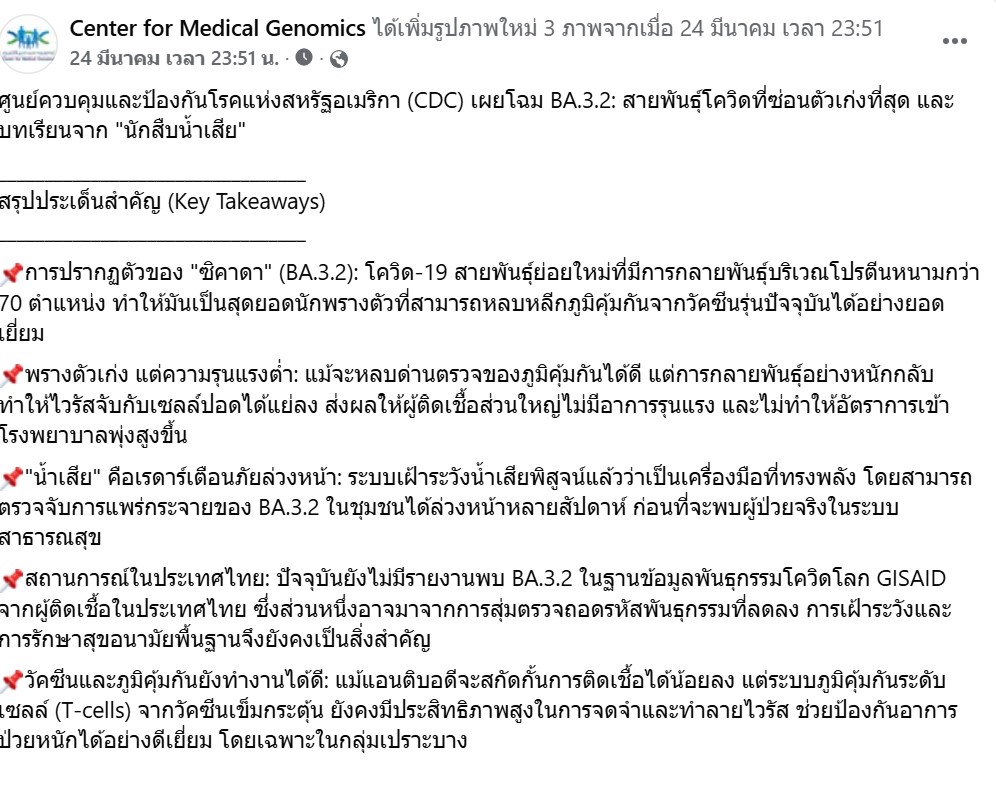
The Center for Medical Genomics at Ramathibodi Hospital, Mahidol University, highlighted on its Facebook page the emergence of the COVID-19 subvariant BA.3.2, commonly referred to as ‘Cicada.’
According to Dr. Anan Jongkaewwattana, virologist and research director at BIOTEC, the COVID-19 subvariant BA.3.2, also known as ‘Cicada,’ is an offshoot of the Omicron BA.3 lineage. Having vanished from the radar for years, the strain has returned with significant spike protein mutations that improve its capacity to bypass existing immunity from both natural infection and vaccines.
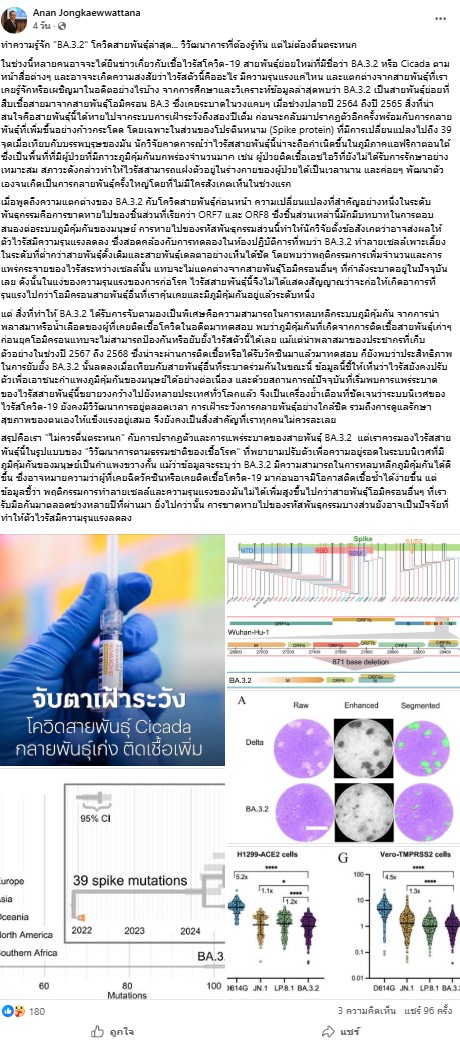
Dr. Anan Jongkaewwattana took to his Facebook page to share insights regarding the COVID-19 subvariant BA.3.2.
Some genetic changes, including the deletion of ORF7 and ORF8, may lead to decreased severity, consistent with data showing the virus is no more dangerous than previous Omicron variants. While reinfection is more probable, this is simply a part of the virus’s natural evolutionary process. Rather than being alarmed, the public is encouraged to monitor updates closely and continue practicing good personal hygiene.
The BA.3.2 subvariant is informally nicknamed ‘Cicada’ due to its unique mutational pattern. Much like the life cycle of a cicada—which remains underground for many years before emerging—this virus remained dormant and undetected for a significant period before resurfacing.
Interesting examples of other Omicron subvariant designations include:
- BA.2.86: Pirola
- XBB.1.5: Kraken
- EG.5: Eris
- JN.1: Juno The JN.1 variant, nicknamed ‘Juno,’ has no reported connection to crickets whatsoever.
COVID Cicada variant spreads easily, but does not cause severe illness
Professor Dr. Wasun Chantratita, Head of the Center for Medical Genomics at Ramathibodi Hospital, explained to Thai PBS Verify that the ‘Cicada’ variant does not actually originate from crickets or cicadas, contrary to popular belief. Instead, it is a COVID-19 subvariant (coded BA.3.2), nicknamed for its resurgence after first appearing about two years ago. Biologically, this strain carries approximately 70–80 mutations. These changes in its spike protein allow the virus to bind effectively with cells in the upper respiratory tract, making it highly transmissible; however, it does not bind well with lung cells.
As a result, most cases are mild, presenting with cold-like symptoms such as a runny nose and sore throat rather than the severe pneumonia seen in earlier COVID-19 strains. Treatment remains the same as for previous Omicron variants, given that the majority of patients recover without complications. For prevention, the public is advised to adhere to established health protocols: practice good hygiene, eat hot-cooked meals, use serving utensils, and avoid risky environments.

Professor Dr. Wasun Chantratita, Head of the Center for Medical Genomics, Faculty of Medicine Ramathibodi Hospital, Mahidol University
Although the world has not yet reacted with alarm, the high contagious nature of this variant demands ongoing monitoring. Thailand’s surveillance efforts are currently constrained by decreased genetic sequencing, meaning regular tests can only detect COVID-19 but not distinguish between subvariants. Should sequencing efforts ramp up, the variant will likely be identified locally. Maintaining international cooperation is vital to mitigate the risk of further mutations that might enable the virus to once again target the lower respiratory tract.
What should be Thailand’s strategic response?
The Center for Medical Genomics at Ramathibodi Hospital, Mahidol University, noted on its Facebook page that although the BA.3.2 subvariant has become more adept at evading antibodies—the body’s primary line of defense—human immunity does not rely on a single mechanism alone.
In addition, T-cells act as an essential internal safeguard by effectively recognizing and eliminating infected cells. Although they might not provide full immunity against infection, resulting in manageable symptoms such as a sore throat, this cellular response is vital for mitigating the impact of the virus and shielding against severe clinical outcomes.
Data from 2024–2025 in the United States indicates approximately 390,000 to 550,000 COVID-19 hospitalizations and between 45,000 and 64,000 deaths. These figures underscore that the disease remains significantly more severe than seasonal influenza.
Thailand remains a key hub for international tourists from regions such as Europe, the U.S. and Japan, all of which have confirmed cases of this variant. Consequently, the introduction of BA.3.2 or other emerging strains into the country may be difficult to prevent.
However, according to GISAID—the global genomic database—there have been no reported cases of this subvariant detected in Thailand to date.
The absence of such data does not necessarily mean the variant is not present in the country. Instead, it likely reflects a recent decline in random testing and genomic sequencing, which has correspondingly reduced our ability to detect new strains.
Guidelines for response
- Maintain a calm perspective: Present data does not indicate that BA.3.2 leads to significantly more severe clinical outcomes compared to previous strains.
- Maintain optimal immunity: Individuals—especially those in vulnerable groups such as the elderly, those with underlying health conditions, and the immunocompromised—should consult a physician regarding appropriate booster vaccinations.
- Adhere to standard hygiene protocols: Mask-wearing in poorly ventilated spaces or if you experience symptoms continues to be a practical and efficient way to curb the spread of the virus.
What is the truth?
Thai PBS Verify has investigated claims regarding the ‘Cicada’ variant. A keyword search revealed that the BA.3.2 subvariant is nicknamed ‘Cicada’ because its mutational behavior involves remaining dormant for a long period before resurfacing. This mirrors the life cycle of cicadas, which live underground for years. The virus does not originate from crickets; it is a mutated strain of COVID-19. Furthermore, there are currently no reported outbreaks of this variant in Thailand.
Verification Process
- Keyword search: A search for the keyword ‘Cicada’ yielded no evidence that the virus originates from crickets. Instead, ‘Cicada’ is a nickname for the BA.3.2 subvariant, inspired by its mutational behavior. Much like the life cycle of a cicada that remains underground for years, this virus undergoes a long period of hidden mutation before resurfacing in a new outbreak.
- Interview with expert: Professor Dr. Wasun Chantratita, Head of the Center for Medical Genomics at Ramathibodi Hospital, told Thai PBS Verify that the so-called ‘Cicada’ variant does not actually originate from crickets or cicadas, despite popular misconceptions. It is, in fact, a COVID-19 subvariant (BA.3.2). The nickname stems from its resurgence after first being detected approximately two years ago.
Impacts of misinformation
- Scientific misconceptions: False claims mislead the public regarding the origin of the disease. People may incorrectly believe the virus is transmitted by insects, whereas it actually stems from viral mutations within the human population.
- Unnecessary panic: This type of news can incite fear toward unrelated subjects, such as insects, or lead to unnecessary behavioral changes. This distracts the public from focusing on the correct and effective preventive measures.
- Improper health practices: When the public is misinformed, they may overlook critical protocols like getting booster shots, wearing masks in crowded settings, or practicing standard personal hygiene.
- Undermining institutional credibility: As false information circulates, it creates skepticism toward public health agencies. This may result in the public ignoring official guidance in favor of unverified and anecdotal sources.
- Communication breakdown: Misleading information spreads quickly, forming a cycle of falsehoods that is hard to stop. This often leads to broad misunderstandings across society, making it difficult to re-establish the facts.
What to do with this misinformation?
- Avoid instant sharing: Stay calm and double-check the facts. Because health news drives public action, verifying information is a vital responsibility.
- Verify the source: Confirm whether the information originates from reputable organizations, such as the CDC or the World Health Organization. Exercise extra caution with information found solely on social media posts.
- Consult multiple sources: Search for information across various reputable websites or mainstream media outlets to see if the reports are consistent and independently verified.
- Beware of exaggerated or misleading explanations: For instance, avoid claims suggesting an insect origin when the name is merely a metaphorical nickname.
- Verify the date of the information: Outdated reports are often reshared, which can lead to significant misunderstandings regarding the current situation.
- Apply professional discretion: When assessing health data, rely on proven scientific principles rather than conjecture or hearsay.
Translation edited by: Peerachai Pasutan