Breakdown of ballot sheet controversy after 2026 Thai election

Thai PBS Verify found the claim to be misleading. A fact-check reveals that, in 2023, only a QR Code indicating the batch was used. In 2026, however, ballots contain barcodes assigned to individual ballot papers, with running numbers matching the ballot stub.
Thai PBS Verify found the disinformation in the Threads post

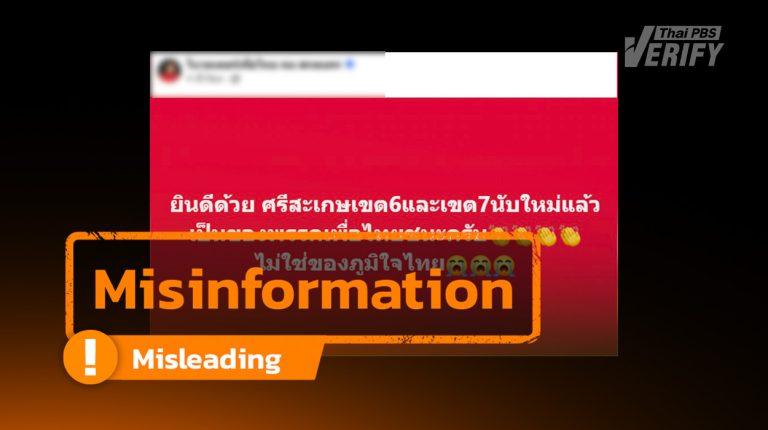
A Threads user, named ‘maitri168’, shared an image from a page called ‘Mor Anamai Khee Mouth (หมออนามัยขี้mouth)’, claiming that there were barcodes on ballot papers in the 2023 election, stating:
“There were also barcodes on the 2023 election’s ballot paper.
Nothing happened = Move Forward Party won
End of story.”
The post received more than 40,000 views, over 700 reactions and more than 130 comments.
Are 2023 and 2026 election’s barcodes the same or different?
In 2023:
Ballots did not contain barcodes. Instead, constituency ballots featured a QR Code indicating the book number or printing batch (Batch ID) for shipping control and to prevent ballots from being used outside their constituencies. The code was identical throughout each booklet and did not identify individual ballot papers. Therefore, it could not be used to identify voters.
In 2026:
- A barcode on party-list (pink) ballots
- A QR Code on constituency (green) ballots
These codes are unique to each individual ballot (Unique ID) and include a running number matching the serial number on the ballot stub. Voters are required to sign or provide a fingerprint on the stub. Technically, this allows the ballot to be matched with the voter’s identity.
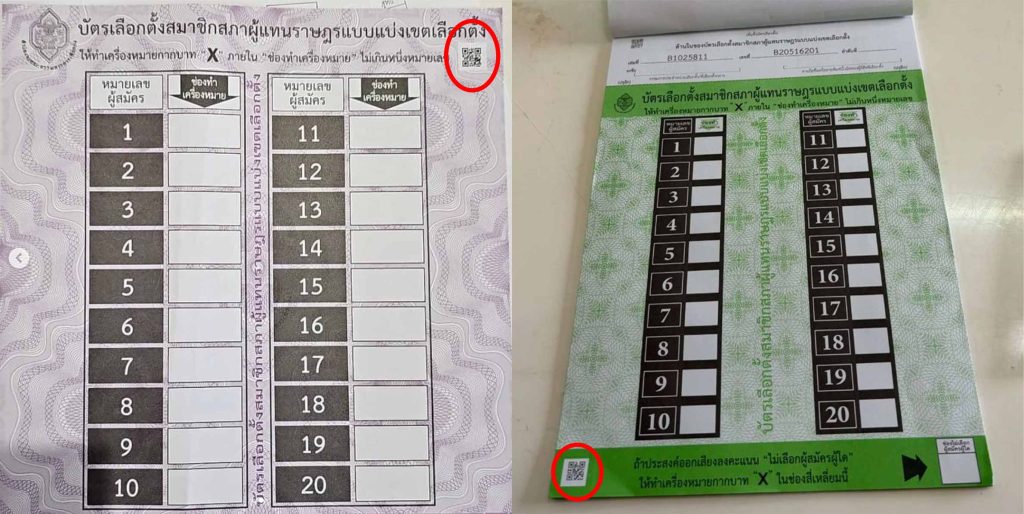
Images comparing 2023 constituency ballots (with batch-level QR Codes) and 2026 ballots (with unique running numbers matching the stub)
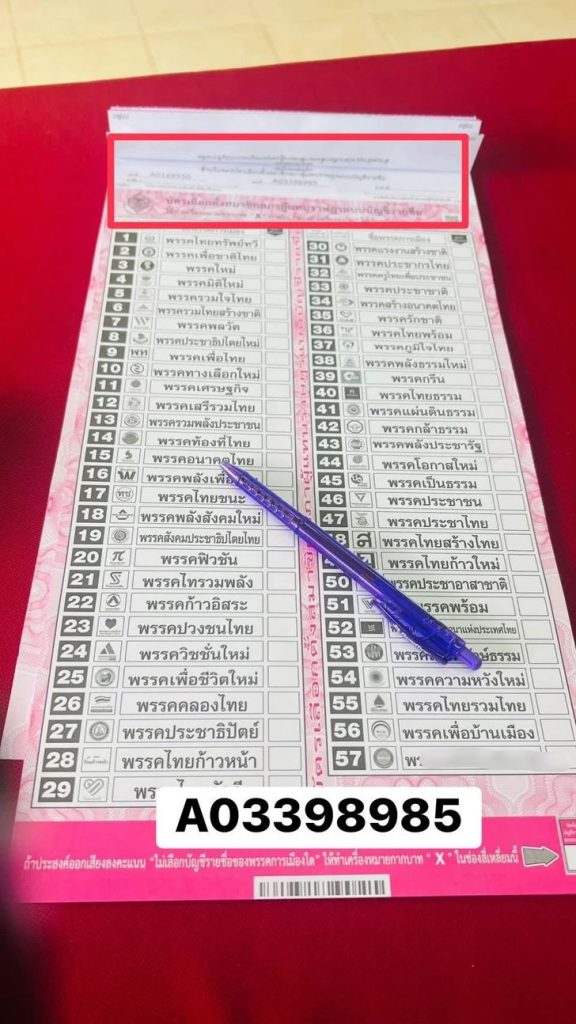
A barcode displaying on the 2026 party-list was not present on party-list ballots in 2023
The Election Commission of Thailand responds
At a press conference on February 13th, 2026, the Election Commission of Thailand stated that the codes are security measures to prevent ballot counterfeiting.
According to the Commission, barcodes and QR Codes are among several anti-forgery tools and are used to manage ballot distribution. They can verify whether ballots were printed in excess, confirm that each booklet contains 20 complete ballots, and prevent “floating ballots.” If ballots are misplaced or misused, authorities can trace their origin and determine responsibility.
Although the system allows verification down to the ballot number, the Commission stated that it is not intended to identify voters.
The EC conference [in Thai]
No Barcode in 2023, according to former election commissioner
Mr. Somchai Srisutthiyakorn, former Election Commissioner, confirmed that 2023 ballots did not contain barcodes.
Both ballots only carried QR Codes on constituency ballots for confidentiality purposes.
He noted that standard ballot security measures typically include watermarks, invisible ink and micro-text, which were considered sufficient. The use of barcodes on ballots was introduced in 2026.

Somchai Srisutthiyakorn, former Election Commissioner
Mr. Somchai’s interview [in Thai]
What is the truth?
The claim that “there was already a barcode in 2023” is a half-truth and misleading.
2023 election ballots carried no barcode: Neither type had a barcode. Only constituency ballots had QR Codes, indicating batch-level information. Codes were identical within each booklet and could not identify individual ballots or voters.
2026 election had unique Identifiers: Pink ballots use barcodes and green ballots use QR Codes. Each ballot has a unique running number which matches the serial numbers signed or fingerprinted by voters on the ballot stub.
Verification Process
- Expert testimony: Somchai Srisutthiyakorn, a former Election Commissioner, confirmed that the 2023 ballots did not have a barcode. They only had a QR code showing the production batch number. He said this system had stronger secrecy protection than the system used in 2026. The codes printed on the ballots in 2023 and 2026 are completely different in technical design and use.
- Agency clarification: The Election Commission acknowledged that 2026 codes can technically trace back to ballot numbers, but emphasised that they are for anti-counterfeiting and floating ballots.
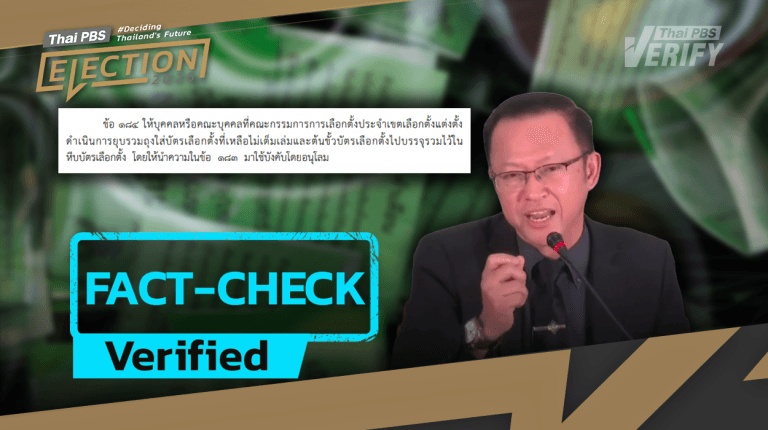
- Technical analysis: Since the ballot code matches the stub containing voter identification, and Election Commission Regulation No. 184 requires both parts to be placed in the same ballot box after voting, the secrecy of voting under Section 85 of the Constitution may be at risk.
Impacts of this false information
- Creating political division: Claiming that the investigation is about one side’s defeat shifts attention away from legal principles and turns the issue into a political conflict.
- Reducing the importance of ballot secrecy: It may confuse the public into thinking that having an identifying code on a ballot is normal. In fact, this goes against the principle of a “direct and secret” vote. This could lead to interference or intimidation of voters in the future.
- Undermining trust in the election system: When technical facts are mixed with political opinions, proper scrutiny of the transparency of state agencies may be overlooked.
What to do with this misinformation?
- Check the type of technology: Do not rely only on the words “barcode” or “QR code.” Check whether the code identifies information at the “batch level” or at the “individual ballot level” (unique).
- Follow reliable fact-checking sources: When information tries to link political win-loss outcomes with technical issues, verify the facts with independent bodies or media outlets that focus on fact-checking, such as Thai PBS Verify.
Translator: Nad Bunnag, Thai PBS World

Related Content