Senator proposes 10% VAT within 3 years, Bhumjaithai wants economic growth first

Thai PBS Verify found the post in question on: Facebook
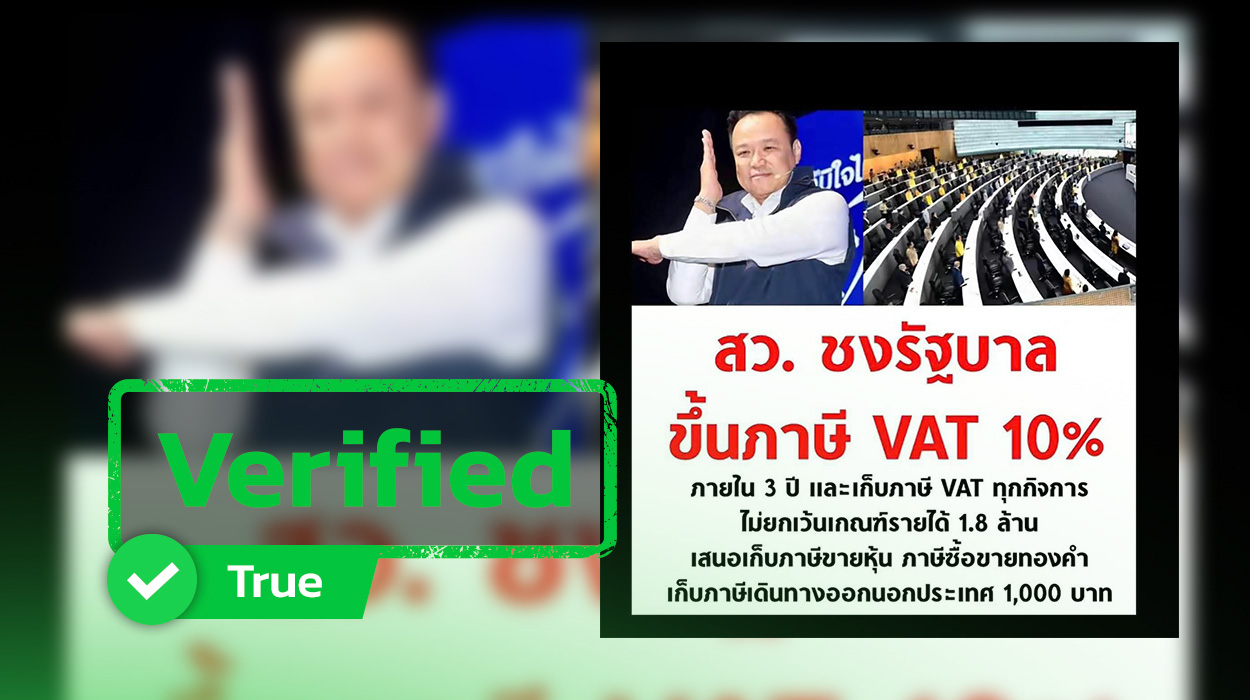
A Facebook page displaying a photo of PM Anutin Charnvirakul with a caption that reads “Senators have proposed that the government raise VAT to 10% within three years and collect VAT from all businesses, removing the 1.8-million-baht income exemption threshold. They also propose imposing a stock sales tax, a gold trading tax and a 1,000-baht outbound travel tax.”
Thai PBS Verify has found a Facebook post which includes a photo of PM Anutin Charnvirakul, along with a caption which reads: “Senators have proposed that the government raise VAT to 10% within three years and collect VAT from all businesses, removing the 1.8-million-baht revenue exemption threshold. They also proposed imposing a stock sales tax, a gold trading tax, and a 1,000-baht outbound travel tax.”
The post attracted 364 reactions and 177 comments at the time of going to press, most of which disagree with the proposed VAT increase.

Netizens expressing their disagreement with proposed VAT increase
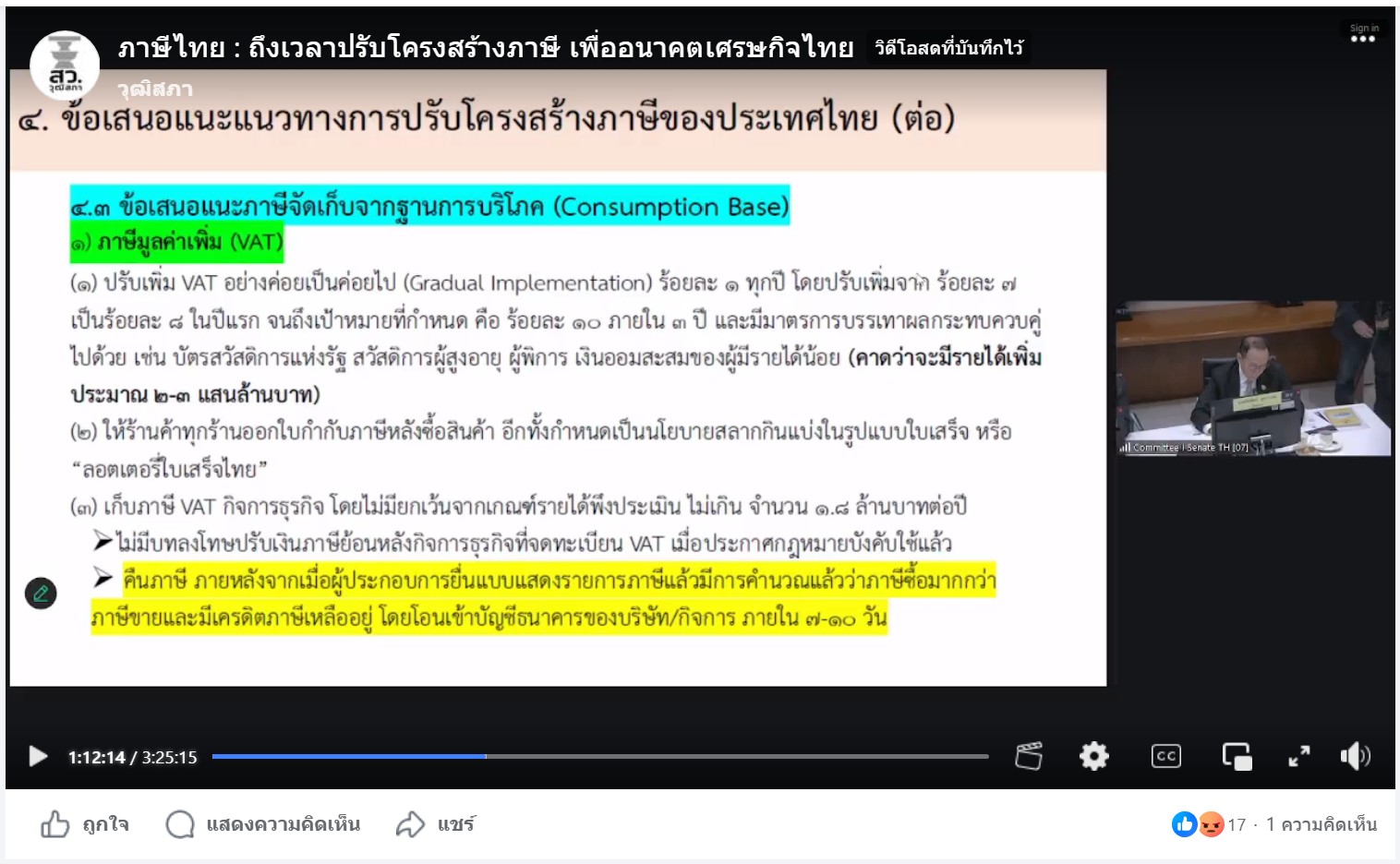
A screenshot of a Senate meeting on the topic of “Thai taxes: It’s time for tax restructuring for Thailand’s economic future”, held on February 12th, 2026 via the Senate’s Facebook page
Thai PBS Verify conducted research using keywords “Senate proposing that the government increases VAT to 10% within 3 years”. The results returned include a Facebook video of a Senate meeting on February 12th, 2026, which discussed the topic of “Thai taxes: It’s time for tax restructuring for Thailand’s economic future”.
Senator Piyapat Supawan, deputy chair of the Senate’s subcommittee on finance, proposed the gradual VAT increase from 7% to 10% over three years. The move is expected to rake an additional 200–300 billion baht into state coffers per year.
At the meeting, the senator also proposed an elderly savings scheme in which the additional 3% from VAT collection would be allocated to individual savings accounts, to help raise the old-age state benefit to 3,000 baht per month. He also proposed mitigating public debt risks, as Thailand’s public sector borrowing requirement is projected to reach 69.78% of GDP by 2028, which is close to the 70% ceiling, while the budget deficit is expected to persist over the long term.
Other proposed measures include:
- A “receipt lottery” scheme to encourage consumers to request tax invoices.
- Imposition of a 0.11% stock sales tax, which have been exempt for more than 40 years.
- Studying the possibility of a gold tax.
- An outbound travel tax for Thai nationals.
No plans to increase VAT yet, says Deputy Leader of Bhumjaithai
Meanwhile, Bhumjaithai party’s deputy leader, Siripong Angkasakulkiat, has denied that the government intends to increase VAT to 10%. He said that Thailand’s economy in 2026 is still facing various challenges. Therefore, the main policies must focus on boosting economic growth, not increasing the state’s income through VAT increases.
Siripong also explained that discussions on building confidence among credit rating agencies, which could be linked to increasing state revenue, are only a conceptual framework that has previously been discussed.
He insists that VAT increases will not take place within the next two to three years, adding that the government will consider reviewing any VAT adjustment when, and only when, the Thai economy has recovered and people genuinely feel that economic conditions have improved.
Tax changes so far by the Thai government
In 2026, the Thai government announced two new tax measures:
Value-Added Tax (VAT): Starting January 1, 2026, the government will enforce VAT and import duties on all imported goods valued at 1 baht or more. This measure removes the previous exemption and aims to ensure fair competition for Thai businesses. Until the end of 2025, only 7% VAT rate was collected.
Under the new system, postal imports can pay taxes immediately via QR Code. For imports through express delivery companies, the company will advance the tax payment and later collect the reimbursement from the recipient. Overall, the measure is not expected to delay deliveries.
The government estimates that the policy will generate at least 3 billion baht in additional revenue per year, help reduce under-invoicing and tax evasion and is urging the public and importers to prepare for higher cost structures carefully and transparently.
Excise Tax: The government has restructured the automobile excise tax, effective January 1st, 2026. The new system changes the criteria from engine size to CO₂ emission levels and clean energy technology. As a result, gasoline-powered vehicles, especially high capacity engine models, luxury cars, and supercars, will face higher taxes, leading to increased retail prices.
Clean energy vehicles will benefit under the new structure. Certain hybrid models will see lower tax rates, while battery electric vehicles (BEVs) will have their tax reduced from 8% to 2%.
The new structure aims to steer Thailand’s automotive industry towards a low-carbon society. It will not affect vehicles registered before 2026, but it may influence the second-hand car market, particularly high-emission vehicles, whose prices may decline over time.
What are the facts?
Thai PBS Verify has confirmed the existence of the Facebook post and found a video of a Senate meeting on February 12th, 2026 on the topic of “Thai taxes: It’s time for tax restructuring for Thailand’s economic future” organised by a Senate committee.
It is also found that Senator Piyapat Supawan, deputy chair of the Senate’s subcommittee on finance, proposed the VAT rise from 7% to 10% within three years, at 1% per year, aiming to increase state revenue by 200-300 billion baht
Bhumjaithai party’s deputy leader, however, confirms that the government has no plans to increase VAT to 10%, as they are focusing on reviving the sluggish Thai economy first.
Verification Process
- Using keywords: “Senate proposing the government to increase VAT 10% within 3 years”, which showed a Facebook video of a Senate meeting on February 12th, 2026, discussing the topic of “Thai taxes: It’s time for tax restructuring for Thailand’s economic future”. Senator Piyapat Supawan proposed the VAT increase from 7% to 10% within three years, at 1% per year, aiming to increase state revenue by 200-300 billion baht
- Verified sources: Deputy leader of Bhumjaithai party confirms that the government has no plans to increase VAT to 10% in the next 2-3 years, as they are focusing on returning life to the sluggish economy.
Translator: Nad Bunnag, Thai PBS World