Chasing Clout with Fake News: A Costly Lesson from the Nonthaburi Mass Shooting

Examining the threat of misinformation in the wake of the Nonthaburi shooting: from deceptive imagery and fake chats pushing illegal gambling to attention-seeking AI visuals. This crisis underscores the perilous impact of false data, compounding trauma and inflicting deeper scars on society.
The tragic shooting incident at Debsirin Nonthaburi School in Bang Krui District, Nonthaburi, resulted in multiple fatalities and injuries, serving as a prominent case study on the spread of disinformation. This singular event encapsulated fabricated claims, identity theft, and deliberate misdirection, thereby inducing public confusion, inciting hatred, and compounding the harm experienced by the victims’ families and broader society.
Thai PBS Verify established a comprehensive timeline detailing the proliferation of disinformation surrounding this event. The investigation identified clear patterns and methodologies of false claims surfacing as early as the first hour following the incident, as categorized below:
1.The Initial Panic: The Wave of Missing
Children Reports Amid the initial pandemonium, confusion sparked a flurry of missing-student alerts across social feeds, fueled by growing fears that unreachable children had vanished or fallen victim to the tragedy.
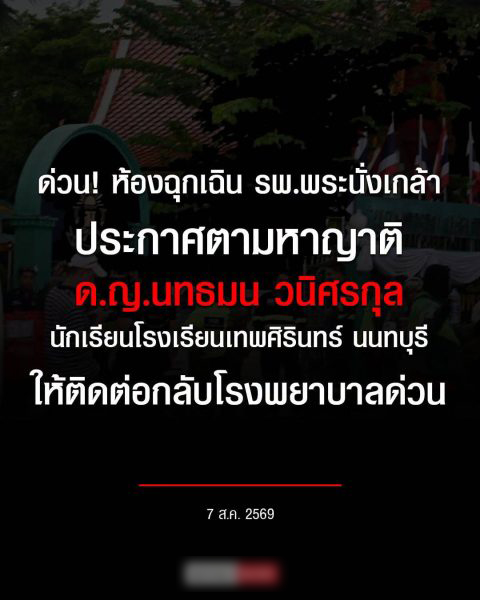
Screenshot showing a media outlet’s post reporting a missing student from the incident.
Even with good intentions, rushing to share unconfirmed news in the middle of a crisis created needless panic for worried families and the public alike.
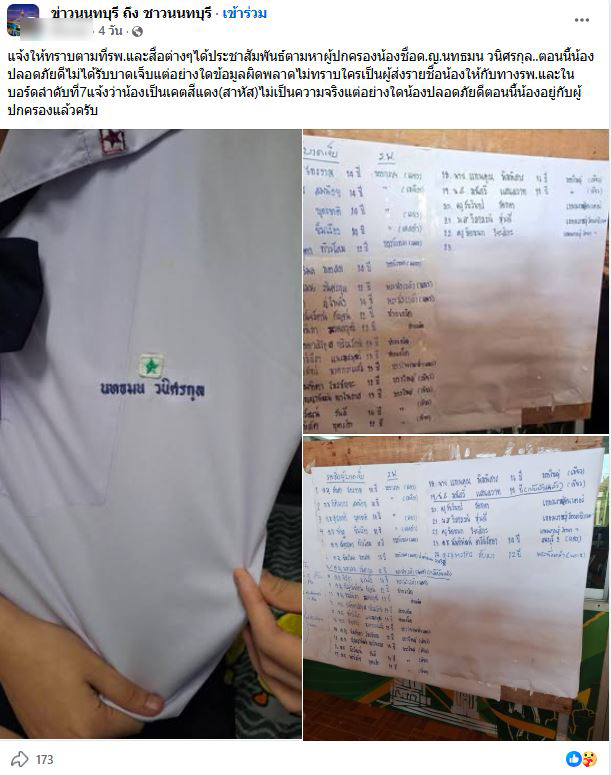
Clarification post stating the girl on the list is safe and completely unharmed.
2. Misleading Impersonation: Recycled Old Photos
As the dust began to settle, social media feeds were suddenly flooded with images purporting to show the suspect’s student ID card, in a frantic attempt to doxx and unmask the shooter.
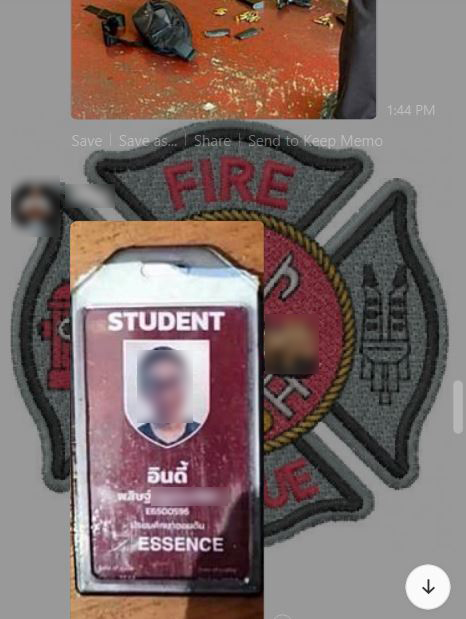
A student identification card image from the previous Siam Paragon shooting was redistributed under the false claim of depicting the suspect in the latest event.
However, fact-checking revealed that the image had nothing to do with the Nonthaburi incident. It was actually an old photo from the Siam Paragon shooting, repurposed simply to grab attention.

Cofact verified the image and found it was an old photo dating back to 2023.
3. Groundless Rumors and Wild Claims: Misleading the Public
The rush to invent a ‘motive’ for the shooter became ground zero for rampant online fabrication. In one viral instance, an impostor claiming to be the suspect’s older sister spun a tragic narrative—alleging the shooter had been relentlessly bullied, physically assaulted, routinely extorted for cash, and even locked inside school bathrooms. Unfounded rumors also circulated claiming that the shooter carried explosives. However, police investigations officially confirmed that only a firearm was recovered at the scene, with no explosives found as alleged.


screenshot showing unsubstantiated claims alleging the suspect was a victim of bullying.
4. Mainstream Media as an Unwitting Megaphone
Disinformation was not restricted to anonymous digital commentary; it subsequently penetrated mainstream journalistic coverage through a broadcast interview with an unverified source asserting direct knowledge that peer bullying and restroom confinement constituted the root cause of the incident.
Consequently, this unverified narrative gained significant traction and perceived credibility across major platforms. It was only later debunked when school personnel officially clarified that the allegations of bullying and restroom detention were entirely untrue.
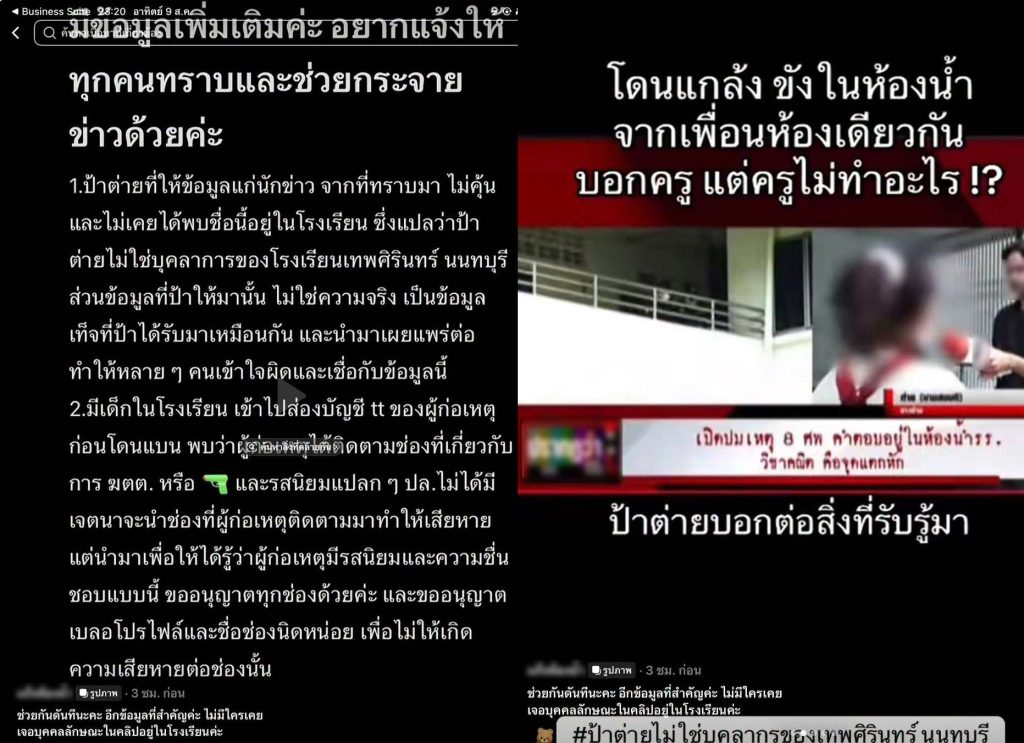
Broadcast footage of an interview citing hearsay evidence, which substantially expedited the proliferation of unconfirmed claims.
5. Staged Chats and Gambling Solicitations: Exploiting Public Grief
One of the most morally bankrupt maneuvers was the release of an alleged text exchange between the mother and the young assailant. It read like a heartbreaking drama that kept audiences hooked, but forensic fact-checking proved it was nothing more than staged disinformation. This content was orchestrated to manufacture engagement and drive web traffic toward illicit gambling platforms, shamelessly turning human suffering into a moneymaking scheme.

Falsified chat logs designed as clickbait to funnel online engagement toward illicit gambling promotional links.
6. “Engagement-Driven AI”: Manipulating Imagery and Content for Social Metrics
Perhaps the starkest reflection of online recklessness was taking a blurry, covert snapshot from the crime scene, running it through Generative AI to artificially enhance the image, and branding it as the ‘face of the shooter.’ Posters paired the visual with sympathy-baiting captions alleging the suspect was heavily bullied—a hollow drama manufactured purely to harvest likes and shares, with zero regard for verified facts or the ongoing investigation.
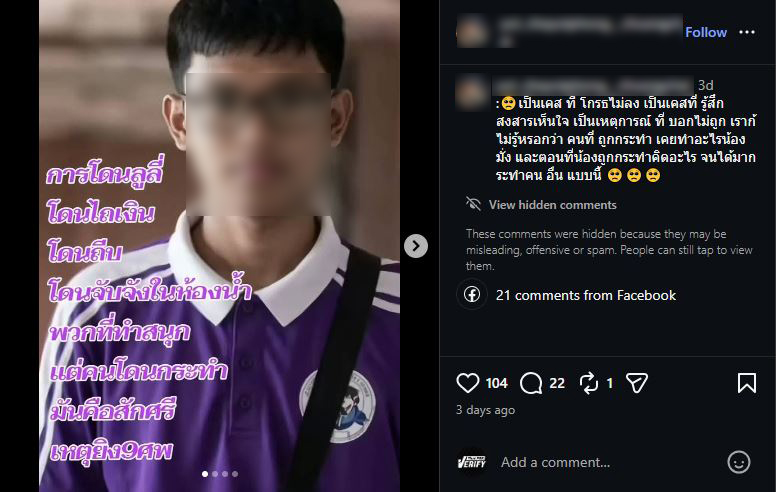
Example of a fake post chasing clout and shares with no verified sources.
The Nonthaburi mass shooting wasn’t just a physical tragedy—it was an ‘information disaster.’ It laid bare an online culture where people are eager to chase clout, make up stories, and shamelessly exploit other people’s trauma.
The Anatomy of Misinformation During Major Crises
Thai PBS Verify sat down with Peerapon Anutarasoat from MCOT’s Sure And Share Center to discuss the impact of the news coverage. He explained that this kind of misinformation cycle is entirely predictable: whenever a major tragedy makes headlines, suspicious claims and rumors are bound to follow. Because fabricating fake news actually makes money and drives traffic for creators, it has become the norm. Whenever a big tragedy happens, you can almost guarantee this type of misinformation will follow.
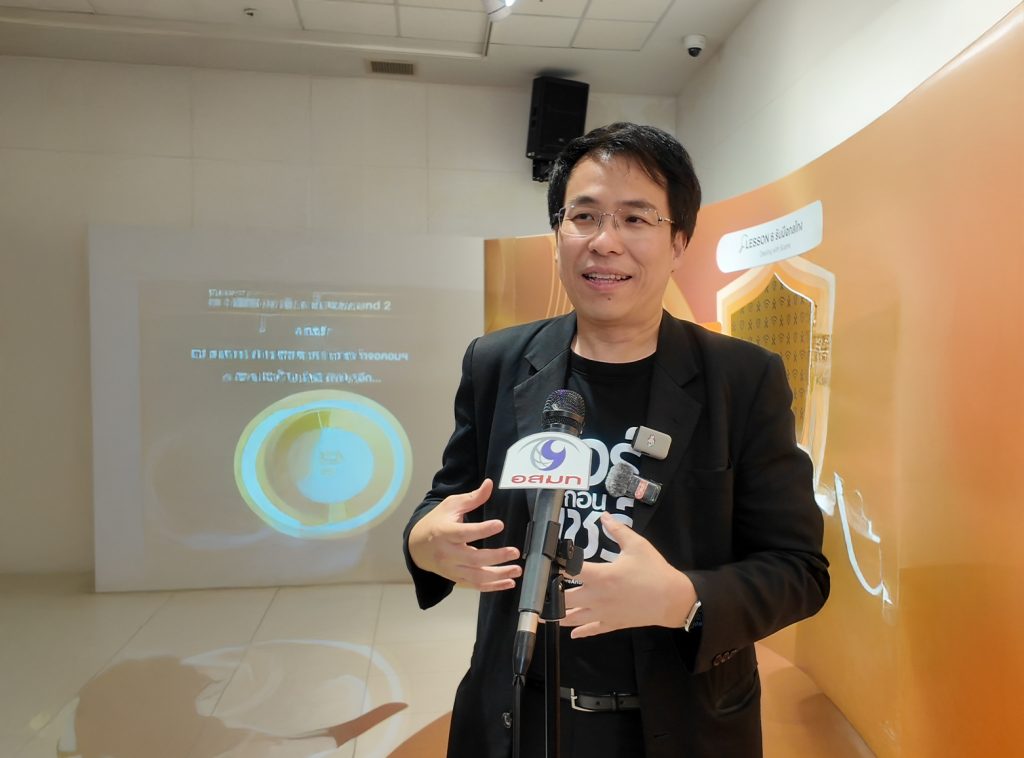
Mr. Peerapon Anutarasoat, lead fact-checker at the Sure And Share Center, Thai News Agency (MCOT).
Compounding the issue is the platform architecture itself, which empowers anyone to create and broadcast unverified content with near-zero accountability. While fact-checkers, Thai PBS Verify, and government agencies work tirelessly to debunk falsehoods case by case, corrections consistently lag behind—by the time the truth surfaces, the misinformation has already circled the globe.
The Divergence Between Verified Truth and Public Sentiment
The fake news and rumors sparked by the shooting show just how broken social media can be today. This pattern shouldn’t be treated as normal, but it does give all of us a real chance to learn and become smarter about what we read online. During major breaking events, public thirst for details spikes dramatically, increasing the odds that incoming claims are dubious. This feeds directly into human psychology: in moments of high anxiety, people tend to let their guard down, trade skepticism for urgency, and rush to share unverified news before thinking twice.
“We as news consumers need to understand how breaking news really works: when a major event unfolds, the first wave of information is usually the least trustworthy. We need to think twice before believing or sharing anything, and be more skeptical right when everyone is rushing for updates.”
Far Beyond Misinformation: The Hidden Toll on Society
Unquestionably, every instance of false or misleading information inflicts tangible harm, differing only in magnitude. In this recent tragedy involving underage casualties, however, the ramifications transcend factual distortion, inflicting profound emotional distress upon numerous bereaved families.
It permanently tarnishes the reputation and public perception of those involved—leaving scars far deeper than isolated rumors about a single topic or individual. To make matters worse, it manufactures bitter arguments and deep social polarization where there never should have been conflict in the first place.
“Sometimes it just gets in the way of finding the truth. Officers have to waste time dealing with all the rumors, and that means the real, verified news gets delayed from coming out.”
Even formal statements should be approached as ‘data points requiring verification,’ not unquestioned reality.
Whenever any side puts out a clarification, we have to treat it as just one point of view. Even if it comes from a well-known influencer or a trusted news page, you still need to double-check it. Just because someone says ‘that’s not true,’ we still have to stop and ask who they actually are and why they’re saying it. Were they truly an eyewitness, or are they simply offering unsubstantiated claims that demand solid proof and hard evidence before gaining any credibility? Ultimately, anyone has the right to state their piece, but it is the audience’s job to recognize that words alone are not proof.
“Content creators or eyewitnesses driven by emotional distress to speak publicly must realize that their situational visibility has altered. Although their platform historically operated with minimal viewership and restricted outcomes, addressing a trending public crisis draws widespread scrutiny. The ramifications are no longer localized, inevitably escalating well beyond their projected calculations.”
Content creators cannot govern the authenticity or disposition of online responses, whether they manifest as vitriol or commendation. In high-visibility contexts, public reaction amplifies tenfold, necessitating psychological preparedness, as these compounding comments systematically trigger multifaceted downstream ramifications. While it is undeniably everyone’s right to step forward and clarify their stance, journalists cannot treat any statement—regardless of who issues it—as the absolute, unassailable truth.
Navigating the Crisis of Truth: Why News Consumers Must Build Resilience
It is imperative for modern audiences to understand structural shifts in the information ecosystem; unlike historic media practices, online information undergoes minimal vetting before reaching the public sphere.
“So many posts skip any fact-checking and get put online directly by whoever made them. As readers, we have to keep our guard up and remember that what we’re reading could be incomplete, totally untrue, or just a 100% honest misunderstanding. Like the kid claiming their friend failed Thai class—they only knew half the story and never checked if the grade had already been fixed. These random pieces of info get picked up and twisted into wild conspiracy theories. If everyday consumers become sharper and harder to fool, the damage caused by fake news will go way down. “
Experts Voice Growing Alarm Over Today’s Social Media Information Climate
Meanwhile, Dr. Jessada Salathong, assistant professor of communication arts at Chulalongkorn University, shared his thoughts on how the news played out on social media: The information swirling around this tragedy raises serious red flags. Much of it comes from creators motivated solely by virality, driving high metrics through a trend called ‘rage baiting’—deliberately stoking anger and indignation to manipulate audience engagement. Where digital engagement was once driven by ‘likes,’ it is now fueled by outrage. Creators deliberately provoke public fury and invite a torrent of backlash just to boost their algorithm metrics. We are seeing a sharp rise in this manipulative trend lately, and this tragedy is no exception—exemplified by unverified claims that the young perpetrator acted out because a teacher failed them, or as retaliation for school bullying.

Jessada Salathong, Chulalongkorn University’s Faculty of Communication Arts
“Several critical dimensions warrant serious scrutiny. The primary issue is systemic disinformation, where fabricated narratives and falsified artifacts circulate unchecked. This is compounded by the unjust vilification of the late teacher, compelling the school to organize a digital defense initiative to mitigate public condemnation. Crucially, the discourse risks rationalizing violent conduct by applying conventional psychological assumptions regarding prior trauma without empirical justification. In cases of mass casualty violence, definitive conclusions must not be precipitously drawn.”
The Danger of Excusing the Offender: Why Sympathy Narratives Harm Society
Making excuses for the shooter is extremely dangerous. If we make it sound like having a hard time justifies shooting people, what happens when another kid gets bullied or fails a test and thinks they have the right to do the same? That thought should never even be an option—there are always better solutions that don’t involve violence. Blaming the teacher who died and defending the attacker does huge damage in so many ways.
Perverse Incentives: The Hidden Engine Driving the Spread of Fake News
The contemporary media landscape reflects widespread opportunism, where individuals leverage societal attention for algorithmic engagement and notoriety. Resolving this structural challenge requires a comprehensive, multi-layered strategy.
- First, creators must exercise social responsibility: They cannot simply chase shares and engagement at all costs. The Thai Content Creator Association has already issued ethical guidelines outlining the dos and don’ts during such sensitive crises.
- Second, audiences must practice digital restraint: News consumers must avoid jumping to conclusions, rushing to judge, or mindlessly forwarding unverified posts.
- Third, platforms must step up moderation: Social media networks must take active ownership in vetting content and filtering out falsehoods to reinforce collective integrity.
Thai society naturally grapples with a high degree of FOMO—the Fear of Missing Out. But a crisis like this is never a race for speed. We must remind both media outlets and news consumers that rushing to break or share a story leads to reckless questions and premature conclusions. In sensitive tragedies, the real competition shouldn’t be about who is first, but who is most careful. Information consumers bear no obligation to be the first to reach a definitive verdict or circulate unvetted claims. Public discourse must not succumb to affective biases that precipitate digital vilification of the faculty or the institution. Such incidents necessitate rigorous emotional restraint and deliberate pauses before engaging.
Disinformation as an Agenda-Setter: Weaponizing the Mood of Society
Ms. Supinya Klangnarong, Chairperson of the Sub-committee on Communication, Telecommunications, and Information Technology, Thailand Consumers Council (TCC), and Co-founder of Cofact Thailand Weighing in on the wave of information generated by this phenomenon, she noted: This case represents a substantially more acute escalation in the dissemination of disinformation. While critical events routinely trigger viral phenomena across digital platforms, the dynamics of this incident extended well beyond standard information propagation. Instead, it erupted into a full-scale frenzy—relentless both in sheer volume and public emotional intensity. We witnessed a complete spectrum of disinformation, from outright fabricated content concocted out of thin air to misleading, false-context claims reminiscent of the Siam Paragon shooting. The phenomenon involves recasting authentic visual artifacts into false contexts, compounded by the total fabrication of unverified narratives. Audiences exhibited an alarming suspension of basic skepticism, credulously consuming these claims even as law enforcement procedures remained in their infancy. Under such conditions, media entities and online posters could not plausibly claim substantiated factual authority.
Above all, the most perilous outcome is how disinformation can derail the course of justice. In the back-to-back incidents across Nonthaburi Province, manufactured online rumors unmistakably influenced the direction of the police inquiry and public perception of the case. These dynamics emerge both organically—fueled by deep emotional resonance and genuine public grief—and cynically, driven by opportunists eager to exploit the tragedy for personal gain. What is even worse, Social media platforms have shown little genuine appetite to address this systemic failure, allowing online mobs to jump on the bandwagon unchecked. There was even internal debate among our own staff, with differing opinions on whether we should even bother getting involved in verifying facts at all.
(Fact-check), under the logic that drawing attention to falsehoods only amplifies them. Conversely, leaving them unchallenged allows bad actors to monetize online outrage, normalizing disinformation to the point where the public instinctively believes and circulates emotionally charged posts without giving truth a second thought. This could turn into a dangerous new norm for other crime cases down the road, and that would be a huge hit to society as a whole.

Supinya Klangnarong, Chair of the IT and Telecom Sub-committee, Thailand Consumers Council, and Co-founder of Cofact Thailand
Why Are Netizens So Vulnerable to the Lure of Fake News?
Audiences with substantial cognitive resilience are not immune to these fabrications, primarily because modern deceptive narratives exhibit high degrees of realism. Algorithmic and social amplification artificially inflates source credibility—a deeply concerning dynamic that fully exemplifies classic viral contagion theory.
“If we fail to intercept a false claim within a single minute—or lack a swift, authoritative debunking—that disinformation takes on a life of its own, spreading beyond control in the blink of an eye.”
The battle to contain viral disinformation is won or lost within the first three to five minutes. The moment a rumor surfaces, an effective counter-strike demands simultaneous action—broadcast stations synchronizing urgent corrections alongside top influencers united in calling out the falsehood and demanding people stop sharing within three minutes. That is the only real way to stop the fire before it spreads. Empirically, executing counter-measures within a single minute is exceedingly demanding. Consider the prior viral incident surrounding the YouTuber: a singular high-traction post was sufficient to trigger rapid diffusion concerning whether the individual was located or deceased. Spanning merely one to two minutes, that preliminary data successfully executed an agenda-setting function, governing public consciousness and creating an enduring initial cognitive anchor nationwide.
The Nonthaburi Shooting: A Chilling Blueprint of the Power of Fake News
This latest tragedy proved far more sinister, as the narrative was cynically weaponized to funnel traffic to illegal online gambling websites. It took just a single, calculated post to trigger an explosive domino effect—amplified exponentially within a mere minute or two by the sheer force of mass sharing. It completely set the narrative, feeding fake news straight into the heads of anyone checking their feed. Just like that, public opinion turned on the shooter’s mother, instantly painting her in a terrible light. Beyond the devastating emotional toll on the perpetrator’s family, the resulting public hysteria actively compromised the integrity of the police investigation. Although juvenile cases necessitate rigorous adherence to statutory protections and due process, subsequent non-juvenile proceedings may lack comparable insulation. Consequently, the strategic manipulation of case direction through rapid-fire disinformation deployed within minutes represents an easily replicable threat for future criminal justice administration.
A particularly notable aspect of this phenomenon lies in its deviation from traditional diffusion models. Typically, high-magnitude virality relies on top-tier nodes such as key opinion leaders, elected officials, or prominent celebrities. Despite heightened vigilance among public figures today, anomalies occur. Crucially, this narrative emerged from an unverified, disreputable digital source with zero journalistic credibility, yet managed to dominate public discourse and dictate collective sentiment. Spanning less than five minutes, the fabrication diffused uncontrollably, solidifying nationwide perception.
On top of that, fact-checks almost always come out too late because of how the process works. Serious fact-checkers can’t just shout ‘that’s fake’—they have to follow strict journalism rules. Global outlets like AFP have to verify everything with at least two separate sources, which takes real time. Some people say it’s a waste of time to chase down stupid internet rumors, and they have a point, but if you do nothing, the lies spread everywhere. Fact-checking by itself just can’t keep up. We need major influencers to step up within that five-minute window, pull everyone’s focus back, and put out the fire before it gets out of control.
Building a Structural Framework to Counter Viral Falsehoods
We need everyone on the same page—macro-influencers, nano-creators, and newsrooms all pushing out the facts at the exact same time. If we just leave it to one station like Thai PBS, with one or two people trying to debunk it, there’s no way they can stop a massive viral wave that hits like a tsunami.
“Verification entities must account for the fundamental asymmetry between the effortless dissemination of disinformation and the labor-intensive demands of containment. Corrective operations require significantly greater exertion, necessitating synchronized deployment and uniform headline taxonomy to optimize algorithmic indexing and elevate accurate content within recommendation feeds.”
This crisis offers a profound, hard-won lesson for media organizations and fact-checkers designing future counter-disinformation frameworks. Simultaneously, government authorities and digital platforms must exercise vigilant oversight. The societal fallout is vast: fake news now hijacks the public agenda without a single gatekeeper to filter the noise—perhaps the single greatest vulnerability of the modern information ecosystem. Defending against it requires a truly resilient and effective systemic response.
Ultimately, cultivating critical awareness, pausing before sharing unverified claims, and questioning every headline remain our only true armor against being weaponized by disinformation networks.