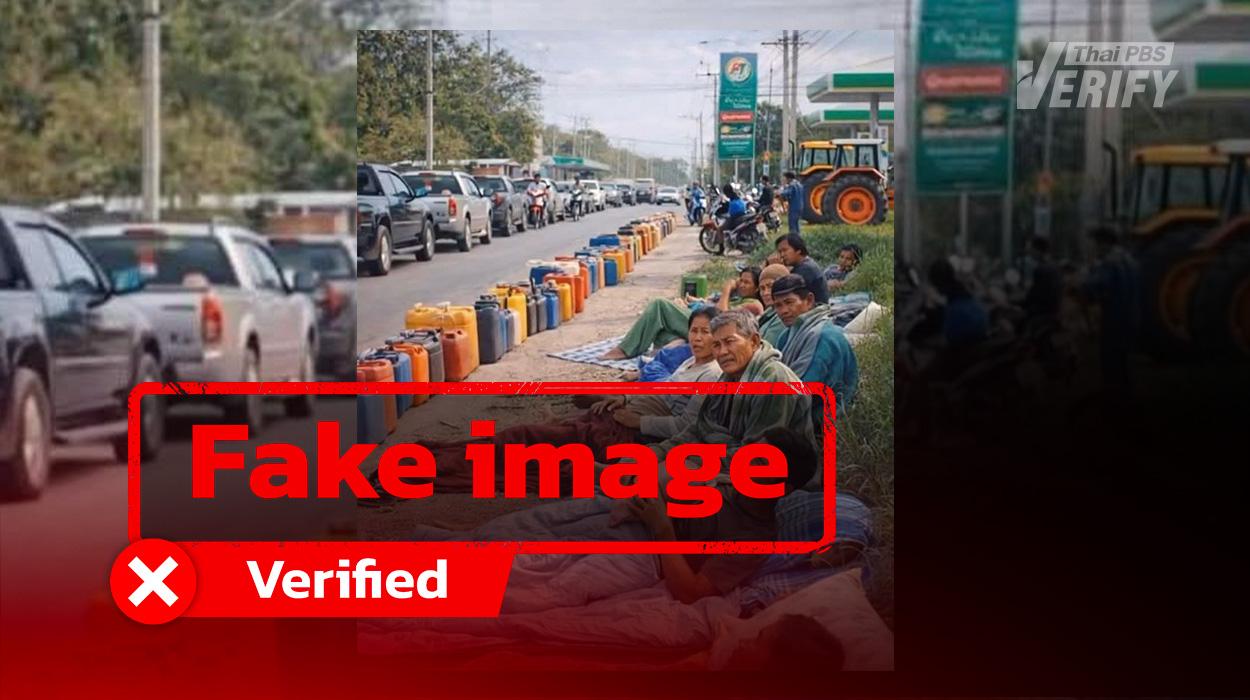
Image of villagers lying on roadside waiting to buy fuel was AI-generated
In addition, claimed information about Thailand’s current oil production is partially correct: the country does have oil fields and refineries, but domestic crude oil production is still insufficient to meet internal demand, forcing Thailand to import 70–80% of its total oil consumption.
Thai PBS Verify found the fake image on: Facebook
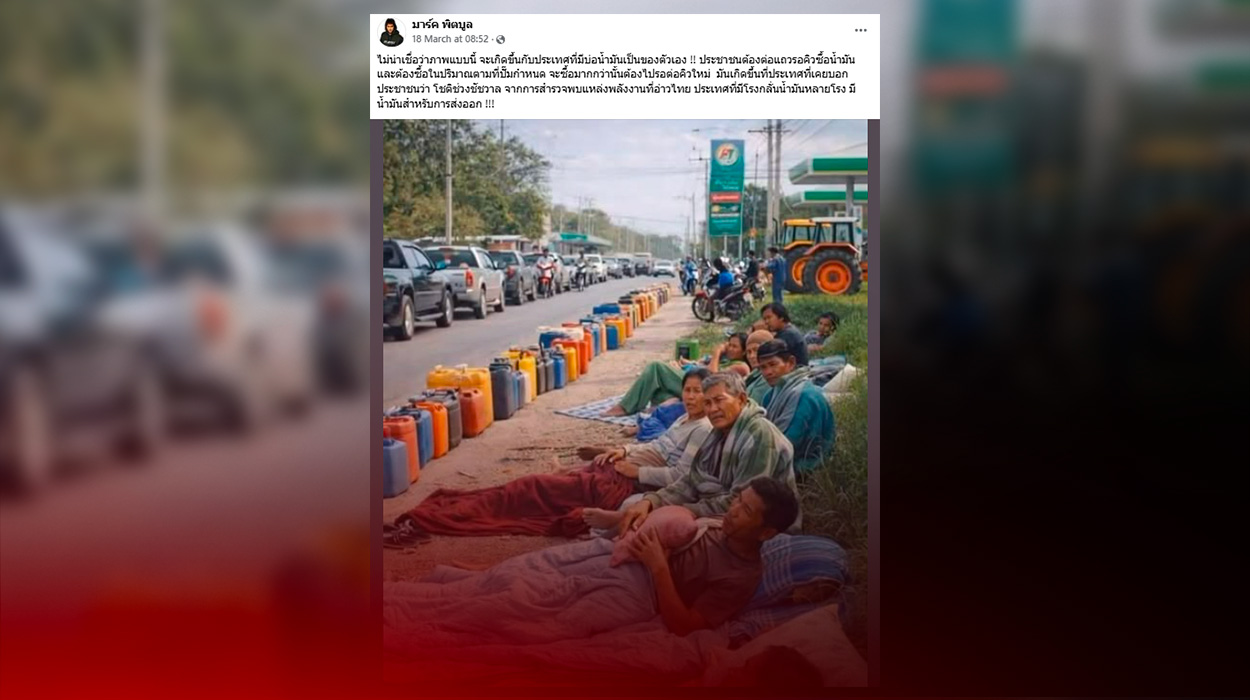
A screenshot of the image in question, published on March, 18 2026.
Thai PBS Verify found that the Facebook account named “Mark Pitbull (มาร์ค พิตบูล)” posted an image with a message about fuel shortages in Thailand:
“It’s unbelievable that something like this could happen in a country that has its own oil fields!! People have to line up to buy fuel, and they can only buy the amount set by the gas station. If they want more, they have to line up again. This is happening in a country that once told its people it would prosper after discovering energy resources in the Gulf of Thailand. A country that has several oil refineries and even exports fuel!!!”
The original post was published on March 18, 2026, gaining more than 22,000 likes.
The image in question is not real
When the image was checked via Hive Moderation, the AI detection tool found a 94.8% likelihood that the image was AI-generated.
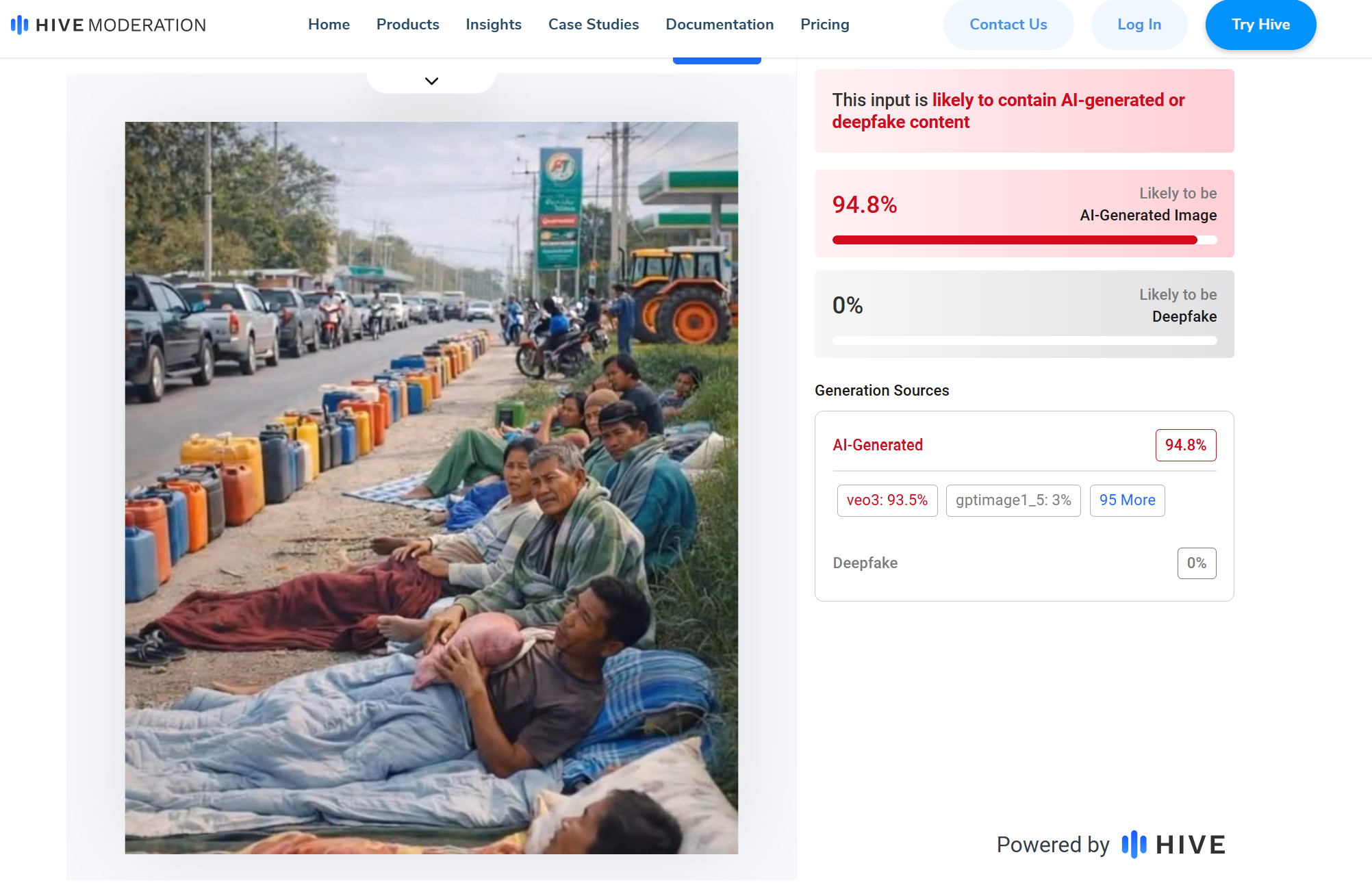
An analysis via Hive Moderation shows a 94.8% likelihood that the image was AI-generated.
In addition, when searching for the origin of the image with Google Lens, the team found no clear original source, but similar content in a video form shared on TikTok.
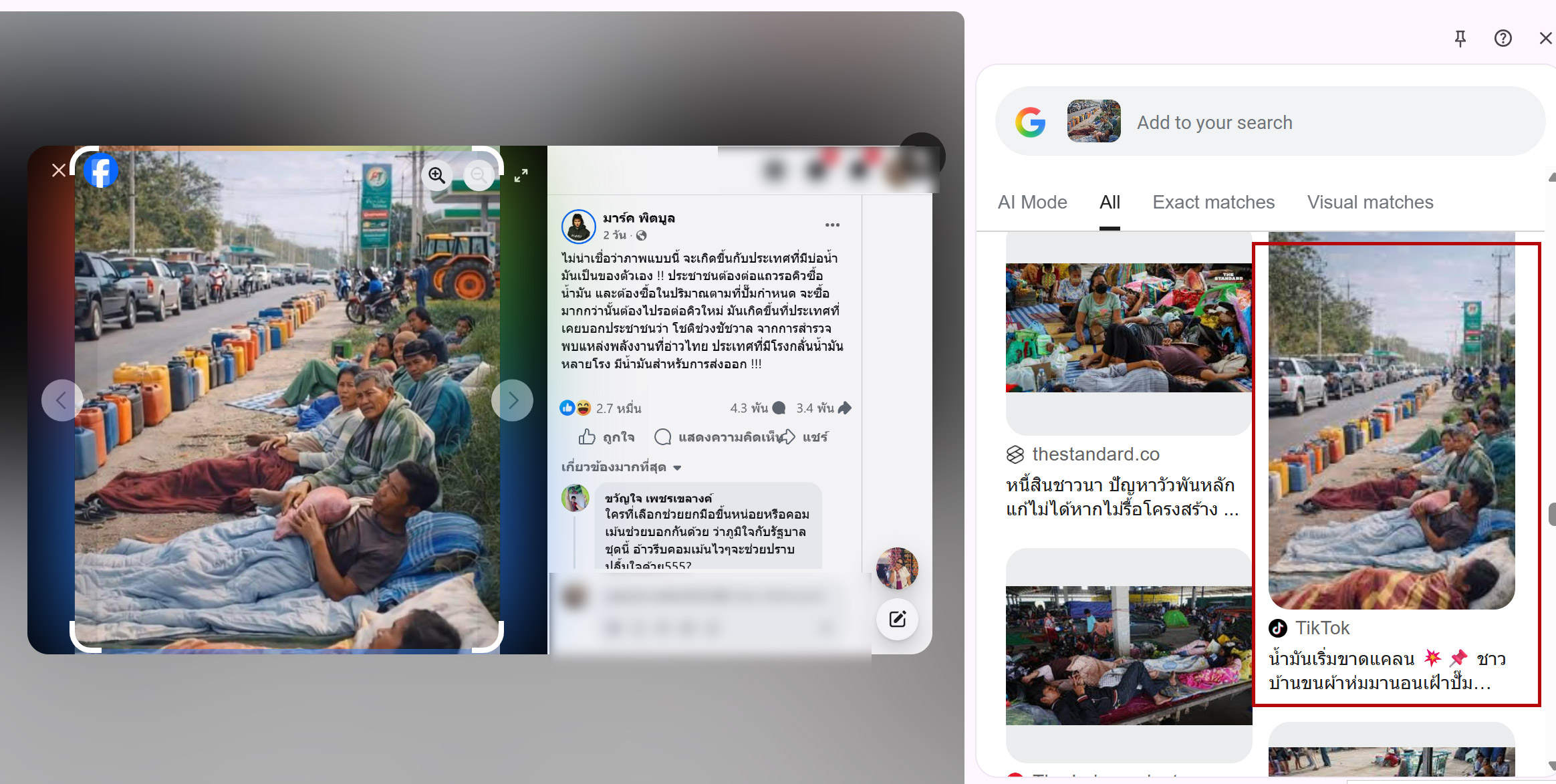
When searching for the origin of the image using Google Lens, similar content was found in the form of a video clip shared on TikTok.
According to the examination via Hive Moderation, there was a 96.2% likelihood of the video being fabricated by AI.
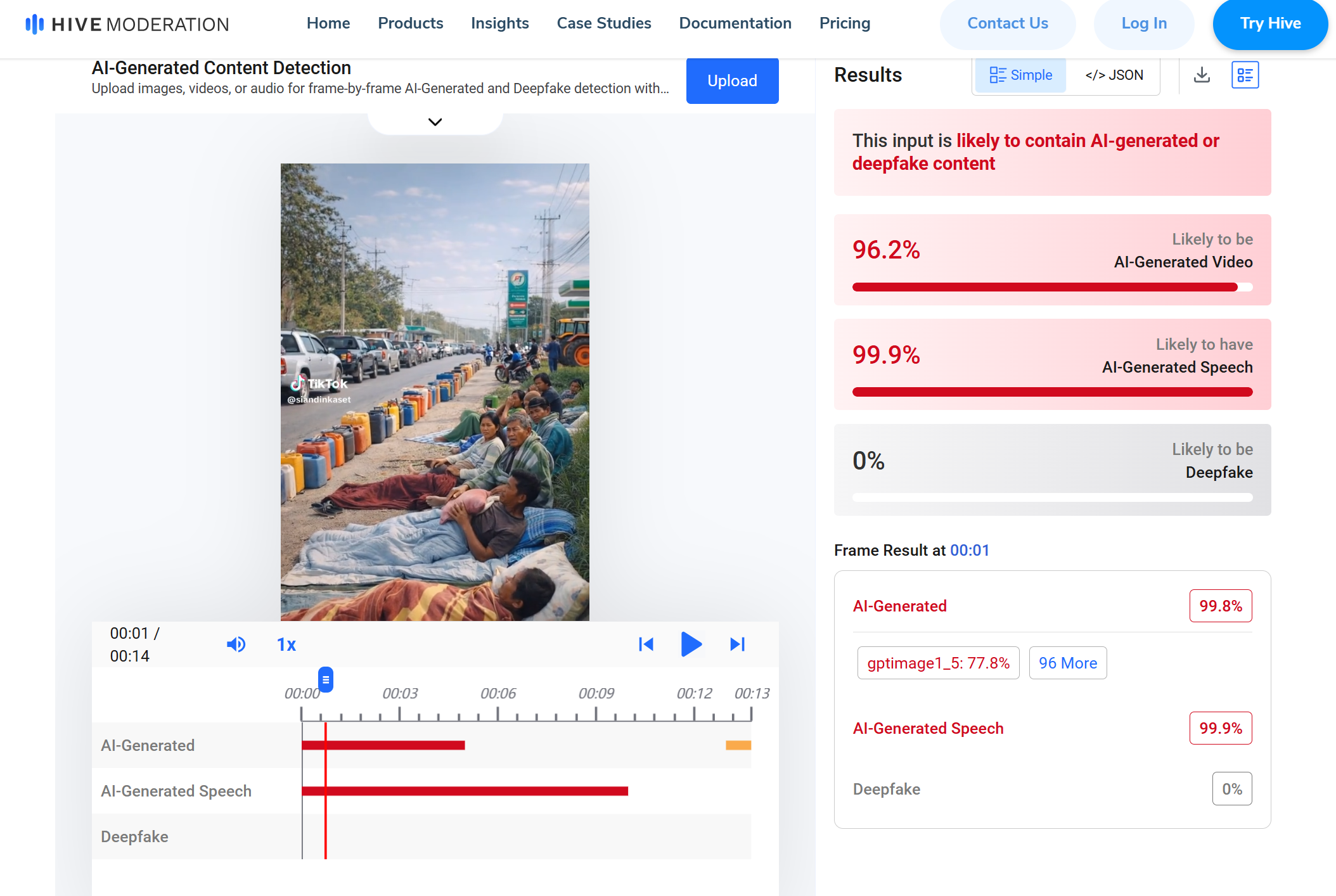
There was a high chance that the video had also been generated by AI.
In addition, several irregularities were observed in the video, such as unusual and unrealistic vehicle movements.
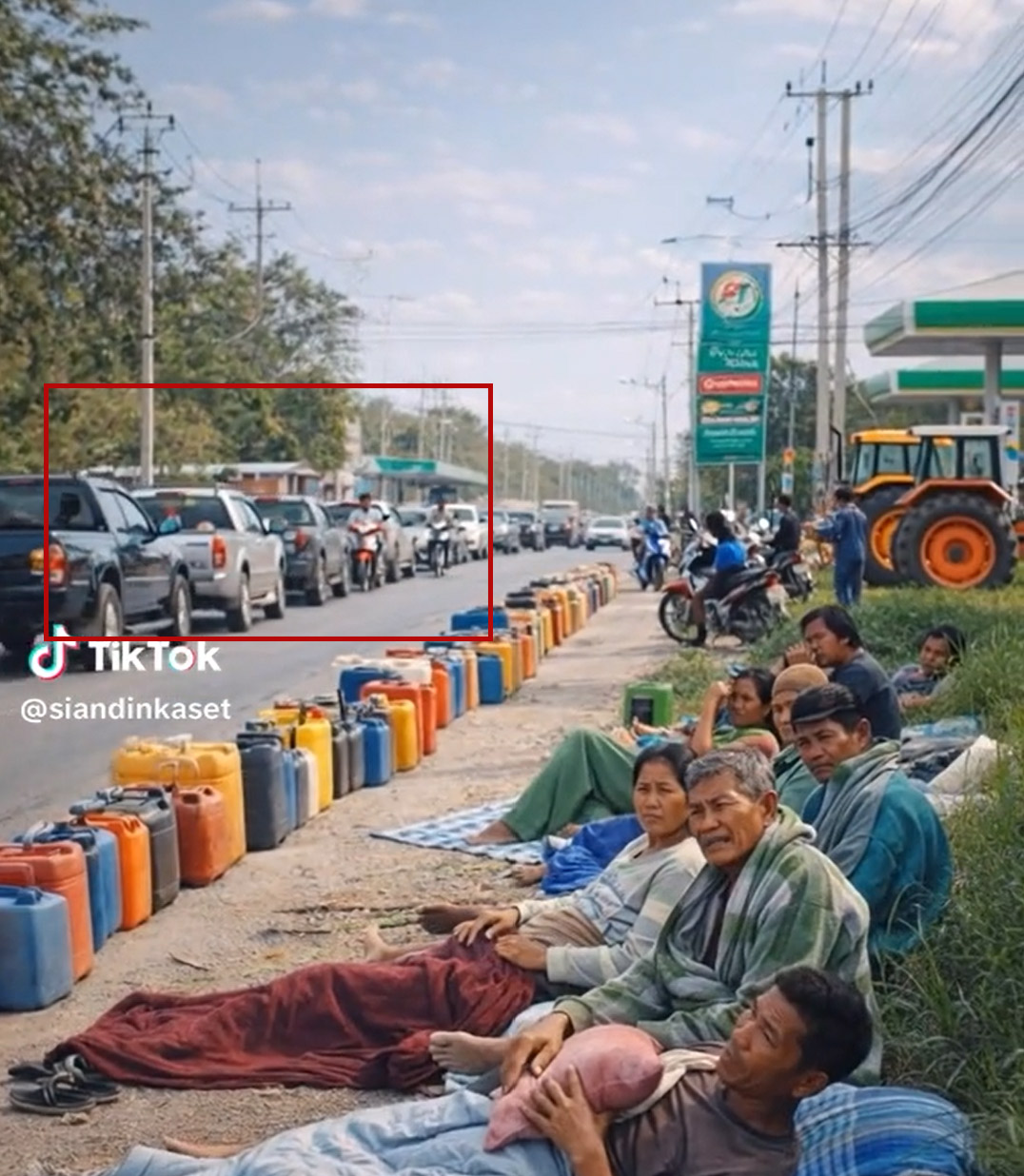
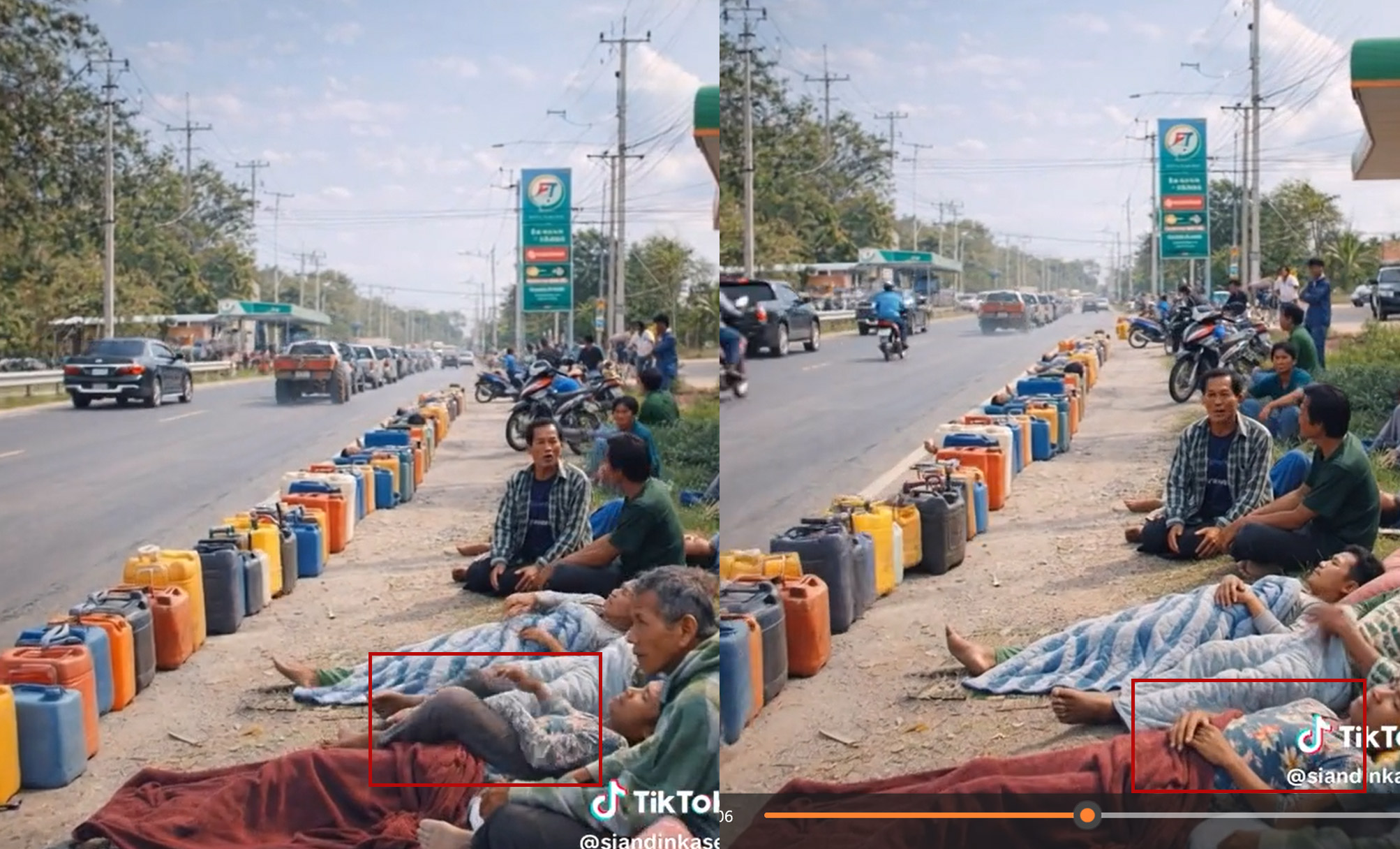
A person’s legs in the video appear unrealistic, looking deformed and partially passing in and out of the blanket.
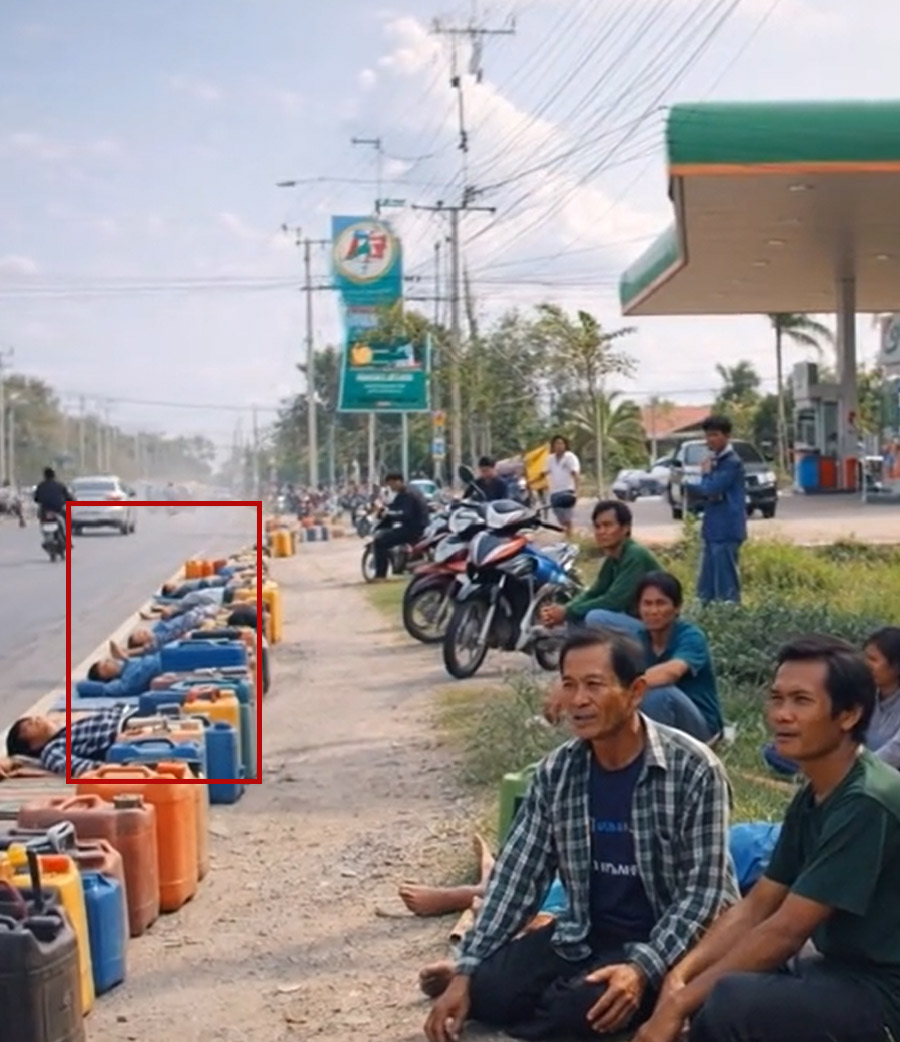
The way the group of people is lying on the roadside appears dangerous and does not align with actual behavior.
How is the real situation amid the “fuel” crisis in Thailand?
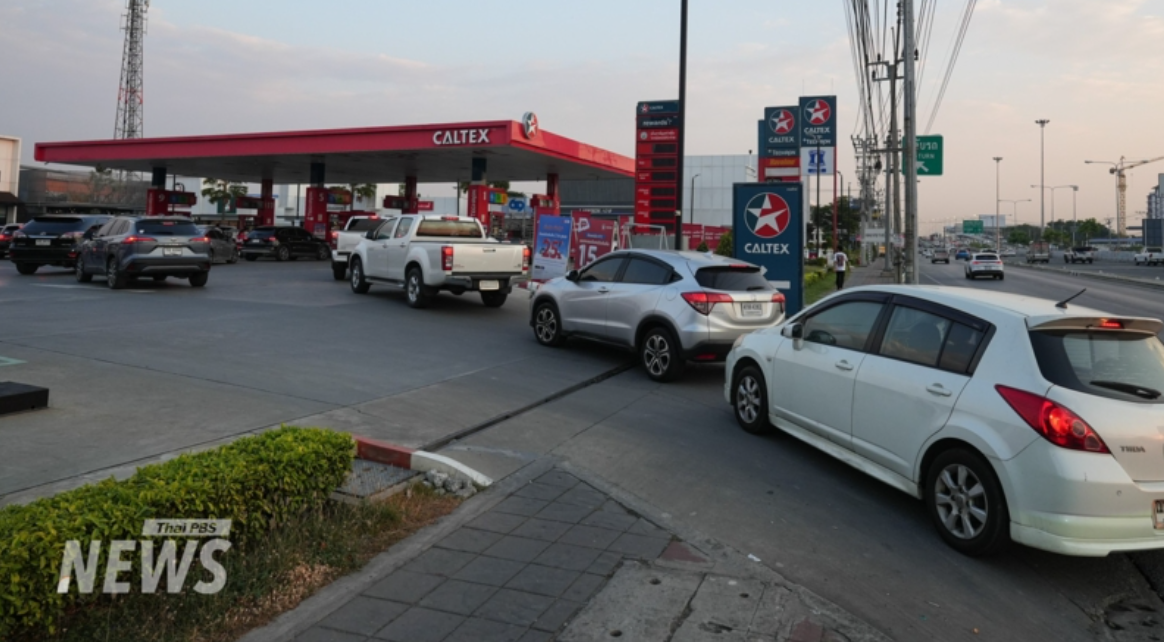
Previously, Thai PBS reported on the fuel situation on 17 March 2026, finding that many areas had large crowds of people lining up to refuel. Although diesel prices were still fixed at that time, many gas stations in several provinces experienced shortages, requiring temporary closures, and fuel ran out within 2–3 hours after a new delivery.
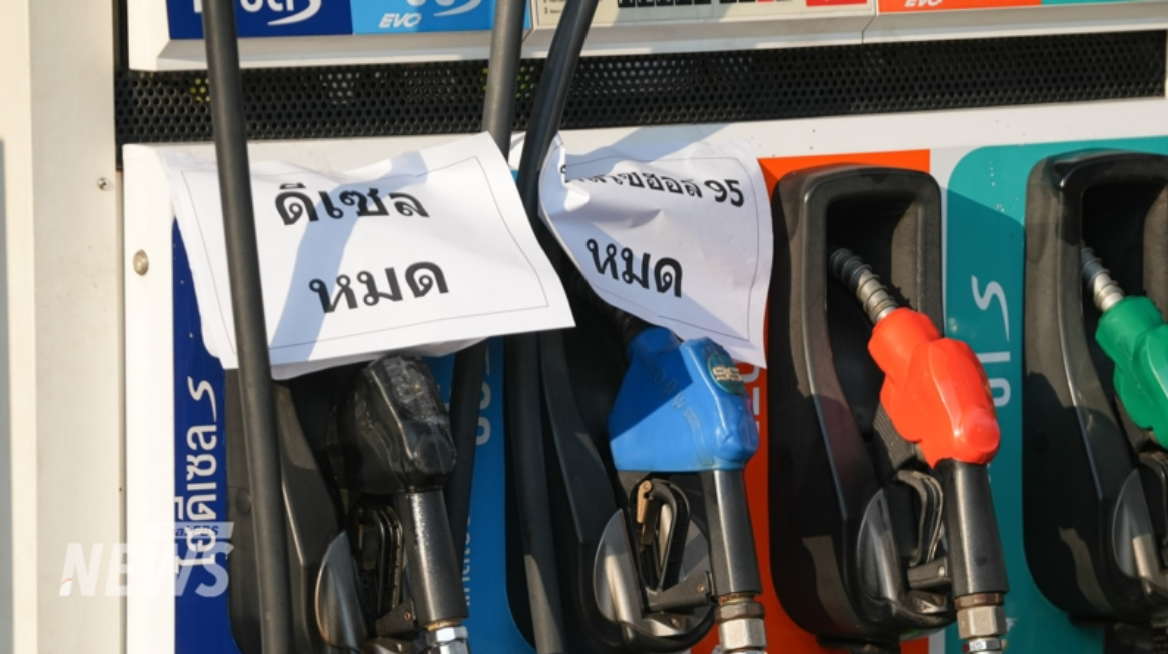
For example, in Maha Sarakham province, gas stations along the city bypass had to close in the evening due to rapid fuel depletion. In Nong Bua Lamphu province and its Si Bun Rueang district, many diesel stations ran out of fuel, forcing locals to visit multiple stations. In Chai Nat province, a new delivery of 6,000 liters of fuel led to long queues, and station owners limited the amount each person could purchase to ensure fair distribution. In Trang province, several stations experienced continuous fuel shortages for 1–2 days, and even when new stock arrived, it ran out quickly.
Thailand does have oil fields and refineries
Thai PBS Verify also fact-check claims from the Facebook post in question, which state:
“It’s unbelievable that something like this could happen in a country that has its own oil fields!! People have to line up to buy fuel, and they can only buy the amount set by the gas station. If they want more, they have to line up again. This is happening in a country that once told its people it would prosper after discovering energy resources in the Gulf of Thailand. A country that has several oil refineries and even exports fuel!!!”
The team thus conducted a keyword search and found the Thailand Energy Situation Report 2025, referencing the Ministry of Energy. The report indicates that Thailand produces about 81,000 barrels of crude oil per day domestically. This confirms that Thailand does indeed have domestic crude oil production (oil fields).
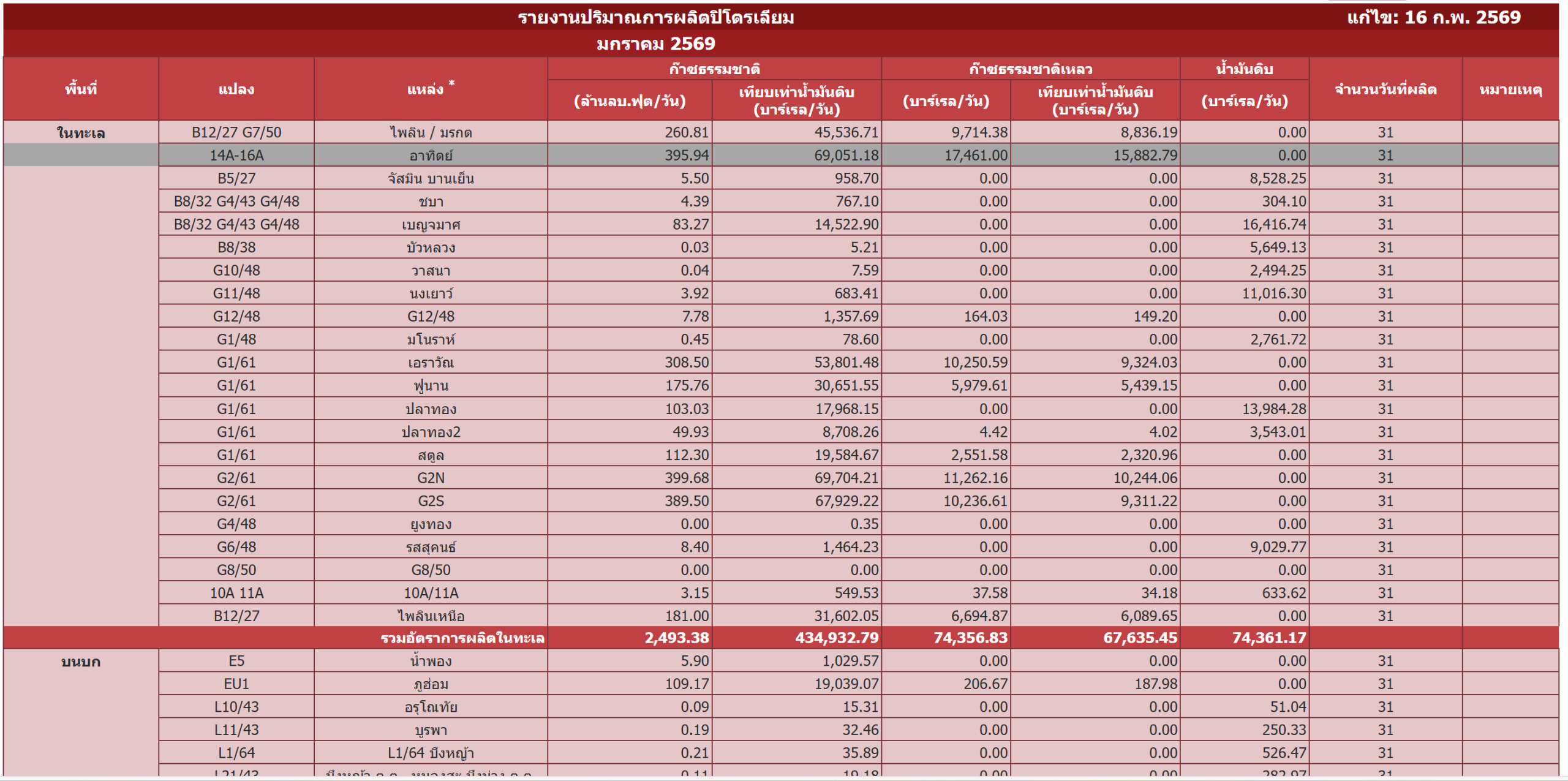
A list of oil sources in Thailand.
However, the domestic production volume is still insufficient to meet national demand, so Thailand relies on crude oil imports, particularly those from the Middle East accounting for about 47%. Note that imports make up approximately 70–80% of total oil consumption.
The report further clarifies that Thailand produces about 81,000 barrels of crude oil per day, while crude oil imports are about 971–972 thousand barrels per day, reflecting that Thailand still relies heavily on imports.
Most crude oil imports come from the Middle East, accounting for about 51% of total imports, while crude oil exports are approximately 19,000 barrels per day.
In addition, the Anti-Fake News Center, together with the Department of Mineral Fuels, Ministry of Energy, verified facts regarding the number of petroleum wells in Thailand published in 2022. It suggests that the volume of petroleum does not depend solely on the number of wells. Most of Thailand’s petroleum fields are small, pocket-sized deposits with discontinuous geological structures, meaning each well produces a limited amount. This is different from large fields in other countries, which can produce high volumes even with fewer wells.
Most of Thailand’s wells primarily produce natural gas in the Gulf of Thailand. As of March 2022, there were 1,757 wells in production out of a total of 5,535 wells.
Regarding production volumes, crude oil amounts to approximately 5,534 million liters (around 34.8 million barrels). When including all petroleum products, the total volume is about 37,391.89 million liters in crude oil equivalent.
Does Thailand have “several” oil refineries?
According to the APEC Oil and Gas Security Exercise in Thailand report, Thailand has seven oil refineries in total with a combined crude refining capacity of about 1,245 thousand barrels per day. Among these, there is a refinery owned by the Royal Thai Army, used for military purposes.
In short, although Thailand has crude oil production fields and oil refineries, domestic production is still insufficient to meet national demand. The country must import about 70–80% of total oil consumption, especially from the Middle East, accounting for 47–51% of imports. Most of Thailand’s oil and gas wells are small and scattered across the Gulf of Thailand, resulting in limited production per well, unlike large fields in other countries.
What is the truth?
Thai PBS Verify found that the image used to accompany the claim—showing people lying on the roadside waiting to buy fuel—was AI-generated. However, in reality, several areas in Thailand did experience people lining up to refuel due to fuel shortages. Nevertheless, the image in question circulated online is unrealistic and only represents an AI-generated depiction.
Regarding Thailand’s oil production, some of the claimed information was correct, but the context was misleading. Thailand does have oil fields and several refineries, but domestic crude oil production is still insufficient to meet national demand, requiring imports of 70–80% of total oil consumption. Therefore, the queues seen in real life result from a combination of factors, including supply, demand and distribution management.
Verification Process
- AI image check: When the image was examined via Hive Moderation, it showed a 94.8% likelihood of being AI-generated.
- Google Lens: Searching for the origin of the image using Google Lens did not reveal a clear source. Similar content was found in the form of a video on TikTok, which Thai PBS Verify determined was also AI-generated.
- Keyword searches: Searching with relevant keywords found the Thailand Energy Situation Report 2025, referencing the Ministry of Energy, which states that Thailand produces about 81,000 barrels of crude oil per day domestically, confirming that Thailand does have crude oil production (oil fields). However, this production volume is still insufficient to meet domestic demand, so Thailand relies on crude oil imports, particularly from the Middle East, which accounts for about 47%. Including other import sources, total imports make up approximately 70–80% of the country’s total oil consumption.
Impacts of the fake image
- Creating misunderstandings about the real situation: Viewers may believe that the country is experiencing a more severe fuel crisis than in reality. AI-generated images or videos showing people waiting to buy fuel can create a false impression of widespread and extreme shortages.
- Distorting understanding of Thailand’s production and energy sector: Some information, such as the existence of oil fields and refineries, is presented without full context. Recipients may mistakenly believe that Thailand can produce enough oil domestically, whereas it still relies on 70–80% imports.
- Affecting trust in authorities and media: Sharing fake images or misleading information can cause the public to question official data.
- Impacting economic and social behavior: Fuel consumption patterns may be affected, leading to hoarding at home or purchasing more than necessary.
What to do with this misinformation?
- Check the source of the image and the news. If the image or video looks unusual, it may be AI-generated or fake.
- Consider the full context of the information, such as production volume, imports and demand before sharing or believing it.
- Follow updates from official authorities or reliable media, such as the Ministry of Energy.
- Do not share information before verifying it, as it may cause panic and negatively affect society.
Translation edited by: Peerachai Pasutan

Related Content

Most Viewed