Viral Clip of Rider Jumping to Save Child in the Street Was Actually Created by AI
Thai PBS Verify found the source of fake news from: Facebook

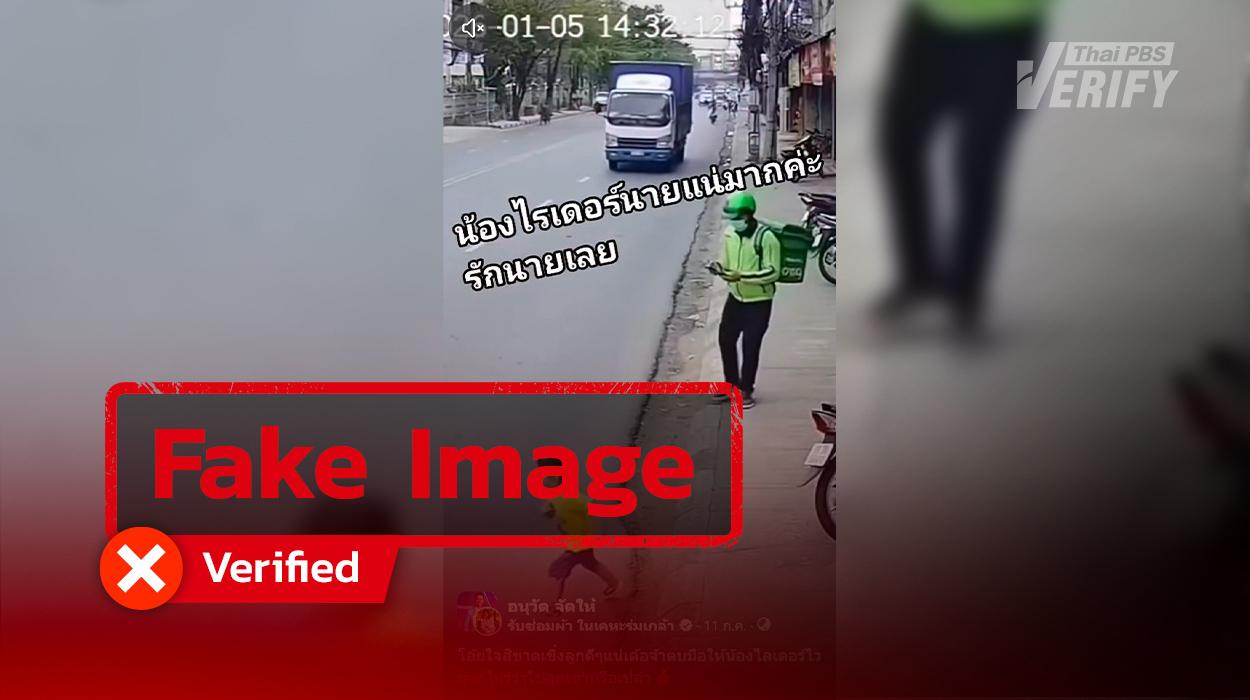
A post claimed to show a rider leaping to save a child who ran into the street, narrowly avoiding an accident. The caption asserted that the rider risked his life to grab the child from the middle of the street just in time. It read: ‘Oh, my heart almost stopped—clap for this rider, so fast! Not sure if it was his child or not 👍’.
Published on July 11, 2026, the post attracted more than 7,200 likes, over 1,000 comments, and 786 shares, with most viewers convinced the clip depicted a real event.

Comments from Social Media Users
Is the clip real ?
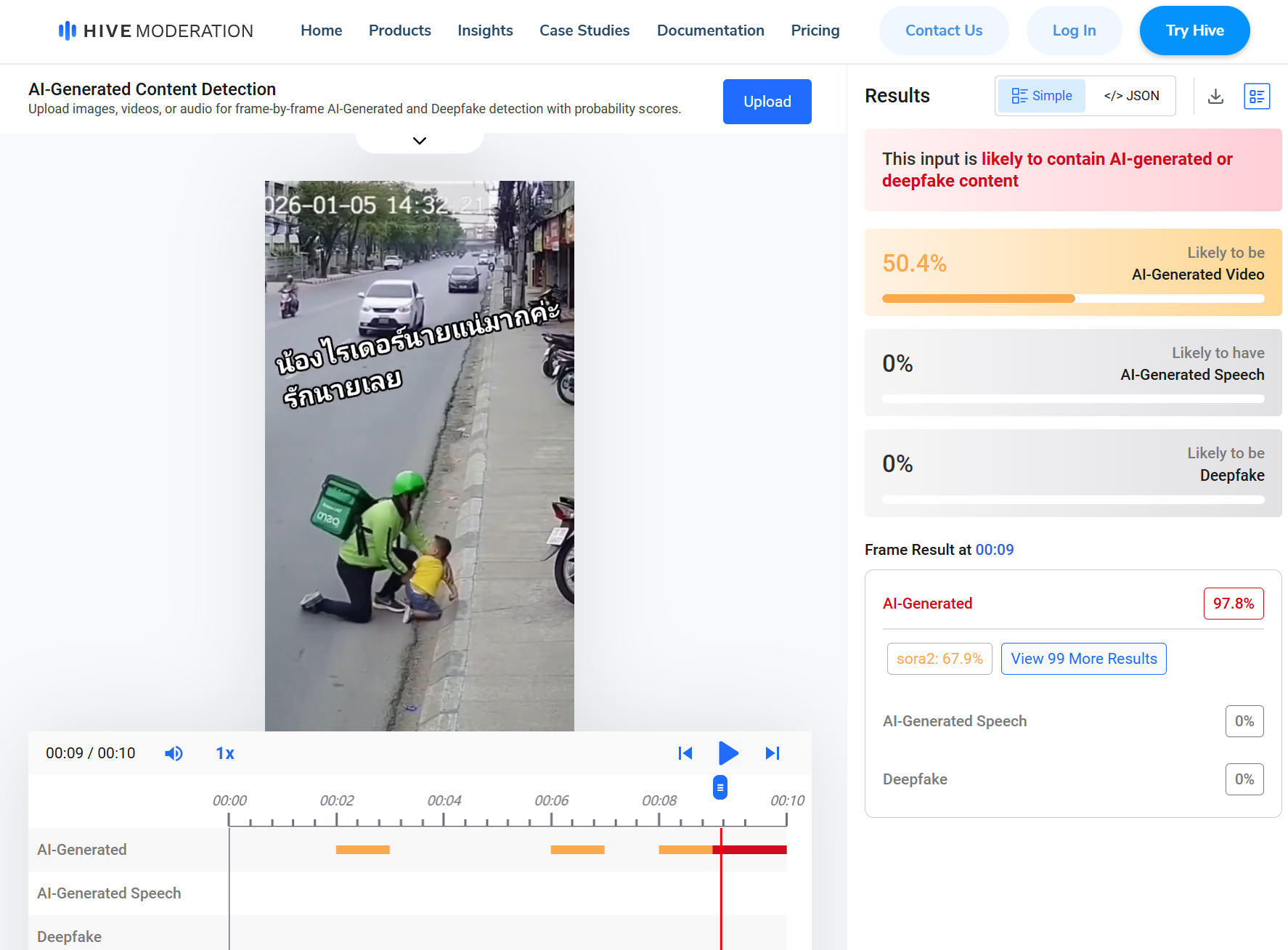
When selected frames from the video were checked with Google Lens, no clear source of the original footage was identified. Meanwhile, analysis using Hive Moderation’s AI‑detection tool estimated a 50.4% likelihood that the images were generated by AI, specifically by the Sora 2 model.
However, results from AI‑detection tools should be treated only as supporting information for consideration.
AI Verification Results
Thai PBS Verify consulted Sathapon Patanakuha, CEO of Guardian AI, to analyze the video clip. He assessed that the clip was likely generated by AI and pointed out the following anomalies:
- The moment when the rider slides in to help the child appears unnatural.
- The rider’s arm position does not align with the child’s location outside the frame, making the movement look unrealistic.
- As the truck passes the rider, there should be stronger wind or turbulence than what is shown in the clip.

Sathapon Patanakuha, CEO of Guardian AI
Verification Findings
Thai PBS Verify noted additional observations regarding the camera angle. The footage does not resemble a CCTV recording, as the framing is relatively close and more consistent with mobile phone video, even though the clip displays a date stamp similar to CCTV footage. Moreover, when the child runs in front of the truck, the vehicle shows no sign of slowing down—an unusual behavior.
At the beginning of the clip, the rider is holding a mobile phone in his right hand. Yet when the phone slips, its movement is inconsistent: the device seems to vanish from the right hand before reappearing near the left hand and then falling to the ground. This sequence does not match the natural motion of objects and raises further suspicion.
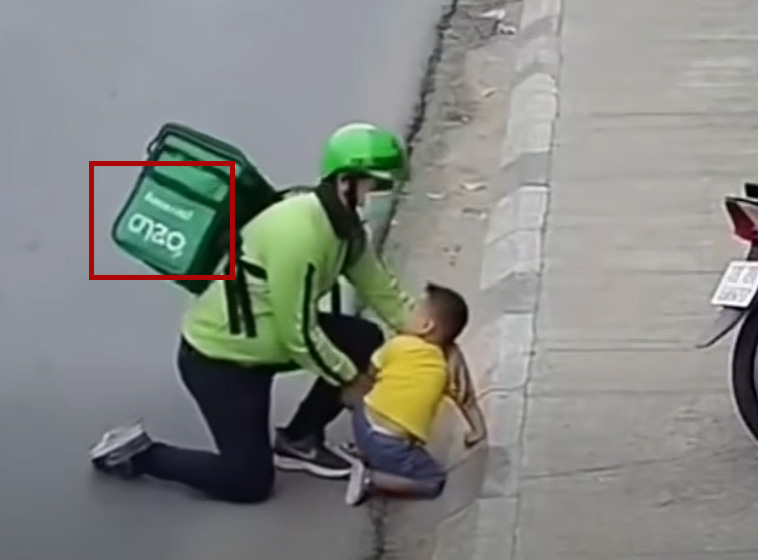
Another anomaly is that the text on the parcel box appears distorted and unreadable, a characteristic often found in AI‑generated images or videos.”
A portion of the image is from an AI-powered clip.
What is the truth ?
The clip of a rider leaping to save a child running in front of a truck has not been verified as a real incident. Thai PBS Verify found no clear source of the original footage when checking with Google Lens.
Meanwhile, analysis by Hive Moderation’s AI‑detection tool and AI experts identified several anomalies consistent with AI‑generated video—including unnatural movements, suspicious camera angles, distorted objects, and unreadable text. Based on this evidence, the clip is likely to have been generated by AI
Verification Process
- Google Lens Check: When selected frames from the clip were examined with Google Lens, no clear source of the original footage was found.
- AI‑Detection Tool: Hive Moderation’s analysis estimated a 50.4% likelihood that the images were generated by AI, specifically by the Sora 2 model.
- Expert Review: Thai PBS Verify consulted Sathapon Patanakuha, CEO of Guardian AI, who assessed that the clip was likely AI‑generated. He highlighted several anomalies:
-
- The rider’s sliding motion to help the child appeared unnatural.
- The rider’s arm position did not align with the child’s location outside the frame, making the movement look unrealistic.
- As the truck passed the rider, there should have been stronger wind or turbulence than what appeared in the clip.
Impact of This False Information
- Public Misunderstanding: The clip, created with AI but presented as a real incident, may mislead viewers into believing the event happened and encourage them to share the content without verifying its source.
- Emotional Trigger and Unverified Sharing: Videos depicting dramatic rescues or emotionally charged events often prompt audiences to quickly share, comment, or praise without fact‑checking first.
- Potential for AI‑Driven Disinformation: Publishing such clips without disclosure that they are AI‑generated could set a precedent for producing fake videos to manipulate public perception, distort facts, or deceive audiences in other contexts.
What to do with this misinformation?
- Do not rush to believe or share simply because the clip looks realistic. Modern AI can generate highly convincing videos, so information should always be verified first—even if the clip appears credible or has been widely shared.
- Check the source of the clip. Try to identify where it was first published and whether reputable news outlets or official agencies have reported the same incident. Pay attention to unusual details in the video, such as unnatural human or object movements, illogical camera angles, unreadable text, or objects shifting in unrealistic ways—all of which may signal AI‑generated media.
- Use verification tools. Google Lens can help trace the origin of images, and AI‑detection tools can provide supporting information. However, results from these tools should not be relied upon alone to draw conclusions.