Looking into EC regulations: are “ballots” and “stubs” stored separately?
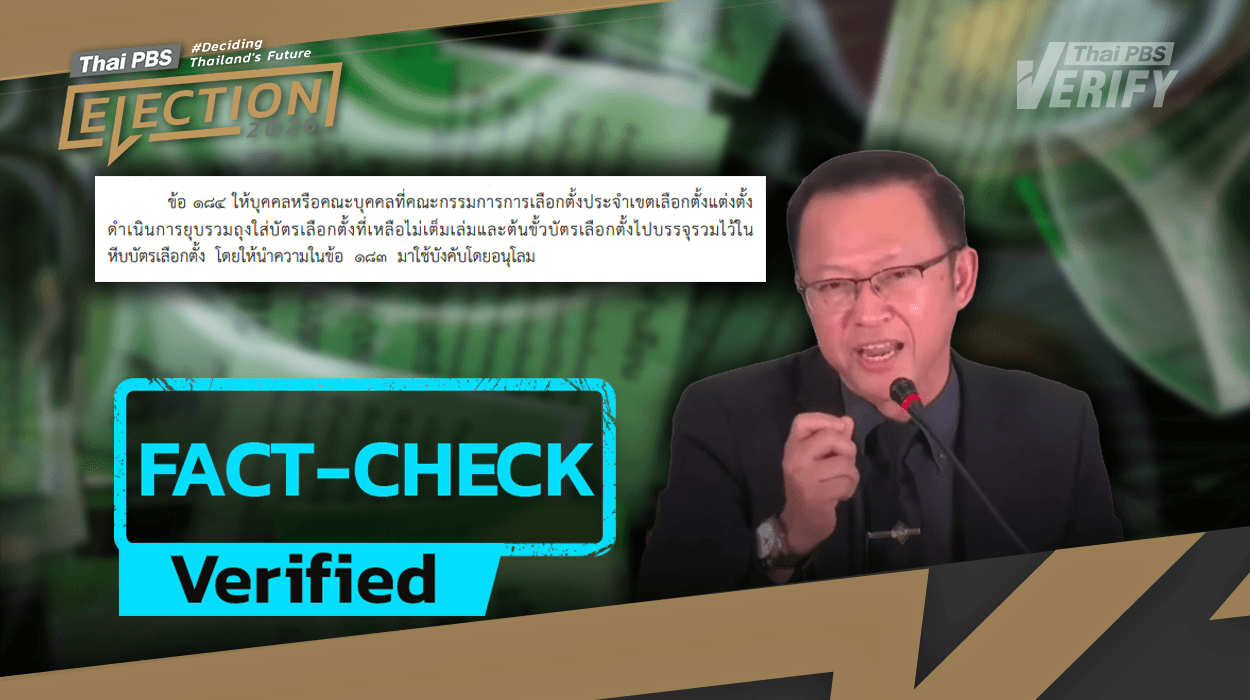
Thai PBS Verify has examined the regulations clause-by-clause and found key evidence suggesting that “ballots” and “their stubs” may not be kept separately as claimed.
Following the election, the Office of the Election Commission held a press conference on February 13, 2026, to address concerns regarding “barcodes” and “QR codes” on both party-list and constituency ballots. The EC stated that these codes are permitted under Clause 129 of the EC Regulations on the Election of Members of the House of Representatives, which grants the EC a power to include special codes, marks, or additional text on ballots without prior notice to prevent counterfeiting.
Summary of the EC’s explanation to the public
As for the EC, although they have not explicitly admitted that the “barcodes on the ballots” can truly be scanned to trace back to the “serial number” of each specific ballot, they maintain that it is merely a security measure. This measure is intended to prevent counterfeit ballots and ensure that the election is conducted with integrity and fairness, rather than being used to identify the voter.
To alleviate concerns regarding the violation of voting secrecy, a key point emphasized by the EC is the assertion that voting is conducted “directly and in secret” as mandated by the Constitution. They argue that no one can access the information due to the EC’s classified security layers. Furthermore, they claim that even if a trace-back were possible, it would require both the “ballot cast in the box” and the “ballot stub.” Since these two parts are “stored separately,” matching them together is practically impossible in reality. The EC reiterated that any attempt to use this data to uncover a voter’s identity constitutes a severe criminal offense, which serves as a deterrent against such misconduct.

The EC held a press conference on February 13, 2026 to address concerns regarding the “barcodes” and “QR codes,” appearing on both party-list and constituency MP ballots.
Video of the EC’s clarification regarding “barcodes on ballots” (in Thai)
However, this clarification failed to dissipate public anxiety. Instead, it drew counter-questions from academics and the public. On his social media post, Dr. Prinya Thaewanarumitkul, professor at the Faculty of Law, Thammasat University, questioned the storage process, specifically, whether the ballots and stubs were truly stored separately as claimed. He noted that if they were not actually separated, the risk of identifying which voter chose which candidate remained.
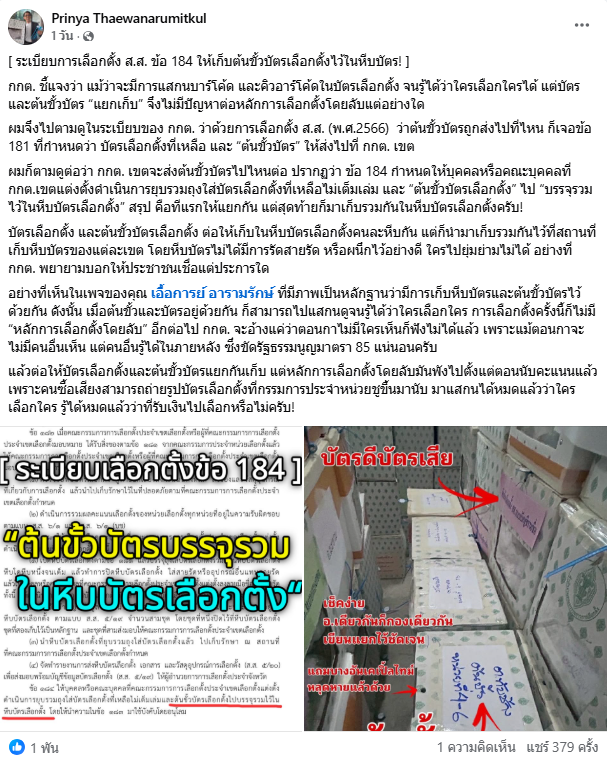
Dr. Prinya Thaewanarumitkul, public law scholar and professor at the Faculty of Law, Thammasat University, posted on Facebook, raising questions for the EC.
He pointed out that if such a feat were possible, it would inevitably violate the intent of Section 85 of the Constitution of the Kingdom of Thailand, B.E. 2560 (2017), which stipulates that the election of members of the House of Representatives must be “direct and secret.” This refers to the voting methods generally organized by the EC, which include registration processes, the use of polling booths, and the marking of ballots for individual candidates. This means that voters must appear in person, that they are unable to appoint others to act on their behalf, and that the casting of the vote must remain “confidential.”
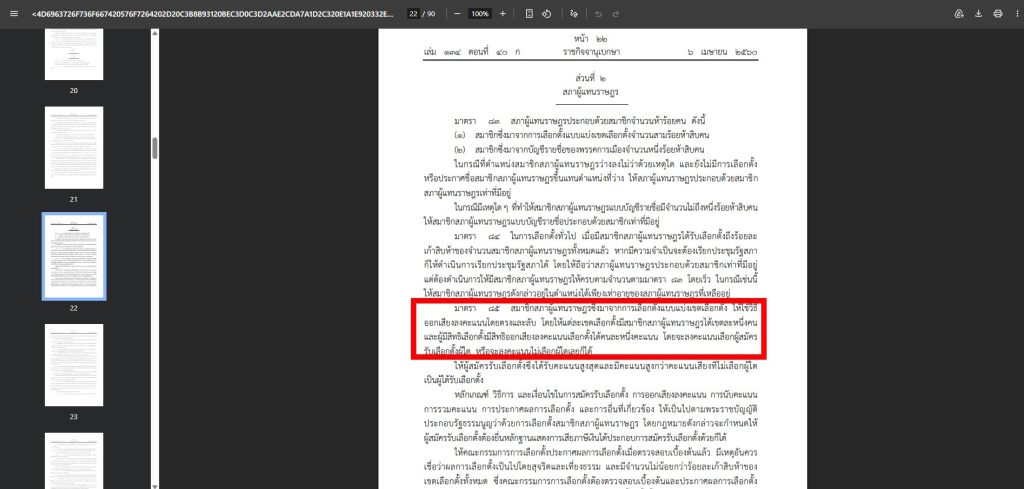
Constitution of the Kingdom of Thailand, B.E. 2560 (2017), Section 85
Have “barcodes” and “QR codes” ever appeared in sample ballots before?
Thai PBS Verify conducted a comparison between the actual ballots and the samples used by the Office of the Election Commission (EC) for public relations before the election day. It was found that in the three sample ballots, consisting of the constituency MP ballot, the party-list MP ballot, and the referendum ballot, no barcodes or QR codes of any kind appeared in any of the previous promotional documents.
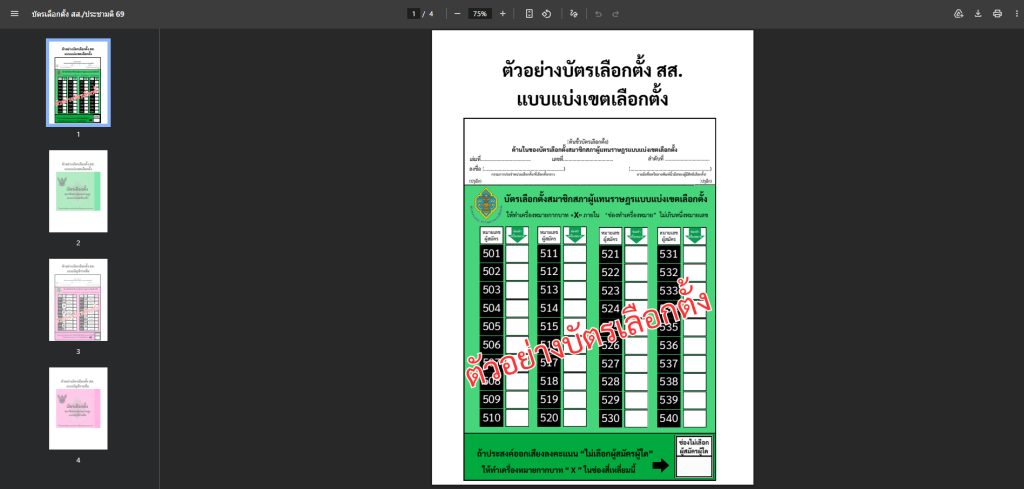
Sample ballot images from the EC website, which show no presence of barcodes whatsoever.
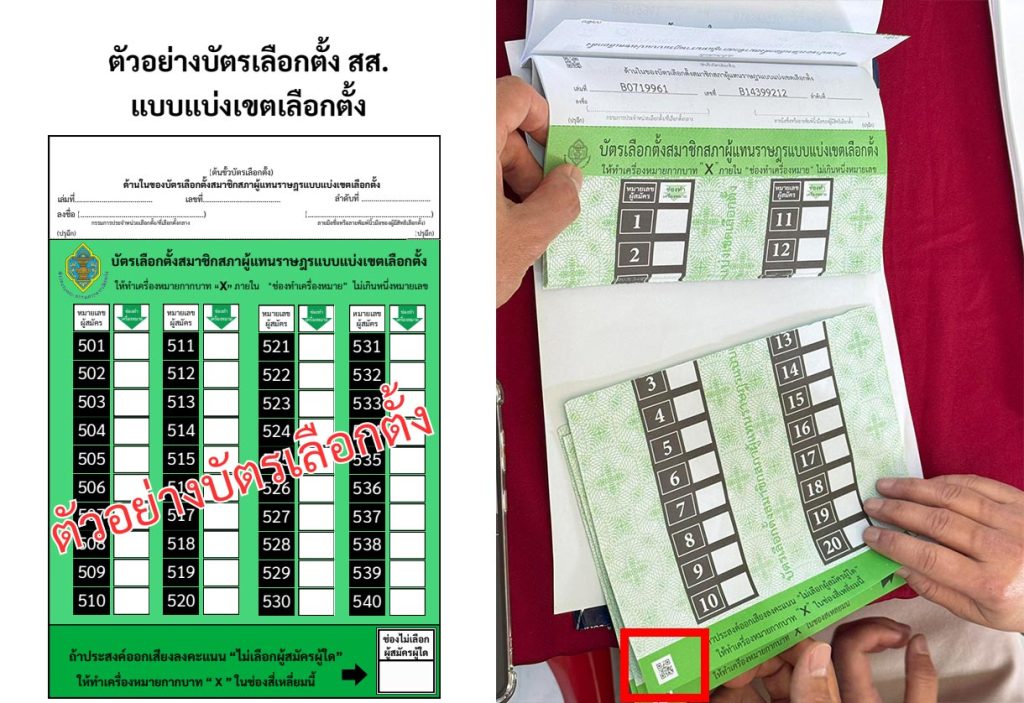
Sample ballot image from the EC website (left) compared with an image of an actual MP ballot containing a QR code (right)
Thai PBS Verify uncovers the truth through EC regulations
To prove the facts regarding the “separate storage” issue, Thai PBS Verify examined the “EC Regulations on the Election of Members of the House of Representatives, B.E. 2566 (2023),” which serves as the primary regulation for managing this election. The investigation found provisions within the regulations specifying the procedures for handling remaining ballots and ballot stubs after the counting process is completed, as follows.
Clause 181 states that upon completion of the vote counting, at least five members of the polling station committee (PSC), along with security officers, shall proceed to deliver the ballot boxes together with various materials and equipment, including “remaining ballots” and “ballot stubs,” to the Constituency Election Committee.
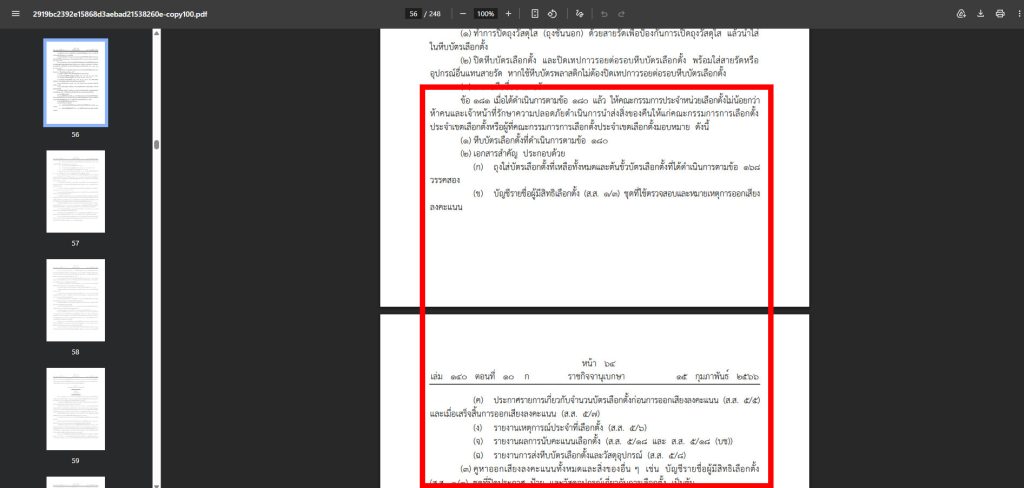
EC Regulations on the Election of Members of the House of Representatives, B.E. 2566 (2023), Clause 181
The critical point lies in the following clause, which indicates the final destination of the ballot stubs.
Clause 184 stipulates that the person or group of persons, appointed by the constituency election committee, shall conduct an inspection and consolidate the bags of remaining ballots from incomplete booklets, and “shall place the ballot stubs” to be “contained together within the ballot box” of that specific polling station, before sealing the ballot box.
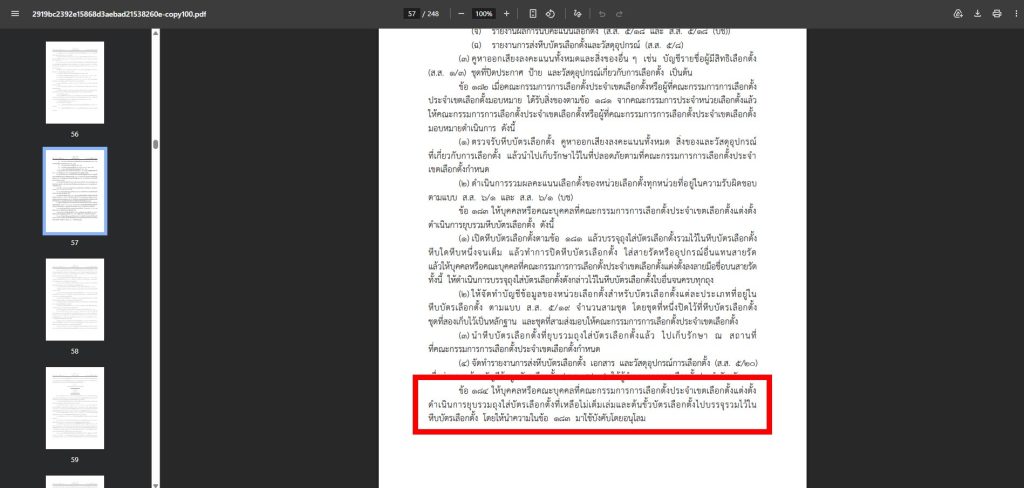
EC Regulations on the Election of Members of the House of Representatives, B.E. 2566 (2023), Clause 184
Conclusion from the regulations: “not stored separately” but “packed together” in the box
The EC Regulations on the Election of MPs, B.E. 2566, specifically Clause 184, clearly demonstrate that in the final stage of preservation, the “ballot stubs” (which bear the voters’ signatures) are to be “contained together within the ballot box,” which naturally already contains the cast ballots.
Consequently, the EC’s clarification stating that the ballots and stubs are “stored separately” directly contradicts the regulations established by the EC itself.
When the ballots (featuring barcodes identifying the ballot number) and the ballot stubs (bearing matching numbers and voter names) are kept in the same location—inside the “ballot box”. Even if placed in different bags, it fundamentally means that, both in theory and in practice, these two sets of data are not completely severed from each other.
What is the truth?
- Actual Ballots “do not match EC samples:” the ballots used by citizens on the election day contained “barcodes” and “QR codes.” This contradicted the sample images from the EC in pre-election public relations that featured none of these codes. The EC cited authority under Regulation Clause 129 to add special security codes without prior notice.
- Identification is “technically possible:” the EC admitted that the codes on the ballots can be scanned to trace back to the “ballot serial number.” This number matches the one appearing on the “ballot stub”, which contains the name and signature of the voter.
- Regulations Do Not Mandate Separate Storage: Despite the EC’s assurance that ballots and stubs are stored separately to maintain secrecy, EC Regulation Clause 184 explicitly states that in the final step, all ballot stubs must be “contained together within the ballot box” of that specific unit. This means the evidence of identity (the stub) and the evidence of voting (the ballot) are kept in the same physical location.
Verification Process
1. Empirical comparison
The actual ballots used on election day were compared with the documents and public relations materials previously released by the EC. This revealed a clear discrepancy: the sample materials “did not display any barcodes or QR codes.” Therefore, the public could not raise questions during the pre-election period.
2. Regulatory and legal research
An in-depth review of the “EC Regulations on the Election of Members of the House of Representatives, B.E. 2566 (2023)” was conducted to trace the “journey” of both the ballots and the stubs. The findings are as follows.
- Clause 181 confirms that after the vote counting is completed, both the ballot boxes and the stubs must be delivered to the constituency election committee.
- Clause 184 specifies that the Constituency Election Committee must “place the ballot stubs inside the ballot box,” directly contradicting the EC’s public statement that they are stored separately.

Related Content

Popular Content