Video claims cooking oil can replace diesel fuel, but in reality it risks engine failure

Thai PBS Verify found the piece of misinformation on: Facebook
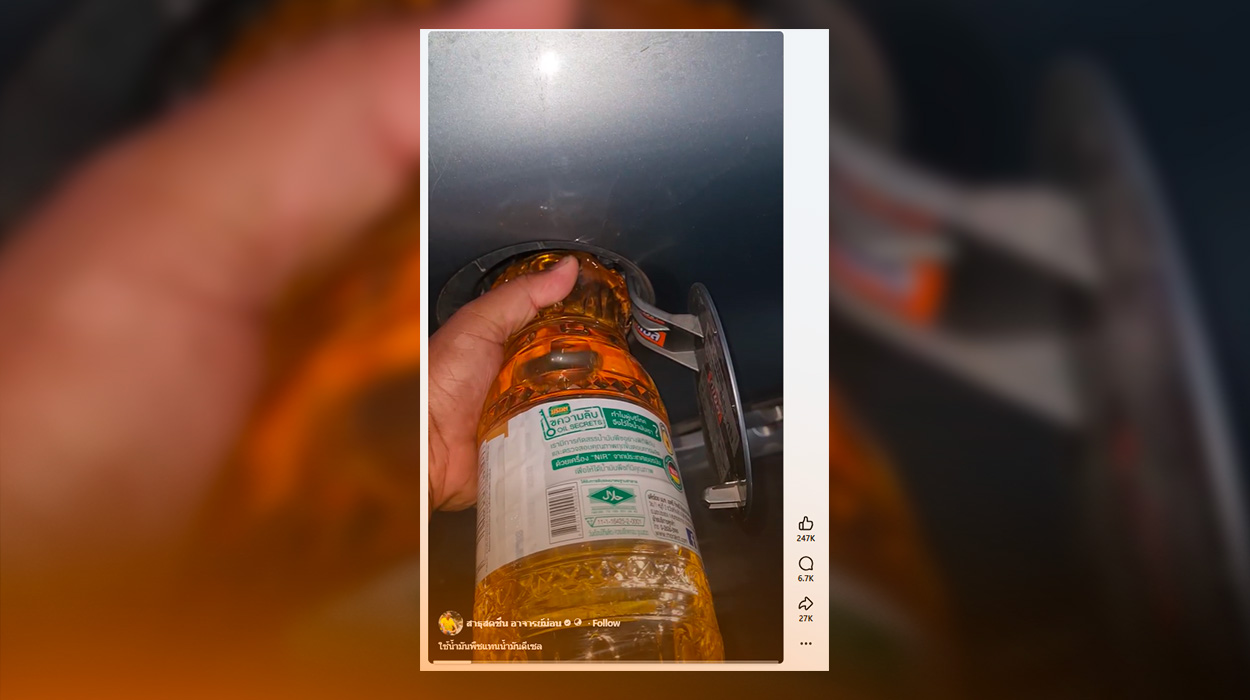
A video clip showing a vehicle being fueled with cooking oil states: “Using cooking oil instead of diesel.”
Thai PBS Verify discovered a video posted by Facebook user “Sathu Sodchuen Ajarn Mon (สาธุสดชื่น อาจารย์ม่อน),” which shows the act of filling a car’s tank with cooking oil. The caption reads: “Using cooking oil instead of diesel.” This post has garnered 230,000 reactions, 6,300 comments, and has been shared over 26,000 times. The majority of users commenting on the post expressed skepticism regarding the feasibility of using cooking oil as a genuine alternative to diesel fuel.
Can cooking oil really be used to fuel vehicles?
Regarding this issue, Thai PBS Verify contacted Assoc. Prof. Acting Sub Lt. Jessada Denduangboripant, lecturer at the Department of Biology, Faculty of Science, Chulalongkorn University. He provided the following insights.
In the context of renewable energy such as biodiesel, cooking oil can be considered to have properties similar to pure biodiesel, or B100. In contrast, the diesel fuels commonly used today are typically blends, such as B7 or B10, which contain approximately 7% and 10% plant-based oil, respectively. Therefore, in theory, bottled cooking oil can indeed be used in diesel engines.
However, the critical distinction is that cooking oil is not engineered or processed for direct engine use. The primary issues arising from using cooking oil in diesel engines stem from unprocessed components, such as lipid residues or glycerin. In standard biodiesel production, these substances must be removed through specific chemical reactions. If these elements are not eliminated, their use in an engine leads to the accumulation of sticky deposits or gum, as well as increased soot. This results in reduced operational efficiency and potential damage to internal engine components. This risk is particularly acute in modern diesel engines equipped with High-Pressure Common Rail fuel injection systems, which are highly precision-engineered and susceptible to clogging.

Assoc. Prof. Acting Sub Lt. Jessada Denduangboripant, Lecturer at the Department of Biology, Faculty of Science, Chulalongkorn University.
For older diesel engines or low-speed engines, such as agricultural machinery, tractors or certain specialized power units, cooking oil may be functional to a certain extent, as these systems are less sophisticated than modern engines. Even so, significant constraints remain regarding cost-effectiveness. The current market price of bottled cooking oil is relatively high compared to standard diesel. Consequently, it is rarely a viable long-term alternative, except in cases of absolute necessity.
“The use of cooking oil is strictly limited to diesel engines and is incompatible with gasoline engines due to their differing operational principles. Gasoline engines rely on spark plugs for ignition. If diesel or biodiesel is introduced, it will fail to combust correctly, causing the engine to stall and potentially leading to mechanical damage. Therefore, instances where cooking oil is trialled typically involve diesel vehicles, such as pickup trucks, rather than standard gasoline-powered cars,” stated by Assoc. Prof. Dr. Jessada.
Expert warns! Using cooking oil instead of diesel fuel risks engine failure
As for Mr. Naruebet Khammongkhon, Head of the Mechanical Engineering Department, Faculty of Technical Education, King Mongkut’s University of Technology North Bangkok, he also shared his insights with Thai PBS Verify regarding the substitution of diesel with cooking oil.
To understand whether cooking oil can effectively replace diesel, one must first look at the operational principles of a diesel engine. These engines function by compressing air to reach high temperatures before injecting fuel to trigger combustion. While diesel and cooking oil perform similarly in a general sense, there is a critical distinction: diesel fuel has a viscosity approximately ten times lower than that of cooking oil.
The reasons why some individuals can successfully use cooking oil in their engines typically stem from two factors: the use of older engine models with less sophisticated systems, or the blending of cooking oil with existing diesel already in the tank, which allows for temporary operation. However, the notion that 100% cooking oil can be used in modern vehicles, particularly those equipped with common rail diesel engines, is considered inappropriate and should be avoided. Such engines consist of high-precision components, and the significantly higher viscosity of cooking oil will invariably cause far more harm than good.

Mr. Naruebet Khammongkhon, Head of the Mechanical Engineering Department, Faculty of Technical Education, King Mongkut’s University of Technology North Bangkok.
For older engine models, such as those with mechanical injection pumps or agricultural machinery, cooking oil may be functional, though it comes with specific conditions. If intended for 100% usage, the oil must be pre-heated before operation to reduce viscosity and ensure better combustion. This process is relatively cumbersome and requires additional specialized equipment. However, blending the oil with diesel at approximately 30% may remain viable in certain instances.
“If cooking oil is used directly, the most immediate symptom is black smoke resulting from incomplete combustion. This can adversely affect the engine, particularly in newer models, leading to issues such as clogged fuel injectors or the activation of engine warning lights. In the long term, this can lead to significant mechanical failure,” stated Mr. Narubet.
Furthermore, in situations characterized by high fuel prices or shortages, reducing overall fuel consumption may be a more appropriate alternative. For those in urban areas, this could mean switching to public transportation, while in provincial areas, carpooling or opting for alternative vehicles, such as gasoline-powered or electric vehicles, could serve to mitigate the long-term impacts of fuel dependency.
Department of Energy Business confirms “cooking oil” is unsuitable for diesel engines
Meanwhile, the Department of Energy Business, Ministry of Energy, has provided information to the Anti-Fake News Center Thailand, stating that it strongly advises against using cooking oil or palm oil as a substitute for diesel in vehicles. Although it may function in certain specific instances, it is entirely unsuitable for practical, everyday use.
Cooking oil has a much higher viscosity, evaporates slowly, and tends to solidify or become waxy in cold temperatures. Furthermore, it oxidizes easily when exposed to air, leading to the accumulation of sticky residues within the engine.
The use of such oils can result in blockages within the fuel system and the buildup of deposits on critical components, such as pistons, piston rings, and valves. This ultimately leads to inefficient engine performance and can drastically shorten the engine’s operational lifespan. A keyword search for “Filling cooking oil instead of fuel” reveals that numerous prior news reports have consistently warned that using cooking oil or palm oil as a diesel substitute in vehicles is inappropriate.
What is the truth?
Thai PBS Verify investigated the viral video by interviewing experts in both mechanical engineering and biology. The conclusion is that using palm oil or cooking oil as a substitute for diesel is only viable for low-speed engines, such as those found in locomotives or older-generation diesel models. If used in modern vehicles, there is a significant risk of engine failure. The primary differences lie in viscosity, which is ten times higher than that of standard diesel, and the lack of a refinement process to remove contaminants, unlike the fuel commercially available at gas stations.
Verification Process
- Verification through expert interview: Assoc. Prof. Acting Sub Lt. Jessada Denduangboripant, lecturer at the Department of Biology, Faculty of Science, Chulalongkorn University, stated that substituting diesel with cooking oil is feasible only in theory. However, modern engines face a high risk of failure due to the accumulation of sticky gum deposits and clogs in high-pressure fuel injectors. He emphasized that this practice is not cost-effective in the long term and is limited strictly to certain types of diesel engines. Furthermore, it is absolutely prohibited for gasoline engines due to their fundamentally different ignition systems.
- Verification through expert interview: Mr. Naruebet Khammongkhon, Head of the Mechanical Engineering Department at the Faculty of Technical Education, King Mongkut’s University of Technology North Bangkok, also warned that cooking oil is ten times more viscous than diesel. This high viscosity poses a severe risk to modern common-rail diesel engines, potentially leading to engine failure, injector clogging and black smoke from incomplete combustion. While older engine models may operate on cooking oil if the oil is pre-heated or blended at appropriate ratios, he recommends alternatives such as public transportation or electric vehicles for better long-term value and safety.
- Keyword search: A search using the phrase “Filling cooking oil instead of fuel” revealed that several prior news reports have warned against the improper use of cooking oil or palm oil as a diesel substitute in vehicles.
Potential impacts of the misinformation
1) Risk of engine damage
- Cooking oil possesses a much higher viscosity than diesel, leading to poor fuel atomization and incomplete combustion.
- This results in the accumulation of deposits and clogged injectors, causing the engine to operate inefficiently.
- Prolonged use can lead to total engine failure or exorbitant repair costs, particularly in modern vehicles with high-precision systems.
2) False assumption: “It can be used as-is”
- The truth is plant-based oil is to be processed to become biodiesel. Standard bottled cooking oil is not a direct substitute.
- Misguided use can lead to ignition difficulties, engine stalling, or severe blockages within the fuel system.
3) Unnecessary financial burden
- Acting on this misinformation may force vehicle owners to pay for expensive repairs to fuel injectors, pumps, or the engine block itself.
- In some cases, damage caused by incompatible fuel can escalate to the point of requiring a complete engine overhaul.
4) Risk of catastrophic misapplication (particularly for gasoline engines)
- Some users may misunderstand the context and attempt to use cooking oil in gasoline-powered vehicles.
- This will cause the engine to cease functioning and sustain instantaneous damage due to the fundamental incompatibility of the combustion types.
What to do with this misinformation?
- Do not Accept “experimental clips” at face value: Videos appearing to show successful operation may only capture a brief experiment and often fail to disclose long-term mechanical consequences. Exercise caution before concluding a single-sided visual presentation.
- Verify through credible sources: Cross-reference such claims with data from government agencies, energy experts, or automotive engineering institutes to see if their official guidance aligns with the viral content.
- Apply technical reasoning to your assessment: Unlike commercial biodiesel, standard cooking oil has not undergone the necessary chemical processes to remove impurities. If a claim contradicts basic mechanical principles, it should be treated with immediate skepticism.
- Avoid attempting the experiment by yourself: While it may “appear” feasible in a video, the technical risk to your engine is substantial and could result in repair costs far exceeding any perceived fuel savings.
- Stop immediate sharing: If the veracity of the information remains unconfirmed, cease further distribution. Sharing unverified content can lead to widespread misunderstanding and damage to others.
Translation edited by: Peerachai Pasutan

Related Content