Video claiming 2026 tsunami in Japan found to be 2011 disaster footage
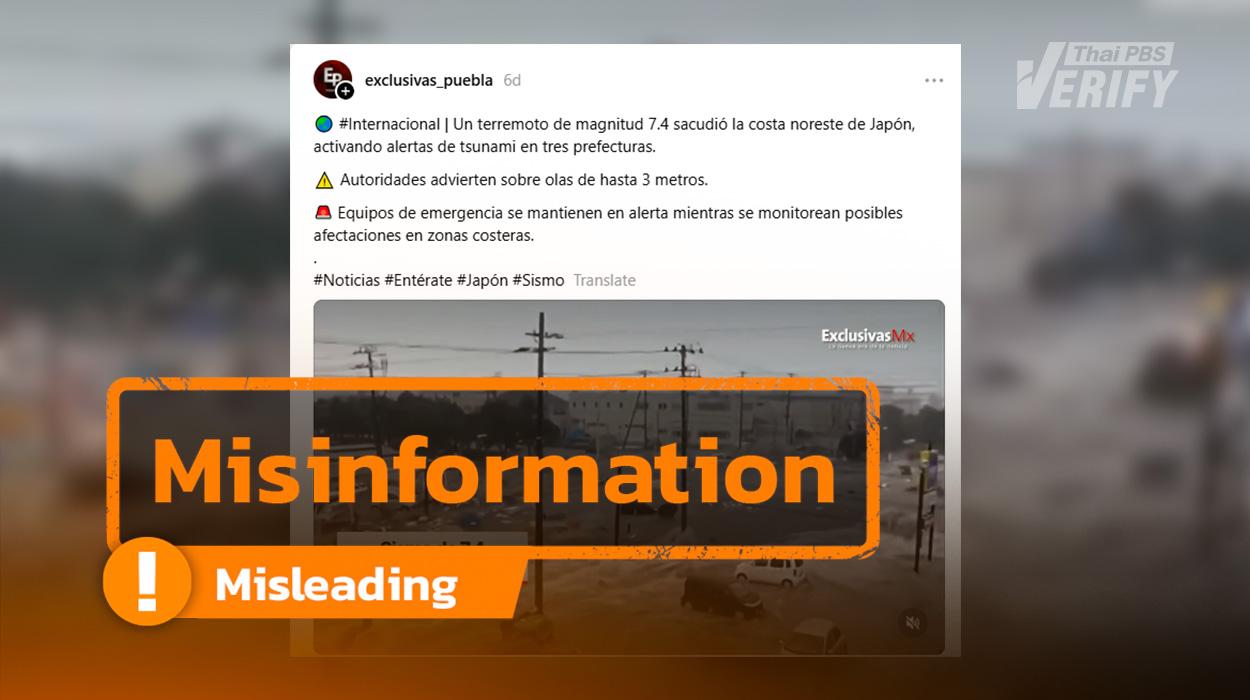
Thai PBS Verify found the piece of misinformation on: Threads
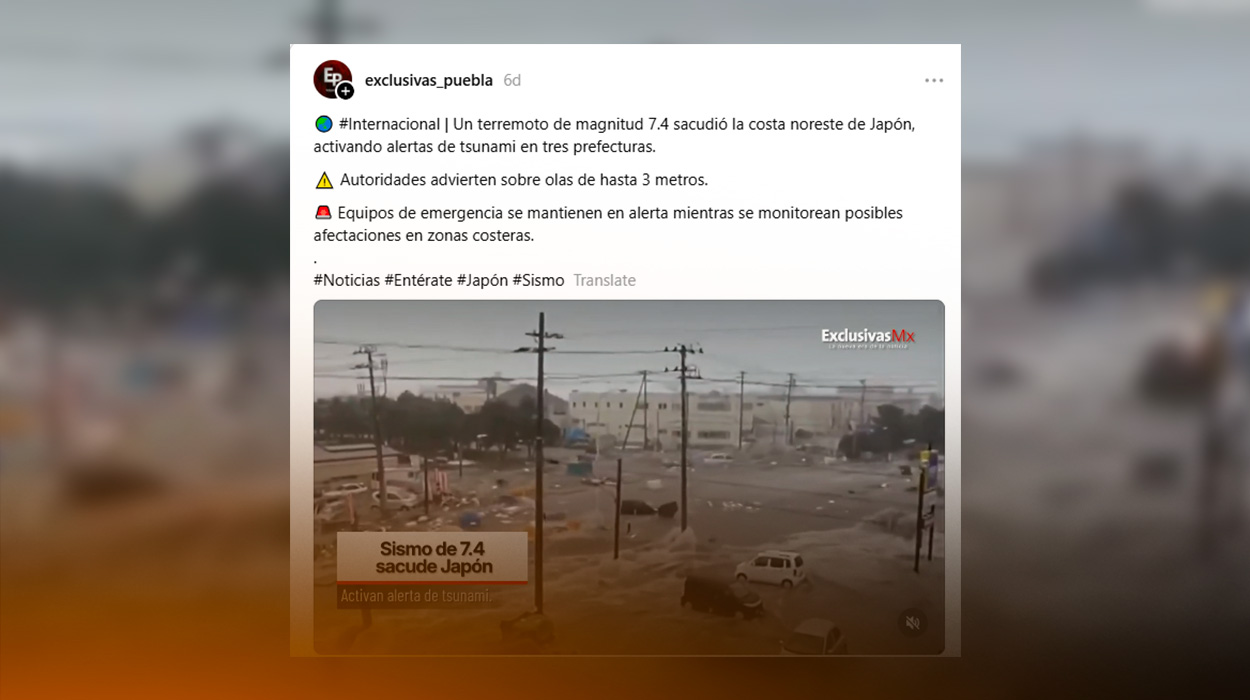
The footage of the Japanese tsunami was posted by user ‘exclusivas_puebla’ April 21, 2026.
Thai PBS Verify identified a video posted on Threads by user ‘exclusivas_puebla‘ on April 21, 2026. The footage, which depicts a Japanese city being severely struck by a tsunami, was shared shortly after a 7.4-magnitude earthquake occurred in Japan on April 20, 2026. The post’s caption was written in Spanish:
🌏 #Internacional | Un terremoto de magnitud 7.4 sacudió la costa noreste de Japón, activando alertas de tsunami en tres prefecturas.
⚠️ Autoridades advierten sobre olas de hasta 3 metros.
🚨 Equipos de emergencia se mantienen en alerta mientras se monitorean posibles afectaciones en zonas costeras.
#Noticias #Entérate #Japón #Sismo
With the aid of Google Translate, the text could be translated as follows:
“#InternationalNews | A 7.4-magnitude earthquake has struck off the northeastern coast of Japan, triggering tsunami warnings across three prefectures.
“Authorities have warned that waves could reach heights of up to 3 meters.
“🚨 Rescue teams remain on high alert, closely monitoring potential impacts on coastal areas.
“#News #BreakingNews #Japan #Earthquake”
The post has garnered over 40,100 views, 1,500 likes, 185 reposts, 765 shares and 72 comments. While some users expressed belief that the footage depicted a recent event, others stepped forward to dispute its authenticity.
The tsunami footage in question dates back in 2011
Thai PBS Verify conducted an examination with Google Lens and determined that the video is not related to the earthquake on April 20, 2026. Instead, the footage captures the tsunami striking Miyagi Prefecture during the Tohoku earthquake on March 11, 2011.
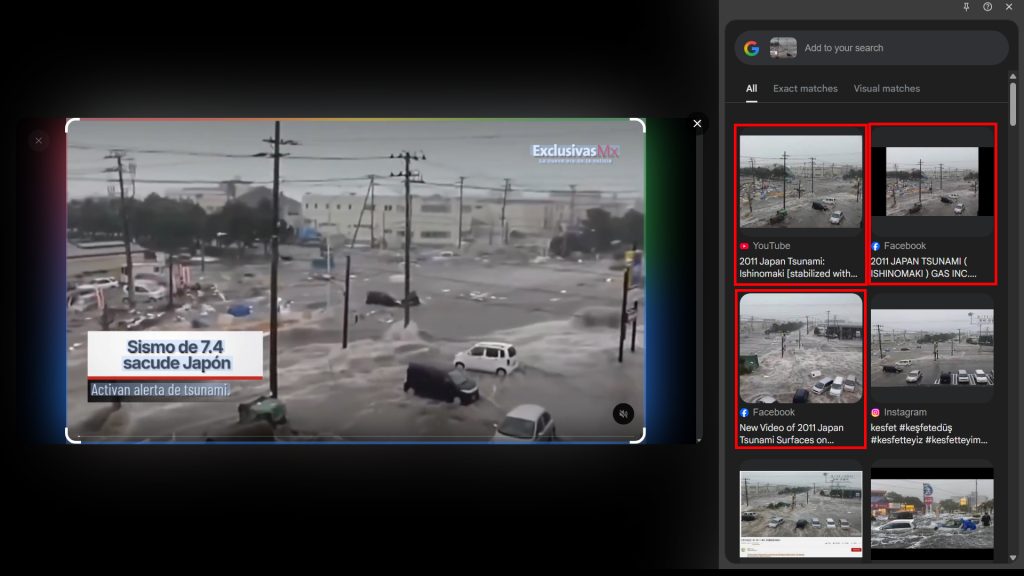
Results from Google Lens confirm that the images perfectly match archival footage from the 2011 disaster.
A comparison between the video shared on Threads and footage of the 2011 Tohoku earthquake reveals that they depict the same event. This is evidenced by identical visual elements, such as the building structures and the specific positioning of the vehicles.
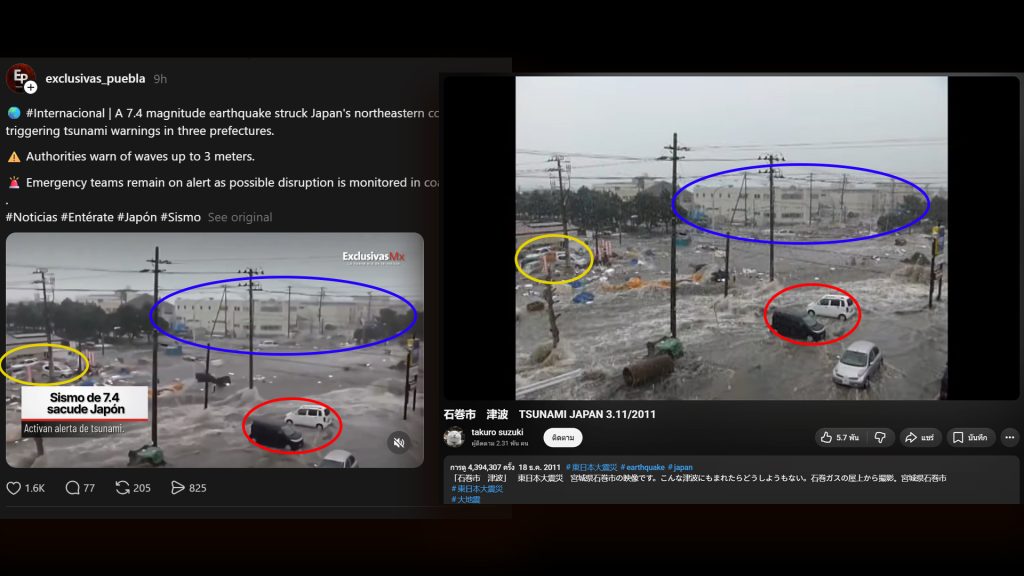
A visual comparison between the tsunami clip allegedly from April 21, 2026 (left), and the historical footage of the March 11, 2011 tsunami (right).
The Tohoku earthquake remains the costliest natural disaster in history
Regarding the Tohoku earthquake, Thai PBS News regarded it as one of the ten most powerful seismic events in history. Specifically, the earthquake that struck on March 11, 2011, is ranked as the fourth strongest ever recorded. A summary of the event is provided below.
The massive undersea earthquake off Japan’s Pacific coast triggered a catastrophic tsunami that devastated coastal towns and led to the Fukushima nuclear disaster. Despite having the world’s most advanced earthquake preparedness systems, Japan suffered immense losses. With economic damages exceeding $220 billion, it remains the costliest earthquake in recorded history.
Beyond the immediate shaking, this earthquake displaced Japan’s mainland of Honshu by 2.4 meters eastward. It stands as a powerful reminder that even with the most advanced state of readiness, the power of nature can produce consequences that surpass all human anticipation.
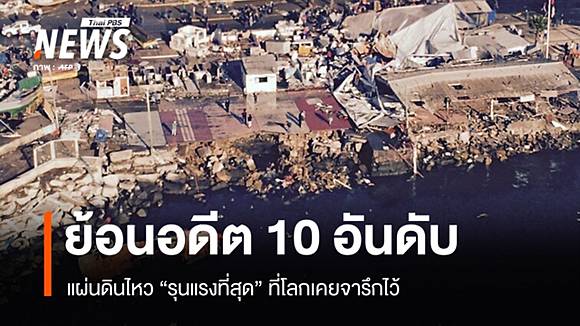
A Retrospective on the Top 10 Most Intense Earthquakes Ever Recorded” by Thai PBS News (March 28, 2026)
What is the current situation in Japan following the recent earthquake?
Furthermore, Thai PBS Verify conducted a keyword search in Japanese regarding the earthquake on April 20, 2026. This led to a report by Nikkei, which detailed the situation as follows:
青森県で震度5強を観測した地震に伴い「北海道・三陸沖後発地震注意情報」が発表され、21日で一夜が明けた。津波注意報は20日深夜に全て解除された。政府が「特別な備え」と、社会活動の両立への対応を市民や事業者に求める期間は27日夕まで。
政府が求める備えの対象地域は、北海道から千葉県の7道県の太平洋側沿岸が中心。非常持ち出し品を持ち歩くことや、すぐ逃げられるよう就寝時枕元に靴を置くことを求めている。同時に、避難経路や家具固定の再確認も呼びかけた。
後発地震情報は、平常時に比べて相対的に大規模地震の危険度が高まったことを伝えるものだ。過去の世界の事例では、先発地震後7日以内に大きな地震が発生したのは100回に1回程度。
震度5強の地震は20日午後4時52分ごろ起きた。震源地は三陸沖で、震源の深さは19キロ、地震の規模はマグニチュード(M)7.7。気象庁は約2時間半後、後発地震情報を発表した。〔共同〕
The text was translated into Thai with Google Translate:
“After a magnitude 5+ earthquake struck Aomori, the government placed the Hokkaido and Sanriku offshore regions under a seismic advisory. While the tsunami warnings were fully rescinded late on the 20th and the advisory ended on the 21st, the public and private sectors are still requested to take extra precautions and balance their daily activities until the evening of the 27th.
“Targeting the Pacific coastlines of seven prefectures from Hokkaido to Chiba, the government is emphasizing the need for heightened readiness. The public is advised to stock up on emergency rations and place shoes near their bedside for a quick exit if needed. Additionally, individuals are encouraged to double-check their evacuation paths and secure any heavy furniture to prevent injury.
“This ongoing advisory suggests an elevated risk of a large-scale earthquake compared to normal periods. Past data shows that a major quake follows an initial shock within a seven-day window in only about 1 out of every 100 cases.
“An earthquake with an intensity of 5 or higher occurred at approximately 4:52 PM on the 20th. The epicenter was located off the Sanriku coast at a depth of 19 kilometers, registering a magnitude of 7.7.
“The Japan Meteorological Agency issued an advisory approximately two and a half hours after the earthquake occurred. [Kyodo]”
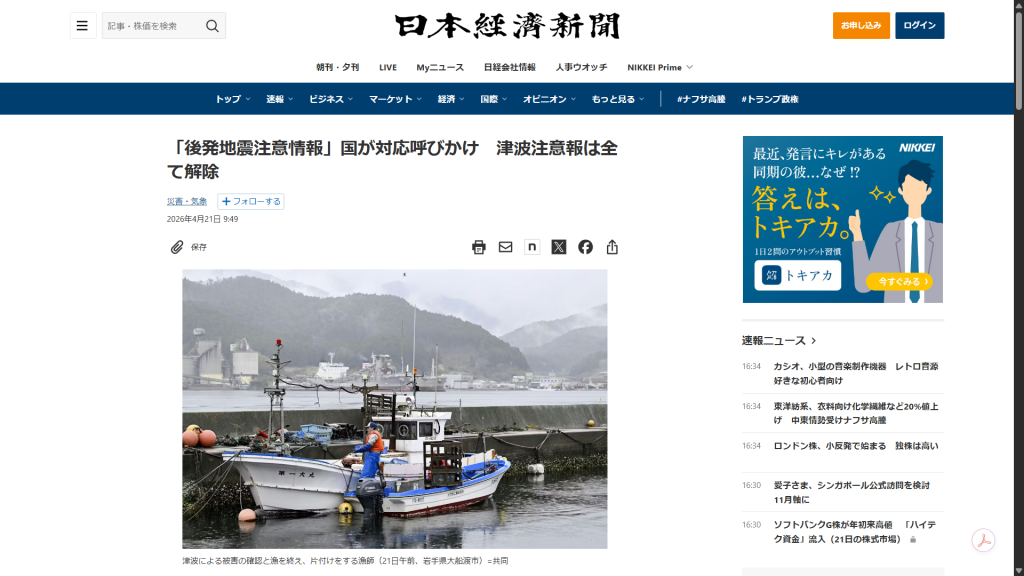
A news report by Nikkei, regarding the current earthquake situation in Japan, was published on April 21, 2026.
What is the truth?
The video in question, shared by the exclusivas_puebla account on Threads on April 21, 2026, claims to show a tsunami hitting the Japanese coast after a 7.7 magnitude earthquake. However, it is false. The footage is actually from the Tohoku earthquake and tsunami on March 11, 2011—a historic disaster that caused immense loss and devastation 15 years ago.
Regarding the recent 7.7 magnitude earthquake off the Sanriku coast on April 20, 2026, it is important to note that all tsunami warnings were rescinded by the Japan Meteorological Agency late that evening. No incidents of catastrophic waves hitting the coast have occurred, refuting the depictions shown in the aforementioned distorted footage.
Verification Process
- Visual verification tools: Google Lens was utilized to trace the origin of the imagery, revealing that the footage actually depicts the 2011 Tohoku earthquake. This was confirmed by matching it with a video published on YouTube as far back as December 2011.
- Keyword search: Targeted searches were conducted in both Japanese and Thai using terms such as ‘Earthquake Tsunami 04/20.’ This led to the discovery of articles from Thai PBS and reports from Japan’s Nikkei news agency regarding the earthquake that occurred on April 20, 2026.
Potential impacts of disinformation
- Causing unnecessary panic: If misrepresented, these videos can incite excessive anxiety and panic among residents in high-risk areas—far beyond the actual situation being managed by authorities.
- Undermining public trust in emergency warnings: When the public realizes that viral footage is fabricated or misleading, it can lead to complacency. This diminishes the credibility of official government alerts and may cause people to take future warnings less seriously.
- Fear mongering: Dramatic footage from past disasters is often repurposed to drive views and engagement during times of public anxiety. This practice is a form of crisis exploitation, taking unfair advantage of people’s fears for digital gain.
What to do with this misinformation?
- Look for official sources: During a disaster, it is crucial to rely on updates from reputable news outlets or official disaster management authorities rather than unverified social media posts.
- Utilize reverse video search tools: If a video depicts extreme or high-impact events, try using a screen capture of the footage in Google Lens. This allows you to verify whether the imagery has previously appeared in past incidents or historical archives.
- Observe resolution and visual quality: Footage from 2011 often exhibits differences in clarity and production techniques compared to present-day recordings from 2026. Such discrepancies in visual quality serve as a red flag that the content may be ‘recycled’ historical footage.
- Refrain from sharing unverified information: In a crisis, sharing information without proper verification can pose risks to yourself and others. If you are uncertain about the accuracy of a post, please pause and rely exclusively on official channels for updates.
- Report posts to break the cycle: If you encounter misleading information, please use the ‘Report’ function on the platform. This helps restrict the spread of harmful content and ensures that accurate, life-saving information can reach the public more quickly.
Editor: Nuttapoln Toomma
Translation edited by: Peerachai Pasutan

Related Content