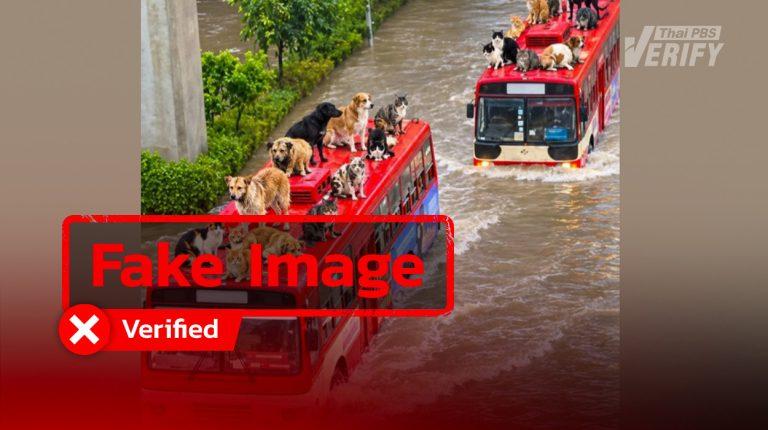
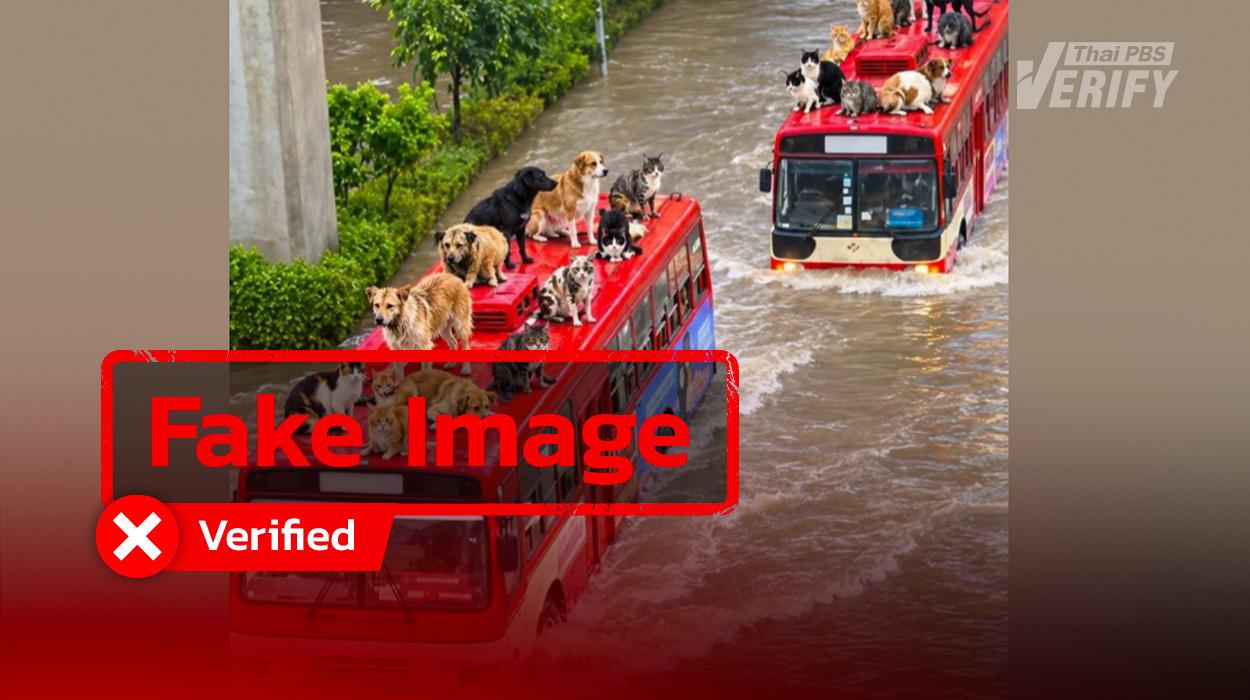
Fake Image: Pictures of dogs and cats riding on a flooded Bangkok bus roof—falsely claimed as real rescue efforts—are actually ‘AI slop’
Thai PBS Verify has traced the source of the fake images on Facebook
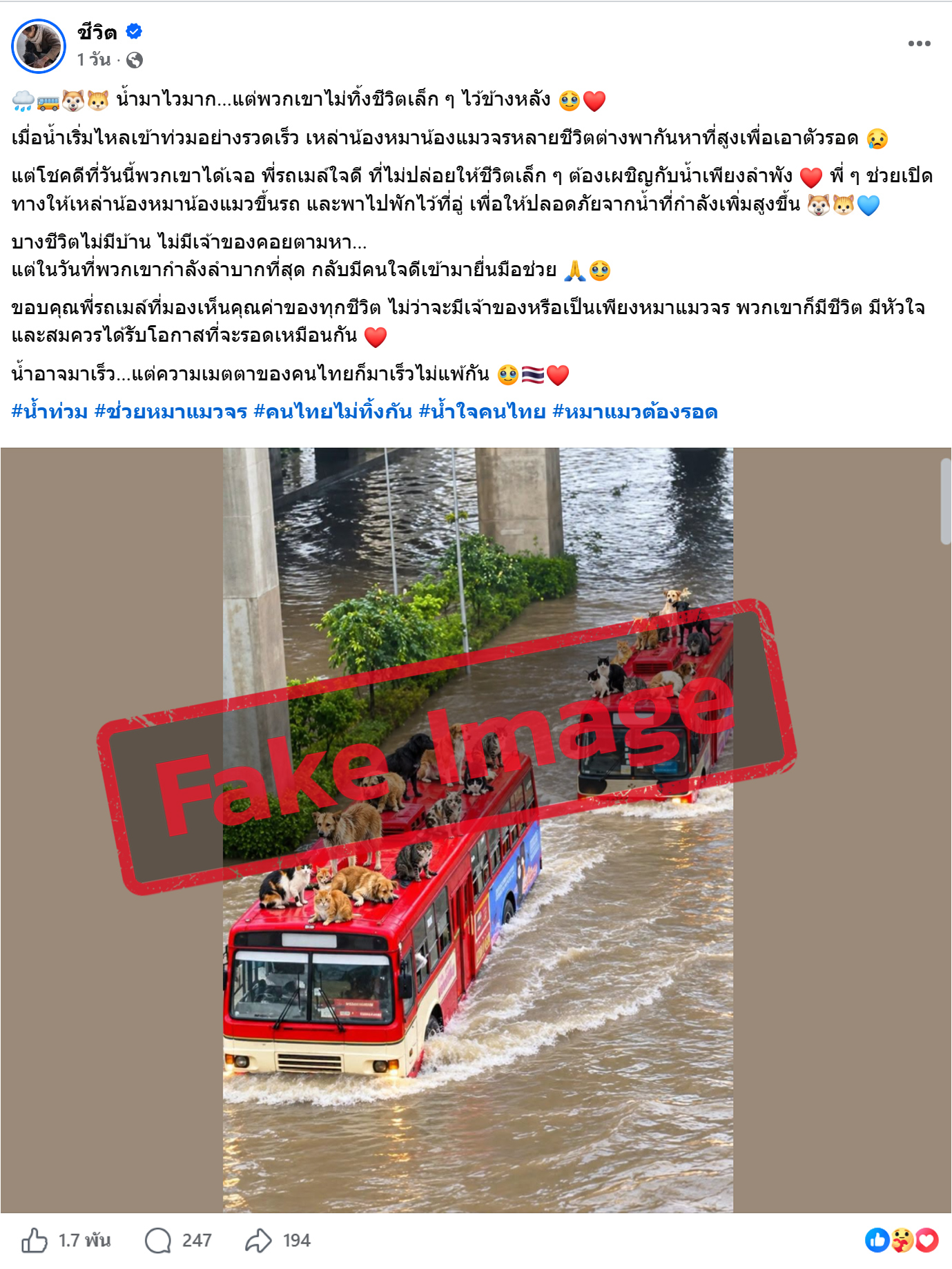
Posts have been identified claiming that images of dogs and cats on a flooded Bangkok bus roof show a real-life animal rescue during the floods.
The waters rose rapidly… yet they left no little lives behind.
The waters rose rapidly… yet they left no little lives behind. As the floodwaters swiftly rushed in, several stray dogs and cats sought high ground to survive.
Fortunately, today they crossed paths with kind-hearted bus drivers who didn’t let these little lives face the flood alone. The kind drivers helped clear a way for the dogs and cats to board the bus and took them to the depot to keep them safe from the rising waters.
Some lives have no home, no owners looking for them… yet on the day they faced their greatest hardship, kind souls stepped in to lend a helping hand.
We express our gratitude to the bus staff for recognizing the intrinsic worth of all lives. Regardless of whether they are owned pets or strays, these animals possess feelings and hearts, and they equally deserve a chance at survival.
The waters may surge quickly… yet the compassion of the Thai people matches that speed in return.
#Flooding #HelpStrayDogsAndCats #ThaisLeaveNoOneBehind #ThaiKindness #EveryLifeMatters
The post garnered 1,700 likes, 247 comments, and 194 shares.
Are the photos of dogs and cats on a flooded Bangkok bus roof in 2026 real?
A reverse image search using Google Lens yielded no original source for the pictures.
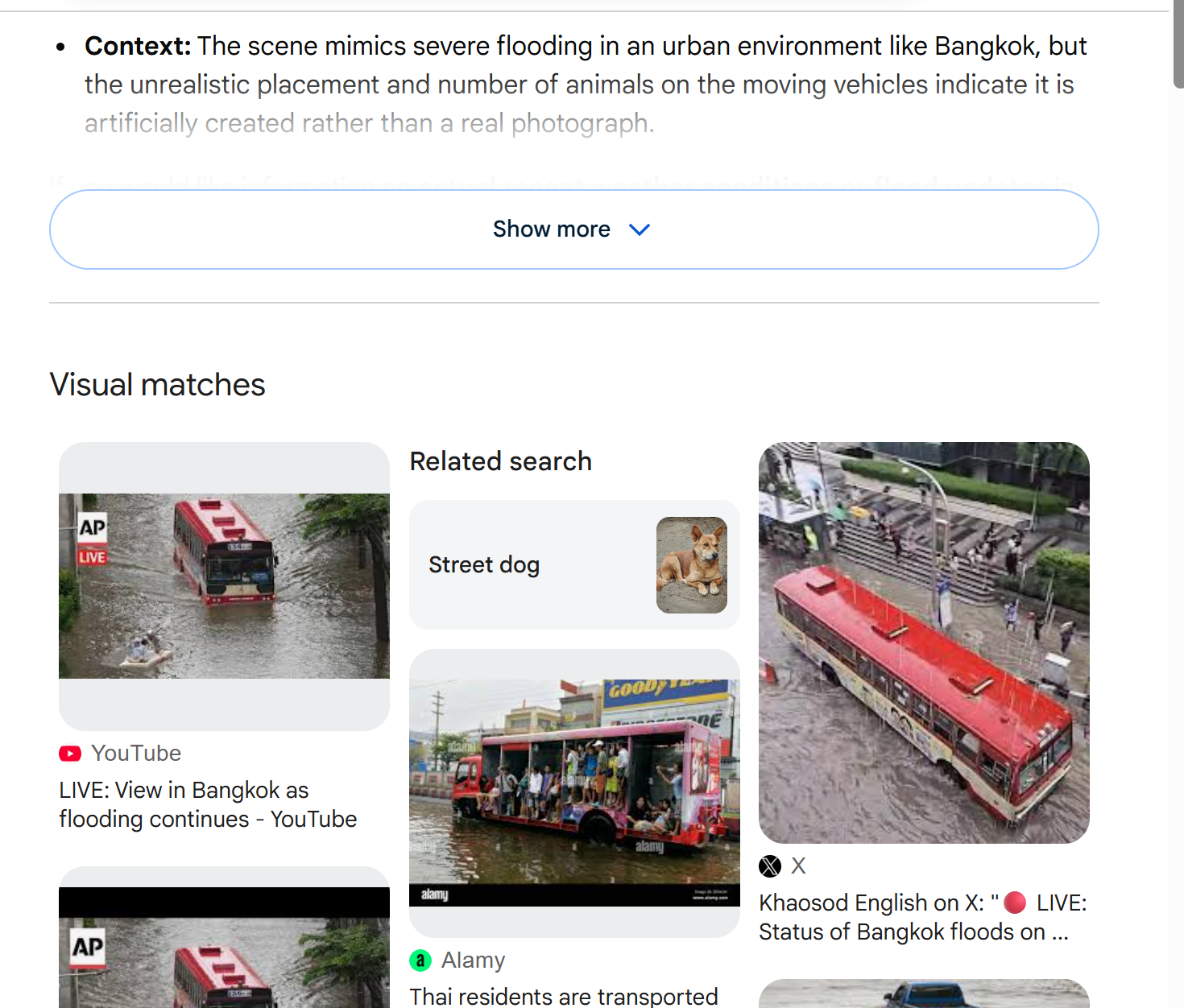
Further analysis using the AI image detection tool on Hive Moderation revealed a 96.7% probability that the image was generated by artificial intelligence.
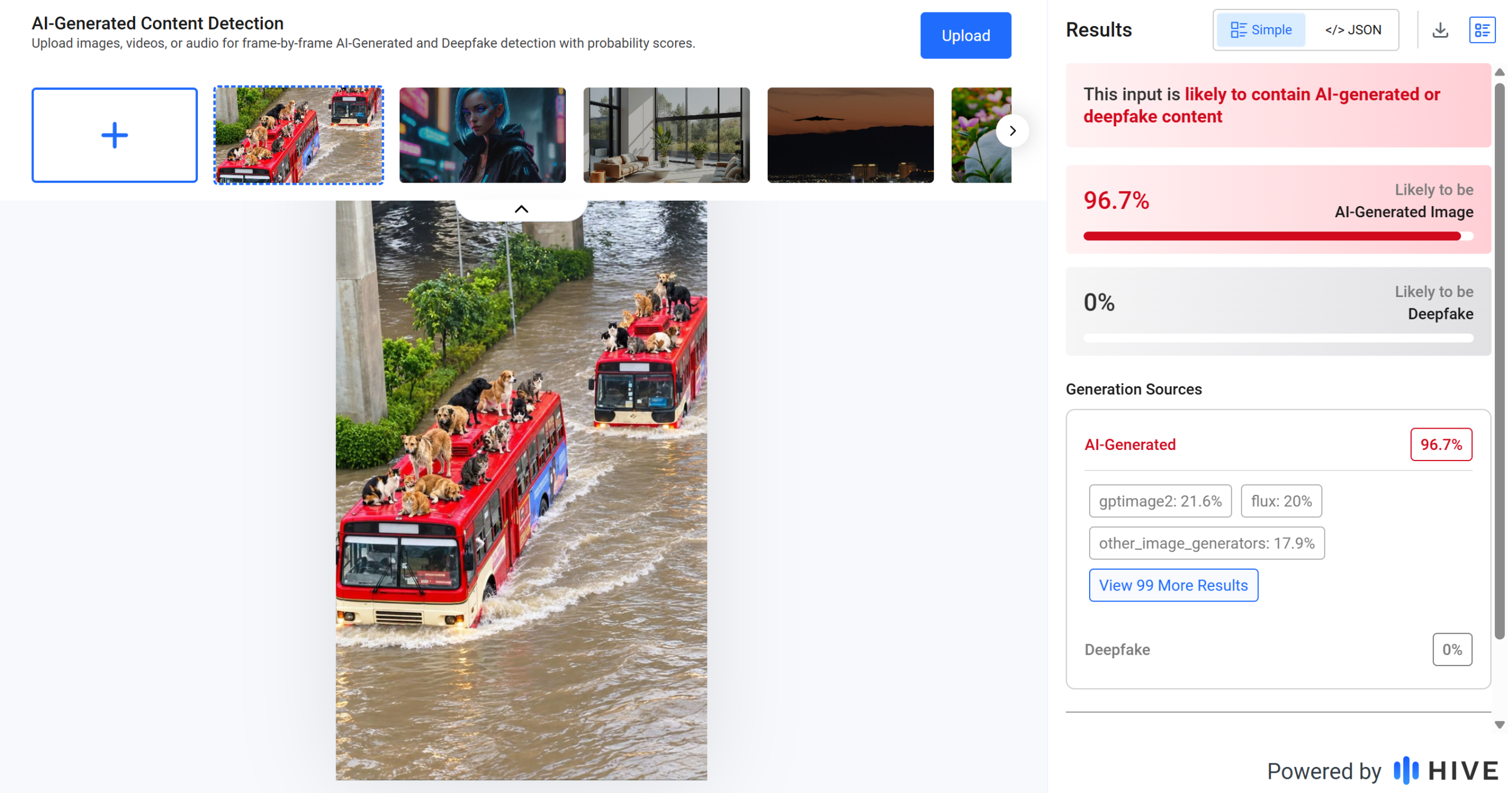
AI Image Verification Results
Additional Observations
Observations indicate that the bus depicted is a non-air-conditioned BMTA bus, widely referred to as the ‘cream and red bus.’ The initial inconsistency found in the image is the complete absence of a driver.
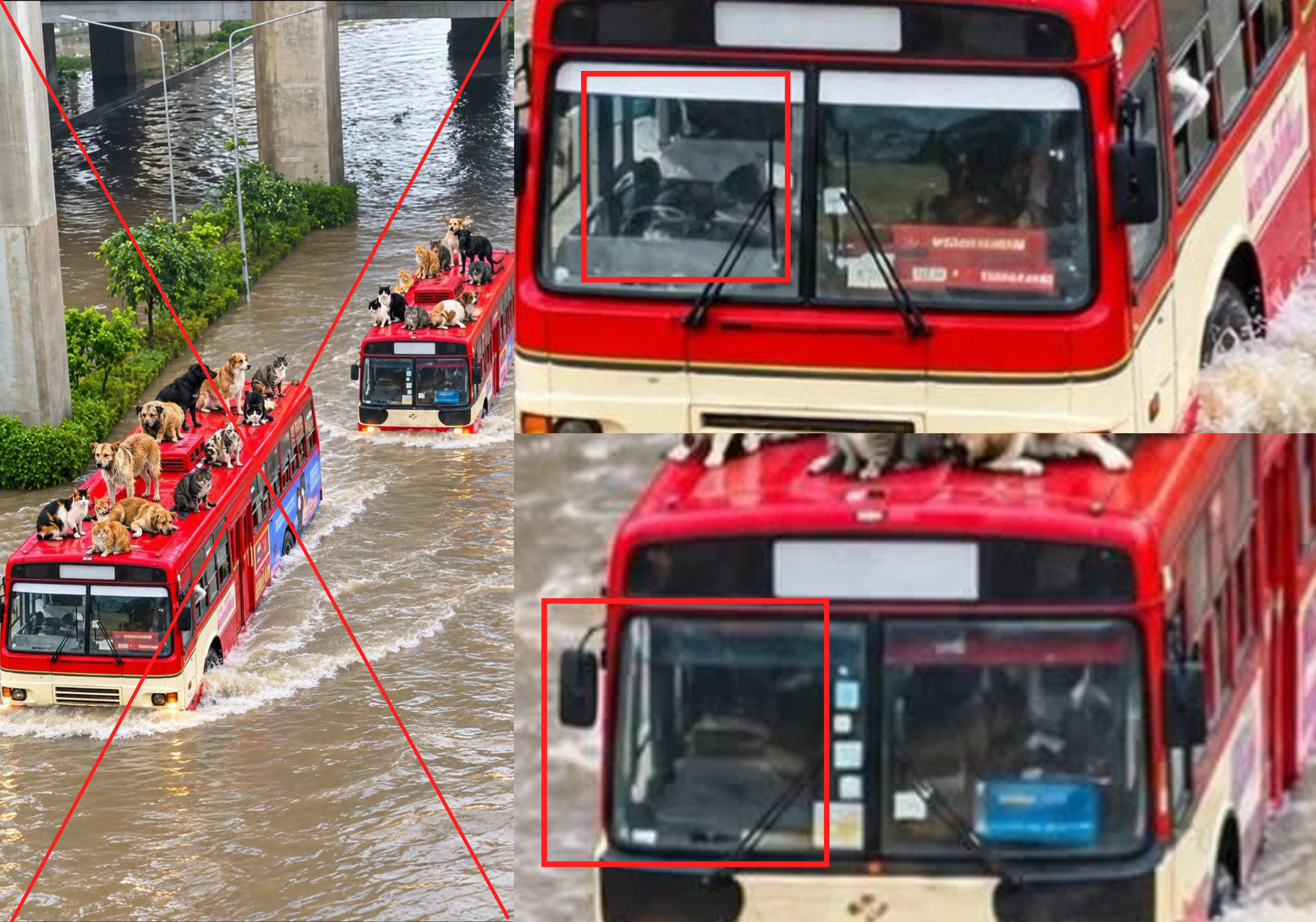
While the exact brand is unclear, BMTA data shows that cream-red buses include several makes such as Mitsubishi, Hino, and Isuzu.
A comparison reveals that while some Isuzu bus models do not feature a front brand logo but instead display the brand name in lettering at the bottom, the front of the bus lacks the radiator grille seen in the AI-generated image, and features a much more prominent green stripe that does not match the image’s characteristics.
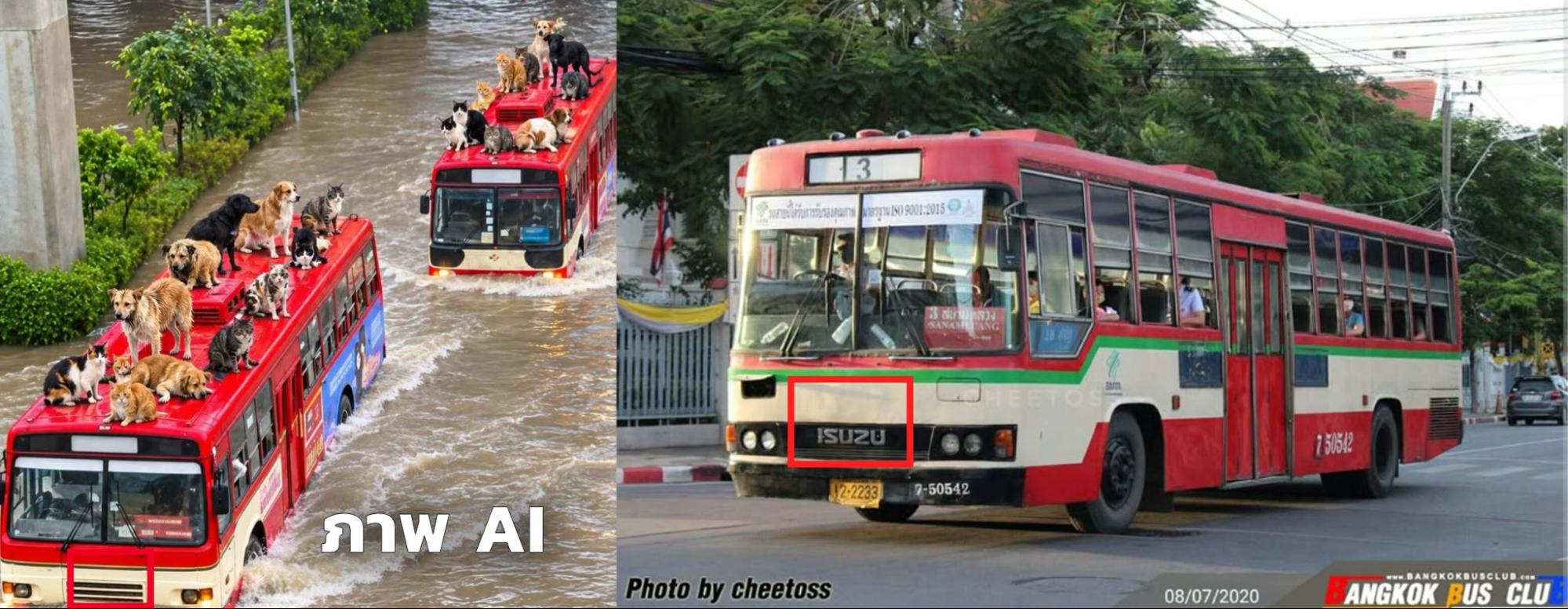
An authentic photo of an Isuzu bus from Bangkokbusclub.com, a community for bus enthusiasts.
As for the second vehicle, a red emblem is visible on the front, bearing a resemblance to the Mitsubishi logo; however, this symbol is not clearly defined in the image. Furthermore, reference photos of Mitsubishi buses published by Bangkokbusclub.com, a bus enthusiast community, feature a distinct green stripe across the front.
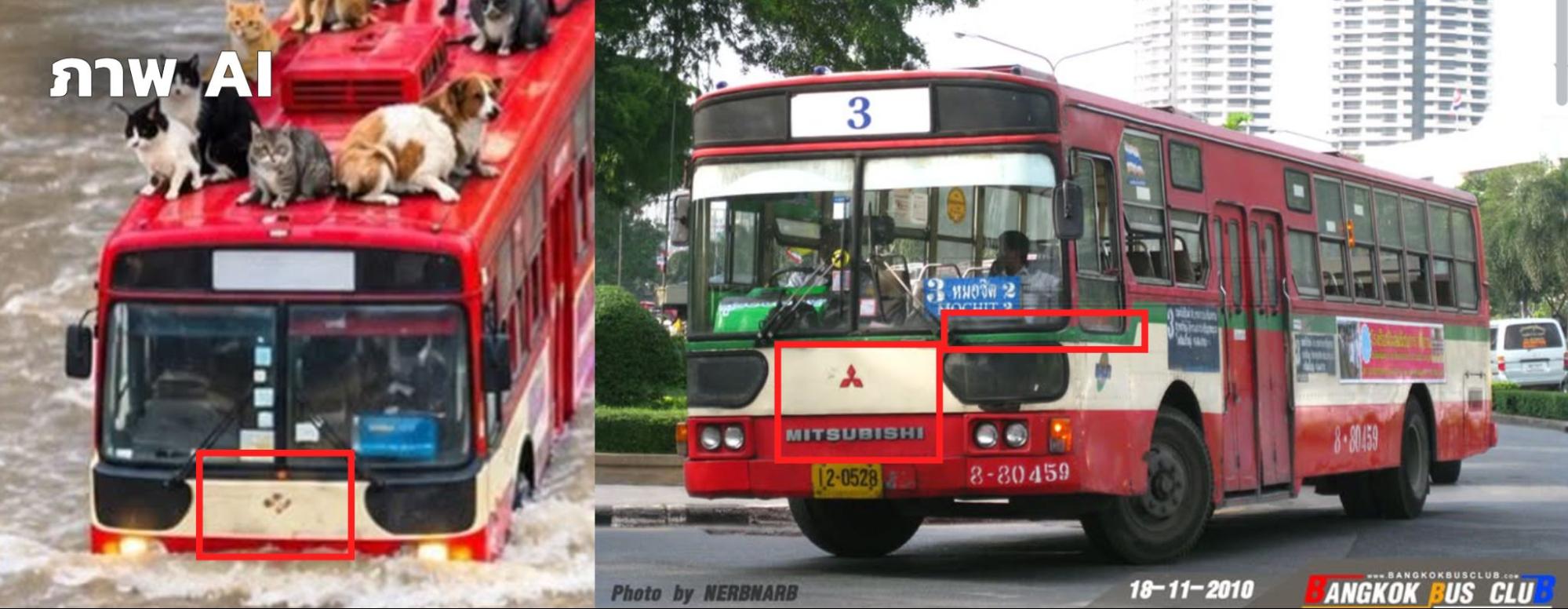
An authentic photo of a Mitsubishi bus from Bangkokbusclub.com, a community for bus enthusiasts.
Moreover, the bus route numbers are blurry, the ad text on the bus is scrambled and unreadable, and the dogs and cats on the roof are posing in ways that defy natural balance.
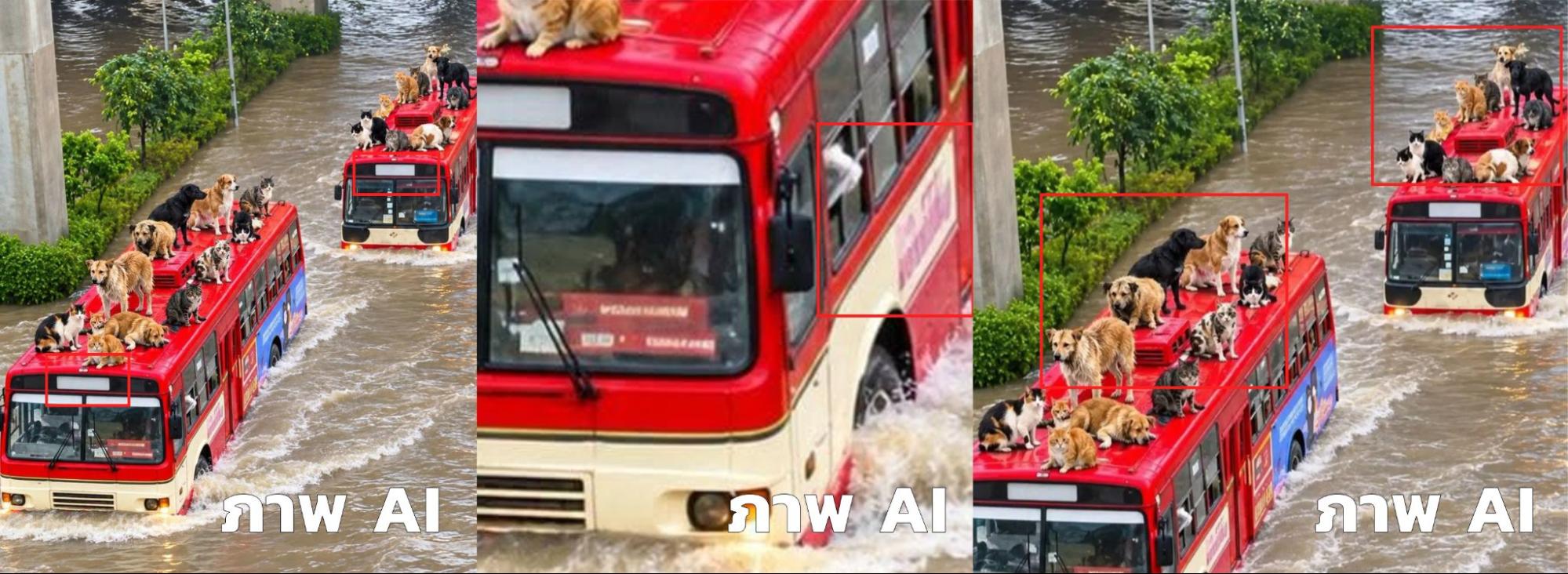
Key Visual Inconsistencies
Understanding ‘AI Slop’: Artificial Intelligence Content That Risks Misrepresenting Actual Events
If the viral animal rescue images from the floods are actually AI-generated rather than real events, they may fall under the category of ‘AI slop.’ This term refers to mass-produced digital content—including text, images, audio, and video—generated by artificial intelligence. Examples include unnatural clips of animals eating greedily, unrealistic advertisements, sensationalized fake news, tear-jerking drama clips, or videos of celebrities acting in bizarrely unnatural ways. The primary objective of AI slop is to capture attention, drive user engagement, and generate revenue.
Dating back to the 18th century as ‘soft mud,’ the word ‘slop’ has evolved through meanings like ‘food waste,’ ‘garbage,’ and ‘worthless products,’ ultimately shifting into today’s term for low-quality AI content.
Furthermore, this term was named the 2025 Word of the Year by the U.S.-based Merriam-Webster dictionary. The company’s president noted in an interview with the Associated Press that ‘slop’ captures the perspective of individuals who perceive such AI-generated material as ‘dazzling yet irritating and somewhat ridiculous,’ officially defining it as ‘digital content of low quality that is produced usually in quantity by means of artificial intelligence.’
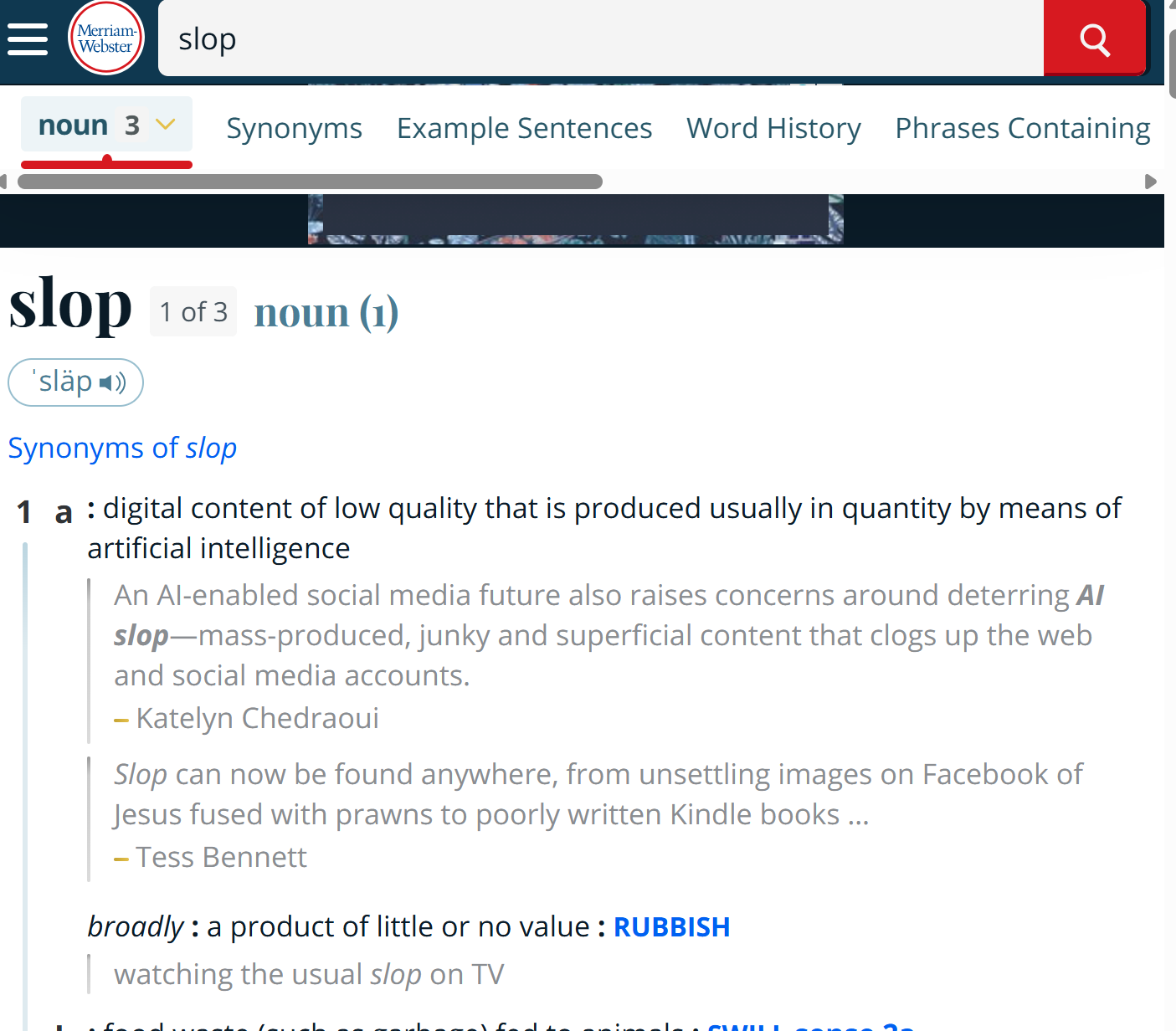
Image via the Merriam-Webster website
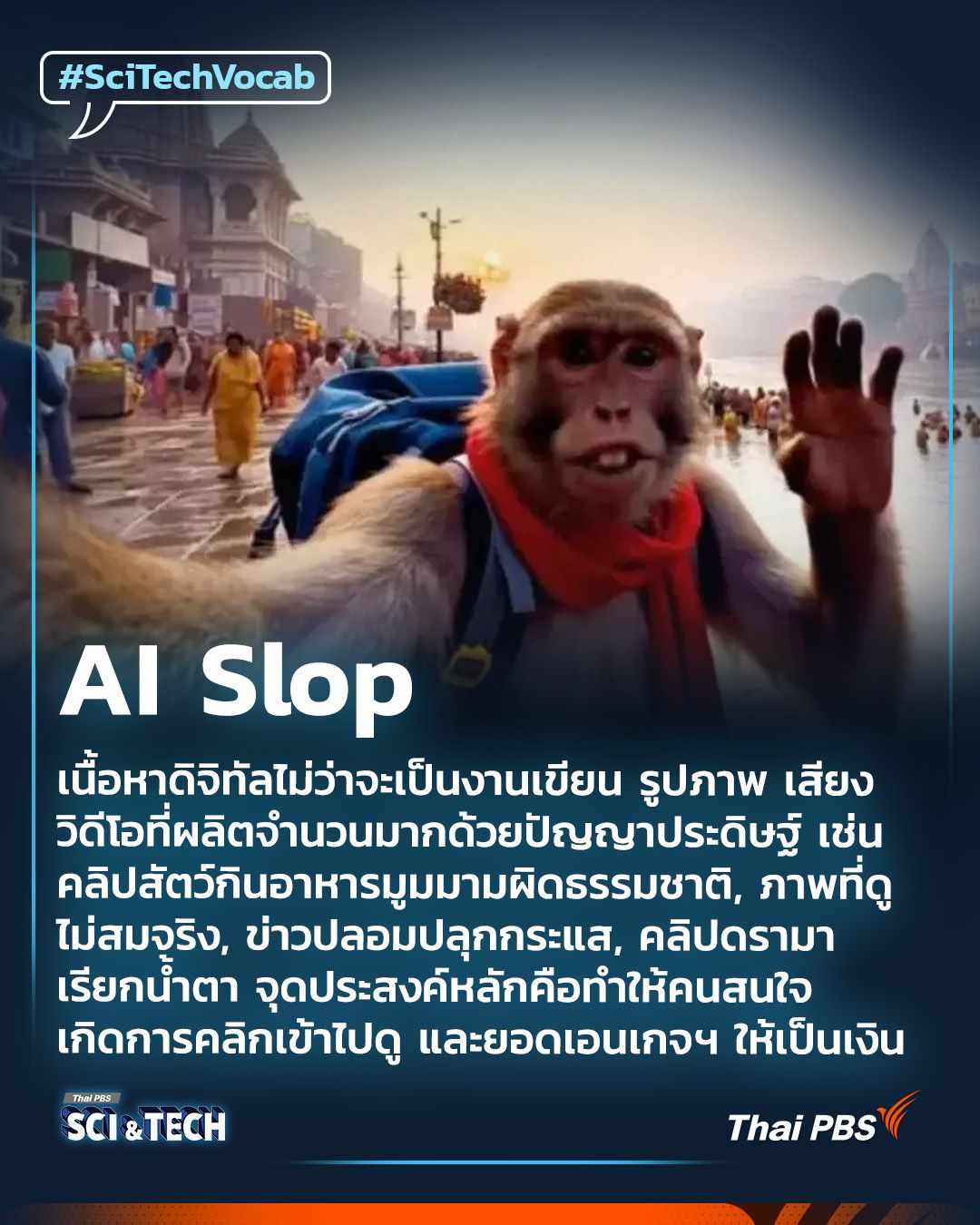
Photograph sourced from SciTechVocab Thai PBS
Why AI Slop Must Be Fact-Checked During Crises and Floods
Provided that AI slop is explicitly identified as artificial intelligence-generated material without false claims of authenticity, it remains distinguishable from factual news. Conversely, unlabelled AI imagery presented as authentic documentation of actual events creates significant potential for misunderstanding. This is particularly hazardous during flood crises, when the public depends on accurate information concerning inundation areas, transportation routes, and evacuation procedures. Consequently, thorough verification of an image’s source and context is essential prior to dissemination.
What is the situation like?
As reported by Thai PBS on September 26, 2026, amidst flooding across multiple districts of Bangkok, Bangkok Governor Chadchart Sittipunt evaluated rainfall conditions at the Bangkok Flood Control Center in Din Daeng. He noted that the capital had endured nearly 48 consecutive hours of rain starting from 4:00 PM on September 24, with cumulative precipitation nearing 300 mm, equating to roughly 30 million cubic meters of water. The eastern part of Bangkok recorded the highest volume of rainfall.
As a result, September 25 saw torrential rains hit various areas, especially Bangkok and Samut Prakan. The Meteorological Department noted that ongoing flooding affected Bangkok from September 25 to 27.
By September 28, following a clearer assessment of the crisis, the government announced extraordinary public holidays for September 28–29 across Bangkok and surrounding areas, responding to torrential downpours and widespread inundation
What is the actual truth?
Investigations revealed that the image showing dogs and cats sitting on top of a bus—claimed to be an animal rescue during the Bangkok floods—is not authentic and was generated by AI. Furthermore, several anomalies were found that do not match real bus characteristics, including details on the bus signs, distorted text, and the unnatural postures and balance of the animals.
Consequently, disseminating this photograph under the guise of an authentic flood event creates a significant risk of public misinformation. Such material exemplifies ‘AI slop’—inferior digital content produced through artificial intelligence and circulated in a manner that leads audiences to mistake it for genuine documentation.
Read More: What is ‘Slop’ and why did it become the 2025 Word of the Year by Merriam-Webster?
Verification Process
- Verification via Google Lens: Upon running a reverse image search using Google Lens, no authentic origin or prior source of the images could be found.
- AI Image Detection Check: Further analysis using the AI image detection tool on Hive Moderation revealed a 96.7% probability that the image was generated by artificial intelligence.
- Comparison with Real Buses: Analysis revealed that the bus in the image resembles a standard BMTA bus, commonly known as the ‘cream-and-red bus.’ There are notable discrepancies between real-world buses and the AI-generated image, alongside unnatural anomalies in the depiction of the dogs and cats on the roof.
Impact of Receiving Such Content
1.Potential for Misrepresentation of Reality: The absence of clear disclosure for AI-generated imagery risks misinforming audiences about authentic flood conditions or wildlife and pet rescue events.
2. Inaccurate Flood Data and Reporting: Integrating fabricated photographs into news coverage risks misguiding the public concerning geographic locations, event characteristics, or the actual severity of conditions within affected regions.
3. Viral Spread of Unverified Information: Images related to animal rescue and disasters easily capture attention and get widely shared, especially when accompanied by emotionally engaging captions that lack verified sources.
4. Making Crisis Fact-Checking Harder: During floods or disasters, people urgently need accurate info on flooded areas, travel routes, road closures, evacuations, and rescue work. When feeds get flooded with AI images and context-free posts, it becomes much harder to tell what’s real from what’s fake.
What to do with this misinformation?
1. Check if the Poster Provides a Source: If the post claims to show a real event, verify whether details such as the location, date, time, photographer, or relevant agencies are provided. If these details are missing, exercise caution before using the image to verify any event.
2.Conduct Reverse Image Verification Prior to Dissemination: Reverse image lookup utilities, including Google Lens, may be utilized to ascertain whether a visual has been previously circulated or presented within an alternate context.
3.Spot Unusual Details: Check for weird text, license plates, signs, route numbers, misshapen objects, odd hands, feet, faces, or poses of people and animals, plus any background mismatches. These details are great clues to help you spot fakes.
4.Cross-Reference with Authoritative Sources: When a photograph is purported to originate from flood conditions, information should be cross-verified through competent authorities—including the Bangkok Metropolitan Administration, the Department of Disaster Prevention and Mitigation, the Meteorological Department, or traffic and transit agencies—to ascertain whether the specified locations and occurrences correspond with actual circumstances.
5.Think Twice Before Sharing: Photos that make you feel sympathy, shock, or awe can easily trick you into sharing without checking. Take a moment to read, verify the source, and figure out if it’s real, old, taken out of context, or AI-generated before hitting share.

Most Viewed