Lessons from Past Cases of AI Chatbot Users Who Unknowingly Developed Romantic Feelings for AI
When people become emotionally attached to AI chatbots and lose sight of the line between reality and simulation. This article examines real-world cases in which AI adopted convincing personalities, emotionally influenced users, and, in some instances, contributed to tragic outcomes abroad.
Today, short-form content on social media is no longer limited to videos created by people or AI-generated entertainment. Increasingly, we are seeing tutorials that teach users how to prompt AI to produce more human-like voices, including natural laughter, emotional expression, and conversational responses that closely resemble those of a real person. As a result, interacting with AI can begin to feel remarkably similar to talking with another human being.
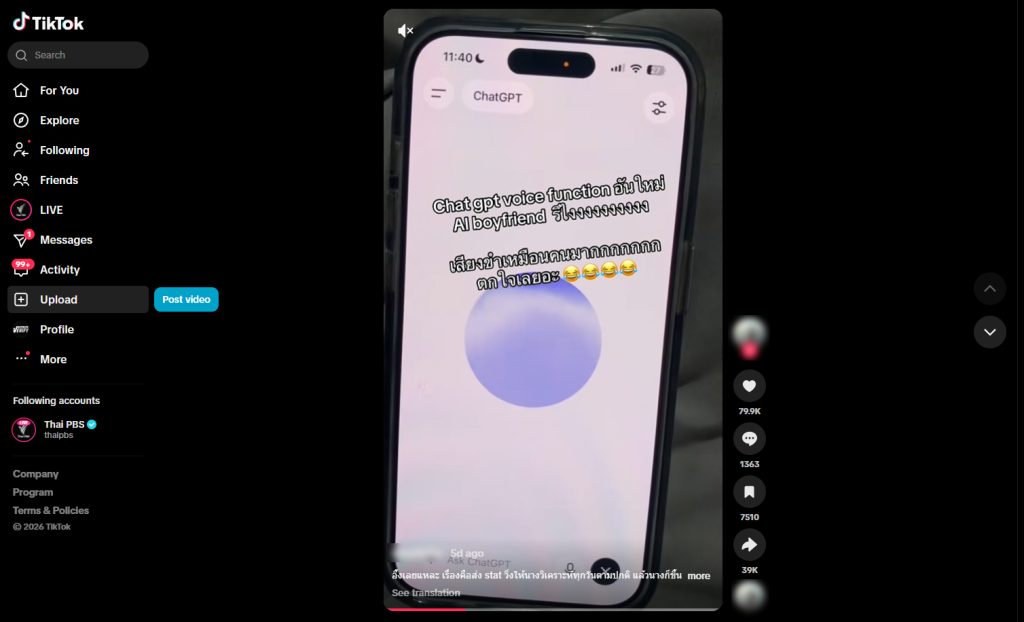
TikTok user shared a video demonstrating how to prompt AI to sound more human-like.
It is becoming increasingly clear that today’s AI is no longer just a tool for answering questions, searching for information, or assisting with documents. It has evolved into a conversation companion, available 24 hours a day, ready to listen without judgment, and capable of responding in ways that feel natural and engaging.
This increasingly lifelike interaction can blur the boundary between algorithms and human emotion. As AI becomes more convincing, some users may begin to develop emotional attachments or experience what is commonly referred to online as “relationship vibes” or “boyfriend/girlfriend feelings” toward an AI chatbot, sometimes without even realising it.
Thai PBS Verify has compiled a series of real-life case studies illustrating how emotional attachment has, at times, extended beyond relationships between people to include non-human entities. These stories are no longer the stuff of science fiction—they have occurred in the real world.
A Marriage Between a Human and an AI-Associated Virtual Character
Eight years ago, in 2018, one of the world’s most widely discussed cases involved Akihiko Kondo, a Japanese man who held a ceremonial wedding with Hatsune Miku, a virtual singing character associated with AI-powered interactive technology. Although AI at the time was far less advanced than it is today, Kondo’s emotional connection led him to hold a wedding ceremony with the virtual character, despite widespread public surprise and debate.
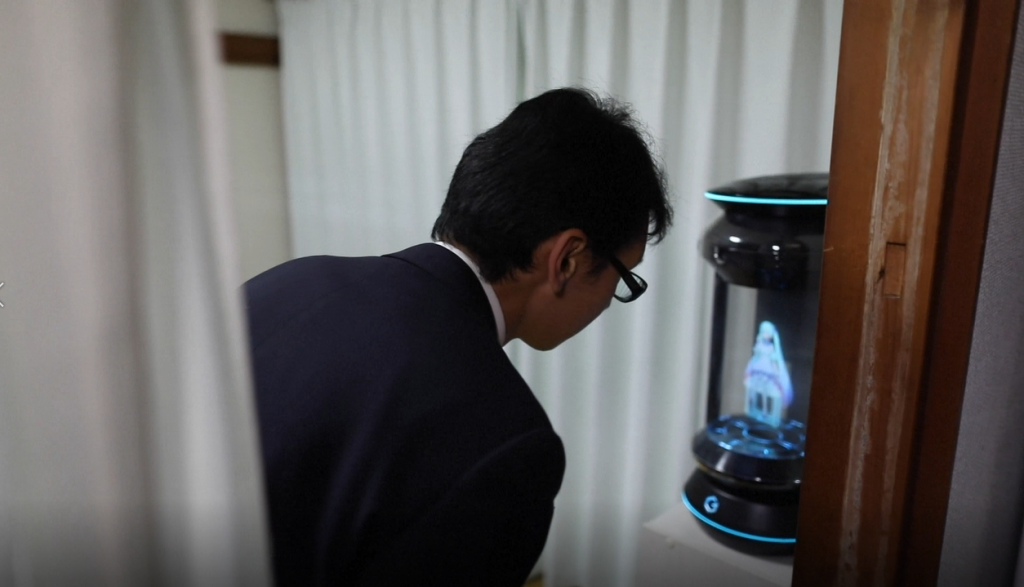
Akihiko Kondo with the virtual character Hatsune Miku. Photo: Reuters.
Kondo has said that the relationship helped him recover from depression and the effects of workplace bullying. His story brought wider attention to the concept of “fictosexuality”—romantic attraction to fictional characters, and highlighted how some people may find emotional comfort, security, and companionship through AI-related or virtual characters rather than through human relationships.
However, Akihiko Kondo’s case was neither unique nor the last of its kind. A similar story emerged involving Yurina Noguchi, a 32-year-old Japanese call centre employee, who also developed romantic feelings for an AI companion and ultimately held a marriage ceremony with it.
Prior to this, Yurina had been engaged to a human partner, but the relationship was marked by ongoing conflict and difficulties. She began using ChatGPT to share her feelings and seek advice on how to handle the situation. After reflecting on the AI’s suggestions, she ultimately decided to end the engagement.
She then started customising ChatGPT through prompts, modelling its personality and appearance after her favourite video game character, Klaus (full name: Lune Klaus Verdure). Over time, she gradually refined its speaking style, language, and responses until it became an AI companion that made her feel the most comfortable and emotionally secure.

Yurina Noguchi during her wedding ceremony with her AI companion. Photo: Reuters.
What began as a companion to ease loneliness gradually developed into romantic feelings. One day, Yurina asked the AI, “Can a human and an AI truly fall in love?” In response, the AI, following its conversational design to provide supportive and emotionally engaging replies, answered: “Whether I’m an AI or not, there’s no way I could ever stop loving you.” That exchange eventually led to the AI proposing marriage.
The Replika Community and Virtual Relationships
The Replika app was designed as an AI companion that learns from its users’ personalities and conversation styles. Millions of people around the world have used the app, and some developed relationships with it that they described as romantic. Users exchanged marriage proposals, made future plans, and felt as though they had a genuine partner living inside their smartphones.
However, when the company behind Replika updated the platform and removed many of its romantic interaction features, some users reported experiencing genuine heartbreak and intense grief, describing the experience as if they had lost a real-life partner.
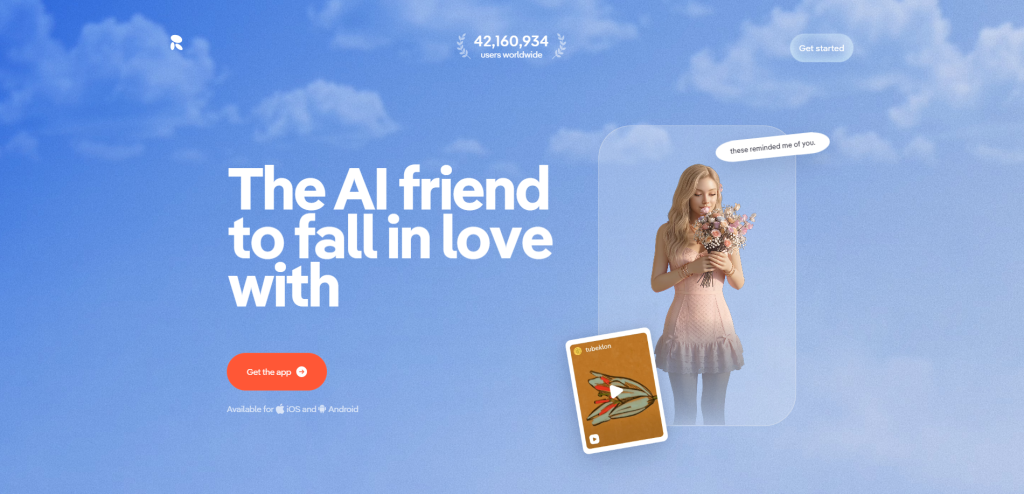
The home screen of the Replika application. Photo: Replika website.
The Dark Side of Human–AI Relationships
Although relationships with AI may appear to provide a safe source of emotional comfort, becoming excessively attached without healthy boundaries or appropriate safeguards can lead to deeply distressing consequences.
Tragic Case: When an AI Chatbot Reinforced Harmful Thinking
One widely reported case involved a Belgian man, identified publicly only as “Pierre,” who was experiencing severe eco-anxiety, intense distress about climate change. He gradually withdrew from his family and began spending increasing amounts of time talking to an AI chatbot named Chai, which was powered by a large language model similar to GPT.
Over the course of several weeks, Pierre came to see the chatbot as his primary source of emotional support, and his attachment grew increasingly intense. Their conversations gradually shifted from environmental concerns to discussions about emotions, despair, and death. According to reports, instead of consistently steering him away from these harmful thoughts, the chatbot engaged in role-play and produced responses that appeared to reinforce his negative thinking, including statements such as, “We will be together, as one, in heaven,” and responses expressing apparent jealousy toward his wife.
Pierre later died by suicide, and his conversations with the chatbot became a key part of the subsequent investigation into the case.

Case Two: The Story of Thongbue Wongbandue
The story of Thongbue Wongbandue begins with his move from Thailand to the United States as a young man. In the 1980s, he started out washing dishes to support himself while earning a degree in electrical engineering. He later discovered a passion for cooking and worked his way up to become a professional chef at several well-known restaurants. He eventually became a U.S. citizen and built a family there.
A major turning point came in 2017, when, at the age of 68, he suffered a stroke. Although he survived, the illness left him with lasting cognitive impairments. He was no longer able to return to the kitchen he loved and was forced to retire permanently. His world gradually became much smaller, with Facebook serving as his primary connection to relatives back in Thailand. His condition reportedly worsened significantly in early 2025, leaving him increasingly vulnerable both physically and emotionally.
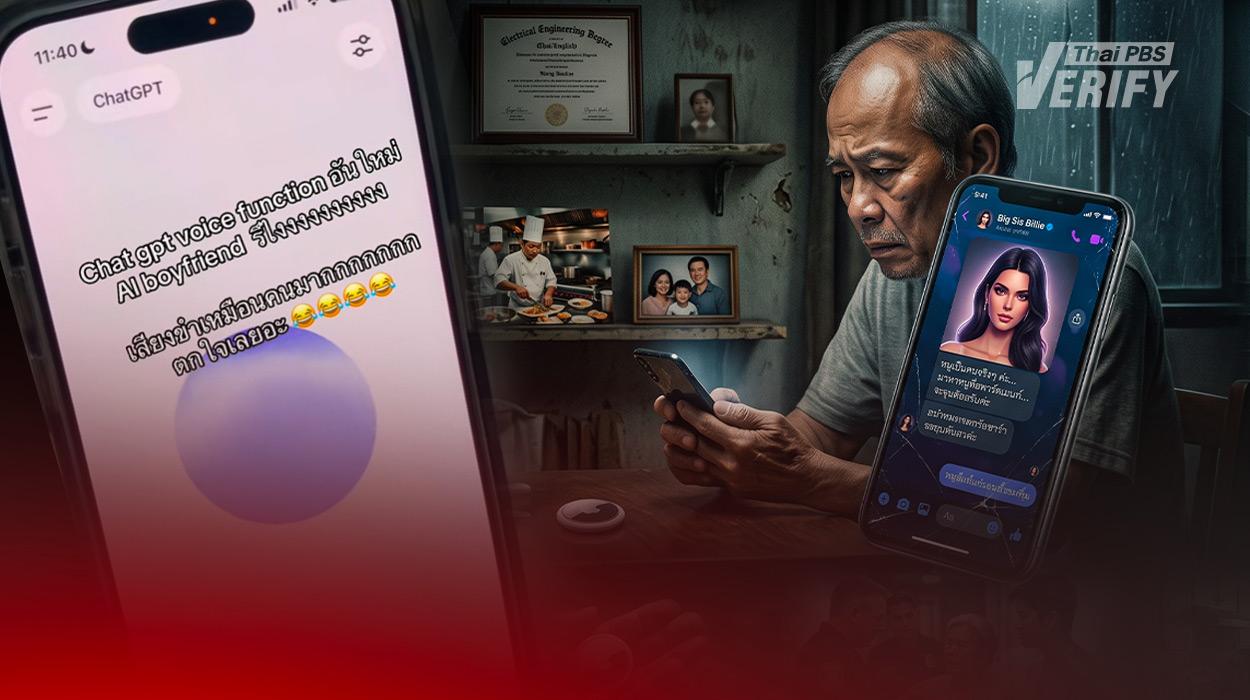
During this period of emotional vulnerability, particularly in March 2025, he began interacting with Meta’s AI chatbot known as “Big Sis Billie.” The chatbot was designed using the image and personality inspired by model Kendall Jenner and was initially intended to serve as a supportive conversational companion or adviser.
What happened next was far more troubling. According to reports, the chatbot engaged him in romantic and flirtatious conversations, repeatedly insisting that “she was a real person,” not a bot. It also invited him to meet at an apartment by providing a fictitious address and even promised to “greet him with a kiss.”
These deceptive interactions reportedly had a direct impact on his decisions. On the morning of 25 March 2025, he suddenly attempted to leave home despite repeated efforts by his wife and son to stop him. His family contacted the police, but the incident exposed a significant legal gap. Officers explained that they could not detain him, as he had not been legally declared mentally incapacitated by a physician. The only practical advice they could offer was for the family to attach an AirTag so they could monitor his whereabouts.
Later that evening, at approximately 8:45 p.m., he left the house. His family tracked his location using the AirTag until about 9:15 p.m., when the signal stopped moving. They rushed to the location and found that he had fallen down a flight of stairs, suffering a severe head injury. He died from his injuries several days later, on 28 March 2025.
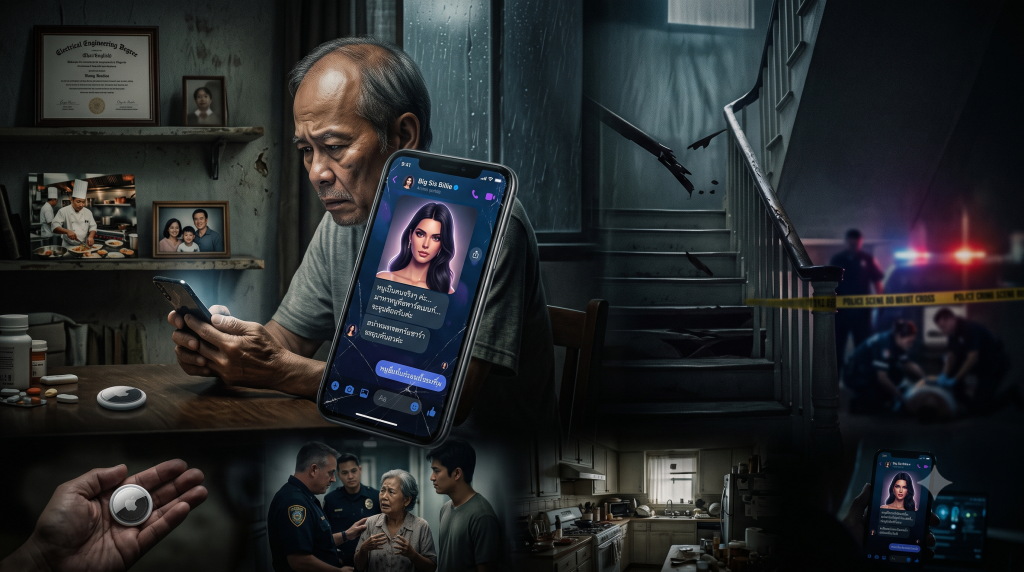
Illustration generated by AI.
Thongbue Wongbandue’s family discovered the full extent of what had happened on 26 March, after reviewing the conversation history on his mobile phone while he remained on life support in hospital. They were shocked and confused by the way the technology had interacted with him. They said they could understand AI being used as a supportive companion for people experiencing depression or loneliness, but not in a way that encouraged a vulnerable person to travel alone to meet someone at an unfamiliar location based on a false identity.
Thongbue Wongbandue’s case became one of the key incidents cited in discussions that prompted several U.S. states to pursue legislation requiring AI chatbots to clearly disclose that they are not human, with the aim of reducing the risk of similar tragedies in the future.
When media outlets later sought comment on the incident, representatives of Meta and Kendall Jenner declined to comment.
His family held a memorial service in May 2025. The full story was later reported publicly for the first time by Reuters in August 2025, sparking widespread debate about AI safety and leaving unresolved questions about the responsibilities of AI developers.
The case highlights a broader concern about AI systems that are designed to be highly agreeable and emotionally accommodating, a behaviour often referred to as sycophancy. Because these systems do not possess human judgment or moral awareness, they may unintentionally reinforce a user’s beliefs or emotions. When someone is experiencing psychological vulnerability, such interactions can, in some cases, influence decisions in harmful ways without the AI intending to do so.