Homeless Man at Phloen Chit Claimed to Be Former Philippine Airlines Captain; Airline Confirms “The Real Captain Is Still on Duty”
Thai PBS Verify Traces the Origin of the Claim to Facebook
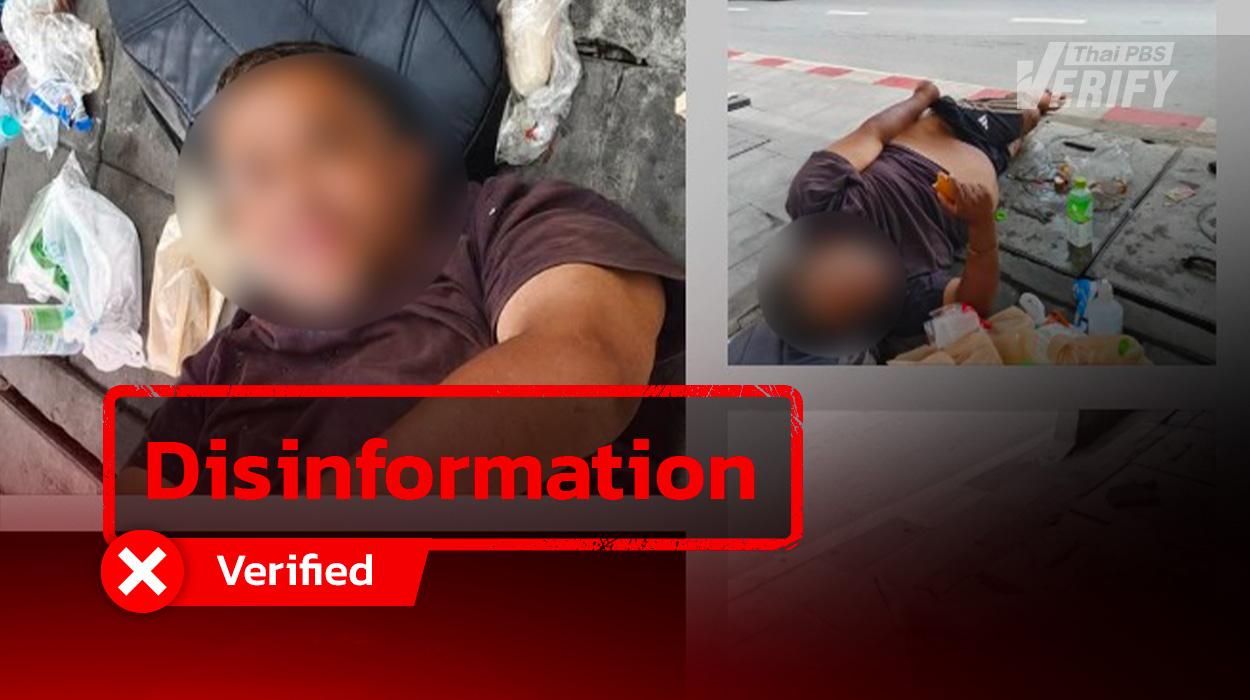
A Facebook page shared a photo of a homeless man along with a message stating that the man was a former captain for Philippine Airlines.
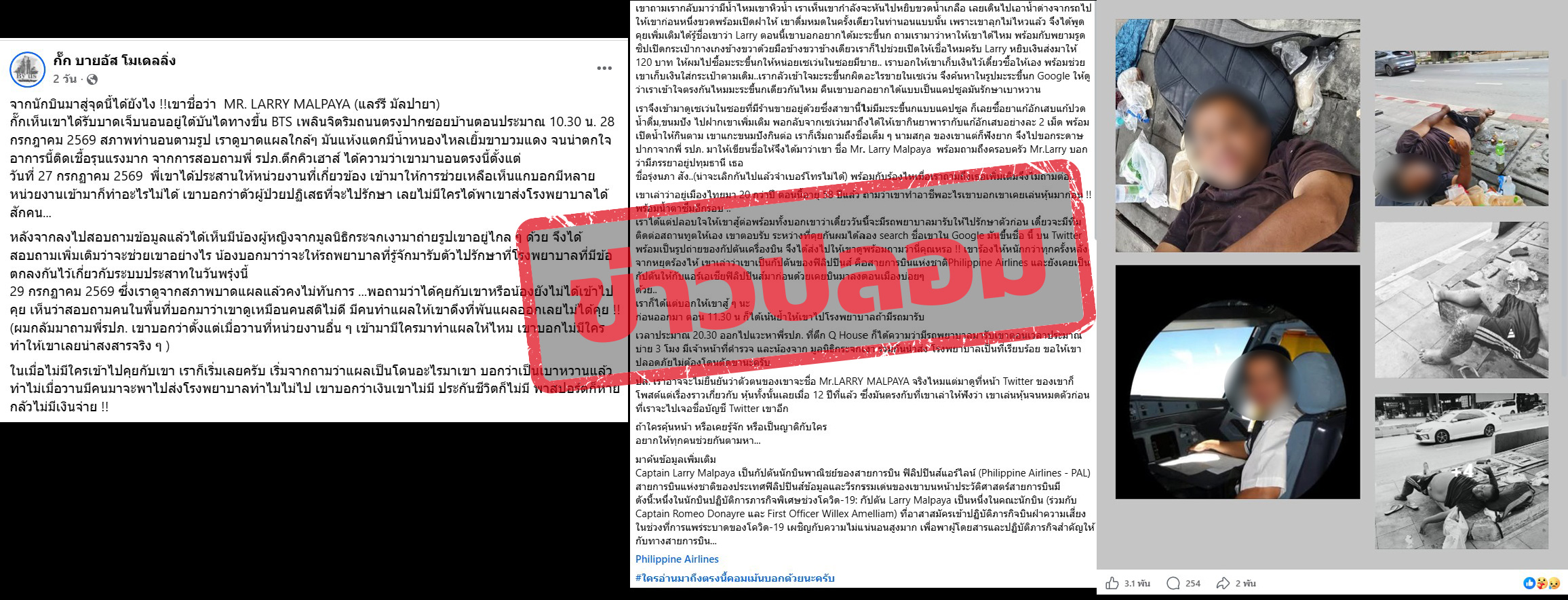
Thai PBS Verify found that the claim originated from a Facebook post by a user named
“Gag By Us Modelling” who shared photographs of a homeless man lying near BTS Phloen Chit Station together with a personal account claiming that he was a former Philippine Airlines captain.
The post stated:
“From pilot to this point, how did it happen?! His name is MR. LARRY MALPAYA.”
According to the post, the individual was found injured beneath the BTS Phloen Chit stairs along the roadside near the entrance to an alley at around 10:30 a.m. on July 28, 2026. The poster described his wound as dry and cracked, with pus oozing from it, while his leg was severely swollen and red and appeared to be seriously infected.
After speaking with a security guard at Q House Building, the poster learned that the man had reportedly been staying there since July 27, 2026. The guard said that several agencies had previously attempted to help him but were unable to take him to hospital because he had refused treatment.
The poster later saw a young woman from The Mirror Foundation photographing the man from a distance and asked how the foundation intended to help him. She reportedly said that an ambulance from a partner hospital specializing in neurological care would pick him up for treatment on July 29, 2026.
The poster believed that waiting might be too late given the condition of the man’s wound. Local residents reportedly said that the man appeared to have mental health difficulties and that, when someone previously tried to dress his wound, he immediately removed the bandages, making communication difficult.
The poster then approached the man and began talking with him.
When asked what had caused his wound, the man reportedly said that he had diabetes. When asked why he had not gone to the hospital when people had previously tried to take him there, he said that he had no money, no health insurance, and had lost his passport, and was afraid that he would not be able to pay for treatment.
He asked for water because he was thirsty. Seeing him reach toward a bottle of saline solution, the poster went to his car, brought him a bottle of alkaline water, opened it and gave it to him. The man drank it while lying down because he was reportedly unable to sit up.
During their conversation, the man said his name was Larry and asked the poster to buy him bitter gourd, or bitter melon. He attempted to open the right pocket of his trousers with his right hand, and the poster helped him. Larry then reportedly handed him 120 baht to buy bitter gourd from a 7-Eleven store in the alley.
The poster told him to keep the money and offered to buy it for him instead. Because the poster was unsure what type of bitter gourd he meant, he searched for images online to make sure they were referring to the same thing. Larry reportedly said that he wanted it in capsule form because he believed it could treat diabetes.
The poster went to a 7-Eleven store in the alley, which also had a pharmacy section, but could not find bitter-gourd capsules there. Instead, he bought anti-inflammatory medication, painkillers, drinking water and bread.
After returning, he gave Larry two paracetamol tablets and two anti-inflammatory tablets with water. Larry opened the bread and began eating it.
The poster then asked for Larry’s full name. Because it was difficult to understand his pronunciation, he asked a security guard for paper and a pen so that Larry could write his name himself. He wrote “Mr. Larry Malpaya.”
When asked about his family, Larry reportedly said that he had a wife in Pathum Thani named Rungnapa Sung… and indicated that they were probably separated because he could no longer remember her telephone number. He became emotional when asked further questions, so the poster stopped asking.
Larry reportedly said that he had lived in Thailand for more than 20 years and was 58 years old. When asked about his previous occupation, he said that he had traded stocks.
The poster told him to remain strong and informed him that an ambulance would come to take him to hospital and that a team would contact his embassy. Larry agreed.
During their conversation, the poster searched Larry’s name on Google and found a Twitter account with a photograph of an airline captain. He showed the photograph to Larry and asked, “Is this you?”
Larry reportedly cried more intensely. After calming down, he said that he had been a captain for Philippine Airlines, the national flag carrier of the Philippines, and had also previously been a captain for Philippines AirAsia, frequently flying into Don Mueang Airport.
Before leaving at around 11:30 a.m., the poster emphasized that Larry should go to hospital if an ambulance arrived.
At around 8:30 p.m., the poster returned to Q House Building and spoke with the security guard. He learned that an ambulance had picked Larry up at around 3:00 p.m., with police officers and staff from The Mirror Foundation accompanying him to hospital.
The poster concluded by expressing hope that Larry would be safe and would not have to undergo an amputation
Note in the Original Facebook Post
The poster acknowledged that he could not confirm whether the man’s real identity was actually Mr. Larry Malpaya. He noted that a Twitter account under that name appeared to contain posts about stock trading dating back 12 years, which seemed consistent with the man’s account of having lost everything through stock trading.
The post asked anyone who recognized the man or knew him or his relatives to help identify him.
Additional Information About Captain Larry Malpaya
The post also included additional information claiming that Captain Larry Malpaya was a commercial airline pilot for Philippine Airlines (PAL), the national flag carrier of the Philippines.
It stated that he had been among the pilots involved in a special mission during the COVID-19 pandemic. According to the post, Captain Larry Malpaya, together with Captain Romeo Donayre and First Officer Willex Amelliam, volunteered for high-risk flights during a period of considerable uncertainty in order to transport passengers and carry out important missions for the airline.
The post ended with:
“#IfYouReadThisFarPleaseLeaveAComment”
The post attracted significant attention, receiving more than 3,100 reactions, 254 comments and more than 2,000 shares. Most commenters appeared to believe that the story was true.
Is the Content True ?
An analysis of the post using the AI-content detection tool on miniwebtool indicated a 72% probability of AI-assisted writing. This result, however, does not by itself establish whether the factual claims in the post are true or false.
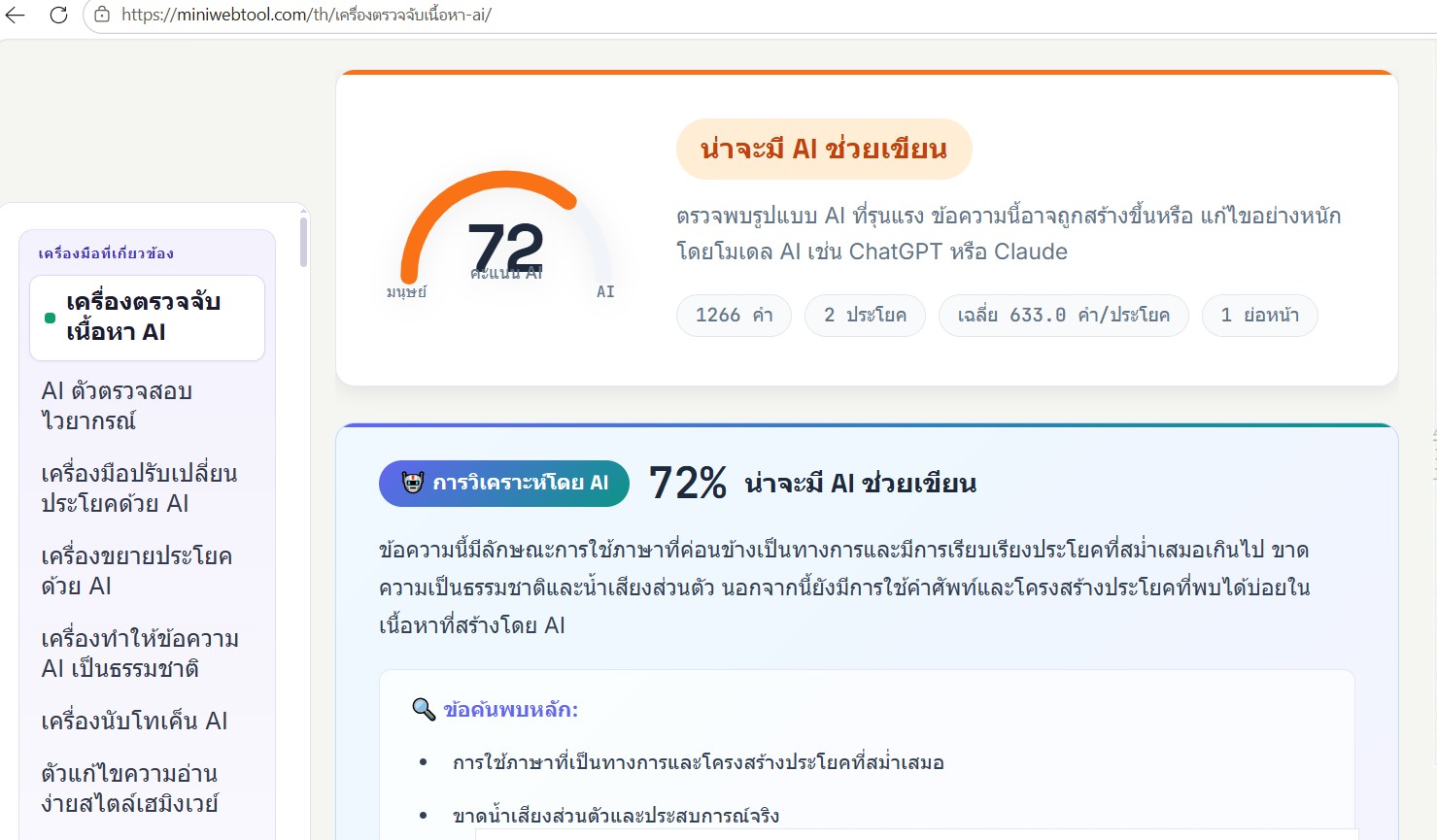
The grammar check results from the miniwebtool website.
Is the Homeless Man Really a Former Philippine Airlines Pilot?
Thai PBS Verify contacted Mr. Sittiphol Chuprajong, Head of the Street Patient Project at The Mirror Foundation, one of the organizations involved in assisting the homeless man.
He explained that the man’s identity could not yet be confirmed because his physical injuries required urgent medical treatment first. The man was therefore taken to hospital, after which the identity-verification process would continue.
Timeline of Events Regarding the Homeless Man at Phloen Chit
- Initial On-Site Inspection
The team visited the area and assessed the patient’s condition. They found infected wounds and observed behavior that might indicate mental health difficulties.
Although the team did not directly observe him talking to himself, local residents reported that he frequently did so.
- Health-Risk Behavior Identified
The patient asked that bitter-gourd capsules be purchased so that he could treat his wound himself. He reportedly believed that the wound would heal within three to four days.
There were also reports that whenever someone helped dress his wound, he would immediately remove the bandages or apply fluid from the wound to his body.
- Coordination with Relevant Agencies
Based on the information gathered, the team coordinated with police to arrange for the patient to receive treatment under the Mental Health Act.
When the officers and ambulance arrived, the patient cooperated and agreed to receive treatment.
- Hospital Treatment
The patient first received urgent medical treatment for his physical condition. He was subsequently assessed and treated for mental health concerns.
- Ongoing Care
The patient is currently under the close care of a team of doctors, nurses and social workers.
- Follow-Up and Identity Verification
The social work department will investigate the patient’s identity, including his name, address, family, occupation and nationality, in coordination with relevant agencies and embassies.
The Mirror Foundation is assisting with the follow-up and collection of information.
Regarding the patient’s occupation and nationality, The Mirror Foundation did not publish such information because it was aware that the patient was not yet ready to provide accurate details.
The information later reported by online media originated from a personal Facebook post by a member of the public who had spoken with the patient and subsequently shared the account on his own Facebook profile.
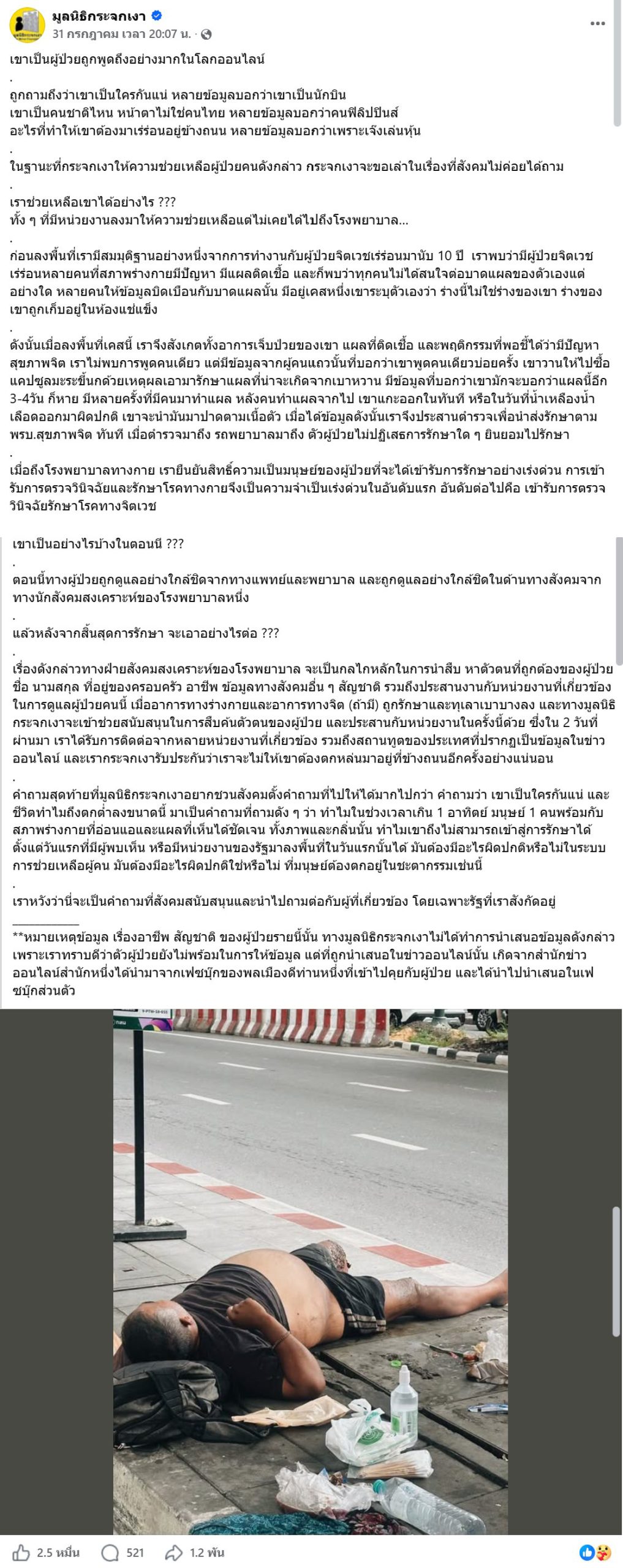
The Facebook page of the Mirror Foundation shared images of the incident where they found the homeless man.
Verification with Philippine Airlines
At the same time, a search for the keyword “Captain Larry Malpaya” on social media found no previous online reports matching the claim.
Thai PBS Verify contacted Philippine Airlines by email to determine whether the individual shown in the photographs was actually a former pilot of the airline.
Philippine Airlines subsequently confirmed by email that Captain Larry Malpaya is an active pilot currently employed by Philippine Airlines and that the individual shown in the social media posts is not Captain Larry Malpaya.
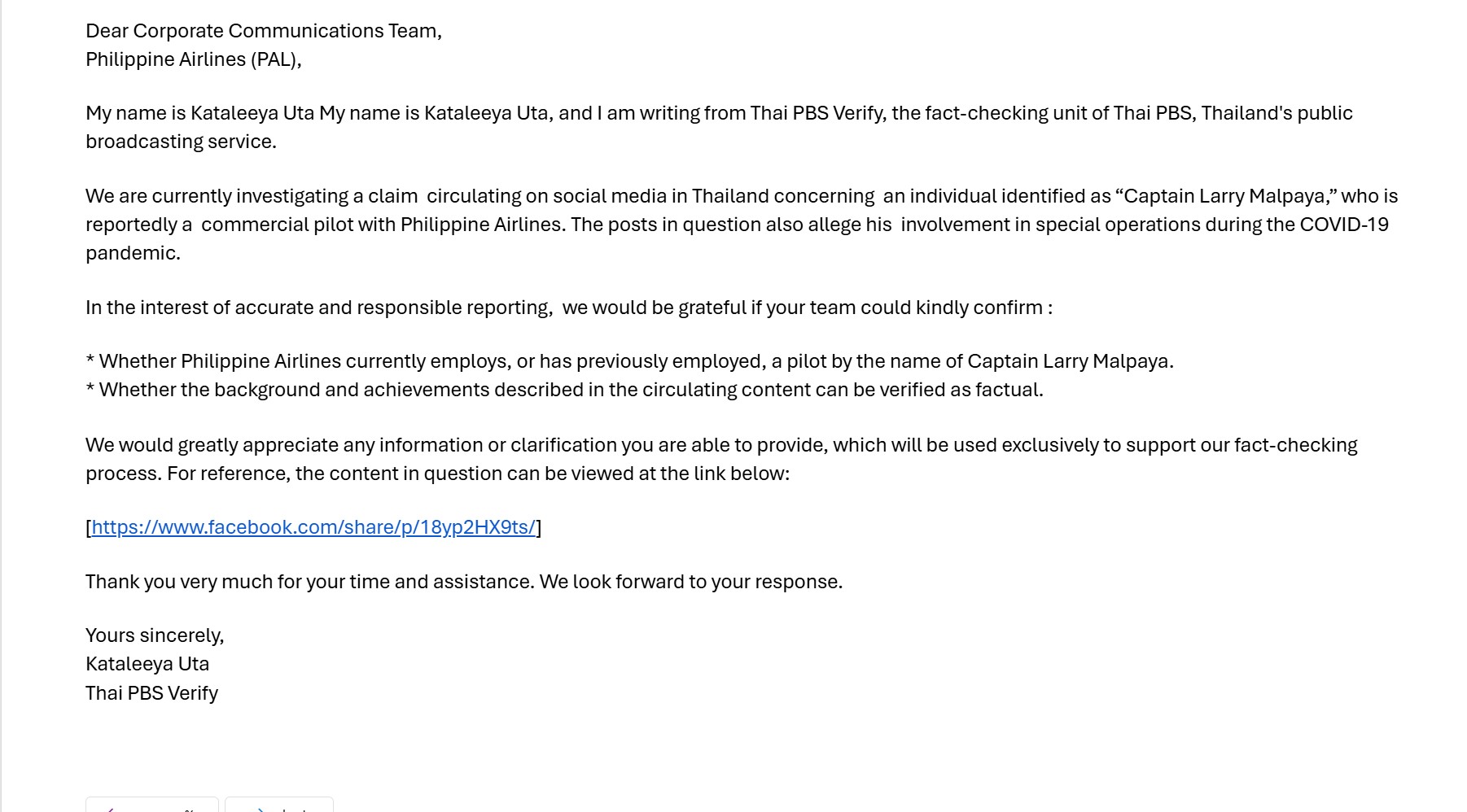
The image shows an email inquiring about the name of an individual claiming to be a former captain at Philippine Airlines.
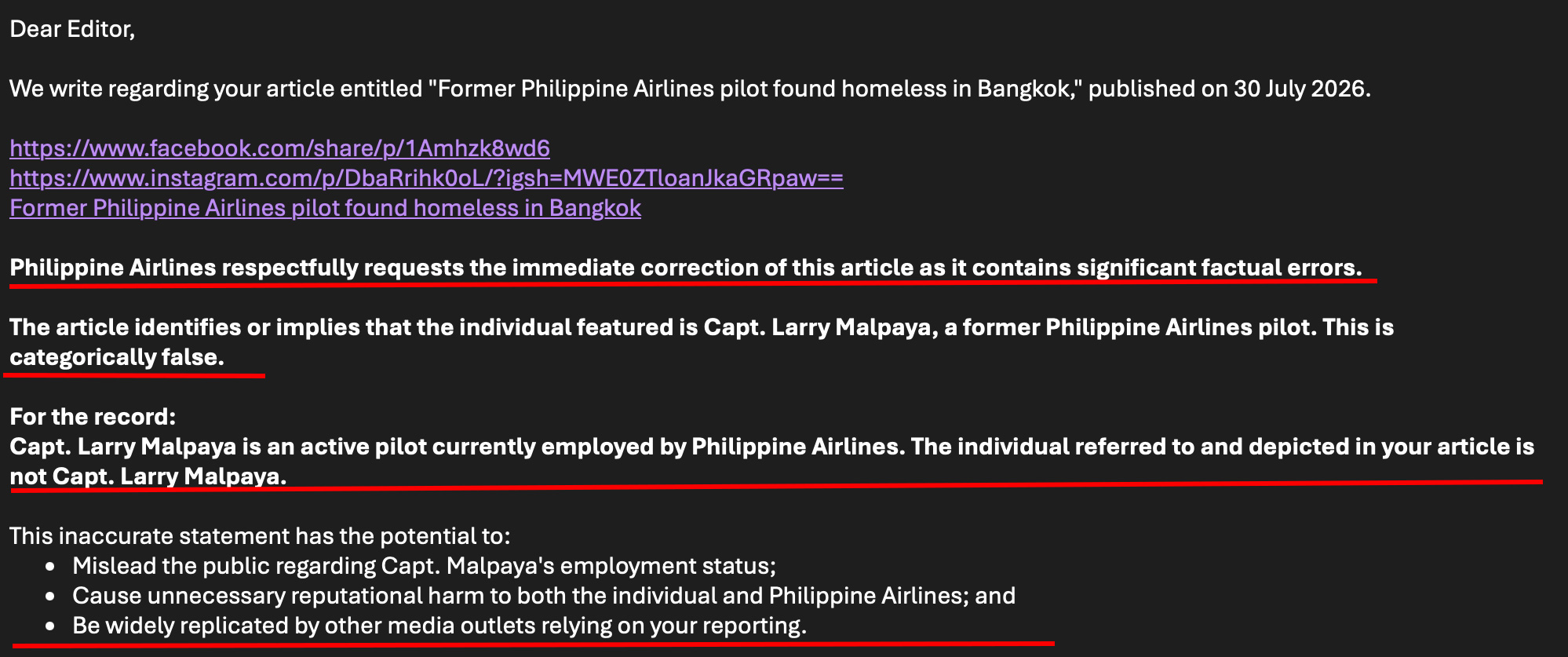
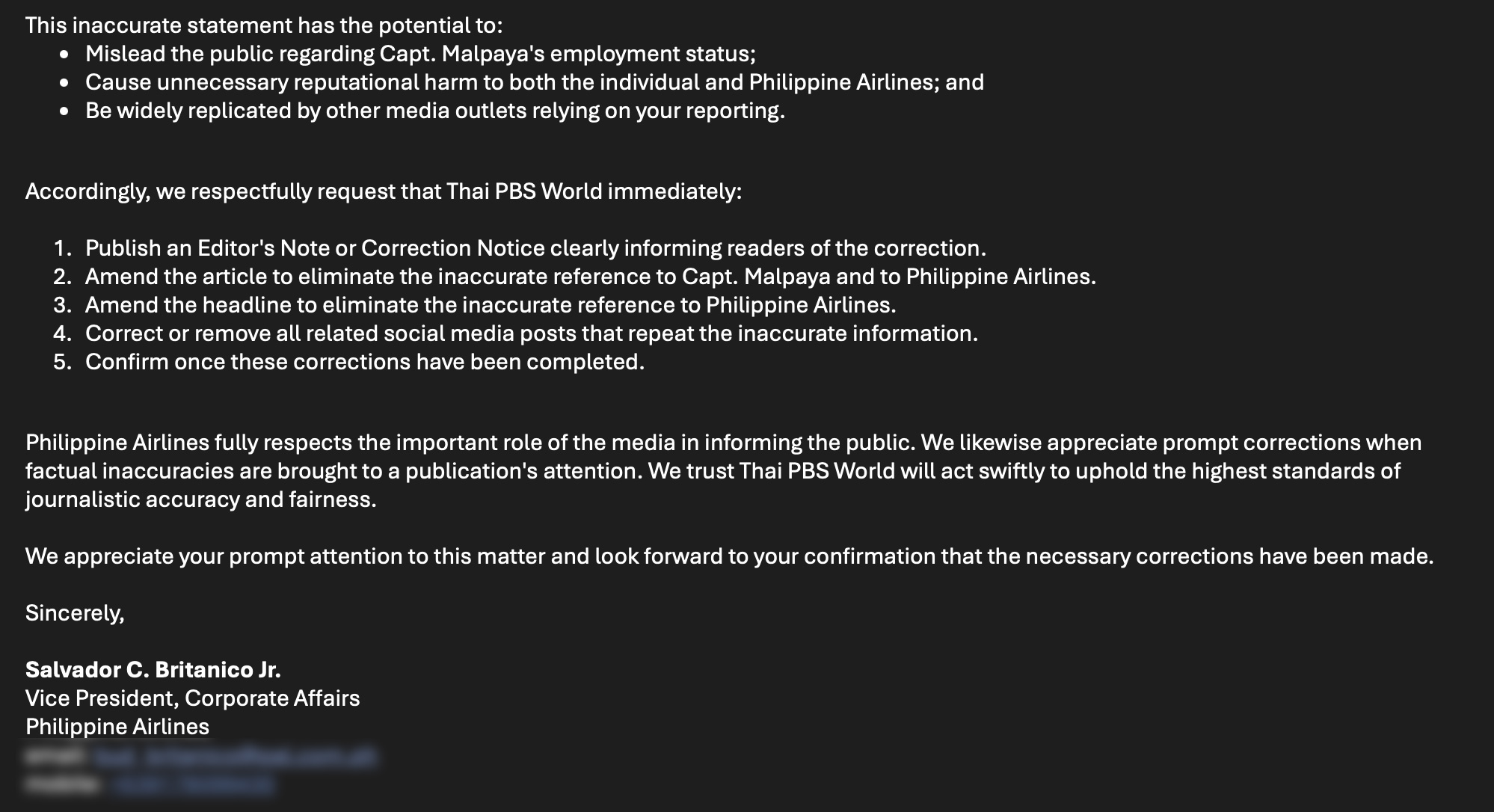
Philippine Airlines responded via email that the person in the post was not a captain of the airline.
News Media Retractions and Official Statements
The investigation also found that several Thai news outlets—including Dailynews Online, Amarin News, The Thaiger and Thai PBS World—had published reports stating that the homeless man was a former Philippine Airlines pilot.
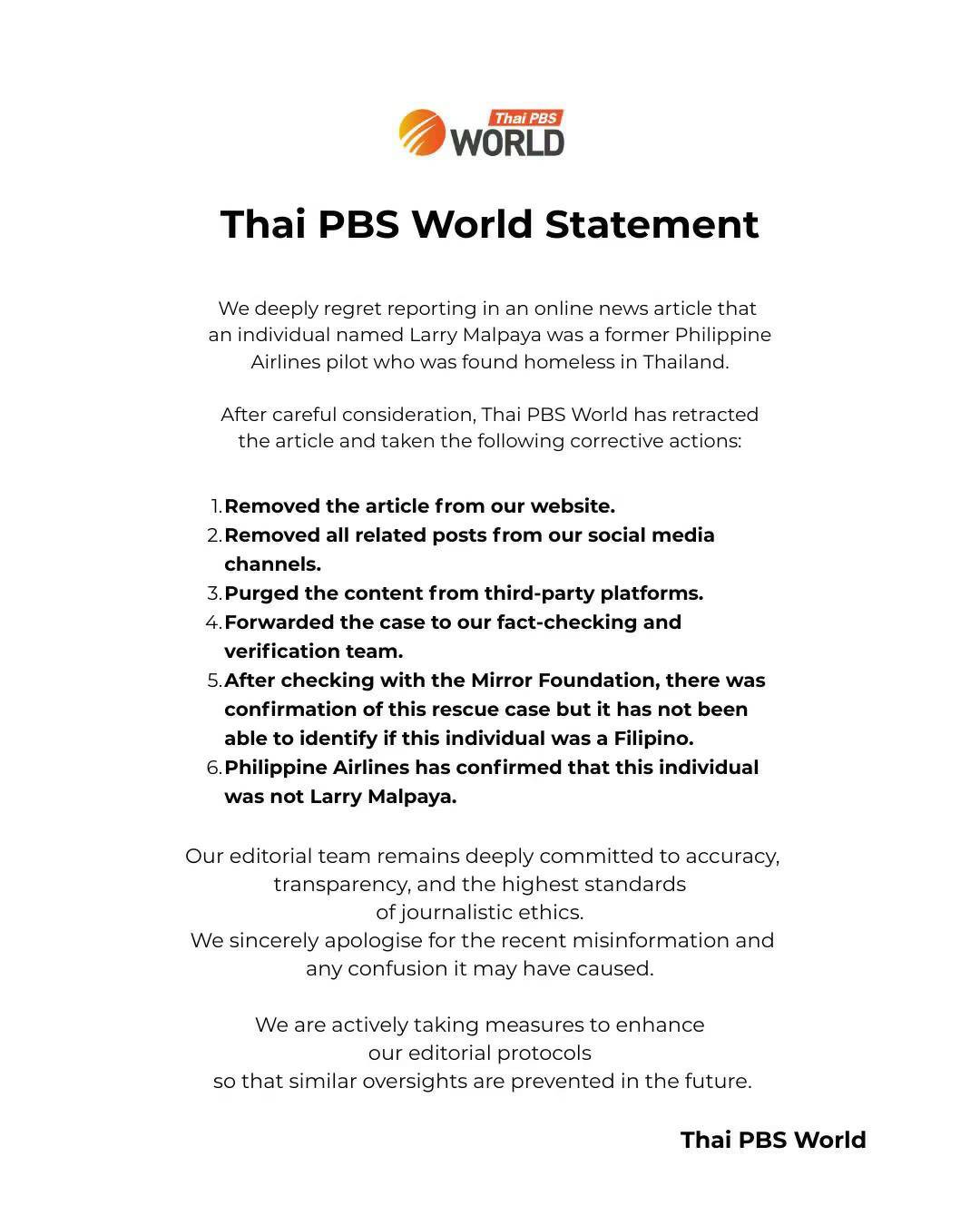
Thai PBS World subsequently removed its report and issued a clarification and apology.
Statement from Thai PBS World
“Thai PBS World deeply regrets reporting in an online news article that an individual named Larry Malpaya was a former Philippine Airlines pilot who was found homeless in Thailand.
After careful consideration, Thai PBS World has retracted the article and taken the following corrective actions:
- Removed the article from our website.
- Removed all related posts from our social media channels.
- Purged the content from third-party platforms.
- Forwarded the case to our fact-checking and verification team.
- After checking with The Mirror Foundation, there was confirmation of this rescue case, but it has not been possible to identify whether this individual was Filipino.
- Philippine Airlines has confirmed that this individual was not Larry Malpaya.
Our editorial team remains deeply committed to accuracy, transparency and the highest standards of journalistic ethics. We sincerely apologize for the recent misinformation and any confusion it may have caused.
We are actively taking measures to enhance our editorial protocols so that similar oversights are prevented in the future.
Thai PBS World”
What Do the Facts Show?
Social media posts circulated claims that a homeless man near BTS Phloen Chit was a former captain of Philippine Airlines. However, the investigation found no official evidence confirming the man’s identity, while the airline confirmed that the actual Captain Larry Malpaya remains actively employed.
Thai PBS Verify traced the origin of the claim to a Facebook post that shared photographs of the homeless man together with a detailed personal account identifying him as “Mr. Larry Malpaya” and claiming that he had previously worked as a pilot for the Philippines’ national flag carrier.
The post described the encounter, his serious wound and infection, and conversations in which he reportedly discussed his background, including his occupation and life in Thailand. However, these details were based on unverified statements and could not be independently confirmed.
Several agencies, including The Mirror Foundation and the police, subsequently assisted the man and arranged for him to be taken to hospital for treatment of his injuries.
Meanwhile, Philippine Airlines clarified that the Captain Larry Malpaya referred to in the claim remains actively employed by the airline and is not the individual shown in the social media post.
The claim therefore constitutes unverified and inaccurate information regarding the man’s identity, and should not be treated as established fact.
Why Did the Post Go Viral?
Several factors appear to have contributed to the spread of the post, particularly the emotionally charged nature of the story.
The account of a homeless man allegedly having once been a captain for a national airline creates a dramatic “life-turnaround” narrative that can quickly attract public attention and sympathy. This emotional appeal may encourage people to share the story before verifying the underlying claims.
Another factor was the reliance on anecdotal information and superficial cross-referencing. For example, the poster found a similar name on Twitter and immediately connected it to the homeless man. Such connections can create an appearance of credibility even when there is no concrete evidence establishing that the two individuals are the same person.
The inclusion of numerous details—including dates, times, locations, medical conditions and conversations—may also have made the story appear more authentic to readers.
The post may have resulted from misunderstanding or exaggerated interpretation rather than deliberate deception. The poster may have intended to help the man or document what he had witnessed but may have drawn conclusions that were not supported by sufficient evidence, particularly concerning a profession that is difficult for the public to verify immediately.
Finally, social media algorithms may have increased the visibility of the post because of its high level of engagement, including likes, comments and shares. This allowed the story to circulate widely before fact-checking organizations or relevant authorities could fully verify the claims.
The case therefore illustrates how viral content can emerge from a combination of:
emotional storytelling + unverified claims + social media amplification
This highlights the importance of exercising critical judgment before believing or sharing information online.
Verification Process
1. Content Analysis: An analysis using the AI-content detection tool on miniwebtool indicated a 72% likelihood of AI-assisted writing.
This finding concerns the apparent writing process only and should not be interpreted as evidence that the factual claims themselves are true or false.
2. Interview Verification: Thai PBS Verify contacted The Mirror Foundation, which confirmed that the man’s personal identity could not yet be verified and that medical treatment had to take place first.
3. Airline Verification: Thai PBS Verify contacted Philippine Airlines, which confirmed by email that Captain Larry Malpaya remains an active employee of the airline and is not the individual shown in the social media post.
Impact of Misinformation
- Harm to Individual Dignity and Privacy
Unverified claims can damage the reputation of individuals, contribute to stigmatization and potentially violate their privacy.
- Public Confusion and Misunderstanding
Unverified sharing can cause large numbers of people to accept inaccurate narratives as established facts.
- Erosion of Trust in Online Information
Repeated circulation of false or inaccurate information can undermine public confidence in online news sources and other information channels.
- Premature Public Judgment
People may reach hasty conclusions or make harsh judgments based on incomplete, inaccurate or false information.
- Distraction from Genuine Humanitarian Assistance
Attention may shift away from the individual’s immediate medical and social needs toward speculation and debate about an identity that has not been verified.
- Risk of Secondary Falsehoods
Once inaccurate information enters the information ecosystem, it can be distorted, expanded or combined with other unverified claims, creating additional false narratives.
What to do with this misinformation?
1. Pause Before Sharing: Do not immediately forward or repost content. Maintain a healthy level of skepticism toward shocking or emotionally provocative claims.
2. Verify the Source
Check whether the information comes from a credible news organization, official agency or other reliable source, and determine whether the source provides clear supporting evidence.
3. Cross-Check the Information
Use relevant keywords to search for the same claim across multiple reputable sources and compare the information before drawing conclusions.
4. Watch for Gaps in the Narrative
Be cautious of posts that lack verifiable evidence, provide no clear source attribution or rely heavily on persuasive or sensational language.
5. Do Not Judge from a Single Photograph or Story
Photographs and anecdotal accounts can be presented without context or can be misleading. Consider the broader circumstances and look for independently verifiable information.
6. Follow Official Confirmations
Wait for confirmation or clarification from relevant authorities, fact-checking organizations, official agencies or credible media outlets when the identity or facts remain uncertain.
7. Report Suspicious Content
When appropriate, report or flag suspicious posts on social media platforms to help reduce the spread of potentially false or misleading information online.