True! Toothpaste Containing 5,000 ppm Fluoride Is Classified as a “Dangerous Drug” — But There Is No Need to Panic!
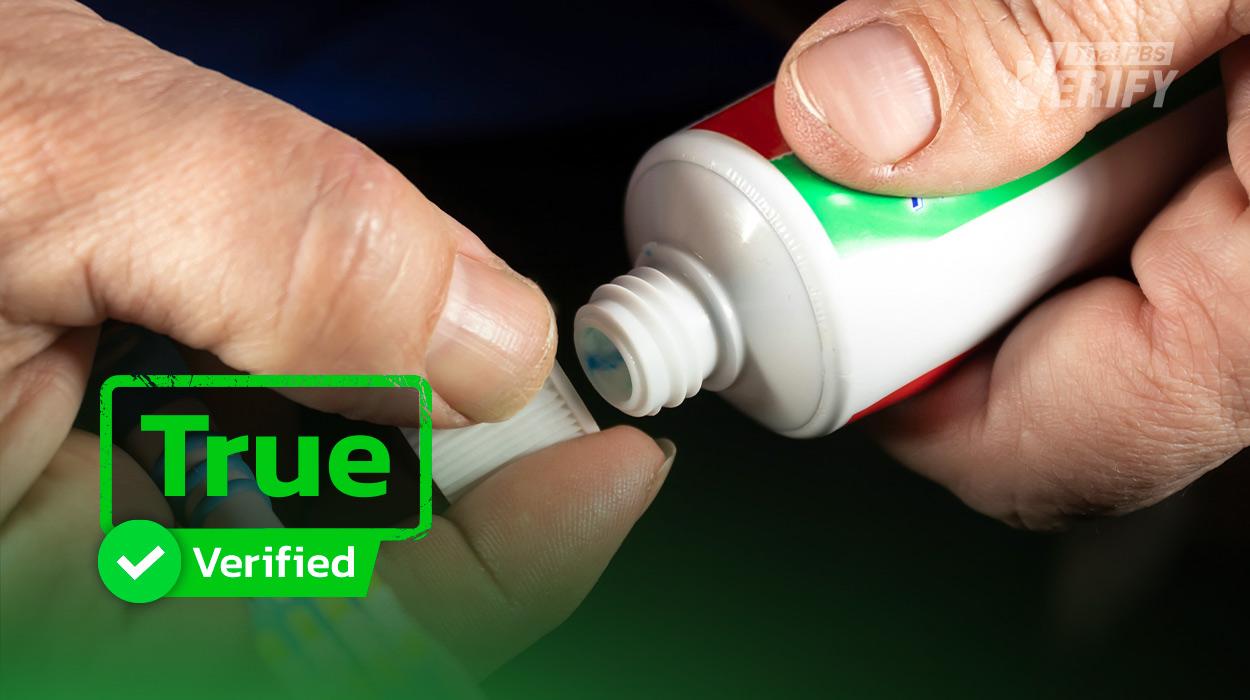
Regular toothpaste used to prevent tooth decay generally contains approximately 1,000–1,500 ppm fluoride, which is the level recommended by the World Health Organization (WHO) for oral health care. By contrast, 5,000 ppm is a high concentration of fluoride classified as a medicine and is intended for specific cases, such as people at high risk of tooth decay. Its use should be based on advice from healthcare professionals.
Therefore, regular fluoride toothpaste currently available on the market can still be used as usual.
Thai PBS Verify Found the Source of the Claim on Facebook
A Facebook post claimed that the Ministry of Public Health had announced that medicines containing “5,000 ppm fluoride” for oral use would be classified as “dangerous drugs.”
The post stated:
“Medicines containing 5,000 ppm fluoride for oral use have been classified as dangerous drugs!!!”
On August 19, 2026, the Royal Gazette website published the Ministry of Public Health Notification on Dangerous Drugs No. 37. The notification was signed by Phiphat Ratchakitprakarn, Minister of Public Health, and dated August 6, 2026. It stipulates that medicines containing 5,000 parts per million (5,000 ppm) fluoride for oral use are classified as dangerous drugs.
The notification was issued under Section 76(3) of the Drug Act B.E. 2510 (1967), as amended by the Drug Act (No. 3) B.E. 2522 (1979). The Minister of Public Health issued the notification based on the recommendation of the Drug Committee at its meeting No. 430-1/2569, held on January 26, 2026.
The key provision of the notification is the addition of the following item as (80) to Clause 3 of the Ministry of Public Health Notification on Dangerous Drugs dated May 26, 1978:
“(80) Medicines containing 5,000 parts per million (5,000 ppm) fluoride for oral use.”
The Ministry of Public Health Notification on Dangerous Drugs No. 37 took effect on the day following its publication in the Royal Gazette, meaning that it came into force on August 19, 2026.
The post received 1,400 likes and 723 shares and was published on August 19, 2026.
Did the Royal Gazette Notification Ban the Use of Fluoride Toothpaste?
Following publication of the Royal Gazette notification classifying medicines containing 5,000 ppm fluoride for oral use as “dangerous drugs,” some people misunderstood the announcement as meaning that fluoride itself is dangerous and that fluoride toothpaste should be avoided.
This led some consumers to become concerned about using regular fluoride toothpaste available on the market.
However, the notification does not mean that all fluoride toothpastes are dangerous drugs or that their use is prohibited.
The Bureau of Dental Health, Department of Health, explained through social media that regular fluoride toothpastes available on the market are classified as cosmetics, whereas products containing fluoride at a concentration of 5,000 ppm are classified as dangerous
drugs for specific uses and are subject to supervision by healthcare professionals.
The term “dangerous drug” does not mean “a drug that must not be used.” Rather, it is a legal classification under drug regulations intended to ensure appropriate control over the use and distribution of medicines, particularly products with high concentrations or those that need to be used under the guidance of healthcare professionals.
Therefore, regular fluoride toothpaste available on the market can still be used as usual.
The Bureau of Dental Health, Department of Health, provides the following details:
How Is 5,000 ppm Fluoride Toothpaste Different from Regular Toothpaste?
Some people may interpret the statement that “5,000 ppm fluoride toothpaste is a dangerous drug” to mean that it is prohibited or has been discontinued. In reality, the key issue is ensuring that its use is appropriately regulated for people at high risk of tooth decay.
- Regular fluoride toothpaste containing no more than 1,500 ppm fluoride can still be used as usual.
- 5,000 ppm fluoride toothpaste contains a high concentration of fluoride and is intended for people at high risk of tooth decay, such as older adults whose reduced saliva production makes them more susceptible to tooth decay, and patients with oral cancer who have undergone radiation therapy.
- Its use should be supervised by dentists, pharmacists, or other relevant healthcare professionals, in accordance with applicable requirements.
Therefore, “dangerous drug” does not mean “prohibited from use.” It refers to products whose use must be controlled to ensure safety and maximize their benefits.
How Does Regular Fluoride Toothpaste Differ from 5,000 ppm Fluoride Toothpaste?
The announcement that 5,000 ppm fluoride toothpaste has been classified as a dangerous drug has led to misunderstandings and concerns about the product. Here is some additional information on the issue.
Regular Fluoride Toothpaste
Fluoride is recognized as an important compound for preventing tooth decay and is therefore commonly included in various oral healthcare products that people can use at home, such as toothpaste and mouthwash.
At present, the Thai Food and Drug Administration (Thai FDA) classifies toothpaste as a cosmetic product, with a fluoride concentration of no more than 1,500 ppm. This means that 1,500 ppm corresponds to 1,500 milligrams of fluoride in one million milligrams of toothpaste.
This concentration is suitable for people with normal oral health to help prevent tooth decay. It is recommended that people brush their teeth twice a day for two minutes each time and avoid eating for two hours after brushing.
Department of Health and Thai FDA Previously Sought Public Comments on 5,000 ppm Fluoride
An earlier report issued by the Department of Health on July 6, 2026, stated that the Department of Health and the Thai FDA had considered promoting access to 5,000 ppm high-fluoride toothpaste for people at high risk of tooth decay, such as older adults and people with limitations in brushing their teeth, while ensuring safe use.
The Drug Committee had opened a public consultation and considered classifying the product as a dangerous drug, allowing it to be sold through pharmacies with pharmacists on duty or healthcare facilities under the supervision of dentists or pharmacists. This would also provide a legal pathway for the product to be manufactured or imported.
One part of the report stated that:
Associate Professor Dr. Pornpoj Fuengtharnthip, Chair of the Training Subcommittee of the Royal College of Dental Surgeons of Thailand in the field of geriatric dentistry and special-care dentistry, said that older adults are at high risk of tooth decay.
Research from other countries has found that toothpaste containing 5,000 ppm fluoride can reduce the incidence of tooth decay in permanent teeth by 40–42% compared with toothpaste containing 1,450 ppm fluoride. It can also slow the progression of tooth decay, including root caries.
Previously, the use of high-concentration fluoride was generally limited to care provided by dentists. Therefore, making 5,000 ppm fluoride toothpaste more accessible could give people at high risk of tooth decay greater and more consistent access to preventive care.
However, it is important to emphasize that 5,000 ppm fluoride toothpaste should be used only under the close guidance of a dentist to prevent adverse effects from excessive fluoride exposure.
Dr. Pharmacist Tharnkamol Chanpraphap, an expert in drug standards at the Thai Food and Drug Administration, said that the Drug Committee had opened a public consultation and considered classifying toothpaste containing 5,000 ppm fluoride as a dangerous drug. This would allow the product to be sold at pharmacies with pharmacists on duty or at healthcare facilities under the supervision of dentists or pharmacists.
The toothpaste contains sodium fluoride at a concentration of 1.1% by weight, providing 5 milligrams of fluoride ion per gram of toothpaste, equivalent to 5,000 ppm. It is available in both cream and gel formulations.
At the time of the report, the Ministry of Public Health Notification on Dangerous Drugs was still in the process of being issued. Although Thailand had not yet officially imported or marketed 5,000 ppm fluoride toothpaste, establishing this regulatory framework was regarded as an important first step toward enabling manufacturers and importers to legally and safely produce or import the product.
The target group for the product was people aged 12 and above who are at high risk of developing tooth decay.
The Bureau of Dental Health, Department of Health, would work with experts to develop guidelines for its use and coordinate with the Thai FDA to provide information to interested manufacturers and businesses. The aim was to give high-risk groups access to effective and safe oral healthcare products in the future.
WHO Recommends Fluoride Toothpaste to Prevent Tooth Decay
The World Health Organization (WHO) states that toothpaste containing fluoride at concentrations of 1,000–1,500 ppm is effective in preventing tooth decay and recommends brushing with fluoride toothpaste twice a day.
Meanwhile, the American Dental Association (ADA) recommends that the general population—including children, adolescents, and adults—brush twice a day with fluoride toothpaste. Children should be supervised regarding the amount of toothpaste they use to prevent them from swallowing excessive amounts.
High-concentration fluoride products, such as 5,000 ppm fluoride toothpaste, are intended for specific cases, such as people at high risk of tooth decay, and are classified as products that require a prescription.
Note: The information above consists of oral health recommendations and information from the World Health Organization (WHO) and the American Dental Association (ADA), provided to explain the principles of fluoride use and tooth-decay prevention.
Who Should Use High-Concentration Fluoride Toothpaste?
Assistant Professor Dr. Chonkan Phaewphalan, a lecturer in Restorative and Esthetic Dentistry at the Faculty of Dentistry, Thammasat University, said that patients with certain medical conditions that reduce saliva production, as well as older adults, may need toothpaste containing a higher concentration of fluoride.
For people at high risk of tooth decay, the fluoride concentration may be increased from the usual level of approximately 1,000–1,500 ppm to 5,000 ppm, at the discretion of a dentist.
By contrast, people at moderate or low risk of tooth decay generally do not need 5,000 ppm fluoride toothpaste. A concentration of 1,000–1,500 ppm is sufficient to prevent tooth decay.
Use of 5,000 ppm Fluoride Toothpaste in Other Countries
In other countries, 5,000 ppm fluoride toothpaste is routinely used by people with appropriate indications, but it must be prescribed or used under the supervision of a dentist or other dental professional.
In Thailand, recent reports indicate that 5,000 ppm fluoride toothpaste has been approved for dentists to prescribe. However, details regarding measures to regulate its distribution and access by the general public still need to be monitored.
Having dentists assess patients and prescribe this type of toothpaste can improve safety because 5,000 ppm fluoride toothpaste contains a substantially higher concentration of fluoride than regular toothpaste and may be harmful if used improperly.
This is particularly important for children, who may swallow large amounts of toothpaste. Measures should therefore be introduced to prevent children from accessing the product, including child-resistant packaging.
Historically, 5,000 ppm fluoride toothpaste had not been widely available on the Thai market. If it needs to be imported for research purposes, the relevant procedures and requirements of the authorities must be followed because the product is classified as a dangerous drug and was previously subject to restrictions on general distribution.
For the general public, there is no need to seek out 5,000 ppm fluoride toothpaste without first undergoing a risk assessment. Its use should be considered on a case-by-case basis and determined at the discretion of a dentist.
Excessive fluoride exposure can cause acute toxicity symptoms such as nausea and vomiting. Long-term exposure to high levels of fluoride may lead to dental fluorosis or skeletal fluorosis.
Therefore, 5,000 ppm fluoride toothpaste should be used only when clinically indicated and following advice from a dentist.

Assistant Professor Dr. Chonkan Phaewphalan, a lecturer in Restorative and Esthetic Dentistry at the Faculty of Dentistry, Thammasat University.
What Is the Truth?
Fact-check: The post claiming that the Ministry of Public Health issued the aforementioned notification is true.
However, the notification does not mean that “fluoride is dangerous and must not be used.” It specifically classifies products containing 5,000 ppm fluoride for oral use as “dangerous drugs” so that their use can be controlled according to the applicable drug classification.
Regular fluoride toothpaste containing approximately 1,000–1,500 ppm fluoride can still be used normally to prevent tooth decay.
Verification Process
1. Verification of the Royal Gazette Notification
The investigation found that the wording of the Royal Gazette notification corresponds with the claim made in the post.
The Ministry of Public Health Notification on Dangerous Drugs No. 37, published in the Royal Gazette on August 18, 2026, and signed on August 6, 2026, stipulates that medicines containing 5,000 parts per million (5,000 ppm) fluoride for oral use are classified as dangerous drugs.
The notification took effect on August 19, 2026.